Cinder Sprite
Small Flame Spirit Dwelling in Embers
Names in Other Languages
 신더 스프라이트한국어
Cinder Sprite · 잿불에 깃드는 작은 불꽃 정령
 シンダースプライト日本語
Cinder Sprite — 残り火の下位精霊
 餘燼精靈繁體中文
Cinder Sprite · 棲於餘燼的小火焰精靈
 AschengeistDeutsch
Cinder Sprite — Unterer Geist der Glut
 Lutin de CendreFrançais
Cinder Sprite — Esprit Inférieur des Braises
 Duende de CenizaEspañol
Cinder Sprite — Espíritu Menor de las Brasas
 Espírito das BrasasPortuguês
Pequeno espírito de chama que habita as brasas
 Skrzat PopiołuPolski
Cinder Sprite — Niższy Duch Żaru
 Углевой СпрайтРусский
Cinder Sprite — Низший Дух Жара
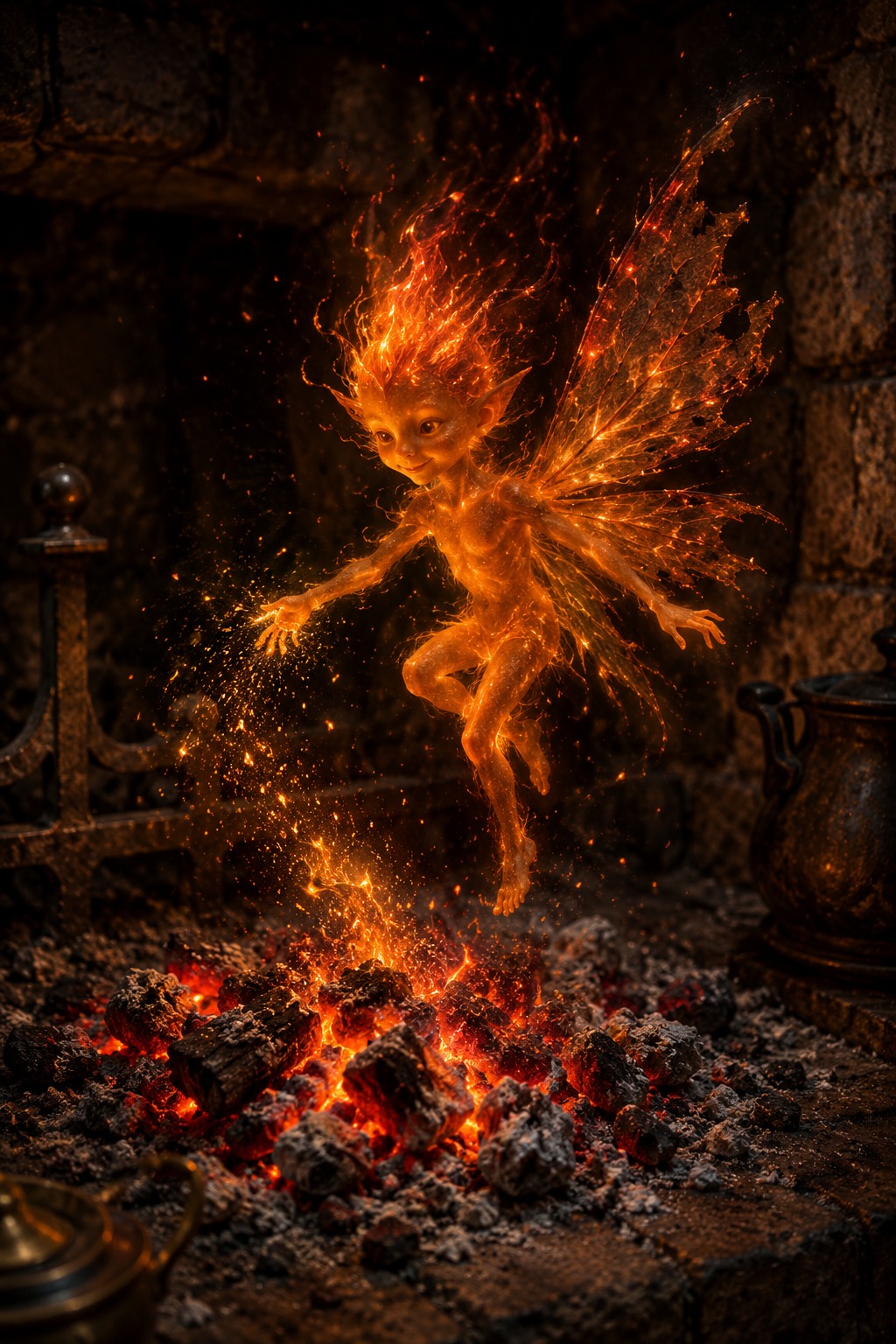
The Cinder Sprite (English Cinder Sprite, Latin Spiritus Cineris) is the small flame spirit that dwells in the cinder (ash-ember), depicted as a palm-sized winged humanoid — a decisive canonical adaptation of Western flame-spirit iconography. The etymology combines the Latin cinis ('ash, cinder'), source of English cinder (Middle English sinder of c. 1290), and the Latin spiritus ('soul, breath'), source of English sprite (Middle English sprite of 1303 via Old French esprit). The iconographic origin is the fusion of (1) the ancient Roman household-hearth (focus) protective beliefs of Lar (household guardian) and Vesta (hearth goddess) and (2) the four-element-spirit canon in the 1566 Latin treatise A Book of Nymphs, Sylphs, Pygmies, and Salamanders (Liber de Nymphis, Sylphis, Pygmaeis et Salamandris) by the Swiss physician-alchemist Paracelsus (Theophrastus Bombastus von Hohenheim, 1493-1541), whose flame spirit is the Salamander. The decisive literary canon is the sprite Puck of William Shakespeare's (1564-1616) 1595 comedy A Midsummer Night's Dream — Robin Goodfellow of English folklore — which established the English-literary sprite canon, and the Fire Mephit and Salamander canon of the 1977 Monster Manual of Dungeons & Dragons (D&D) by Gary Gygax (1938-2008) of TSR in the USA is the decisive iconography of the modern fantasy RPG flame-spirit canon.
Origin
The iconographic origin is the fusion of (1) the household-hearth (focus) protective beliefs of ancient Rome and (2) the four-element-spirit canon of Paracelsus of 1566. In the household faith of ancient Rome (753 BCE - 476 CE) — the Lar (household guardian spirit), Penates (food-storage guardians), and Vesta (household-hearth goddess) — are the decisive canonical guardian spirits of the household hearth (focus), and the Vestal Virgins (Vestales), serving the goddess Vesta, who guarded the Sacred Flame for thirty years in the Temple of Vesta (Aedes Vestae) in the Roman Forum — institutionalised by Numa Pompilius (753-673 BCE) in the seventh century BCE — are the decisive canon of Western hearth-spirit iconography. In ancient Greece, the hearth goddess Hestia (Hestia, sister of Zeus) is the equivalent canon. The 1566 Latin posthumous publication A Book of Nymphs, Sylphs, Pygmies, and Salamanders by the Swiss physician-alchemist Paracelsus (1493-1541) in Basel, Switzerland — the four element-spirits (Elemental Spirits): the Undine of Water, the Sylph of Air, the Gnome of Earth, and the Salamander of Fire — is the decisive canon of Western elemental-spirit theory. Written in the 1530s and published posthumously in 1566, this treatise is the decisive event of Renaissance European natural philosophy and alchemy. The etymology of the English sprite from the Latin spiritus ('soul, breath') — via Old French esprit — settled in Middle English as sprite or spreit in the fourteenth century and was canonised in fourteenth- to sixteenth-century English folk iconography of small spirits and fairies. Puck the sprite in William Shakespeare's 1595 comedy A Midsummer Night's Dream — the Hobgoblin Robin Goodfellow of English folklore — established the English-literary sprite canon, and the 1850 Joseph Noel Paton (1821-1901) painting The Reconciliation of Oberon and Titania is the visual canon of the nineteenth-century Victorian sprite.
Features
- Small humanoid spirit of cinder size
- Wings and emission of warm golden light
- Dwelling in household hearth (focus) and stove
- Strongest presence at the last moment of dying fire
- Small adaptation of the Paracelsus Salamander canon
- Weakness to water, strong wind, and complete extinguishing
Stories
The eternal Sacred Flame of the Temple of Vesta in ancient Rome and the canon of the goddess Hestia of ancient Greece are the origins of Western hearth-spirit iconography, and the Salamander of Paracelsus's 1566 A Book of Nymphs, Sylphs, Pygmies, and Salamanders is the decisive canon of Renaissance European elemental-spirit theory. Puck of William Shakespeare's 1595 A Midsummer Night's Dream established the English-literary sprite canon, and the spirit iconography was canonised in the 1590 The Faerie Queene by Edmund Spenser (1552-1599) and the 1668 Paradise Lost by John Milton (1608-1674). The decisive modern RPG canon is the Fire Mephit, Fire Elemental, and Salamander canon of the tabletop RPG Dungeons & Dragons (D&D) released in January 1974 by TSR in Lake Geneva, Wisconsin, USA, by Gary Gygax (1938-2008) and Dave Arneson (1947-2009), in the 1977 Monster Manual, and the Fire magic of the Black Mage in Square's Final Fantasy released in Japan on 17 December 1986 and the summon Ifrit (citing the Arab-mythological canon) of Final Fantasy IV released on 19 April 1991 are the canon of the Japanese RPG flame spirit. The Fire Lord of Blizzard's Diablo of 31 December 1996 and Warcraft III of 2002 and the Fire Elemental of World of Warcraft of 2004 are the global video-game flame-spirit canon of the twenty-first century, and the fire magic and spirit enemies of Japanese Konami's Castlevania of 1986 and FromSoftware's Dark Souls of 2011 extended the modern fantasy canon.
Weakness
The Cinder Sprite's weaknesses are: (1) water — the decisive weakness canonised as the elemental opposition (Mutual Restraint) of Fire and Water in the four-element-spirit canon of Paracelsus of 1566, the damage-type compatibility canon of the D&D system of 1977; (2) strong wind — the decisive weakness that the small spirit of cinder size is swept away by strong wind, the weak opposition with the Sylph (Air) in the Paracelsus canon of 1566; (3) complete extinguishing of the hearth — the decisive weakness in the Paracelsus canon that the elemental spirit vanishes with the extinction of its element, that the Cinder Sprite vanishes with the complete extinguishing of the hearth fire; (4) sacred sealing rite — the canonical sealing rite of the Vestal Virgins pacifying the Sacred Flame in the Temple of Vesta of ancient Rome; (5) cold metal and ice — the decisive weakness of the flame spirit to Cold damage in the D&D system canon of 1977; (6) environmental binding — the environmental binding canon of the elemental spirit of Paracelsus of 1566, that the Cinder Sprite is bound to the household hearth and cannot leave the hearth; (7) sacred light and purification — the canonical weakness equivalent to Catholic exorcism; (8) failure to pass on the embers — the decisive weakness in English folk canon, that the meaning of the Cinder Sprite's existence is annihilated if the ember of the household hearth is not passed on to the next generation. The cold vulnerability of the flame spirit has been the consistent canon since the D&D system of 1977 up to 5e (5th Edition) of 2014.
Cultural Significance
The Cinder Sprite is not merely a horror icon but the canonical iconographic figure of the Western elemental-spirit canon, traversing ancient Roman Vesta-hearth belief, the goddess Hestia of ancient Greece, Paracelsus's four-element-spirit theory of 1566, the English-folk sprite of the fourteenth to sixteenth centuries, the nineteenth-century Victorian fairy painting, the twentieth-century D&D fantasy RPG, and the twenty-first-century global video-game flame spirit. The Temple of Vesta (Aedes Vestae) of ancient Rome — institutionalised by Numa Pompilius in the seventh century BCE — and the eternal Sacred Flame belief were maintained by the Vestal Virgins for about 1,100 years until 24 August 391, when Emperor Theodosius I (Theodosius I) of Rome abolished the institution of the Vestal Virgins by Christianising the state — the decisive social history of Western hearth-spirit iconography. The 1566 A Book of Nymphs, Sylphs, Pygmies, and Salamanders of Paracelsus (Theophrastus Bombastus von Hohenheim, born in Switzerland) — the decisive event of Renaissance European natural philosophy and alchemy — had decisive influence on nineteenth-century European fantasy literature, including the 1690 Le Comte de Gabalis by the French author Montfaucon de Villars (1635-1673) and the 1818 Frankenstein by the Swiss author Mary Shelley. The Victorian fairy-painting movement of the nineteenth-century Britain — Joseph Noel Paton's The Reconciliation of Oberon and Titania of 1850 and Richard Dadd's (1817-1886) The Fairy Feller's Master-Stroke of 1864 — established the spirit iconography as a visual canon. The Salamander and Fire Mephit of the 1977 D&D Monster Manual — consistent through to 5e (5th Edition) of 2014 — are the decisive canon of the modern fantasy RPG flame spirit, and the household-hearth iconography of the Disney 1990 The Little Mermaid and the Pixar 2006 Ratatouille extended the twenty-first-century global animation (Disney and Pixar) household-hearth canon.
In Popular Culture
- Eternal Sacred Flame of the Temple of Vesta in ancient Rome (seventh century BCE) — origin of Western hearth-spirit belief
- Hestia, hearth goddess of ancient Greece — equivalent hearth canon
- Paracelsus, A Book of Nymphs, Sylphs, Pygmies, and Salamanders (1566) — decisive canon of the four element spirits
- Edmund Spenser, The Faerie Queene (1590) — origin of English-literary spirits
- Shakespeare, A Midsummer Night's Dream, Puck (1595) — decisive English-literary sprite canon
- Joseph Noel Paton, The Reconciliation of Oberon and Titania (1850) — Victorian fairy-painting canon
- Richard Dadd, The Fairy Feller's Master-Stroke (1864) — decisive Victorian fairy-painting canon
- Gygax, D&D Monster Manual, Fire Mephit (1977) — fantasy RPG flame-spirit canon
- Square, Final Fantasy, Fire magic and Ifrit (1986, 1991) — Japanese RPG canon
- Blizzard, World of Warcraft, Fire Elemental (2004) — twenty-first-century video-game canon
Trivia
The English cinder, the etymology of Cinder Sprite, settled as canonical vocabulary as cinder around 1500, from the Middle English sinder (cinder, slag) of around 1290 — a fusion of the Old English sinder (iron slag) and the Latin cinis (ash) — and sprite first attested in Middle English as sprite in 1303, from the Latin spiritus (soul, breath) via Old French esprit. The 1566 Latin posthumous publication of Paracelsus's A Book of Nymphs, Sylphs, Pygmies, and Salamanders (Liber de Nymphis, Sylphis, Pygmaeis et Salamandris) in Basel, Switzerland — written by Paracelsus in the 1530s in Austrian and Swiss regions including Salzburg and Innsbruck — is the decisive canon of four-element-spirit theory, and the original Latin Salamander (from the Greek salamandra) appears in the fourth-century BCE Historia Animalium of Aristotle as the canonical amphibian able to live in fire. The eternal Sacred Flame of the Temple of Vesta of ancient Rome — maintained from Numa Pompilius in the seventh century BCE until Theodosius I in 391 CE, about 1,100 years — is the decisive canon of Western hearth-spirit belief, and the 1499 Renaissance Italian author Polifilo's Hypnerotomachia Poliphili is the Renaissance visual canon of hearth-spirit iconography. The Fire Mephit of the 1977 D&D Monster Manual (TSR of Lake Geneva, Wisconsin, USA) by Gary Gygax — a small adaptation of the Salamander canon — is the decisive canon of the modern fantasy RPG flame spirit, consistent through to 5e (5th Edition) of 2014. The household-hearth iconography of the Paris bistro in the 2006 Pixar animated film Ratatouille (directed by Brad Bird, worldwide box office of 624 million US dollars) is the decisive adaptation of the twenty-first-century global household-hearth canon.