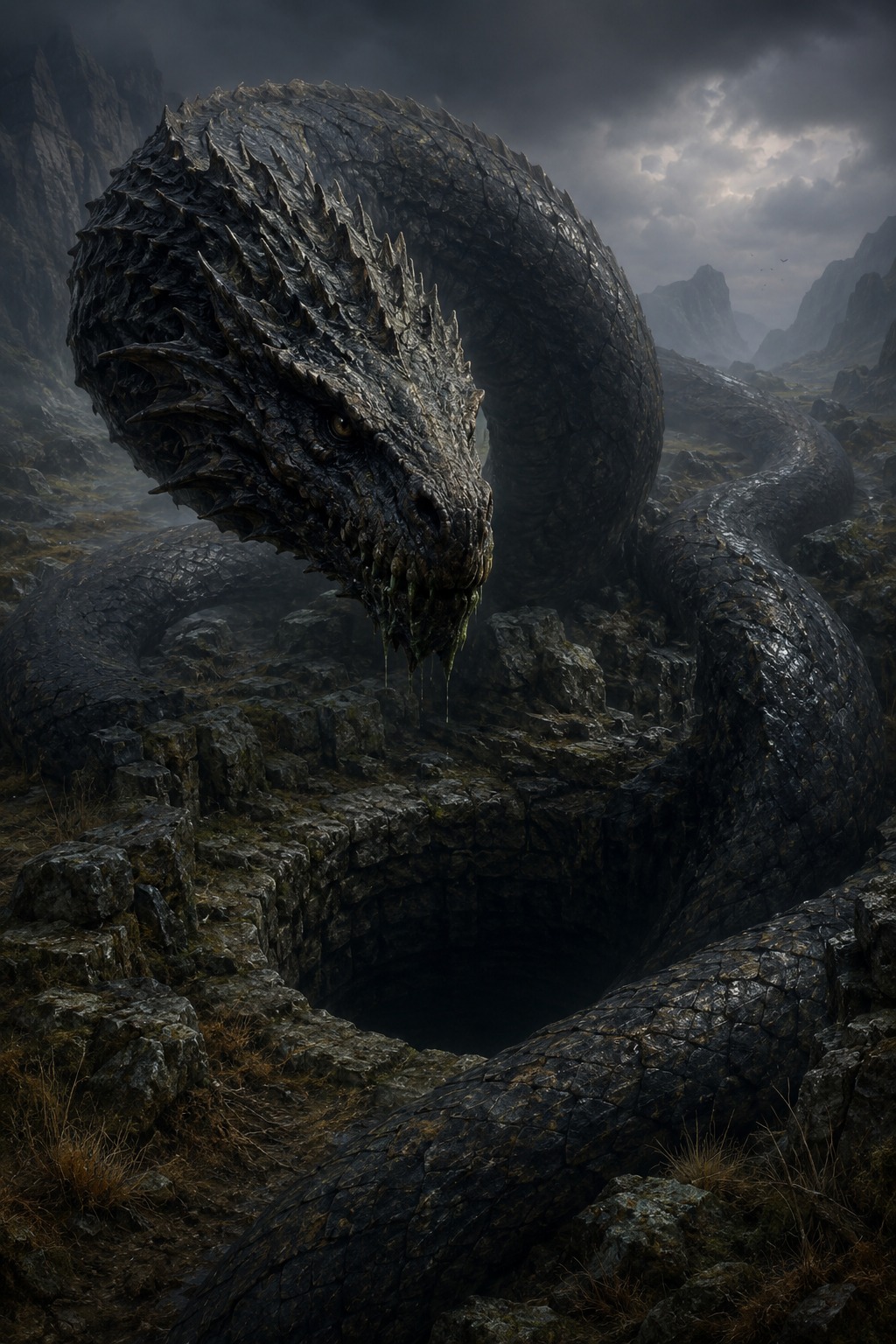
Fafnir
Cursed Treasure Dragon of Norse Myth
Names in Other Languages
 파프니르한국어
Fafnir · 북유럽 신화의 저주받은 보물 용
 ファフニール日本語
Fafnir · 北欧神話の呪われた財宝の竜
 法夫尼爾繁體中文
Fafnir · 北歐神話的詛咒寶藏之龍
 FafnirDeutsch
Fafner · Verfluchter Schatzdrache der nordischen Mythologie
 FáfnirFrançais
Dragon au trésor maudit de la mythologie nordique
 FafnirEspañol
Dragón del tesoro maldito de la mitología nórdica
 FafnirPortuguês
Dragão do tesouro amaldiçoado da mitologia nórdica
 FafnirPolski
Przeklęty smok skarbu mitologii nordyckiej
 ФафнирРусский
Fafnir · Проклятый дракон сокровищ скандинавской мифологии
Fáfnir is the tragic dragon of Norse legend, recorded in the late thirteenth-century Icelandic 'Völsunga saga' and in the Poetic Edda lays 'Reginsmál' and 'Fáfnismál' preserved in the Codex Regius (GKS 2365 4to, c. 1270, Árni Magnússon Institute, Reykjavik), and retold in the early thirteenth-century Middle High German 'Nibelungenlied' as the hoard-dragon slain by Siegfried. He was originally a dwarf, the son of king Hreiðmarr, but coveted the cursed gold paid as compensation for the accidental killing of his shape-shifted brother Otr — the hoard contained the ring Andvaranaut, taken from the dwarf Andvari under a curse — and murdered his father, drove out his brother Regin, and transformed into a venom-spitting wyrm (legless serpent-dragon) coiled atop the gold. The hero Sigurðr (Middle High German Siegfried), aided by Regin's sword Gramr, dug an ambush pit beside the dragon's path to a stream and stabbed Fáfnir from below in the soft belly; drinking the dragon's blood gave Sigurðr the speech of birds, and eating its roasted heart gave him universal wisdom. The episode is the direct source of Richard Wagner's 'Der Ring des Nibelungen' (1869-1876) and of J.R.R. Tolkien's Smaug in 'The Hobbit' (1937).
Origin
The direct textual sources are the 'Völsunga saga' (late thirteenth century) and the Poetic Edda lays 'Reginsmál' and 'Fáfnismál' preserved in the Codex Regius manuscript (c. 1270), now in the Árni Magnússon Institute in Reykjavik; the same matter reappears in the early thirteenth-century 'Nibelungenlied'. Indo-European comparative mythology, notably the work of Georges Dumézil (1898-1986), reads the Fáfnir slaying as a Germanic instance of the storm-god / serpent slayer pattern — Indra against Vritra, Thor against Jörmungandr. The Ramsund carving in Södermanland, Sweden (late eleventh century), is the earliest surviving visual record of Sigurðr killing Fáfnir from the pit.
Features
- Originally a dwarf transformed into a vast dragon by greed for gold
- Bound by the curse of the ring Andvaranaut, which marks his tragic arc
- Legless wyrm body, the canonical Germanic dragon shape
- Spits venom and coils atop the hoard he guards
- Killed by Sigurðr from an ambush pit beside the river, struck in the unscaled belly with the sword Gramr
- His blood gives the speech of birds; his roasted heart confers universal wisdom
Stories
Functions as the apex boss of the Norse hero-initiation cycle, the founding instance of the 'curse of the hoard' motif, and the textbook source for the tragic dragon archetype of Wagnerian and Tolkienian fantasy.
Weakness
The unscaled belly is the lethal weak point, and his fixed track from lair to water makes him vulnerable to a pit ambush; psychologically he is bound to the cursed ring and cannot relinquish the hoard.
Cultural Significance
The Sigurðr-Fáfnir episode is a standard subject of medieval Scandinavian visual art — the Ramsund carving (eleventh century, Sweden), the Urnes stave-church carvings (twelfth century, Norway) — and entered the European operatic canon through Wagner's 'Der Ring des Nibelungen' in the nineteenth century.
In Popular Culture
Poetic Edda 'Fáfnismál' (thirteenth century), 'Völsunga saga' (late thirteenth century), 'Nibelungenlied' (early thirteenth century), Ramsund runestone (eleventh century), Urnes stave-church carvings (twelfth century), Wagner's 'Der Ring des Nibelungen' (1869-1876), Smaug in Tolkien's 'The Hobbit' (1937), and Fritz Lang's film 'Die Nibelungen' (1924).
Trivia
The term 'wyrm' is cognate with Old Norse 'ormr', Old English 'wyrm' and Old High German 'wurm' and is the standard label for the legless Germanic serpent-dragon. Tolkien's Smaug being slain through the unscaled belly is a direct lift of the Fáfnir pattern.