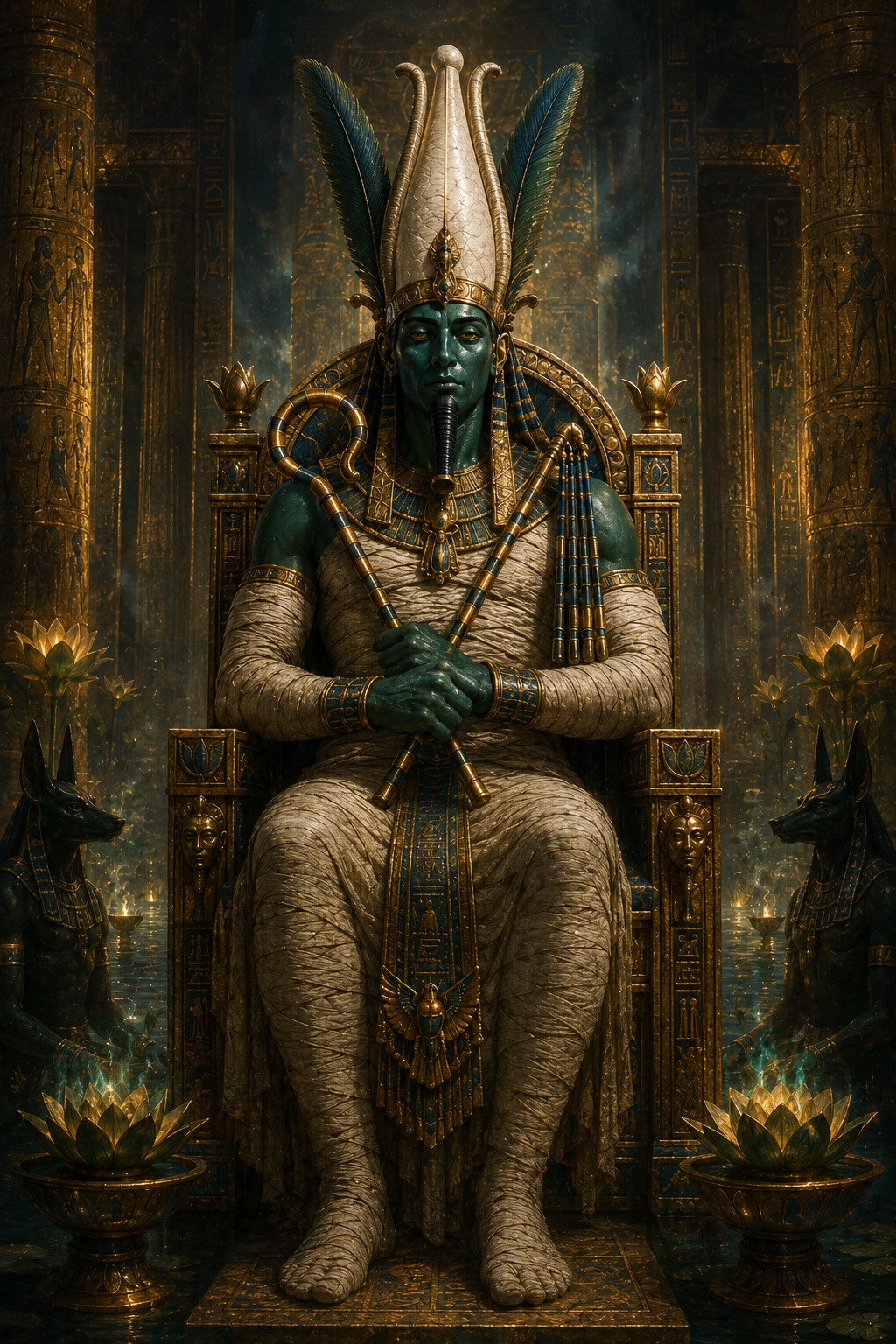
Osiris
Osiris · Egyptian King of the Afterlife — God of Resurrection and Abundance
Names in Other Languages
 오시리스한국어
Osiris · 이집트 저승의 왕 — 부활과 풍요의 신
 オシリス日本語
Osiris · エジプト冥府の王 — 復活と豊穣の神
 歐西里斯繁體中文
Osiris · 埃及冥府之王 — 復活與豐饒之神
 OsirisDeutsch
Osiris · Ägyptischer König des Jenseits — Gott der Auferstehung und Fruchtbarkeit
 OsirisFrançais
Osiris · Roi égyptien des morts — Dieu de la résurrection et de l'abondance
 OsirisEspañol
Osiris · Rey egipcio del más allá — Dios de la resurrección y la abundancia
 OsírisPortuguês
Osíris · Rei egípcio do além — Deus da ressurreição e da abundância
 OzyrysPolski
Ozyrys · Egipski król zaświatów — Bóg zmartwychwstania i obfitości
 ОсирисРусский
Osiris · Египетский царь загробного мира — Бог воскресения и изобилия
Osiris (Egyptian Wsjr Asar or Usir, Greek Osiris, 'seat of the strong' or 'throne') is the god of the underworld, resurrection, fertility, and grain of ancient Egyptian mythology — the decisive canon, the son of Geb (Geb, earth) and Nut (Nut, sky) of the Heliopolitan Ennead (Ennead), husband of Isis (Isis), who was killed by his brother Seth (Seth), whose dismembered body was gathered and resurrected by Isis, and then became the king of the underworld Duat (Duat) judging the souls of the dead — the decisive canonical iconographic figure. The decisive textual canon is the Pyramid Texts (Pyramid Texts) of c. 2400-2300 BCE — Old Kingdom 5th dynasty — the decisive origin canon of about 200 of the about 759 spells of the pyramid texts of Unas (Unas, reigned 2375-2345 BCE) in Saqqara — and the Coffin Texts (Coffin Texts) of c. 2100-1700 BCE Middle Kingdom — and the Book of the Dead (Book of the Dead) of c. 1550 BCE New Kingdom, especially chapter 125 'Negative Confession (Negative Confession)' — the decisive canon of Osiris's 42 judges. The De Iside et Osiride (De Iside et Osiride) of the Greek Plutarch (Plutarch, c. 46-119) of c. 100 CE of the c. 1st century CE is the most complete decisive Greek-Latin mythological canon.
Origin
The iconographic origin is the agriculture-fertility god worship of the c. 2890 BCE 2nd dynasty period, and the decisive textual canon is the Pyramid Texts (Pyramid Texts) of c. 2400-2300 BCE — Old Kingdom 5th dynasty — the decisive origin canon of about 200 of the about 759 spells of Unas (Unas) of Saqqara, and the Coffin Texts (Coffin Texts) of c. 2100-1700 BCE Middle Kingdom — about 1,185 spells — and the Book of the Dead (Book of the Dead) of c. 1550 BCE New Kingdom 18th dynasty — about 192 spells — especially chapter 125 'Negative Confession (Negative Confession)' — the decisive canon of the 'Weighing of the Heart (Weighing of the Heart)' in which the deceased confesses 42 negations such as 'I have not killed, I have not stolen' before the 42 judges in front of Osiris's throne, and the heart is weighed against the feather of the goddess Maat (Ma'at). The De Iside et Osiride (De Iside et Osiride) chapters 12-19 of the Greek Plutarch (Plutarch) of c. 100 CE — the decisive canon in which Seth (Seth), along with 72 conspirators, made a coffin that fit Osiris's body, tested it at a banquet, and after Osiris entered the coffin, nailed it shut, sealed it with lead, and threw it into the Nile, killing him — and the decisive canon in which after Isis found the coffin in Byblos (Byblos), Seth dismembered him again into 14 pieces and scattered them, and Isis gathered 13 pieces but the phallus had been eaten by a fish (Oxyrhynchos), so she made a golden phallus.
Features
- King with green or blue skin wrapped like a mummy
- Atef (atef) crown with two feathers and ram horns
- Sheaves of grain with flail (flail) heka and crook (crook) nekhakha
- Sits on a throne and judges the souls of the dead
- Weighing of the Heart — balance with the feather of Maat (Ma'at)
- Main temple — Abydos (Abydos)
Stories
The agriculture-fertility god worship of the c. 2890 BCE 2nd dynasty is the decisive origin, and the decisive textual canon is the Pyramid Texts (Unas's pyramid) of c. 2400-2300 BCE Old Kingdom 5th dynasty, the Coffin Texts of c. 2100-1700 BCE Middle Kingdom, and chapter 125 'Negative Confession' and the 'Weighing of the Heart' of the Book of the Dead of c. 1550 BCE New Kingdom. The decisive canon of the murder and resurrection of Osiris in the De Iside et Osiride chapters 12-19 of Plutarch of c. 100 CE of the c. 1st century CE, and the decisive canon in which as the central god of funerary rites, every deceased was called 'Osiris ○○' and prayed to be resurrected like him. The decisive canon of farmers following his resurrection myth by making grain dolls 'Osiris bed (Osiris bed)' every year, burying them, and waiting for germination, and the decisive canon of the Osiris temple of Abydos (Abydos) in Egypt and the annual 'Osiris Mysteries (Osiris Mysteries)' festival is the decisive religious canon. The Osiris of the 1980 D&D Deities & Demigods (Deities & Demigods) by TSR in the USA is the decisive fantasy RPG canon, and the Osiris of the film Stargate (Stargate) (directed by Roland Emmerich, MGM) released in the USA on 28 October 1994, the Osiris myth of the film The Mummy (The Mummy) (directed by Stephen Sommers, Universal) released in the USA on 7 May 1999, and the Osiris played by Bryan Brown (Bryan Brown) of the film Gods of Egypt (Gods of Egypt) (directed by Alex Proyas, Lionsgate) released in the USA on 26 February 2016 are the 21st-century decisive global film canon.
Weakness
Osiris's weaknesses are: (1) Seth's plot — the decisive canonical weakness — the decisive canon in the c. 1st century CE Plutarch De Iside et Osiride chapters 13-18 — being trapped in the coffin and killed by Seth and 72 conspirators; (2) lost phallus — the most decisive canonical weakness — after being dismembered into 14 pieces, the phallus was eaten by a fish and lost, so Isis made a golden phallus — the decisive canon; (3) binding of the living world — the decisive canon that he can no longer reign in the living world — the decisive canon that Horus (Horus) became the god of living kings; (4) binding of the mummy — the decisive canon of being wrapped like a mummy; (5) binding of Duat (Duat) — the decisive canon of the underworld; (6) binding of grain — the decisive canon as the god of grain who dies and resurrects every year; (7) binding of 14 pieces — the decisive canon; (8) weight of judgement — the decisive canon. The decisive canonical finale is the decisive mythological canon of the c. 1st century CE Plutarch De Iside et Osiride chapters 19-20 — Isis resurrected Osiris's body, conceived Horus (Horus), and then Osiris became the king of Duat.
Cultural Significance
Osiris is not merely an underworld-god icon but the canonical iconographic figure of the decisive Egyptian canon, traversing the c. 2400-2300 BCE Old Kingdom 5th dynasty Unas's Pyramid Texts, the c. 2100-1700 BCE Middle Kingdom Coffin Texts, the c. 1550 BCE New Kingdom Book of the Dead chapter 125 'Negative Confession' and 'Weighing of the Heart', the c. 1st century CE Plutarch De Iside et Osiride chapters 12-19, the Osiris temple of Abydos (Abydos) in Egypt, the 1980 D&D Deities & Demigods, the 1994 film Stargate, the 1999 film The Mummy, and the 2016 film Gods of Egypt. The agriculture-fertility god worship of the c. 2890 BCE 2nd dynasty period settled as the decisive canon in the Pyramid Texts (Pyramid Texts) of c. 2400-2300 BCE — Old Kingdom 5th dynasty — of Unas (Unas) in Saqqara. The decisive mythological canon is the De Iside et Osiride (De Iside et Osiride) chapters 12-19 of the Greek Plutarch (Plutarch, c. 46-119) of c. 100 CE of the c. 1st century CE — the decisive canon in which Seth (Seth), along with 72 conspirators, made a coffin that fit Osiris's body, tested it at a banquet, and after Osiris entered the coffin, nailed it shut, sealed it with lead, and threw it into the Nile, killing him — and the decisive canon in which after Isis found the coffin in Byblos (Byblos), Seth dismembered him again into 14 pieces and scattered them, and Isis gathered 13 pieces but the phallus had been eaten by a fish and was lost, so she made a golden phallus. The decisive 21st-century canon is the Osiris of the film Stargate (Stargate) (directed by Roland Emmerich, MGM, worldwide box office about 196.5 million dollars) released in the USA on 28 October 1994, the Osiris myth of the film The Mummy (The Mummy) (directed by Stephen Sommers, Universal, worldwide box office about 416.4 million dollars) released in the USA on 7 May 1999, and the Osiris played by Bryan Brown (Bryan Brown, born 23 June 1947 in Sydney, Australia) of the film Gods of Egypt (Gods of Egypt) (directed by Alex Proyas, Lionsgate) released in the USA on 26 February 2016 are the 21st-century decisive global film canon.
In Popular Culture
- Old Kingdom 5th dynasty Unas's Pyramid Texts (c. 2400-2300 BCE) — decisive origin canon
- Middle Kingdom Coffin Texts (c. 2100-1700 BCE) — decisive funerary canon
- New Kingdom Book of the Dead chapter 125 'Negative Confession' (c. 1550 BCE) — decisive judgement canon
- New Kingdom Amduat (c. 1550 BCE) — decisive underworld canon
- Plutarch De Iside et Osiride chapters 12-19 (c. 1st century CE) — decisive Greek-Latin canon
- Abydos (Abydos) Osiris temple (New Kingdom) — decisive religious-architecture canon
- TSR D&D Deities & Demigods, Osiris (1980) — decisive fantasy RPG canon
- Film Stargate, Osiris (1994) — 21st-century decisive film canon
- Film The Mummy, Osiris myth (1999) — 21st-century decisive film canon
- Film Gods of Egypt, Osiris Bryan Brown (2016) — 21st-century decisive film canon
Trivia
The etymology of Osiris (Egyptian Wsjr Asar or Usir) is the decisive canonical vocabulary of 'seat of the strong (seat of the strong)' or 'throne (throne)', and the Greek Osiris, Latin Osiris, and aliases Wennefer (Wn-nfr Wennefer, 'eternally good one'), Khenty-Amentiu (Khenty-Amentiu, 'foremost of the westerners'), and Neb-Duat (Neb-Duat, 'lord of Duat') are the decisive canonical vocabulary. The decisive textual canon is the Pyramid Texts (Pyramid Texts) of c. 2400-2300 BCE — Old Kingdom 5th dynasty — the decisive origin canon of about 200 of the about 759 spells inside the pyramid of Unas (Unas, reigned 2375-2345 BCE) in Saqqara — and the De Iside et Osiride (De Iside et Osiride) chapters 12-19 of the Greek Plutarch (Plutarch, c. 46 born in Chaeronea, Greece, died c. 119) of c. 100 CE of the c. 1st century CE — the most complete canon. The decisive canon in which he is the son of Geb (Geb, earth) and Nut (Nut, sky) of the Heliopolitan Ennead (Ennead), husband of Isis (Isis), and one of the four siblings together with his brother Seth (Seth) and sister Nephthys (Nephthys). The decisive canon in which Seth (Seth), along with 72 conspirators, made a coffin that fit Osiris's body, tested it at a banquet, and after Osiris entered the coffin, nailed it shut, sealed it with lead, and threw it into the Nile, killing him — and the decisive canon in which after Isis found the coffin in a cedar tree in Byblos (Byblos), Seth dismembered him again into 14 pieces and scattered them, and Isis gathered 13 pieces but the phallus (phallus) had been eaten by an Oxyrhynchos (Oxyrhynchos) fish and was lost, so she made a golden phallus. The decisive canon in which Isis mummified Osiris's body and resurrected him, conceived Horus (Horus), and then Osiris became the king of Duat (Duat), and in chapter 125 of the Book of the Dead's 'Weighing of the Heart (Weighing of the Heart)', the heart of the deceased was weighed against the feather of Maat (Ma'at), and if balanced, he resurrected — the decisive canon, and the decisive canon of the annual 'Osiris Mysteries (Osiris Mysteries)' festival held at Abydos (Abydos). The Osiris played by Bryan Brown (Bryan Brown, born 23 June 1947 in Sydney, Australia) of the film Gods of Egypt (Gods of Egypt) (directed by Alex Proyas, Lionsgate) released in the USA on 26 February 2016 is the 21st-century decisive global film canon.
Related
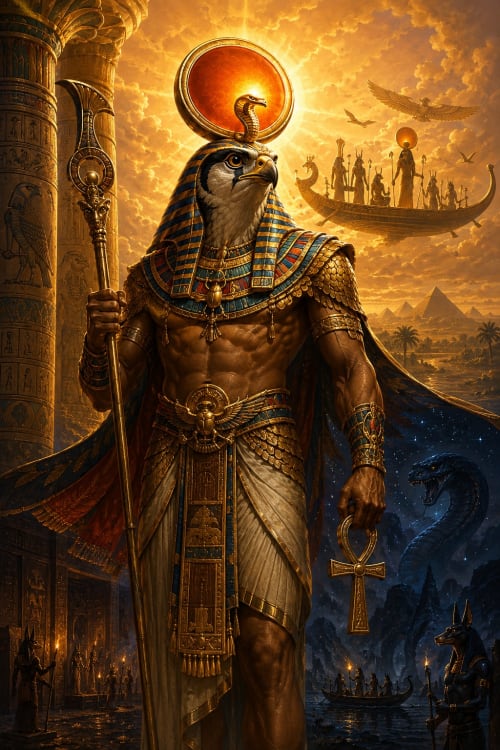
Ra
Ra · Egyptian Sun God — Creator and King of the Gods
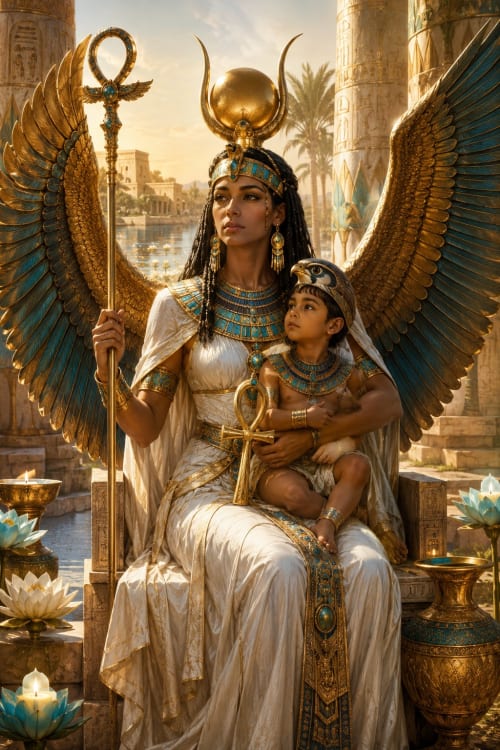
Isis
Isis · Egyptian Goddess of Magic and Motherhood — Goddess of Ten Thousand Names
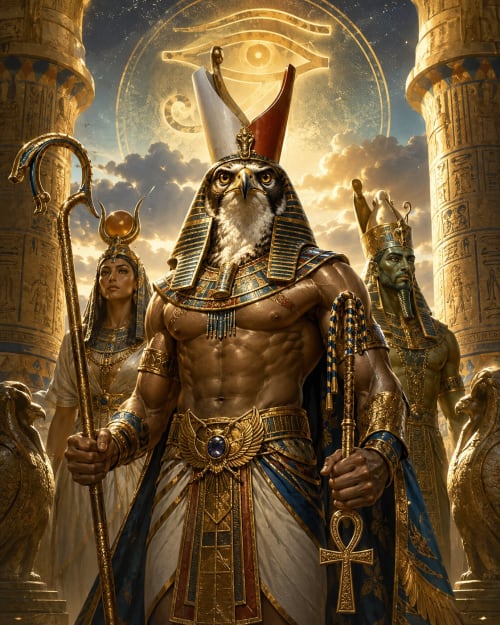
Horus
Horus · Egyptian God of Sky and Kingship — Falcon-Eyed Restorer of Justice

Anubis
Anubis · Egyptian God — Guardian of Death and Mummification
Michael
Michael · Archangel — Captain of the Heavenly Host, Vanquisher of Satan
Raphael
Raphael · Archangel — Angel of Healing and Guide of Travelers
Uriel
Uriel · Archangel — Light of God, Angel of Wisdom and Repentance
Metatron
Metatron · Scribe of Heaven — Voice of God and Recorder of Divine Acts
Azrael
Azrael· Angel of Death Reaper of Souls
Seraphim
Seraphim · Highest Order of the Nine Angelic Choirs — The Burning Ones Around God
Cherubim
Cherubim · Second of the Nine Angelic Choirs — Guardians of Divine Wisdom and the Throne
Ophanim
Ophanim · Third of the Nine Angelic Choirs — Wheels of God, Throne of Justice