Monoceros
Monoceros · Unicorn — Legendary one-horned creature
Names in Other Languages
 모노케로스한국어
Monoceros · 일각수 — 전설 속 신비한 단각 짐승
 モノケロス日本語
モノケロス · ユニコーン — 伝説の一本角の獣
 莫諾克洛斯繁體中文
Monoceros · 獨角獸 — 傳說中的單角神獸
 MonocerosDeutsch
Monoceros · Einhorn — Legendäres einhörniges Wesen
 MonocérosFrançais
Monocéros · Licorne — Créature légendaire à une corne
 MonoceronteEspañol
Monoceronte · Unicornio — Criatura legendaria de un solo cuerno
 MonocerosPortuguês
Monoceros · Unicórnio — Criatura lendária de um só chifre
 MonocerosPolski
Monoceros · Jednorożec — Legendarne stworzenie z jednym rogiem
 МонокеросРусский
Монокерос · Единорог — Легендарное однороговое существо
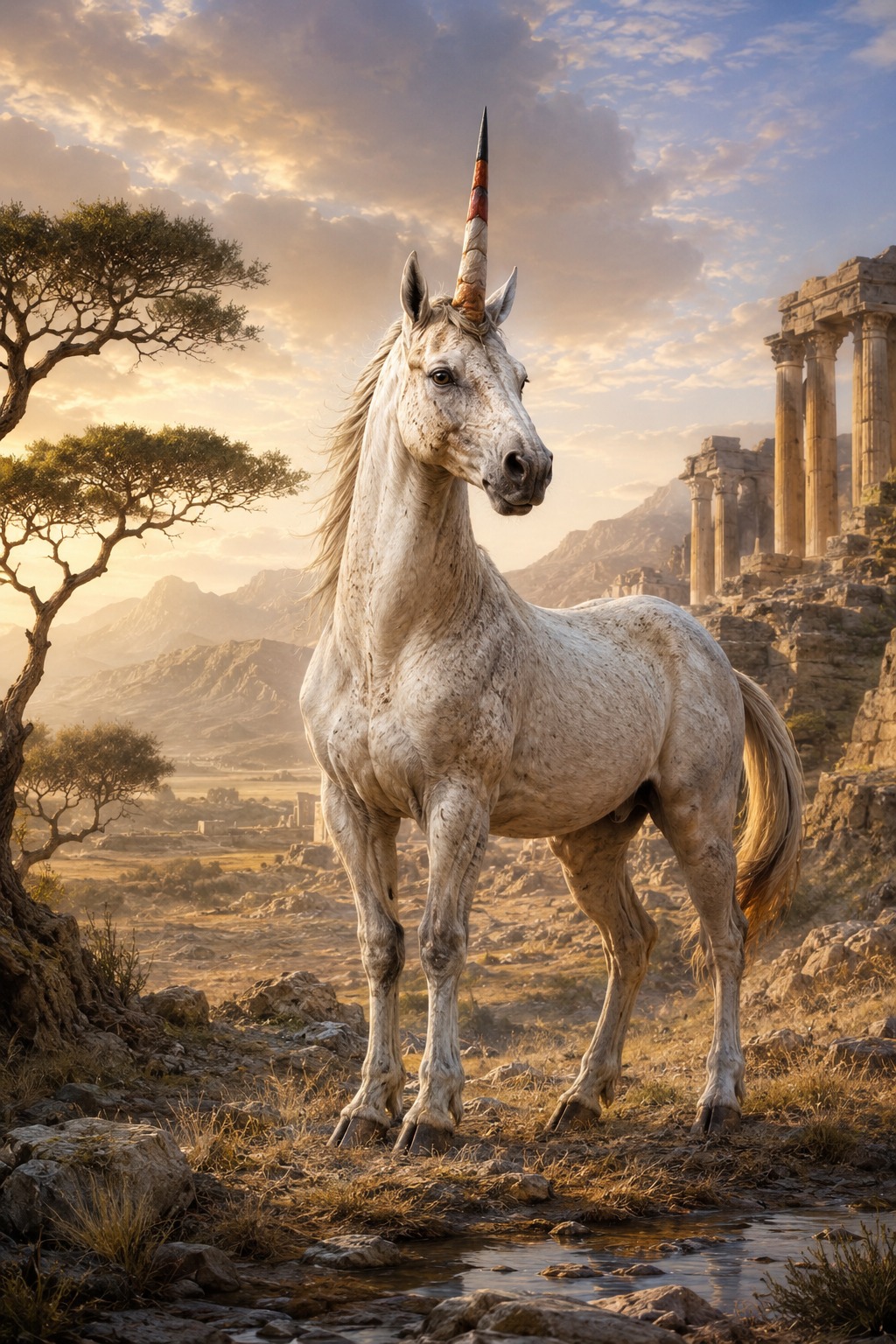
The Monoceros (Greek Monokeros, Latin Monoceros, 'single horn') is the archetype of the one-horned beast in Greek and Roman natural history. It first appears in the Indika of Ktesias of Knidos (fifth century BCE), a Greek physician at the Persian court who describes wild asses of India with white bodies, purple heads, blue eyes, and a single horn about one cubit long, banded in white, black, and crimson; cups carved from the horn make the drinker immune to poison, seizures, and epilepsy. In the first century CE, Pliny the Elder's Natural History VIII.31 standardised the description as 'a body like a horse, head like a stag, feet like an elephant, tail like a boar, and a single black horn about two cubits long in the middle of the forehead.' When this image reached medieval Europe through Latin sources it was equated with unicornus, the unicorn. In later fantasy, however, Monoceros often persists as a wilder, fiercer original distinct from the white-horse unicorn.
Origin
The iconographic origin of Monoceros is the fifth-century BCE Indika of Ktesias, where it is the Indian wild ass with a tri-coloured horn whose detoxifying cup gave the creature its lasting reputation. The fourth-century BCE ambassador Megasthenes recorded it under the name kartazonos as a horse-sized beast with a black horn and a savage temper. Aristotle's Historia Animalium book II groups the Indian ass and the oryx as examples of one-horned animals. Pliny the Elder's Natural History VIII.31, first century CE, fixed the Latin name monoceros and the canonical hybrid description: horse-bodied, stag-headed, elephant-footed, boar-tailed, with a single black horn. The Septuagint translation of the Hebrew Bible rendered the Hebrew re'em (now identified by scholars as the aurochs) as monokeros, and the Latin Vulgate continued this as unicornis, embedding the unicorn-image in Christian iconography. The second- to fourth-century Physiologus introduced the virgin-and-unicorn allegory, allegorising the creature as Christ.
Features
- A single horn rising from the forehead
- Ktesian tradition: white body, purple head, blue eyes, tri-coloured horn
- Plinian tradition: horse body, stag head, elephant feet, boar tail, black horn
- Cups carved from the horn neutralise poison, seizures, and epilepsy
- Fierce and almost impossible to capture alive
- Native to India or the easternmost edges of the known world
Stories
Ancient pharmacology turned the Monoceros horn (alicorn) into a universal antidote. Renaissance pharmacopoeias listed alicorn powder among the costliest of medicinal substances, dearer than gold by weight; Elizabeth I of England held a unicorn cup among her royal treasures. Most actual 'unicorn horns' in circulation, however, were the spiralled tusks of the narwhal (Monodon monoceros), as the Danish naturalist Olaus Worm demonstrated in 1638 from museum specimens. In astronomy, the constellation Monoceros was introduced in 1612 by the Dutch theologian-astronomer Petrus Plancius and consolidated on Jakob Bartsch's 1624 star chart; it now sits among the 88 IAU constellations. Medieval bestiaries, the late-fifteenth-century Lady and the Unicorn tapestries at Cluny, and the Hunt of the Unicorn tapestries at The Cloisters fixed the visual canon.
Weakness
The decisive weakness in medieval tradition is the maiden's lap. The Physiologus, second to fourth century CE, established the allegory: although no hunter can take the unicorn by force, a virgin alone in the forest will draw the beast to her, where it lays its head on her lap and sleeps, then is captured. The motif is absent from Ktesias and is the product of Christian allegorisation, in which the unicorn figures Christ entering the Virgin's womb. The horn's antitoxic power also bears variants: it must be cut while the beast lives, or the touch of an unworthy hand voids its virtue, so the horn's availability rather than the creature itself becomes the practical barrier.
Cultural Significance
Monoceros sits at the head of a long chain: Greek natural history, Latin encyclopaedism, medieval Christian allegory, Renaissance pharmacology, early modern astronomy. The Septuagint's monokeros rendering, picked up as unicornis in the Vulgate, made the unicorn a regular figure in Christian art, and the Physiologus's virgin motif produced the Cluny tapestries (1490s) and the Cloisters Hunt of the Unicorn cycle. Petrus Plancius's 1612 constellation gave it astronomical coordinates; Olaus Worm's 1638 narwhal identification gave it a natural-history afterlife. In contemporary fantasy, Monoceros often remains distinct from the white-horse unicorn as a fiercer, wilder original; the Dungeons and Dragons Monster Manual lists 'monoceros' or 'black unicorn' variants. In European heraldry, the unicorn of the Scottish royal arms preserves the figure as an emblem of authority and purity.
In Popular Culture
- Ktesias, Indika (5th c. BCE) — earliest description as Indian wild ass
- Megasthenes, Indika (4th c. BCE) — kartazonos variant
- Aristotle, Historia Animalium book II — classes Indian ass and oryx as one-horned
- Pliny the Elder, Natural History VIII.31 — Latin monoceros canon
- Septuagint, Psalms 22 and 92 — Hebrew re'em rendered as monokeros
- Physiologus (2nd-4th c.) — virgin-and-unicorn allegory established
- Constellation Monoceros — introduced by Petrus Plancius in 1612
Trivia
Ktesias's fifth-century BCE account is widely regarded as a Greek hearsay version of the Indian rhinoceros (Rhinoceros unicornis): a single horn, fierce temper, Indian habitat. Most of the 'unicorn horns' circulating in early modern Europe were narwhal tusks; Olaus Worm published the identification from museum specimens in 1638. The constellation Monoceros, introduced by Petrus Plancius in 1612 and fixed on Jakob Bartsch's 1624 chart, lies in the winter southern sky between Canis Major and Canis Minor and is among the 88 IAU constellations. Marco Polo's Travels describes an 'ugly and fierce unicorn' seen in Sumatra, identified by later scholars as the Javan rhinoceros.