Lamia
Serpent-bodied Enchantress · Seductress and Devourer in Greek Mythology
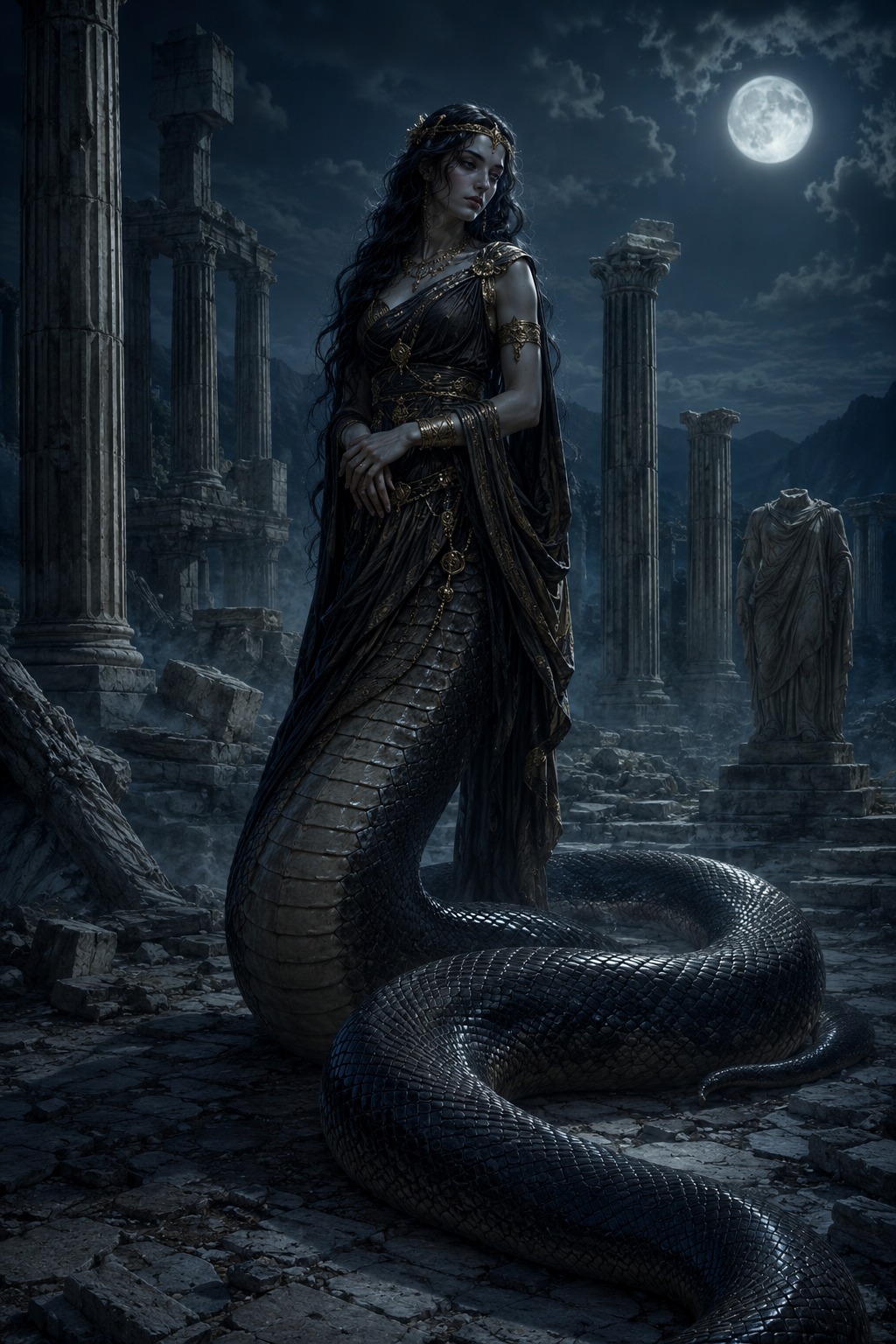
A monster of Greek myth, the upper body a beautiful woman and the lower body that of a great serpent. Once the beautiful queen of Libya and a lover of Zeus, she was driven by Hera's jealousy to the loss of all her children, and from her grief and rage was changed into a creature that, by night, steals and devours the children of other mothers (Diodorus Siculus, Library 20.41, 1st c. BCE). Hera further denied her sleep by cursing one of her eyes to remain forever open, and she carries her eyes out in a bowl when she leaves home (Plutarch, On Curiosity 2). Philostratus's Life of Apollonius of Tyana 4.25 (3rd c. CE) tells how a Lamia seduced the young Menippus, and was unmasked at the wedding feast by the philosopher Apollonius — the source which John Keats reworked in his poem Lamia (Lamia, Isabella, the Eve of St. Agnes, and Other Poems, Taylor & Hessey, 1820), turning her into a tragic figure of love and revealed truth.