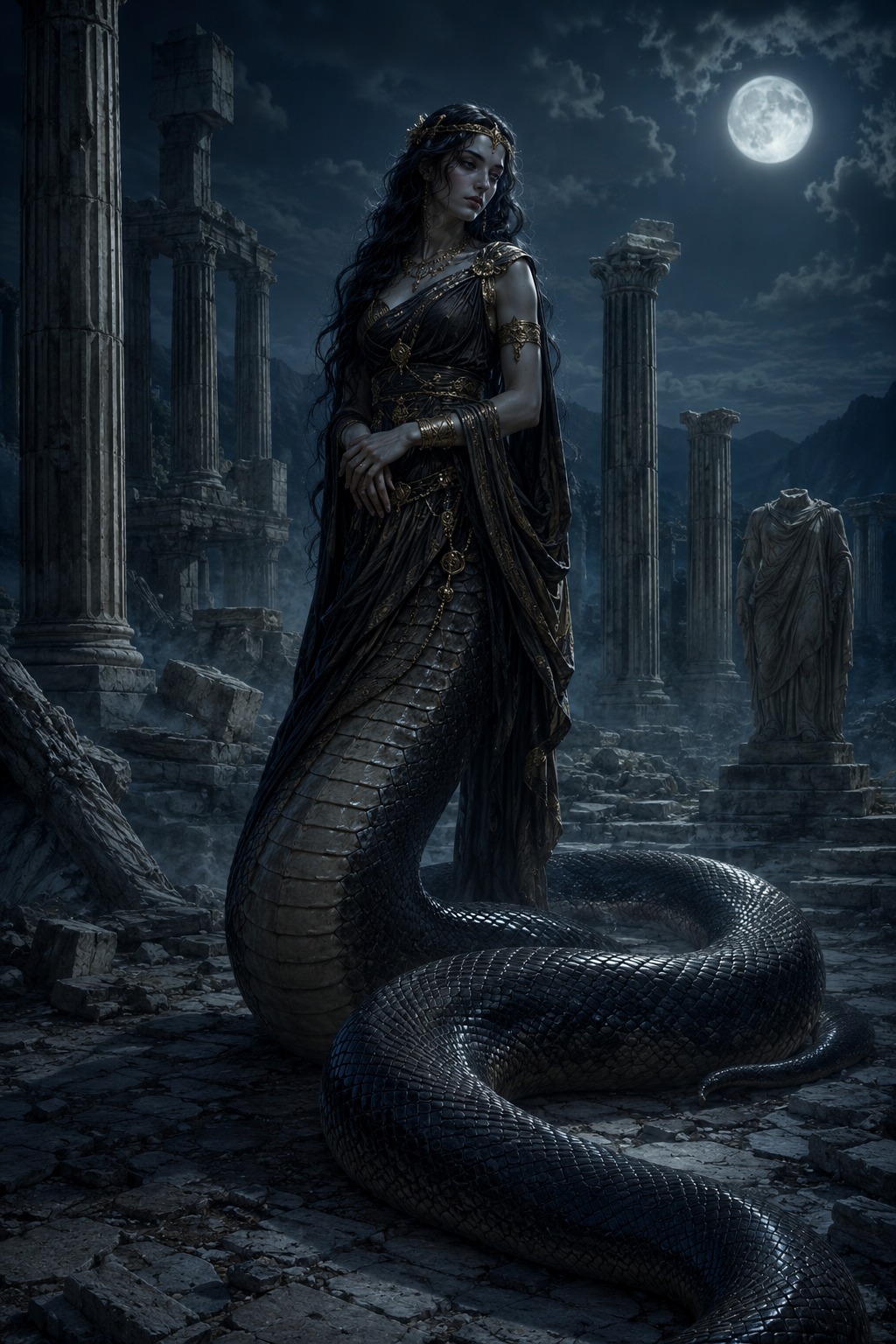
Lamia
Serpent-bodied Enchantress · Seductress and Devourer in Greek Mythology
Names in Other Languages
 라미아한국어
Lamia · 뱀 하반신 여괴 — 그리스 신화 속 유혹과 파멸의 존재
 ラミア日本語
ラミア · 蛇下半身の女怪物 — ギリシャ神話の誘惑者
 拉米亞繁體中文
Lamia · 蛇身女妖 — 希臘神話中的誘惑與毀滅
 LamiaDeutsch
Schlangenunterleibige Verführerin · Unheilvolle Gestalt der griechischen Mythologie
 LamiaFrançais
Lamia · Enchanteresse à queue de serpent — Séductrice fatale de la mythologie grecque
 LamiaEspañol
Lamia · Mujer serpiente — Seductora y devoradora de la mitología griega
 LâmiaPortuguês
Lamia · Mulher-serpente — Sedutora e devoradora da mitologia grega
 LamiaPolski
Lamia · Syrena o wężowym ogonie — Uwodzicielka i potwór z mitologii greckiej
 ЛамияРусский
Ламия · Женщина-змея — Соблазнительница и пожирательница из греческой мифологии
A monster of Greek myth, the upper body a beautiful woman and the lower body that of a great serpent. Once the beautiful queen of Libya and a lover of Zeus, she was driven by Hera's jealousy to the loss of all her children, and from her grief and rage was changed into a creature that, by night, steals and devours the children of other mothers (Diodorus Siculus, Library 20.41, 1st c. BCE). Hera further denied her sleep by cursing one of her eyes to remain forever open, and she carries her eyes out in a bowl when she leaves home (Plutarch, On Curiosity 2). Philostratus's Life of Apollonius of Tyana 4.25 (3rd c. CE) tells how a Lamia seduced the young Menippus, and was unmasked at the wedding feast by the philosopher Apollonius — the source which John Keats reworked in his poem Lamia (Lamia, Isabella, the Eve of St. Agnes, and Other Poems, Taylor & Hessey, 1820), turning her into a tragic figure of love and revealed truth.
Origin
The earliest written references are Aristophanes's Wasps 1035 and Peace 758 (5th c. BCE), in which Lamia already serves Athenian comedy as a stock terror; her name is presupposed by the rural Greek lullaby in which a mother threatens her child with abduction by Lamia. The tragic origin myth is canonised by Diodorus Siculus, Library 20.41 (1st c. BCE): Lamia, beautiful queen of Libya, became a lover of Zeus and bore him children; the jealousy of Hera either killed those children or drove the maddened Lamia to kill them herself, and Lamia withdrew to a cave to steal and devour other mothers' children. Plutarch's On Curiosity 2 (1st-2nd c. CE) tells the variant of the detachable eyes: Hera cursed Lamia with sleeplessness by leaving one eye always open, and Lamia removed her eyes into a bowl when at rest. Pausanias, Description of Greece 10.12.1 (2nd c. CE), records the Sibyl Demo as her daughter by Zeus. The serpent-bodied iconography becomes canonical in Latin verse — Horace, Ars Poetica 340 (1st c. BCE) — and the love narrative comes to its classical climax in Philostratus's Life of Apollonius of Tyana 4.25 (3rd c. CE): a Lamia seduces the young Menippus, and the philosopher Apollonius unmasks her at the wedding feast. Robert Burton's Anatomy of Melancholy (Henry Cripps, Oxford, 1621) carried the Philostratus story into English; John Keats wrote his poem Lamia in July-September 1819 at Wentworth Place in Hampstead and published it in Lamia, Isabella, the Eve of St. Agnes, and Other Poems (Taylor & Hessey, 1820), refiguring Lamia as a tragic figure undone by revealed truth. John William Waterhouse painted Lamia twice (1905, private collection; 1909, Art Gallery of Ontario in Toronto), establishing the Pre-Raphaelite visual canon.
Features
- Beautiful woman from the waist up, great serpent (or in some traditions a sea-monster tail) below — the canonical form from the Hellenistic period onward
- Nocturnal; she steals into bedrooms while mothers sleep and devours children, and her name is invoked as a threat in Greek peasant lullabies
- One eye that cannot close, by Hera's curse; in Plutarch's variant she removes her eyes into a bowl when she sleeps
- A seductive appearance and song that lets her draw young men and feed on their vital essence (Philostratus, and the heart of Keats's poem)
- Tragic self-knowledge: in Keats and Waterhouse alike, the unmasking of her serpent nature before the man she loves destroys both lover and beloved
Stories
In ancient Greek practice, Lamia served as the canonical lullaby threat of the night, channelling a mother's fear that she will not be able to keep her child safe. Diodorus's tragic origin myth gave her a deeper dimension as the figure of maternal loss and revenge, and Philostratus's young-man-seduction tale made her in late antiquity the type of the dangerous beautiful unknown. Robert Burton (1621) and John Keats (1819) brought this combination into English letters as the figure of tragic love undone by revelation. The Pre-Raphaelites — Waterhouse most importantly — made her one of their canonical female subjects. In modern fantasy the serpent-bodied seductive woman has become a fixture: the AD&D Monster Manual (TSR, 1977) sets the gameable lamia, the Final Fantasy series (1987-) keeps her as a recurring enemy, and Japanese light novels such as Inui Takemaru's Monster Musume (Tokuma Shoten, 2012-) put her at the centre of comedy and romance.
Weakness
Lamia's decisive weakness is the unmasking of her true form. In Philostratus, Apollonius of Tyana names her at Menippus's wedding feast and she screams and vanishes; in Keats's poem the philosopher Apollonius names her at her wedding to Lycius and she is undone in a single line, taking the young Lycius with her. Sleep, too, is denied her by Hera's curse — one eye that cannot close — and the variant of the detachable eyes in Plutarch points to the same psychological wound. The trauma of her lost children is past all magical healing. In fifth-edition D&D the lamia is Challenge Rating 4, an enchantress and mind-charmer vulnerable to allies who are immune to charm and to strong-willed targets.
Cultural Significance
The Lamia myth begins as the rural Greek lullaby threat in which the mother's own fear is projected onto a child-stealing monster, and matures through Diodorus and Plutarch into a figure of tragic feminine vengeance. Robert Burton's Anatomy of Melancholy (1621) brings the Philostratus story into English; John Keats writes Lamia in the second half of 1819 at Wentworth Place in Hampstead (now the Keats House Museum, London Borough of Camden) and publishes it in 1820 as a poem on the tragic dialectic of imagination and disenchantment. John William Waterhouse paints Lamia twice — 1905 (private collection) and 1909 (Art Gallery of Ontario, Toronto, inv. 1939/29) — and establishes the Victorian iconography. Feminist criticism has long read this image of the serpent-woman as a demonisation of female sexuality (Nina Auerbach, Woman and the Demon: The Life of a Victorian Myth, Harvard University Press, 1982). Japanese light novels and manga since the 1990s have made the lamia one of the canonical 'demi-human' (ajin) types, with Inui Takemaru's Monster Musume (Tokuma Shoten, 2012-) as the popular standard.
In Popular Culture
- Aristophanes, Wasps 1035 and Peace 758 (5th c. BCE) — familiar terror in Athenian comedy
- Diodorus Siculus, Library 20.41 (1st c. BCE) — tragic origin as queen of Libya
- Horace, Ars Poetica 340 (late 1st c. BCE) — serpent-bodied iconography in Latin
- Plutarch, On Curiosity 2 (1st-2nd c. CE) — detachable eyes and the curse of sleeplessness
- Pausanias, Description of Greece 10.12.1 (2nd c. CE) — Sibyl Demo as Lamia's daughter by Zeus
- Philostratus, Life of Apollonius of Tyana 4.25 (3rd c. CE) — seduction of Menippus and Apollonius's unmasking
- Robert Burton, The Anatomy of Melancholy (Henry Cripps, Oxford, 1621) — Philostratus rewritten in English
- John Keats, Lamia (in Lamia, Isabella, the Eve of St. Agnes, and Other Poems, Taylor & Hessey, 1820) — Romantic tragic canon
- John William Waterhouse, Lamia (1905, private collection; 1909, Art Gallery of Ontario, Toronto) — Pre-Raphaelite visual canon
- Inui Takemaru, Monster Musume (Tokuma Shoten, 2012-) — contemporary Japanese light-novel lamia
Trivia
- The word Lamia is generally derived from Greek laimos (throat, gullet), giving the sense 'devourer', following Georg Curtius's Greek Etymology (1840); the parallel with Latin larva (mask, ghost) was discussed in nineteenth-century comparative philology but never settled.
- Plutarch's variant of the detachable eyes was, according to W. R. Halliday's Greek Folklore (Manchester University Press, 1933, ch. 5), a piece of rural humour woven into the lullaby: the mother could tell the child that Lamia takes out her eyes when she steps out, so a quick child might still escape.
- Keats wrote Lamia between July and September 1819 at Wentworth Place in Hampstead, living next door to his fiancee Fanny Brawne; Helen Vendler in The Odes of John Keats (Harvard University Press, 1983) reads the poem as a foreboding self-allegory of Keats's own approaching death and lost engagement.
- Waterhouse's 1909 Lamia (Art Gallery of Ontario, inventory 1939/29) was painted directly from lines 47-50 of book one of Keats's Lamia, depicting the moment of her transformation into a human woman; the artist himself cited the Keats lines in the catalogue of the 1909 Royal Academy exhibition.