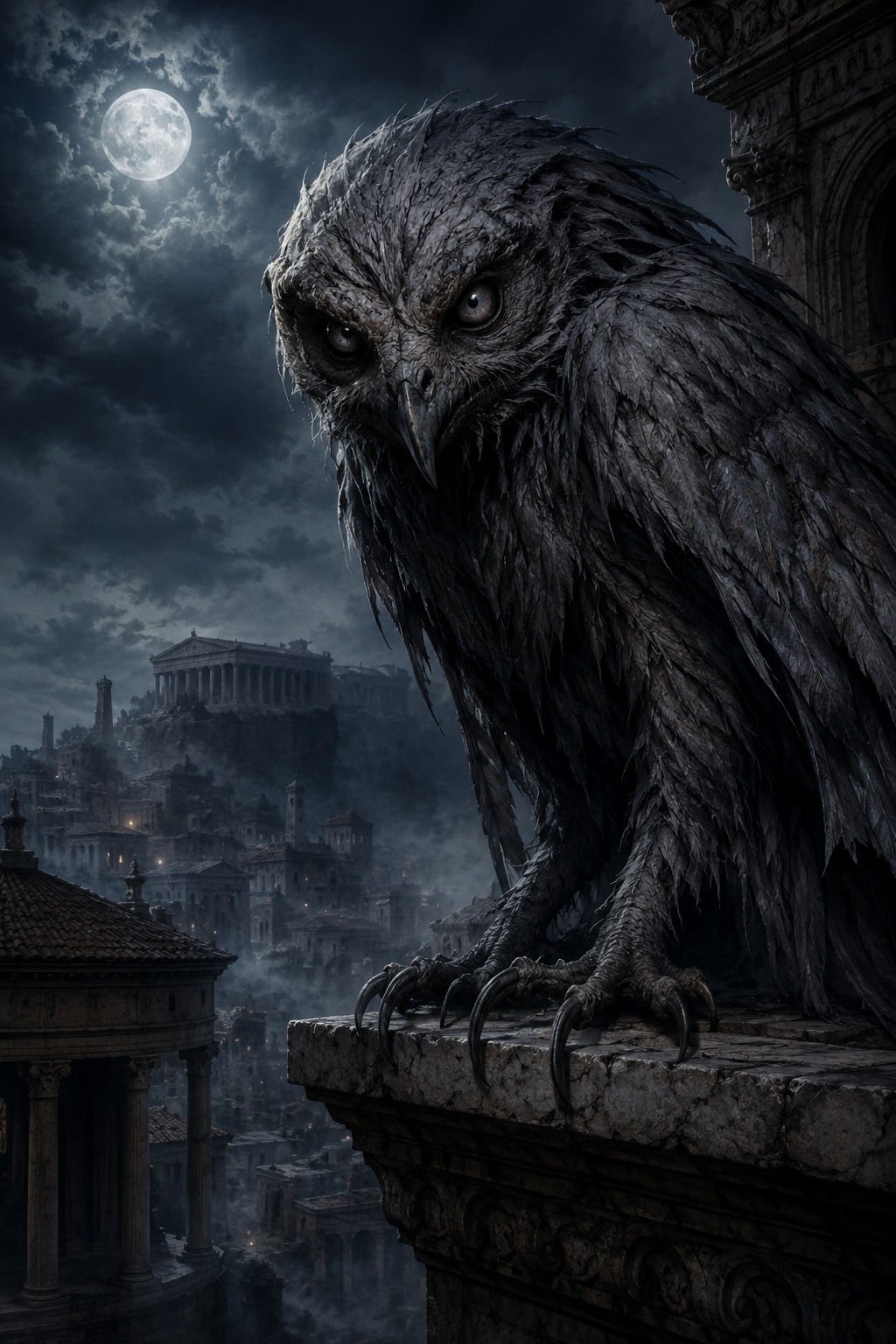
Strix
Strix · Night Bird — Vampiric Bird of Ancient European Myth
Names in Other Languages
 스트릭스한국어
Strix · 밤의 괴조 — 고대 유럽 신화의 흡혈성 새
 ストリクス日本語
Strix(ストリクス)· 夜の怪鳥 — 古代ヨーロッパ神話の吸血鳥
 斯特里克斯繁體中文
Strix · 夜之怪鳥 — 古歐洲神話中的吸血鳥
 StrixDeutsch
Strix · Nachtvogel — Vampirischer Vogel der antiken Mythologie
 StrixFrançais
Strix · Oiseau nocturne — Oiseau vampire de la mythologie antique
 StrixEspañol
Strix · Ave nocturna — Pájaro vampírico de la mitología antigua
 StrixPortuguês
Strix · Ave Noturna — Pássaro vampírico da mitologia antiga
 StrixPolski
Strix · Nocny ptak — Wampiryczny ptak z mitologii starożytnej
 СтриксРусский
Strix · Ночной птица — Вампирическая птица древних мифов
A vampiric bird-creature of Roman and Greek myth, a nocturnal raptor that creeps into the bedrooms of sleeping infants to drink their blood and entrails. It is described variously as a witch transformed into a bird, or as a demon born in the shape of a bird. The most canonical account is Ovid's Fasti 6.131-168 (c. 8 CE), which depicts it as 'with a large head, staring eyes, a beak fit for plunder, grey feathers and curved talons', and describes the ritual of the goddess Carna with hawthorn branches that protected the newborn king Procas. Etymologically the figure is the direct ancestor of the later European vampire tradition — Romanian Strigoi, Italian strega 'witch', French stryge — all of which descend from the Latin strix.
Origin
The earliest direct attestation of strix is at Plautus, Pseudolus 819-820 (c. 191 BCE), where the Roman comedy already takes the name as a familiar horror; the term derives from the Greek verb strizein, to shriek (Liddell-Scott-Jones, Greek-English Lexicon, 1843). The most detailed canonical account is Ovid's Fasti 6.131-168 (c. 8 CE), part of the aetiology of the festival of Carna on the first of June (Kalendae Iuniae): a flock of striges crept into the bedroom of the infant prince Procas to drink his blood, until the goddess Carna hung a branch of white hawthorn (virga albae spinae) and a clove of garlic on the doorposts and laid the entrails of a young white pig on the threshold; the striges withdrew. Ovid sets out the canonical appearance — a large head, staring eyes, a beak fit for plunder, grey feathers, curved talons. Petronius's Satyricon 63 (c. 60 CE) records the slave's testimony at Trimalchio's banquet of a witch-strix swapping a dead child for a straw bundle. Pliny's Natural History 11.232 (c. 77 CE) reports that the strix drips milk into the mouths of newborns to kill them. Antoninus Liberalis's Metamorphoses 21 (2nd c. CE) preserves the myth of the two sons of Polyphonte, transformed by the gods into strix-like birds. The Carna ritual of hawthorn, garlic and pig entrails on the first of June remained alive in Roman urban families through Ovid's day.
Features
- Large head, staring eyes, a beak fit for plunder, grey feathers, curved talons (Ovid, Fasti 6.135-138)
- Nocturnal, flies in darkness and silence, slips into the rooms of sleeping infants to drink blood and entrails
- Either a witch transformed into a bird (Petronius), or a human cursed by the gods into bird-form (Antoninus Liberalis) — two traditions coexist
- A shrieking cry — the very name strix names that screech
- Vulnerable to hawthorn (virga albae spinae), garlic, and the entrails of a young white pig (Ovid, Fasti 6.155-168)
Stories
In Roman household practice the strix was the superstitious form of fear over infant death, and the ritual practice of the festival of Carna on the first of June — hawthorn branches at the bedposts, garlic by the cot, the entrails of a young white pig at the doorway, all in honour of the goddess Carna — was the codified maternal answer. From Petronius onward the identification of witch and strix is fixed in Roman letters, and the medieval Latin Church inherits this: in Burchard of Worms's Decretum Book 19 (c. 1008-12) the plural strigae names both the female witch and the blood-drinking demon. From that strand the figure carried into Eastern Europe to become the Romanian Strigoi, into Italian as strega, into French as stryge, and into the English-language vampire canon via Bram Stoker's Dracula (Constable & Co., 1897); Stoker's research notes (Bram Stoker Notes, BSL/03/56, Victoria and Albert Museum, London, edited by Elizabeth Miller, Bram Stoker's Notes for Dracula, McFarland, 2008) cite the word 'Strigoi' directly from Emily Gerard's The Land Beyond the Forest (William Blackwood, 1888). Wizards of the Coast's Volo's Guide to Monsters (Dungeons & Dragons fifth edition, 2016) reintroduced the strix as a small nocturnal blood-drinking bird at Challenge Rating one-eighth, and White Wolf's Vampire: The Requiem (2004) gave the name to a horror clan.
Weakness
Ovid's Fasti 6.155-168 fixes three weaknesses: a branch of white hawthorn (virga albae spinae) at the bedposts and window keeps the strix out; garlic at the bedside drives her back by its smell; and the entrails of a young white pig placed at the threshold under the goddess Carna's protection bar her entirely. In Petronius's Satyricon 63 the strix-witch is driven off by a loud cry, the cry-and-call of recognition — naming her is the decisive thing. In the later Strigoi tradition codified by Emily Gerard, The Land Beyond the Forest (1888), and Bram Stoker, the cross, holy water, and direct sunlight were added. In fifth-edition D&D the strix is Challenge Rating one-eighth, a small beast with Sunlight Sensitivity and vulnerability to fire.
Cultural Significance
The strix is the superstitious form taken in ancient Rome by the fear of infant death, and the hawthorn ritual of the festival of Carna on the first of June was its maternal liturgy. Giuseppe Pitre, in his Usi e costumi credenze e pregiudizi del popolo siciliano (Forni, 1875), recorded the survival of the corresponding strega protection of infants in nineteenth-century rural Sicily. The most influential etymological descendant is the Romanian Strigoi: in Orthodox Eastern Europe a soul of the living can pass through death into a vampiric undead, and the English writer Emily Gerard, after her residence in Transylvania in 1885, introduced the word to English in The Land Beyond the Forest (William Blackwood, 1888). Bram Stoker drew on Gerard at the London Lyceum Theatre Library between 1890 and 1895 in preparing the Transylvanian vampire tradition of Dracula (Constable & Co., 1897), as the notebook BSL/03/56 at the Victoria and Albert Museum records. In modern popular culture, White Wolf's Vampire: The Requiem (2004) gave its Strix clan their name from this same source, and the word remains in active use across video games and tabletop horror.
In Popular Culture
- Plautus, Pseudolus 819-820 (c. 191 BCE) — earliest direct attestation in Roman comedy
- Ovid, Fasti 6.131-168 (c. 8 CE) — Carna ritual and the canonical appearance
- Petronius, Satyricon 63 (c. 60 CE) — Trimalchio's banquet and the slave's testimony to the witch-strix
- Pliny, Natural History 11.232 (c. 77 CE) — the strix as poisoner of newborns through dripped milk
- Antoninus Liberalis, Metamorphoses 21 (2nd c. CE) — the two sons of Polyphonte transformed
- Burchard of Worms, Decretum Book 19 (c. 1008-12) — medieval Latin Church use of strigae
- Emily Gerard, The Land Beyond the Forest (William Blackwood, Edinburgh, 1888) — Strigoi enters English
- Bram Stoker, Dracula (Constable & Co., 1897) — Transylvanian vampire canon
- White Wolf, Vampire: The Requiem (2004) — Strix clan
- Wizards of the Coast, Volo's Guide to Monsters (D&D 5th ed., 2016) — gameable strix
Trivia
- The Carna ritual of hawthorn, garlic and pig entrails on the Kalends of June survived in plebeian families of the city of Rome through the time of Ovid; Pitre's nineteenth-century survey of Sicilian folklore (1875) shows that village families were still hanging hawthorn over an infant's cradle on the first of June well into the modern period.
- Carl Linnaeus chose the Latin strix as the genus name for the typical owls in his Systema Naturae 10th edition (1758), so that the modern taxonomic genus Strix — containing twenty-one species including the great grey owl Strix nebulosa — descends from the same name that named Ovid's monster.
- Bram Stoker's research notes for Dracula at the Victoria and Albert Museum (BSL/03/56), edited by Elizabeth Miller in Bram Stoker's Notes for Dracula (McFarland, 2008), include the spelling 'Strigoi' annotated by Stoker with the pronunciation 'stree-goy'; the gloss is taken directly from Gerard 1888.
- In Antoninus Liberalis, Metamorphoses 21, the two sons of Polyphonte are turned, by the punishment of the gods, into an eagle-owl, a vulture-owl, and a strix — three bird-names which Brian Davies in Greek Bird Names (1996) traced to the same Greek verbal root meaning 'to shriek'.