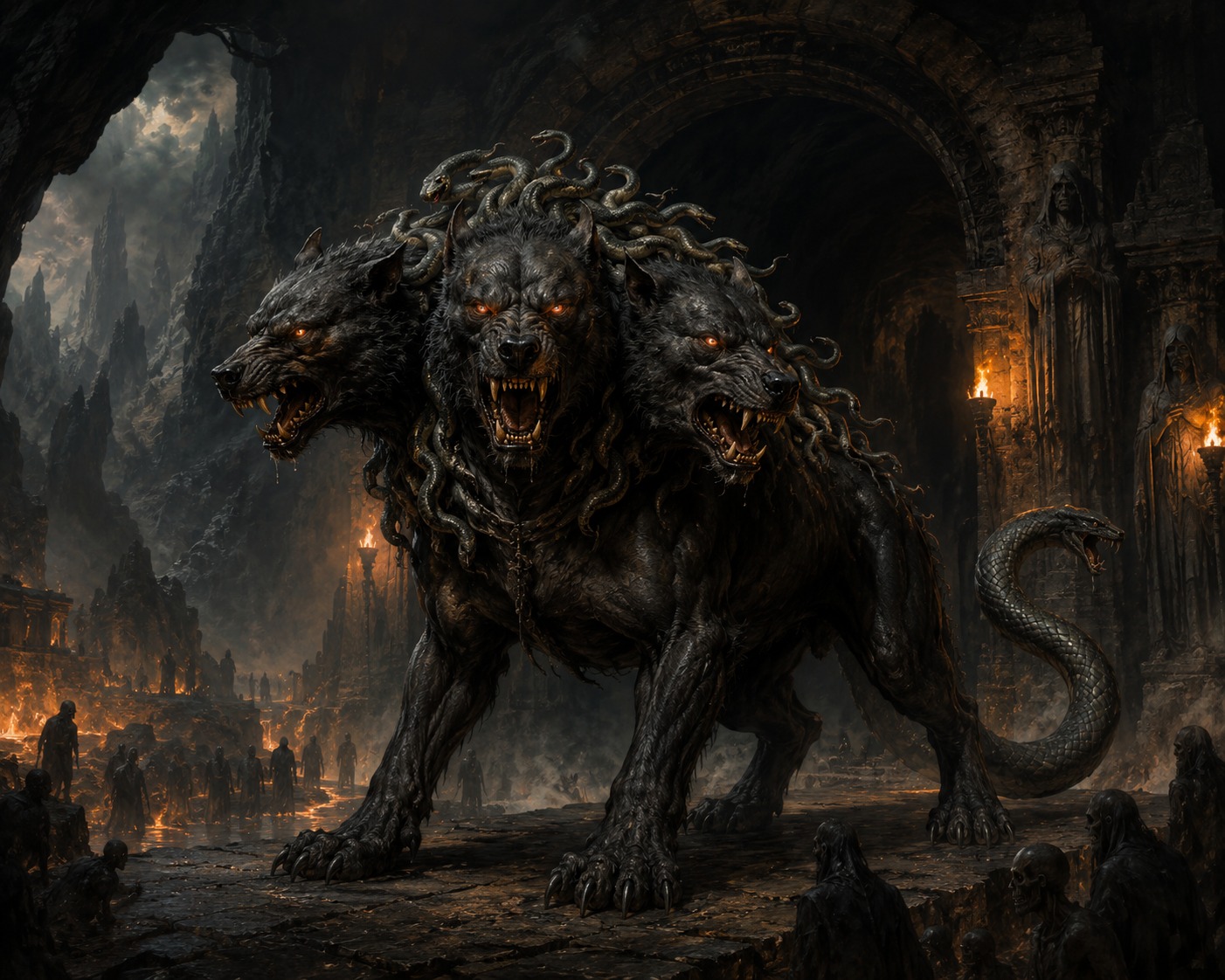
Cerberus
Cerberus · Infernal Gatekeeper — Legendary triple-headed hound
Names in Other Languages
 케르베로스한국어
Cerberus · 지옥의 문지기 — 세 개의 머리를 가진 전설의 개
 ケルベロス日本語
ケルベロス · 冥界の門番 — 三つの頭を持つ伝説の犬
 刻耳柏洛斯繁體中文
Cerberus · 冥界守門犬 — 擁有三個頭的傳說巨犬
 ZerberusDeutsch
Zerberus · Höllentorwächter — Legendärer dreiköpfiger Hund
 CerbèreFrançais
Cerbère · Gardien des Enfers — Chien légendaire à trois têtes
 CerberoEspañol
Cerbero · Guardián del Inframundo — Perro legendario de tres cabezas
 CérberoPortuguês
Cérbero · Guardião do Inferno — Cão lendário de três cabeças
 CerberPolski
Cerber · Strażnik Hadesu — Legendarny trójgłowy pies
 ЦерберРусский
Цербер · Страж Аида — Легендарный трёхголовый пёс
The colossal three-headed hound of Greek myth, set at the gate of the underworld of Hades. In Hesiod's Theogony 310-318 (c. 700 BCE) he is the offspring of the great monsters Typhon and Echidna, sibling of the Hydra, the Chimera, and Orthos; Hesiod gives him fifty heads, but from Pindar and Stesichorus in the fifth century BCE the canonical three-headed form has been standard (Apollodorus, Library 2.5.12, 1st-2nd c. CE). His task is two-way: he prevents the dead from rising and the living from descending. The twelfth and last of the labours of Heracles was to bring Cerberus alive from the underworld; Virgil's Aeneid 6.417-425 (19 BCE) shows the Sibyl casting a honey-and-drugged cake to send the three heads at once to sleep, and Dante in Inferno 6.13-33 (c. 1308-1320) sets him as the warden of the gluttonous in the third circle of Hell. J. K. Rowling's three-headed Fluffy in Harry Potter and the Philosopher's Stone (Bloomsbury, 1997), who is sent to sleep by music, is a direct descendant of the same canonical motif.
Origin
The earliest direct attestation of Cerberus is Hesiod's Theogony 310-318 (c. 700 BCE), which gives him fifty heads, a bronze voice, and the parentage of Typhon and Echidna, sibling of the Hydra, the Chimera, and Orthos. Homer's Iliad 8.366-369 and Odyssey 11.623-626 (c. 8th c. BCE) refer to Heracles dragging up 'the dog of Hades' from the underworld without naming him; the name Cerberus first appears in Hesiod. The Greek Kerberos has no settled etymology, but Max Mueller's Comparative Mythology (1856) and Manfred Mayrhofer's Etymologisches Woerterbuch des Altindoarischen (1986) propose a cognate of Sanskrit Sarvara, 'spotted', the name of one of the two dogs of Yama in Vedic myth. The three-headed canonical form first appears on late sixth-century BCE Corinthian pottery and is fixed in literature by Pindar and Stesichorus (fragment 11) in the fifth century. The decisive canonical version is Apollodorus, Library 2.5.12 (1st-2nd c. CE): the twelfth and last labour of Heracles was to bring Cerberus alive to the surface, and he did so by hand, without weapons, with the permission of Persephone. Virgil's Aeneid 6.417-425 (19 BCE) gives the Sibyl a cake of honey and drugged grain (melle soporatam et medicatis frugibus offam) that puts all three heads to sleep at once, and Ovid's Metamorphoses 4.450, 7.408-419 (8 CE) explains aconite as growing from Cerberus's saliva when Heracles dragged him from the underworld. Dante's Inferno 6.13-33 (c. 1308-1320) sets him as the warden of the third circle of Hell, where the gluttonous suffer, and the guide Virgil tames him by throwing earth into his three mouths.
Features
- Three heads (the canon from the fifth century BCE; Hesiod's original had fifty), a mane of serpents, a serpent's tail, and a bronze-voiced bark
- Offspring of Typhon and Echidna, sibling of the Hydra, the Chimera, Orthos, and the Sphinx (Hesiod, Theogony 310-318)
- A two-way gatekeeper at the entrance of Hades, preventing the dead from rising and the living from descending (Virgil, Aeneid 6.395-396)
- Saliva drips poison from his jaws; in Ovid the plant aconite grew where his foam touched earth
- Vulnerable to food and music: the Sibyl's honey-cake, Orpheus's lyre, Dante's handful of earth, and Rowling's lullaby for Fluffy are all variations on the same canonical motif
Stories
In myth Cerberus is the two-way warden of the boundary between life and death, the underwriter of the cosmic order. The twelfth and most extreme labour of Heracles was to bring him alive to the upper world, and the names of those who passed him alive are themselves markers of mythic achievement: Heracles by force, Orpheus by the lyre (Apollodorus, Library 1.3.2), Pirithoos and Theseus by attempting (Apollodorus, Epitome 1.24). Virgil's honey-cake gave English the idiom 'a sop to Cerberus' for a concession made to placate a dangerous adversary, fixed in nineteenth-century British parliamentary language (Oxford English Dictionary, 'sop'). Dante's Inferno 6 fixed Cerberus in Western art as the eternal guardian of the gluttonous, and J. K. Rowling's Fluffy in Harry Potter and the Philosopher's Stone (Bloomsbury, 1997) — a three-headed dog put to sleep by music — is the canonical modern descendant of the Virgilian-Orphic tradition. Dungeons & Dragons placed a Hell Hound variant in the Advanced Dungeons & Dragons Monster Manual (TSR, 1977), and Supergiant Games's Hades (2020) gave a humanised Cerberus as the protagonist's pet dog.
Weakness
Cerberus's decisive weaknesses are appetite and music. In Virgil's Aeneid 6.417-425 the Sibyl casts a cake of honey and drugged grain into his jaws and the three heads sleep at once; this is the direct source of the English idiom 'a sop to Cerberus'. Orpheus, descending after his lost Eurydice, put Cerberus to sleep with the lyre alone (Apollodorus, Library 1.3.2). In Dante's Inferno 6.25-27 the guide Virgil throws a handful of earth into the three mouths to silence them. And in Heracles's twelfth labour, the hero subdued Cerberus by hand without weapons, only by the permission of Persephone and Hades — that is, Cerberus is bound by divine command (Apollodorus, Library 2.5.12). In fifth-edition D&D, the three-headed hellhound variant of Cerberus is Challenge Rating 3, with explicit mechanical vulnerabilities to sleep magic and to food bait — a direct game-rule echo of the mythic canon.
Cultural Significance
Cerberus is one of the central pieces of evidence in comparative Indo-European mythology. From Max Mueller's Comparative Mythology (1856) onward, Greek Kerberos has been treated as cognate with the Vedic Sabala, one of the two dogs of Yama, lord of the dead, and the parallel with Norse Garm, the dog of Hel that howls at Ragnarok (Voluspa 44, 49, 58), points to a shared Indo-European 'dog at the door of the dead' (Bruce Lincoln, Death, War, and Sacrifice, University of Chicago Press, 1991). In the visual tradition Cerberus is fixed by Sandro Botticelli's series of illustrations to Dante (1481-1495, in the Kupferstichkabinett of the Staatliche Museen zu Berlin, KdZ 5099 and following) and William Blake's nineteenth-century Dante watercolours (Tate, London, 1824-1827). In 1985 the chemists who discovered the carbon-60 allotrope (the Nobel laureates Harold Kroto, Richard Smalley, and Robert Curl in 1996) reportedly considered the name 'cerberene' for the new molecule, before settling on 'buckminsterfullerene' (interview in Chemical & Engineering News, 1991). J. K. Rowling's Fluffy in Harry Potter and the Philosopher's Stone (Bloomsbury, 1997) is the broadest modern popular recycling of the figure, and the weakness to music in that book is a direct Virgilian-Orphic citation.
In Popular Culture
- Hesiod, Theogony 310-318 (c. 700 BCE) — fifty heads, bronze voice, child of Typhon and Echidna
- Stesichorus, fragment 11; Pindar, fragmentary (6th-5th c. BCE) — onset of the three-headed canon
- Late 6th c. BCE Corinthian vase painting (e.g. British Museum BM 1899,0721.1) — visual canon of three heads
- Apollodorus, Library 2.5.12 (1st-2nd c. CE) — twelfth labour of Heracles
- Virgil, Aeneid 6.417-425 (19 BCE) — Sibyl's honey-cake and the source of 'a sop to Cerberus'
- Ovid, Metamorphoses 4.450, 7.408-419 (8 CE) — aconite as the plant of Cerberus's foam
- Dante Alighieri, Inferno 6.13-33 (c. 1308-1320) — third circle of Hell, the guardian of the gluttonous
- Sandro Botticelli, illustrations to Dante (1481-1495, Kupferstichkabinett Berlin, KdZ 5099 and following) — Renaissance visual canon
- J. K. Rowling, Harry Potter and the Philosopher's Stone (Bloomsbury, 1997) — Fluffy, broadest modern recycling
- Supergiant Games, Hades (2020) — Cerberus as the protagonist's pet dog
Trivia
- The Hesiodic Cerberus has fifty heads; the reduction to three from the fifth century BCE onward is generally explained as a matter of visual stability for the vase painter, since fifty heads cannot reasonably be drawn (John Boardman, Greek Art, 4th edition, Thames & Hudson, 1996, p. 256).
- Harold Kroto, Richard Smalley, and Robert Curl, who discovered the spherical carbon-60 molecule in 1985 and shared the 1996 Nobel Prize in Chemistry, are reported to have considered the name 'cerberene' for the new allotrope before settling on 'buckminsterfullerene' after the geodesic domes of Buckminster Fuller; the report is in a 1991 interview in Chemical & Engineering News.
- Virgil's phrase melle soporatam et medicatis frugibus offam (Aeneid 6.420) — 'a cake softened with honey and drugged with grain' — is the source of the English idiom 'a sop to Cerberus', which entered nineteenth-century British parliamentary speech for a concession offered to placate an opponent (Oxford English Dictionary, 'sop').
- The scene in Dante's Inferno 6.25-27, in which Virgil throws a handful of earth into Cerberus's three mouths to quiet him, is the favoured episode of Renaissance illustrators: Sandro Botticelli's 1481 plates, and Gustave Dore's plates for the 1857 Paris Hachette edition of Dante, both reproduce it directly.