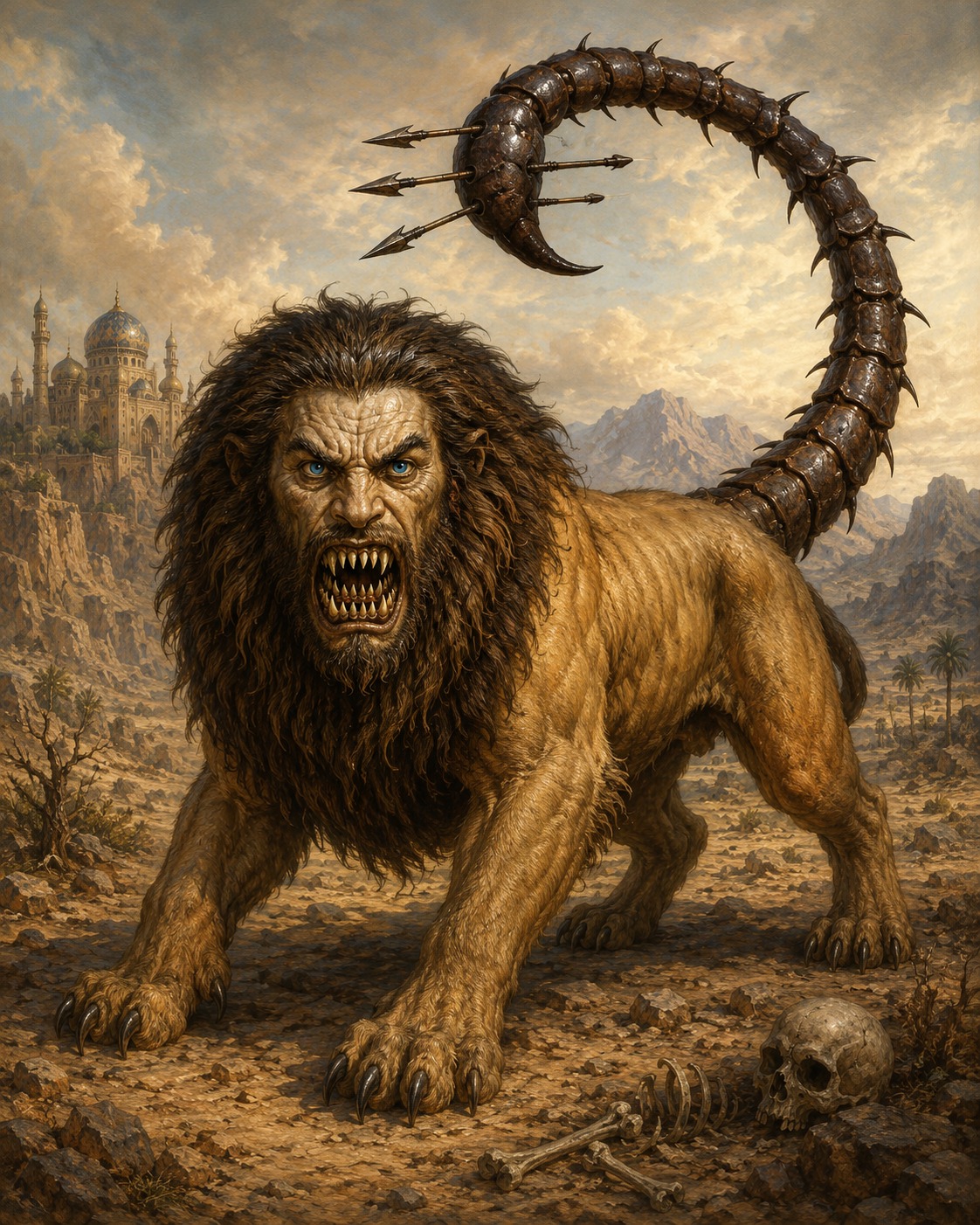
Manticore
Persian Legendary Lion-Man-Scorpion Hybrid
Names in Other Languages
 만티코어한국어
Manticore · 페르시아 전설의 사자-인간-전갈 합성 괴수
 マティア日本語
伝説の生物 — 歴史的記録のない未確認存在
 馬提亞繁體中文
傳說生物 — 缺乏歷史記錄的未確認存在
 MatiaDeutsch
Legendäres Wesen — Nicht historisch belegt
 MatiaFrançais
Créature légendaire — Être non attesté par les sources historiques
 MatiaEspañol
Criatura legendaria — Ser no documentado en fuentes históricas
 MatiaPortuguês
Criatura lendária — Ser não registrado em fontes históricas
 MatiaPolski
Legendarna istota — Brak historycznych źródeł
 МатияРусский
Легендарное существо — Не подтверждено историческими источниками
The Manticore (Persian martyaxwar, 'man-eater') is a composite beast of ancient Persian tradition, with the body of a lion, the face of a human, and the tail of a scorpion. The earliest Greek reference is in the Indika of Ctesias of Knidos (fourth century BCE), a Greek physician at the Persian court, who describes it as an Indian man-eater with blue eyes, three rows of shark-like teeth, and a tail that shoots venomous spines like arrows. Ctesias' account is hearsay he gathered at the Persian court; later scholars have read it as a Greek interpretation of the Indian tiger overlaid with Persian-Indian mythic elements. Pliny's Natural History and Aelian's De natura animalium expanded the description, and Isidore of Seville's Etymologies fixed the Latin manticora. From the twelfth-century Aberdeen Bestiary and MS Bodley 764 onward, the manticore became a standard image in medieval bestiaries, then a heraldic emblem of cruelty and cannibalism. Gary Gygax's 1977 Dungeons and Dragons Monster Manual added bat-wings and standardised the modern fantasy manticore.
Origin
The earliest Greek source is Ctesias' Indika (fourth century BCE), which the Knidian physician composed while serving at the Persian court. The name derives from Old Persian martyaxwar, 'man-eater', the compound of martya ('man') and xwar ('to eat'); the Greek transliteration mantichoras became Latin manticora. In Ctesias the manticore is an Indian beast the size of a lion with a human face, three rows of shark-like teeth, a voice like trumpet mixed with flute, and a scorpion-like tail whose spines it can shoot like arrows. Aristotle's Historia Animalium book II.1 cites Ctesias briefly. Pliny the Elder's Natural History VIII.30 (first century CE) and Aelian's De natura animalium IV.21 (third century) provide the fullest descriptions. Pausanias' Description of Greece IX.21.4 (second century) gives the first rationalist reading: that the manticore is an exaggerated account of the Indian tiger. Isidore of Seville's Etymologies XII.2.31 (seventh century) fixed the Latin name, and the medieval bestiaries — the Aberdeen Bestiary, MS Bodley 764, the Rochester Bestiary — completed the iconography.
Features
- Lion's body, legs, and tail with a human face
- Blue eyes and three rows of shark-like teeth
- A scorpion's tail tipped with venomous spines
- Can shoot the tail-spines like arrows; depleted, the beast is weakened
- Voice like a trumpet mixed with a flute
- Cannibalistic appetite, preferring human flesh
Stories
In heraldry the manticore became an emblem of cruelty, predation, and revenge. Sir William Hastings (1431-1483) of the House of Hastings bore the manticore on his arms, and English families such as Radclyffe adopted the figure as canonical. In 1607 the English naturalist Edward Topsell's The Historie of Foure-Footed Beastes treated the manticore as a serious natural-history entry, propagating the iconography among seventeenth-century Shakespearean readers. Dante in Inferno XVII used the kindred composite Geryon, a manticore-like beast of fraud, as the steed of the descent to the lower circles. Gygax's 1977 Dungeons and Dragons Monster Manual standardised the bat-winged manticore for modern fantasy; J. K. Rowling's Harry Potter (Fantastic Beasts and Where to Find Them, 2001), Marvel Comics, the film The Sorcerer's Apprentice (2010), and the Warhammer Fantasy canon all keep the figure alive.
Weakness
The manticore's clearest weakness is the finite supply of tail-spines. Ctesias and Aelian make this explicit: the beast shoots its venomous spines like arrows, and once it has expended them the manticore is reduced to lion-grade strength alone. Ctesias also notes that the manticore cannot prevail against the Indian elephant, an observation consistent with the natural-history fact that tigers cede ground to elephants. The medieval bestiary tradition used the manticore as an allegory of gluttony, one of the seven deadly sins, and Christian allegorising had it submit to the truth of the apostles. The 1977 Dungeons and Dragons treatment quantified the spine count to twenty-four for game balance, a convention that has since become standard across fantasy games.
Cultural Significance
The manticore stands at the iconographic relay from Persia through Greece and Rome to the medieval Latin bestiary and on into modern fantasy. Ctesias's Indika carried the eastern man-eater into Greek literature, where Aristotle, Pliny, and Aelian repeated and refined it; Isidore's seventh-century Etymologies fixed the Latin manticora and the medieval bestiaries theologised it as an emblem of gluttony or cannibalism. In heraldry the Hastings manticore and other English crests made the figure a sign of cruelty and threat; Topsell's 1607 Historie of Foure-Footed Beastes propagated the iconography in Renaissance scholarship. With Gygax's 1977 Dungeons and Dragons Monster Manual the bat-winged manticore became the canonical fantasy image, sustained in J. K. Rowling's Fantastic Beasts, Marvel Comics, The Sorcerer's Apprentice (2010), and the Warhammer Fantasy canon.
In Popular Culture
- Ctesias, Indika (4th c. BCE) — earliest Greek reference to the manticore
- Aristotle, Historia Animalium II.1 — brief citation of Ctesias
- Pliny the Elder, Natural History VIII.30 (1st c. CE) — expanded description
- Aelian, De natura animalium IV.21 (3rd c.) — fullest classical account
- Pausanias, Description of Greece IX.21.4 (2nd c.) — rationalist Indian-tiger reading
- Isidore of Seville, Etymologies XII.2.31 (7th c.) — Latin manticora fixed
- Edward Topsell, The Historie of Foure-Footed Beastes (1607) — Renaissance natural-history diffusion
Trivia
The name manticore derives from Old Persian martyaxwar, the compound of martya ('man') and xwar ('to eat'): literally 'man-eater'. Through Greek mantichoras the form became Latin manticora and so English manticore. Pausanias' second-century rationalist reading that the manticore is an exaggerated Indian tiger has been followed by most modern natural-history commentators. Topsell's 1607 Historie of Foure-Footed Beastes treated the manticore as a serious entry with illustration, making the work a standard reference in Shakespearean-era England. When Gary Gygax included the manticore in the 1977 Dungeons and Dragons Monster Manual, he added bat-wings to the classical lion-body / human-face / scorpion-tail combination, following a late-medieval iconographic variant; since 1977 the bat-winged manticore has become the standard fantasy depiction.