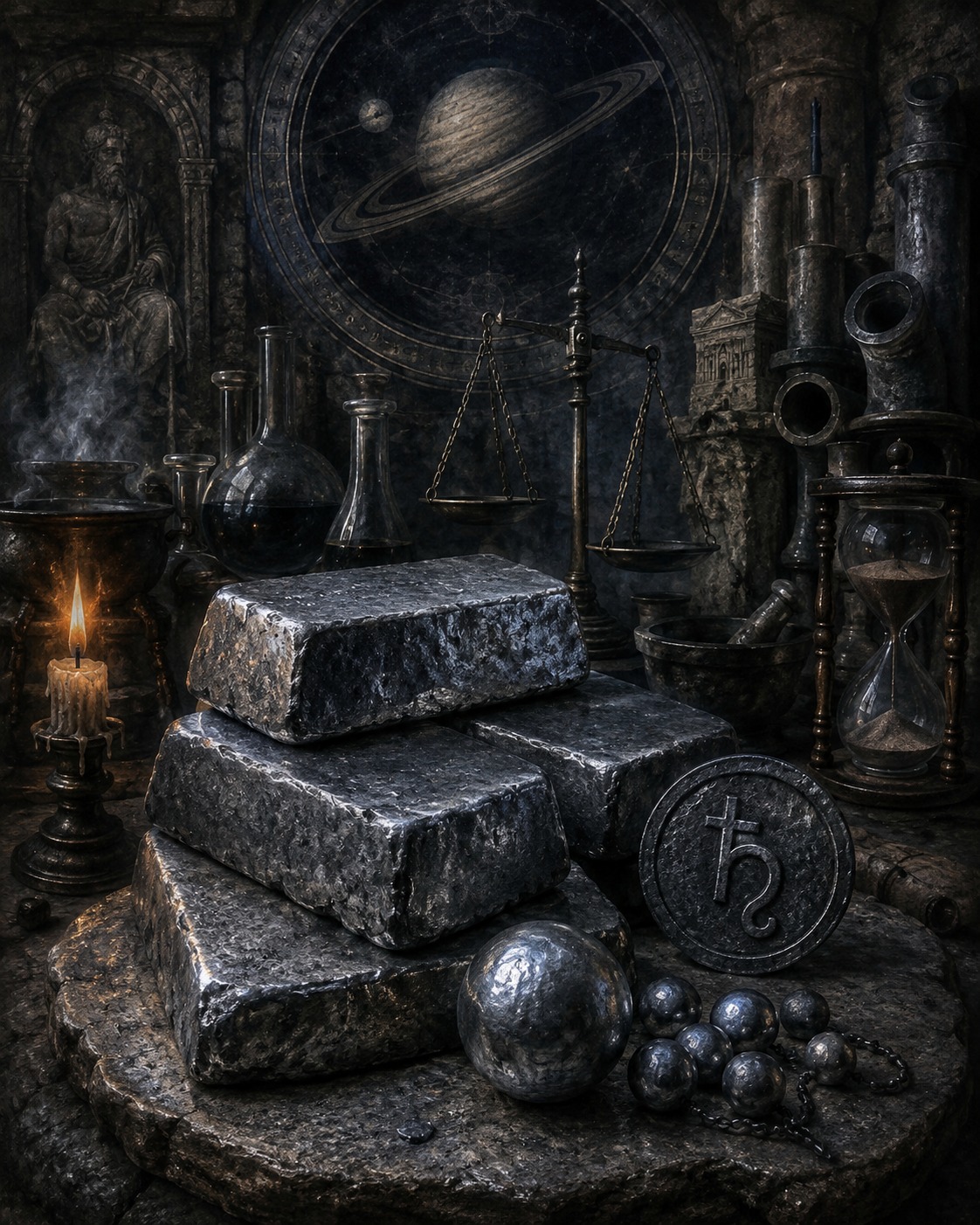
Lead
Lead· Pb Metal of Saturn
Names in Other Languages
 납한국어
납한국어Lead· 鉛 사투르누스의 금속
 鉛日本語
鉛日本語Lead· 鉛 サトゥルヌスの金属
 鉛繁體中文
鉛繁體中文Lead· 鉛 薩圖恩之金屬
 BleiDeutsch
Lead· Pb Metall des Saturn
 PlombFrançais
Lead· Pb Metal de Saturne
 PlomoEspañol
Lead· Pb Metal de Saturno
 ChumboPortuguês
Lead· Pb Metal de Saturno
 OlowPolski
Lead· Pb Metal Saturna
 СвинецРусский
Lead· Pb Металл Сатурна
Lead (English Lead, Latin plumbum, Greek mólybdos) is the metal of Saturn (Saturn) of the decisive canon — derived from Latin 'plumbum (lead)' — the decisive canonical vocabulary — the decisive metallic canon of element 82 (Pb) — and the decisive canon as the metal of Saturn (god of time) and Saturn (planet) among the seven ancient metals. Aliases — Lead (Lead), plumbum (plumbum, Latin), mólybdos (mólybdos, Greek), metal of Saturn, primal matter of alchemy, dark metal — are the decisive canonical vocabulary. The decisive natural history canon is the decisive canon of 'plumbum nigrum (dark lead, lead) and plumbum candidum (white lead, tin)' in Pliny the Elder's (Pliny the Elder, 23-79) Natural History (Naturalis Historia) Book 34 chapters 156-164 of the 1st century. The decisive seven metals canon is the decisive canon of the correspondence of the Hellenistic seven metals (gold, silver, copper, iron, tin, mercury, lead) and the seven planets (sun, moon, Venus, Mars, Jupiter, Mercury, Saturn).
Origin
The etymological origin is the decisive canonical vocabulary of Latin 'plumbum (lead)' — the decisive canon becoming the etymology of element symbol 'Pb' — and Greek 'mólybdos (μόλυβδος mólybdos, lead)' and English 'lead' deriving from Germanic 'lauda'. The decisive natural history canon is the decisive canon of the Roman Pliny the Elder's (Pliny the Elder, 23-79) Natural History (Naturalis Historia) Book 34 chapters 156-164 of the 1st century — 'plumbum nigrum (dark lead, real lead) and plumbum candidum (white lead, tin) distinguished as two kinds', and the decisive seven metals canon is the decisive canon of the Hellenistic seven metals (gold = sun, silver = moon, copper = Venus, iron = Mars, tin = Jupiter, mercury = Mercury, lead = Saturn). The decisive archaeological canon is the decisive canon of the lead beads of Çatalhöyük (Çatalhöyük) of Turkey of c. 7000 BCE. The decisive Roman canon is the decisive canon of the use of lead water pipes (plumbarius) in Rome of the 1st century — the decisive canon of the etymology of 'plumbing'. The decisive Bible canon is the decisive canon of 'Pharaoh's army sank like lead' in Exodus 15:10. The decisive alchemical canon is the decisive canon of the medieval transmutation of Saturn's lead into gold — the decisive canon of the primal heavy matter (prima materia).
Features
- Element 82 (Pb) Mohs hardness 1.5 very heavy gray metal melting point 327.5 degrees
- Main axis Pliny Natural History Book 34 chapters 156-164 'plumbum nigrum'
- Latin plumbum etymology of element symbol Pb
- Metal of Saturn (Saturn planet) among the Hellenistic seven metals
- Lead beads of Çatalhöyük of c. 7000 BCE — one of humanity's seven ancient metals
- Origin Australia, China, USA, Peru, Mexico
Stories
The 'plumbum nigrum' in Pliny the Elder's Natural History Book 34 chapters 156-164 of the 1st century is the decisive natural history canon, and the metal of Saturn (Saturn planet) among the Hellenistic seven metals is the decisive seven metals canon. The decisive canon used as the metal of Saturn, and the decisive canon invoked as the primal heavy matter of alchemy. The decisive Roman canon is the decisive canon of the lead water pipes of Rome of the 1st century — the decisive canon of the etymology of 'plumbing', and the decisive alchemical canon is the decisive canon of the medieval transmutation of Saturn's lead into gold. The decisive Bible canon is the decisive canon of Exodus 15:10, and the decisive environmental canon is the decisive canon of the addition of tetraethyl lead (tetraethyl lead) to gasoline in the USA in 1922 and the introduction of unleaded gasoline in 1976.
Weakness
Lead's weaknesses are: (1) toxicity — the decisive canonical weakness — the decisive canon of being a powerful neurotoxin — the decisive canon of the hypothesis of the fall of the Roman Empire; (2) Mohs hardness 1.5 limit — the decisive canonical weakness — very soft; (3) binding of Saturn — the decisive canon of the heavy binding of the god of time; (4) binding of alchemy — the decisive canon of the falsity of transmutation into gold; (5) binding of Roman plumbing — the decisive canon of lead poisoning; (6) binding of the sacred domain — the decisive canon; (7) binding of gasoline — the decisive canon of the binding of tetraethyl lead of the 20th century; (8) binding of time — the decisive canon of the binding of 9000 years of humanity. The decisive canonical finale is the decisive mythological canon of the introduction of unleaded gasoline in 1976.
Cultural Significance
Lead is not merely a metal icon but the canonical iconographic figure of the decisive Mesopotamian-Greco-Roman-Christian-alchemical canon, traversing the lead beads of Çatalhöyük of c. 7000 BCE, Exodus 15:10 of the Old Testament, the metal of Saturn (Saturn planet) of the Hellenistic seven metals, Pliny the Elder's Natural History Book 34 chapters 156-164 of the 1st century, the plumbarius water pipes of Rome of the 1st century, the primal heavy matter of medieval alchemy, the addition of tetraethyl lead in 1922, and the introduction of unleaded gasoline in 1976. The etymological origin settled as the decisive canon of Latin 'plumbum (lead)' — the decisive canon becoming the etymology of element symbol 'Pb' — and Greek 'mólybdos (μόλυβδος mólybdos)' and English 'lead' deriving from Germanic 'lauda'. The decisive archaeological canon is the decisive canon of the lead beads of Çatalhöyük (Çatalhöyük) of Turkey of c. 7000 BCE — one of the metals first used by humanity among the seven ancient metals. The decisive natural history canon is the decisive canon of the Roman Pliny the Elder's (Pliny the Elder, 23-79) Natural History (Naturalis Historia) Book 34 chapters 156-164 of the 1st century — 'plumbum nigrum (dark lead, real lead) and plumbum candidum (white lead, tin) distinguished as two kinds', and the decisive canon of 'Britannia and Hispania as sources'. The decisive seven metals canon is the decisive canon of the Hellenistic seven metals (gold = sun ☉, silver = moon ☽, copper = Venus ♀, iron = Mars ♂, tin = Jupiter ♃, mercury = Mercury ☿, lead = Saturn ♄) — the decisive canon of the correspondence of Saturn (Saturn, Roman god of time, Greek Cronos), the farthest and slowest planet, with the heaviest metal. The decisive Roman canon is the decisive canon of the use of lead water pipes (plumbarius, Latin plumber) in Rome of the 1st century — the decisive canon of the etymology of English 'plumbing' and 'plumber' — and the decisive canon of the hypothesis of Roman lead poisoning. The decisive Bible canon is the decisive canon of the Song of Moses in Exodus 15:10 — 'the Pharaoh's army sank as lead in the mighty waters'. The decisive alchemical canon is the decisive canon of the medieval alchemical Great Work (Magnum Opus) of transmuting Saturn's lead into gold — the decisive canon of the primal heavy matter (prima materia), and the decisive Jung canon is the decisive canon of 'nigredo' (nigredo, blackening) in the psychology of Carl Jung (Carl Jung) of the 20th century. The decisive environmental canon is the decisive canon of the addition of tetraethyl lead (tetraethyl lead) to gasoline by Thomas Midgley Jr. (Thomas Midgley Jr.) of the USA on 9 December 1922 and the introduction of unleaded gasoline in the USA in 1976.
In Popular Culture
- 'plumbum nigrum' in Pliny the Elder Natural History (Naturalis Historia) Book 34 chapters 156-164 (1st century) — decisive natural history canon
- Lead beads of Çatalhöyük (Çatalhöyük) of Turkey (c. 7000 BCE) — decisive archaeological canon
- Metal of Saturn (Saturn planet) among the Hellenistic seven metals — decisive seven metals canon
- Lead water pipes of Roman plumbarius etymology of 'plumbing' (1st century) decisive Roman canon
- Song of Moses in Exodus (Exodus) 15:10 of the Old Testament — decisive Bible canon
- Metal of Saturn (Saturn) and Greek Cronos (Cronos) — decisive mythological canon
- Primal heavy matter (prima materia) of medieval alchemy — decisive alchemical canon
- Nigredo (nigredo) in Carl Jung's (Carl Jung) psychology — decisive Jung canon
- Addition of tetraethyl lead (tetraethyl lead) to gasoline by Thomas Midgley Jr. (Thomas Midgley Jr.) (1922) — decisive environmental canon
- Introduction of unleaded gasoline in the USA (1976) — decisive environmental canon
Trivia
The etymology of Lead (English Lead, Latin plumbum, Greek μόλυβδος mólybdos) is the decisive canonical vocabulary of Latin 'plumbum (lead)' — the decisive canon becoming the etymology of element symbol 'Pb' — and the decisive canon of the etymology of English 'plumbing (piping)', 'plumber (pipe worker)', and 'plumb (vertical)'. Greek 'mólybdos (μόλυβδος mólybdos, lead)' and English 'lead' derive from Germanic 'lauda (lead)'. Aliases — Lead (Lead), plumbum (Latin), mólybdos (Greek), metal of Saturn (planet), primal matter of alchemy (prima materia), dark metal, nigredo, plumbum nigrum — are the decisive canonical vocabulary. The decisive archaeological canon is the decisive canon of the lead beads of Çatalhöyük (Çatalhöyük, Neolithic site) of Turkey of c. 7000 BCE — one of the metals first used by humanity among the seven ancient metals (gold, silver, copper, iron, tin, mercury, lead). The decisive natural history canon is the decisive canon of the Roman Pliny the Elder's (Pliny the Elder, born 23 CE, died at Pompeii 79 CE) Natural History (Naturalis Historia) Book 34 chapters 156-164 of the 1st century — 'plumbum nigrum (dark lead, real lead, Latin) and plumbum candidum (white lead, tin) distinguished as two kinds, with Britannia (Britain) and Hispania (Spain) as sources'. The decisive seven metals canon is the decisive canon of the Hellenistic seven metals (gold = sun ☉, silver = moon ☽, copper = Venus ♀, iron = Mars ♂, tin = Jupiter ♃, mercury = Mercury ☿, lead = Saturn ♄) — the decisive canon of the correspondence of Saturn (Saturn, Roman god of time, Greek Cronos), the farthest and slowest planet, with the heaviest metal. The decisive Roman canon is the decisive canon of the use of lead water pipes (plumbarius, Latin 'pipe worker') in Rome of the 1st century — the decisive canon of the etymology of English 'plumbing' and 'plumber' — and the decisive canon of the hypothesis of Roman lead poisoning by Clair Patterson (Clair Patterson) of the USA in 1965. The decisive Bible canon is the decisive canon of the Song of Moses in Exodus (Exodus) 15:10 of c. 13th century BCE — 'You blew with your wind, the sea covered them; they sank as lead (Hebrew עוֹפֶרֶת oferet) in the mighty waters'. The decisive alchemical canon is the decisive canon of the medieval alchemical Great Work (Magnum Opus) of transmuting Saturn's lead into gold — the decisive canon of the primal heavy matter (prima materia) — and the decisive canon of 'nigredo (nigredo, blackening, stage of the darkness of the self)' in the psychology of the 20th-century Carl Jung (Carl Gustav Jung, 1875-1961). The decisive environmental canon is the decisive canon of the addition of tetraethyl lead (tetraethyl lead, TEL) to gasoline by Thomas Midgley Jr. (Thomas Midgley Jr., 1889-1944) of the USA on 9 December 1922 — the decisive canon of the greatest environmental pollution of the 20th century — and the decisive canon of the introduction of unleaded gasoline in the USA in 1976, the lead-free transition in Japan in 1986, and the complete lead-free transition in the USA in 1996.