Mercury
Mercury· Hg Liquid metal, the element of Hermes
Names in Other Languages
 수은한국어
수은한국어Mercury· 水銀 액체 금속, 헤르메스의 원소
 水銀日本語
水銀日本語Mercury· 水銀 液体の金属、ヘルメスの元素
 水銀繁體中文
Mercury· 水銀 液態之金屬,赫爾墨斯之元素
 QuecksilberDeutsch
Mercury · Hg — Fluessiges Metall, Element des Hermes
 MercureFrançais
Mercury· Hg Metal liquide, l element d Hermes
 MercurioEspañol
Mercury · Hg — Metal liquido, el elemento de Hermes
 MercurioPortuguês
Mercury· Hg Metal liquido, o elemento de Hermes
 RtecPolski
Mercury· Hg Cieply metal, element Hermesa
 РтутьРусский
Mercury· Hg Жидкий металл, элемент Гермеса
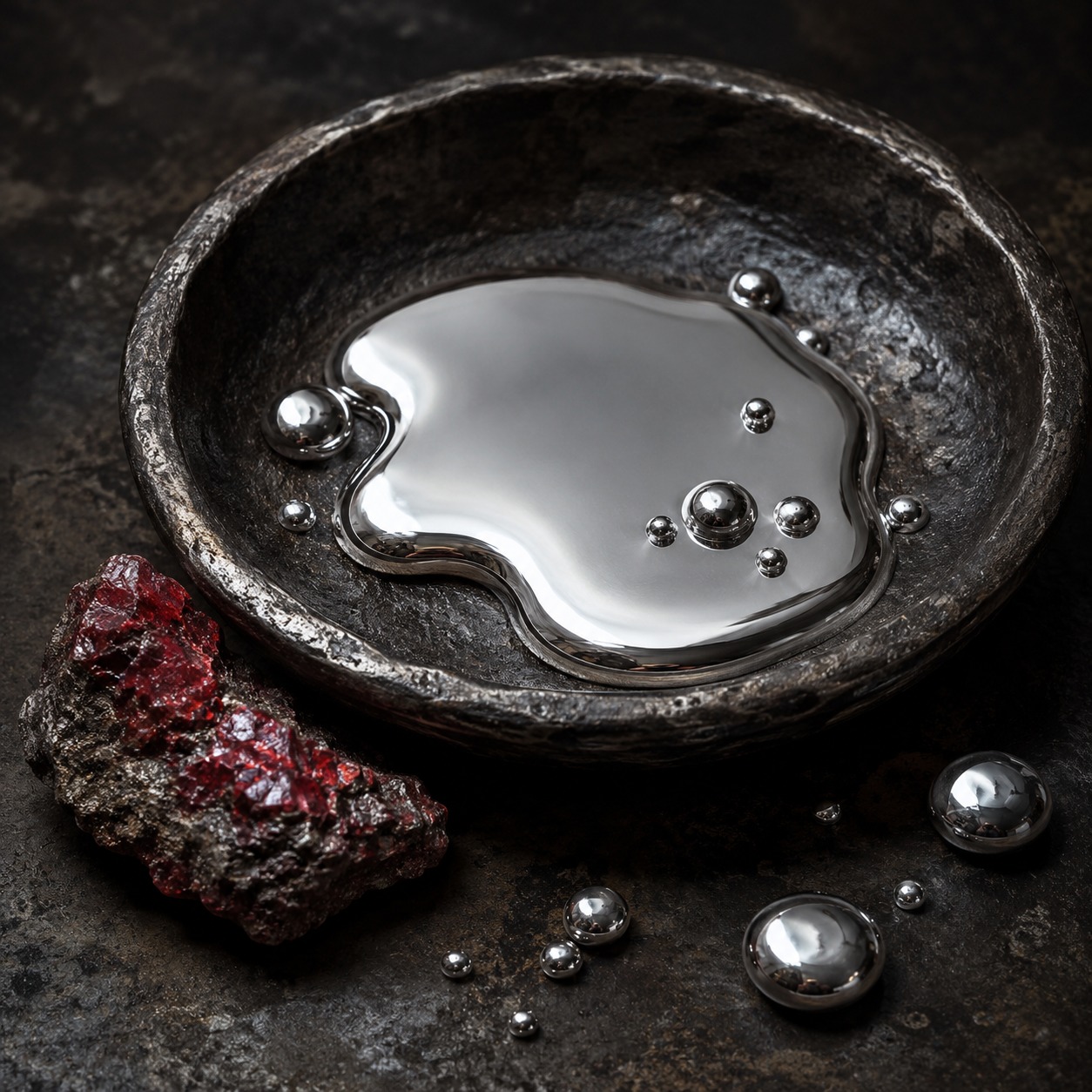
Mercury (English Mercury, Latin hydrargyrum, Greek hydrárgyros) is the liquid metal of the decisive canon and the element of Hermes (Mercury) — derived from Greek 'hydrárgyros (ὑδράργυρος, water-silver, hýdōr 'water' + árgyros 'silver')' — the decisive canonical vocabulary — the decisive metallic canon of element 80 (Hg) — and the decisive canon as the only liquid metal at room temperature. Aliases — Mercury (Mercury, name of the god), hydrárgyros (Greek), hydrargyrum (Latin), quicksilver, liquid metal, element of spirit in alchemy — are the decisive canonical vocabulary. The decisive natural history canon is the decisive canon of 'hydrargyrum is silver that flows like water' in Pliny the Elder's (Pliny the Elder, 23-79) Natural History (Naturalis Historia) Book 33 chapters 99-100 of the 1st century. The decisive Qin Shi Huang canon is the decisive canon of the mercury river in Qin Shi Huang's mausoleum in Sima Qian's Records of the Grand Historian (Shiji) of c. 210 BCE.
Origin
The etymological origin is the decisive canonical vocabulary of Greek 'hydrárgyros (ὑδράργυρος hydrárgyros, water-silver, from hýdōr ὕδωρ 'water' + árgyros ἄργυρος 'silver')' — the decisive canon becoming the etymology of Latin 'hydrargyrum' — and English 'mercury' was borrowed by alchemists from the name of the Roman messenger god Mercury (Mercury, Greek Hermes). The decisive natural history canon is the decisive canon of the Roman Pliny the Elder's (Pliny the Elder, 23-79) Natural History (Naturalis Historia) Book 33 chapters 99-100 of the 1st century — 'hydrargyrum is silver that flows like water, extracted from cinnabar (cinnabar HgS), used in the amalgamation of gold'. The decisive Aristotle canon is the decisive canon of 'argyros chytós (molten silver)' in the Greek Aristotle (Aristotle, 384-322 BCE) of the 4th century BCE. The decisive Qin Shi Huang canon is the decisive canon of the Chinese Sima Qian's (Sima Qian) Records of the Grand Historian (Shiji) Book 6 of c. 210 BCE — the mercury rivers in the mausoleum (Mount Li, modern Xi'an mausoleum of Qin Shi Huang) of Qin Shi Huang (Qin Shi Huang, 259-210 BCE) — 'the hundred rivers and great seas of mercury were made to flow'. The decisive Paracelsus canon is the decisive canon of the three principles of alchemy (tria prima, mercury mercurius — spirit, sulfur sulphur — soul, salt sal — body) by the Swiss Paracelsus (Paracelsus, 1493-1541) of the 16th century — the decisive canon of mercury as the volatility of spirit.
Features
- Element 80 (Hg) liquid at room temperature only liquid metal boiling point 356.7 degrees
- Main axis Pliny Natural History Book 33 chapters 99-100 silver flowing like water
- Greek hydrárgyros (water-silver) etymology
- Mercury river in Qin Shi Huang's mausoleum — about 100 tons of mercury
- Volatility of spirit in Paracelsus's three principles of alchemy
- Origin Almadén (Almadén) of Spain 60% of humanity's source
Stories
The hydrargyrum in Pliny the Elder's Natural History Book 33 chapters 99-100 of the 1st century is the decisive natural history canon, and the mercury river in Qin Shi Huang's mausoleum in Sima Qian's Records of the Grand Historian of c. 210 BCE is the decisive Chinese canon. The decisive canon used as the element of Hermes and the volatility of spirit in alchemy. The decisive Egyptian canon is the decisive canon of the use of mercury in Egypt of c. 1500 BCE, and the decisive Qin Shi Huang canon is the decisive canon of the mercury river in Qin Shi Huang's mausoleum of c. 210 BCE. The decisive Paracelsus canon is the decisive canon of the three principles of alchemy of the 16th century, and the decisive Mad Hatter canon is the decisive canon of 'mad as a hatter' from mercury poisoning in the British hat industry of the 19th century. The decisive Minamata canon is the decisive canon of the mercury poisoning of Minamata Bay in Japan in 1956.
Weakness
Mercury's weaknesses are: (1) toxicity — the decisive canonical weakness — the decisive canon of being a powerful neurotoxin — the decisive canon of the Mad Hatter of the 19th century and Minamata of 1956; (2) binding of volatility — the decisive canon of evaporation at room temperature; (3) binding of liquid — the decisive canon of being difficult to handle as the only liquid metal; (4) binding of alchemy — the decisive canon of the falsity of transmutation into gold; (5) binding of Qin Shi Huang — the decisive canon of poisoning from elixir of immortality; (6) binding of the sacred domain — the decisive canon; (7) binding of Hermes — the decisive canon of the binding of the god of change; (8) binding of time — the decisive canon of the binding of 3500 years of humanity. The decisive canonical finale is the decisive canon of the Minamata Convention (Minamata Convention) of 2013.
Cultural Significance
Mercury is not merely a metal icon but the canonical iconographic figure of the decisive Greco-Roman-Chinese-alchemical canon, traversing the use of mercury in Egypt of c. 1500 BCE, Aristotle's 'argyros chytós' of the 4th century BCE, Sima Qian's Records of the Grand Historian of Qin Shi Huang's mercury river of c. 210 BCE, Pliny the Elder's Natural History Book 33 chapters 99-100 of the 1st century, Paracelsus's three principles of alchemy of the 16th century, the Mad Hatter of England of the 19th century, the mercury poisoning of Minamata Bay in Japan in 1956, and the Minamata Convention of 2013. The etymological origin settled as the decisive canon of Greek 'hydrárgyros (ὑδράργυρος hydrárgyros, water-silver)' — the decisive canon becoming the etymology of Latin 'hydrargyrum' — and English 'mercury' was borrowed by alchemists from the name of the Roman Mercury. The decisive natural history canon is the decisive canon of the Roman Pliny the Elder's (Pliny the Elder, 23-79) Natural History (Naturalis Historia) Book 33 chapters 99-100 of the 1st century — 'hydrargyrum is silver that flows like water, extracted from cinnabar (cinnabar HgS), used in the amalgamation of gold', and the decisive Aristotle canon is the decisive canon of 'argyros chytós (molten silver)' in the Greek Aristotle (Aristotle, 384-322 BCE) of the 4th century BCE. The decisive Qin Shi Huang canon is the decisive canon of the Chinese Sima Qian's (Sima Qian, 145-86 BCE) Records of the Grand Historian (Shiji, completed in 91 BCE) Book 6 Annals of Qin Shi Huang of c. 210 BCE — the mausoleum (Mount Li, modern Xi'an mausoleum of Qin Shi Huang) of Qin Shi Huang (Qin Shi Huang, 259-210 BCE) — 'the hundred rivers, great waterways, and great seas of mercury were made to flow into it' — the decisive canon of the confirmation of abnormal mercury concentration in the mausoleum by Chinese geochemical surveys since 1981. The decisive Paracelsus canon is the decisive canon of the three principles of alchemy (tria prima, mercury mercurius — spirit, volatility, sulfur sulphur — soul, combustibility, salt sal — body, solidity) by the Swiss physician and alchemist Paracelsus (Paracelsus, 1493-1541) of the 16th century — the decisive canon of mercury as the volatility of spirit. The decisive Mad Hatter canon is the decisive canon of neurotoxicity caused by the use of mercury (mercuric nitrate for felt treatment, 'carroting') in the British hat industry of the 19th century — the decisive canon of 'mad as a hatter' — and the decisive canon of the Mad Hatter in Lewis Carroll's (Lewis Carroll, 1832-1898) Alice's Adventures in Wonderland (Alice's Adventures in Wonderland) of 1865. The decisive Minamata canon is the decisive canon of Minamata disease (Minamata disease) affecting about 2,265 people due to the contamination of fish by methylmercury wastewater from the Chisso chemical plant of Minamata Bay (Minamata Bay) in Kumamoto, Japan in May 1956, and the decisive canon of the Minamata Convention on Mercury (Minamata Convention on Mercury) signed in Kumamoto, Japan on 10 October 2013.
In Popular Culture
- Hydrargyrum (hydrargyrum) in Pliny the Elder Natural History (Naturalis Historia) Book 33 chapters 99-100 (1st century) — decisive natural history canon
- Argyros chytós (molten silver) of Aristotle (Aristotle) (4th century BCE) — decisive Aristotle canon
- Mercury river in Qin Shi Huang's mausoleum in Sima Qian (Sima Qian) Records of the Grand Historian (Shiji) Book 6 (c. 210 BCE) — decisive Qin Shi Huang canon
- Mercury in Paracelsus (Paracelsus) three principles of alchemy (tria prima) (16th century) — decisive Paracelsus canon
- Element of Roman Mercury (Mercury) and Greek Hermes (Hermes) — decisive mythological canon
- Mercury poisoning of British hatters ('mad as a hatter') (19th century) — decisive Mad Hatter canon
- Mad Hatter in Lewis Carroll (Lewis Carroll) Alice's Adventures in Wonderland (1865) — decisive Alice canon
- Mercury poisoning of Minamata Bay (Minamata Bay) in Japan (1956) — decisive Minamata canon
- Minamata Convention on Mercury (Minamata Convention on Mercury) (2013) — decisive environmental canon
- Almadén (Almadén) of Spain 60% of humanity's source decisive source canon
Trivia
The etymology of Mercury (English Mercury, Latin hydrargyrum, Greek ὑδράργυρος hydrárgyros) is the decisive canonical vocabulary of Greek 'hydrárgyros (ὑδράργυρος hydrárgyros, water-silver, from hýdōr ὕδωρ 'water' + árgyros ἄργυρος 'silver')' — the decisive canon becoming the etymology of Latin 'hydrargyrum' — and the decisive canon of the element symbol 'Hg'. English 'mercury' was borrowed by alchemists from the 8th century onward from the name of the Roman messenger god Mercury (Mercury, Greek Hermes) — the decisive canon that the swift movement of the planet Mercury (Mercury) and the swift flow of mercury are alike. Aliases — Mercury (Mercury, Roman god), hydrárgyros (Greek), hydrargyrum (Latin), quicksilver, liquid metal, element of spirit in alchemy, element of Hermes, drop of Hermes — are the decisive canonical vocabulary. The decisive natural history canon is the decisive canon of the Roman Pliny the Elder's (Pliny the Elder, born 23 CE, died at Pompeii 79 CE) Natural History (Naturalis Historia) Book 33 chapters 99-100 of the 1st century — 'hydrargyrum is silver that flows like water, extracted from cinnabar (cinnabar HgS), used in the amalgamation (amalgam) of gold, with Almadén (Almadén) of Spain as the main source'. The decisive Aristotle canon is the decisive canon of 'argyros chytós (molten silver)' in the Meteorologica (Meteorologica) of the Greek Aristotle (Aristotle, 384-322 BCE) of the 4th century BCE. The decisive Qin Shi Huang canon is the decisive canon of the Chinese Han historian Sima Qian's (Sima Qian, 145-86 BCE) Records of the Grand Historian (Shiji, completed in 91 BCE) Book 6 Annals of Qin Shi Huang of c. 210 BCE — the mausoleum (Mount Li mausoleum, modern Xi'an Qin Shi Huang mausoleum) of Qin Shi Huang (Qin Shi Huang, Ying Zheng, 259-210 BCE, unifier of China in 221 BCE) — 'the hundred rivers, great waterways (rivers), and great seas of mercury were made to flow into it, mechanically circulated' — the decisive canon of the confirmation of abnormal mercury concentration (100 times surrounding) in the mausoleum's soil by Chinese geochemical surveys since 1981. The decisive Paracelsus canon is the decisive canon of the three principles of alchemy (tria prima, mercury mercurius — spirit, volatility, sulfur sulphur — soul, combustibility, salt sal — body, solidity) by the Swiss physician and alchemist Paracelsus (Paracelsus, real name Theophrastus von Hohenheim, 1493-1541) of the 16th century — the decisive canon of mercury as the volatility of spirit. The decisive Mad Hatter canon is the decisive canon of neurotoxicity caused by the use of mercuric nitrate (mercuric nitrate, the 'carroting' treatment of hat felt) in the British hat industry of the 19th century — the decisive canon of 'mad as a hatter' — and the decisive canon of the Mad Hatter (Mad Hatter) in the English Lewis Carroll's (Lewis Carroll, 1832-1898) Alice's Adventures in Wonderland (Alice's Adventures in Wonderland) of 1865. The decisive Minamata canon is the decisive canon of Minamata disease (, Minamata disease) affecting about 2,265 people due to the contamination of fish by methylmercury (methylmercury) wastewater from the Chisso () chemical plant of Minamata Bay (Minamata Bay) in Minamata City, Kumamoto Prefecture, Japan on 1 May 1956, and the decisive canon of the Minamata Convention on Mercury (Minamata Convention on Mercury, signed by 128 countries, effective 2017) signed in Kumamoto, Japan on 10 October 2013.