Vampire
Vampire · The Bloodsucker — Night's Aristocrat Living Immortal on the Blood of the Living
Names in Other Languages
 뱀파이어한국어
Vampire · 흡혈귀 — 산 자의 피로 불멸을 사는 밤의 귀족
 ヴァンパイア日本語
Vampire · 吸血鬼 — 生者の血で不死を生きる夜の貴族
 吸血鬼繁體中文
Vampire · 吸血鬼 — 以生者之血永生的暗夜貴族
 VampirDeutsch
Vampire · Der Blutsauger — Aristokrat der Nacht, unsterblich vom Blut der Lebenden
 VampireFrançais
Vampire · Le buveur de sang — Aristocrate de la nuit, immortel par le sang des vivants
 VampiroEspañol
Vampire · El chupasangre — Aristócrata de la noche, inmortal por la sangre de los vivos
 VampiroPortuguês
Vampire · O chupa-sangue — Aristocrata da noite, imortal pelo sangue dos vivos
 WampirPolski
Vampire · Krwiopijca — arystokrata nocy żyjący nieśmiertelnie krwią żywych
 ВампирРусский
Vampire · Кровопийца — аристократ ночи, живущий бессмертно кровью живых
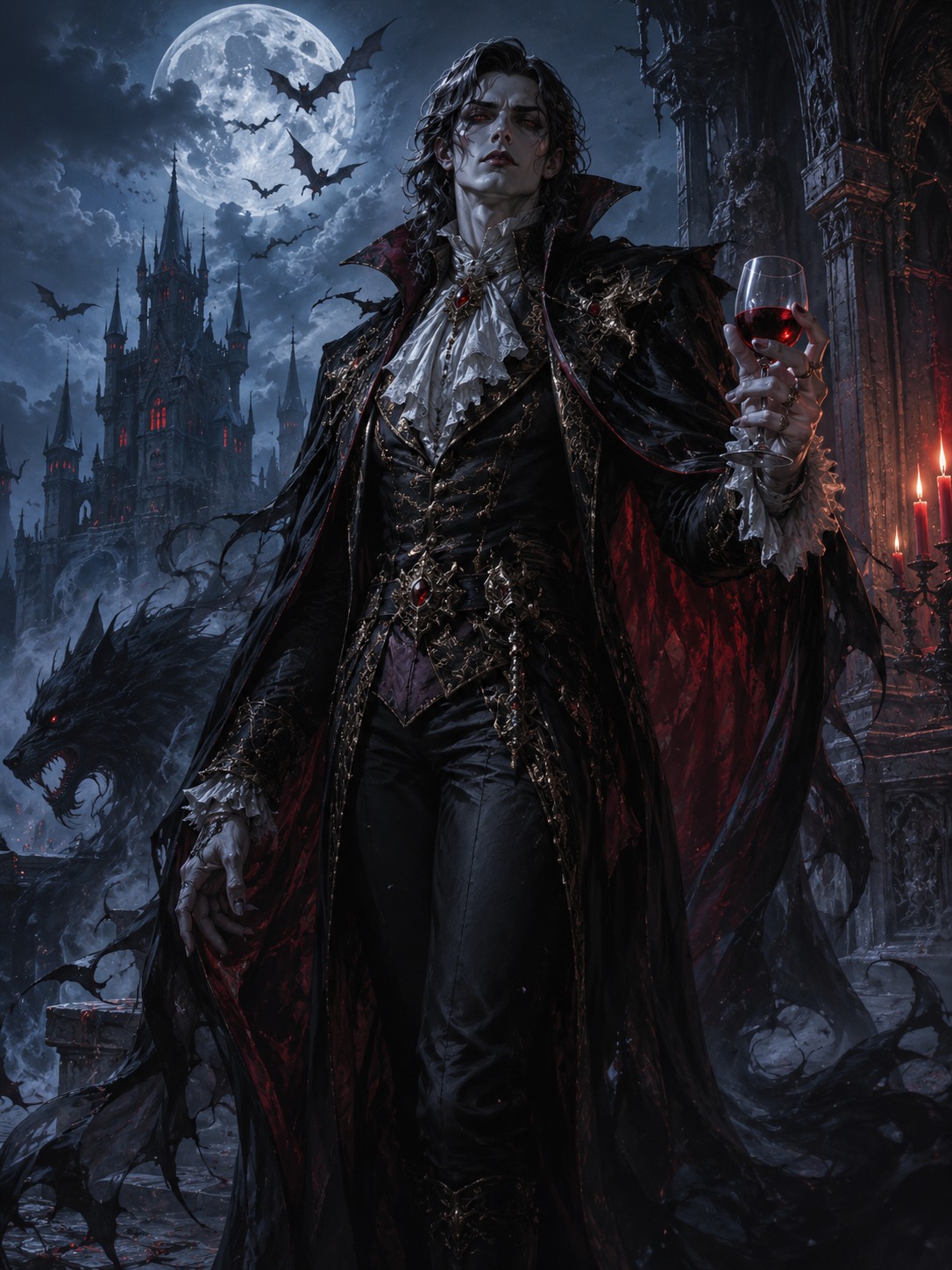
The Vampire (English Vampire, Slavic Upir or Vampir) is the undead who is dead yet has not died, sustaining immortality by drinking the blood of the living, possessed of pale skin, fangs, and a seductive charisma, transforming into bat, mist, or wolf — the canonical iconographic figure that originated in Slavic Eastern-European folklore and was completed in nineteenth-century English literature. The etymology derives from the Slavic upir (East Slavic) and vapir (South Slavic), and the first English use of vampire appears in the 1734 London Journal travel magazine. The iconographic origin is the resurrected-corpse tradition of Slavic folklore and the eighteenth-century Eastern European Vampire Panic (1725-1755 in Habsburg-occupied Serbia and Hungary), of which the decisive cases are the 1725 Petar Blagojevic affair in Kisilova, Serbia, and the 1726-1732 Arnold Paole affair in Medvegja, Serbia — the Visum et Repertum, the official 1732 Latin report by the Austrian-Habsburg military surgeon Johann Flueckinger, is the decisive textual canon that registered the vampire as an official subject in European academia. The Vampyre by John William Polidori (1795-1821), published on 1 April 1819 in the British New Monthly Magazine — written at the Villa Diodati in Switzerland in 1816 at the suggestion of Lord Byron together with Mary Shelley (Frankenstein) — is the origin of the English-literary vampire canon, and Bram Stoker's (1847-1912) Dracula, published in Britain on 26 May 1897, completed the decisive canon of the elegant, aristocratic modern vampire iconography.
Origin
The iconographic origin is the resurrected-corpse tradition of the Slavic (Eastern European) peoples and the eighteenth-century Eastern European Vampire Panic. The etymology of the Slavic upir (East Slavic), vapir (South Slavic), and waupierz (Polish) lies in the indigenous Slavic post-mortem belief in which the decomposition phenomena of the corpse (livor mortis, gas distension, blood seepage) were misinterpreted as evidence of post-mortem resurrection. The decisive canonisation is the eighteenth-century Eastern European Vampire Panic (1725-1755) — the collective vampire fear that occurred at village level in Habsburg-occupied Serbia, Hungary, and Transylvania — and the decisive cases are the 1725 Petar Blagojevic affair in Kisilova, Serbia, and the 1726-1732 Arnold Paole affair in Medvegja, Serbia. The Latin Visum et Repertum (Seen and Discovered), the official report drafted on 7 January 1732 by the Austrian-Habsburg military surgeon Johann Flueckinger after disinterring and examining thirteen corpses in Medvegja, was submitted to the Vienna court, reported in newspapers in Berlin, London, and Paris, and made the European Enlightenment academia treat the vampire as a scholarly subject — the decisive textual canon. In 1755, the Habsburg Empress Maria Theresa issued an edict forbidding the disinterment of corpses, which ended the Eastern European Vampire Panic. Polidori's The Vampyre, published on 1 April 1819 — an adaptation of an unfinished short story Augustus Darvell (1816) by his employer Lord Byron — is the origin of the English-literary vampire canon, and Sheridan Le Fanu's (1814-1873) Carmilla of 1872 established the female-vampire canon. Bram Stoker's (1847-1912) Dracula, published on 26 May 1897 by Constable in Britain, with Count Dracula of Transylvania — inspired by the fifteenth-century Wallachian voivode Vlad III Draculea (1431-1476) — established the decisive canon of the elegant Transylvanian aristocrat vampire.
Features
- Pale skin, fangs, and seductive charisma
- Transformation into bat, mist, and wolf
- Immortality and superhuman strength sustained by blood-drinking
- Vulnerability to sunlight, silver, the cross, garlic, and the stake
- No reflection in mirrors or shadow
- Cannot enter a human's home without invitation
Stories
Polidori's The Vampyre of 1819 and Le Fanu's Carmilla of 1872 are the origins of the English-literary vampire canon, and Bram Stoker's Dracula of 1897 established the decisive canon. The German Expressionist silent film Nosferatu, eine Symphonie des Grauens (Nosferatu, A Symphony of Horror), directed by F.W. Murnau and released in Berlin on 4 March 1922, with Max Schreck as Count Orlok — an unauthorised adaptation of Dracula, with the surviving prints ordered burned by Stoker's widow Florence's copyright suit — is the origin of the modern cinematic vampire iconography. The American Universal Pictures film Dracula, directed by Tod Browning (released 14 February 1931, with Bela Lugosi as Dracula) — Lugosi's thick Hungarian Eastern-European accent, black cape, and slicked-back hair fixed the decisive visual canon of the American film vampire — is the decisive canon of American cinema vampire iconography, and the 1958 British Hammer Film Productions' Dracula (directed by Terence Fisher, with Christopher Lee) established the 1960s-1970s Hammer Horror vampire canon. Anne Rice's (1941-2021) 1976 novel Interview with the Vampire — the canon of the tragic anti-hero vampire Louis who agonises over his humanity — is the decisive turning point of modern vampire literature, and Neil Jordan's 1994 film (Brad Pitt and Tom Cruise) is canonical. Stephenie Meyer's 2005 novel Twilight (published 5 October 2005) and Catherine Hardwicke's 2008 film adaptation (Kristen Stewart and Robert Pattinson) settled the twenty-first-century YA romance vampire canon. HBO's True Blood (created by Alan Ball, premiered 7 September 2008) and the CW's The Vampire Diaries (based on L.J. Smith, premiered 9 September 2010) are the twenty-first-century television vampire canon.
Weakness
The vampire's weaknesses are: (1) sunlight — in the finale of F.W. Murnau's 1922 Nosferatu, the cinematic-historical decisive scene of Count Orlok being annihilated by dawn sunlight was the canonical visual that settled, through 1960s Hammer Horror, as the decisive weakness of modern vampire iconography; in Stoker's 1897 Dracula original, sunlight only weakens the vampire and does not annihilate him, so the cinematic adaptation is canon; (2) stake through the heart — the canonical Slavic-folkloric vampire-placation rite, the canon in the 1897 Dracula of Doctor Van Helsing driving a stake through Lucy Westenra's heart; (3) silver — the Slavic and European folk canon that silver weapons and the cross harm the vampire; (4) the cross and holy water — the canonical Christian-faith weakness, with Van Helsing repelling Dracula with cross and holy water in the 1897 Dracula; (5) garlic — the decisive Eastern European folk weakness, with the garlic wreath as vampire ward in the 1897 Dracula; (6) running water — the Eastern European folk canon that the vampire cannot cross running water (rivers, seas); (7) the prohibition of entry without invitation — the canon in the 1897 Dracula that the vampire cannot enter a human home without invitation; (8) decapitation and cremation — the decisive Slavic-folkloric placation method. In Stephenie Meyer's 2005 Twilight, the Cullen-family vampires, when exposed to sunlight, sparkle like diamonds — a modern adaptation that became the canonical adaptation of the twenty-first-century YA romance vampire.
Cultural Significance
The vampire is not merely a horror icon but the canonical iconographic figure of Western horror canon, traversing the indigenous Slavic post-mortem belief, the eighteenth-century Habsburg Enlightenment, nineteenth-century English literature, twentieth-century American cinema, and twenty-first-century global YA romance. The eighteenth-century Eastern European Vampire Panic (1725-1755), in which Flueckinger's 1732 Visum et Repertum was submitted to the Vienna court and brought European Enlightenment academia to treat the vampire as a scholarly subject, is analysed as the socio-historical product of Habsburg colonial rule of Eastern Europe and the Orthodox-Catholic religious conflict. Polidori's 1819 The Vampyre's Lord Ruthven — modelled on Lord Byron, whom Polidori served at the Villa Diodati in 1816 — is the origin of the British Victorian aristocrat-vampire canon, and Count Dracula in Stoker's 1897 Dracula, the Transylvanian aristocrat, is the canonical case of Said's Orientalism critique as the condensation of late-Victorian-British xenophobia and reverse colonialism. Murnau's 1922 Nosferatu and Browning's 1931 Dracula (Bela Lugosi) established the canonical horror of the American Universal Pictures Golden Age, and Anne Rice's 1976 Interview with the Vampire — the tragic anti-hero vampire agonising over humanity — became the decisive turning point of modern vampire literature. Stephenie Meyer's 2005 Twilight series (cumulative print run of 170 million copies) and the 2008-2012 five-film series (worldwide box office of 3.34 billion US dollars), together with HBO's True Blood (seven seasons, eighty episodes) and the CW's The Vampire Diaries (eight seasons, 171 episodes), settled the twenty-first-century global YA romance vampire canon.
In Popular Culture
- Slavic folk Upir (medieval) — etymological origin of the Eastern European vampire
- Petar Blagojevic affair (1725) — origin of the Eastern European Vampire Panic
- Arnold Paole affair and Flueckinger's Visum et Repertum (1732) — academically decisive canonisation
- John William Polidori, The Vampyre (1819) — origin of the English-literary vampire
- Sheridan Le Fanu, Carmilla (1872) — female-vampire canon
- Bram Stoker, Dracula (1897) — decisive English-literary canon
- F.W. Murnau, Nosferatu (1922) — Expressionist cinematic canon
- Tod Browning, Dracula (Bela Lugosi) (1931) — American cinematic canon
- Anne Rice, Interview with the Vampire (1976) — modern anti-hero vampire
- Stephenie Meyer, Twilight (2005) — twenty-first-century YA romance canon
Trivia
The Slavic etymology upir means 'the resurrected' in East Slavic, and the first English use of vampire is in a 1734 Eastern European travelogue of the British travel magazine London Journal. The Latin Visum et Repertum of 1732 by Johann Flueckinger — submitted to the Vienna court and reported in five major European newspapers — is the first document that registered the vampire as an official subject of European academia, and is the basis on which the Oxford English Dictionary records 1734 as the first attestation of 'vampire'. The horror-short-story contest among Byron, Mary Shelley, Shelley, and Polidori at the Villa Diodati on Lake Geneva in 1816, the four of them trapped by torrential rain — out of which Mary Shelley wrote Frankenstein (1818) and Polidori The Vampyre (1819) — is the decisive origin of nineteenth-century horror literature. The model of Stoker's 1897 Dracula was the fifteenth-century Wallachian voivode Vlad III Draculea (Vlad the Impaler, 1431-1476) — nicknamed Tepes ('the Impaler') for executing 20,000-30,000 enemy prisoners by impaling them on stakes — and Stoker researched Eastern European material in the London British Museum for seven years from 1890. Bela Lugosi (1882-1956), of Hungarian origin, with his thick Eastern European accent — already canonical in the 1927 Broadway stage Dracula — fixed the decisive visual canon of the American vampire iconography through the 1931 film. Stephenie Meyer's 2005-2008 four-volume Twilight saga sold 170 million copies, topping the contemporary publishing market, and the 2008-2012 five-film series earned 3.34 billion US dollars worldwide.