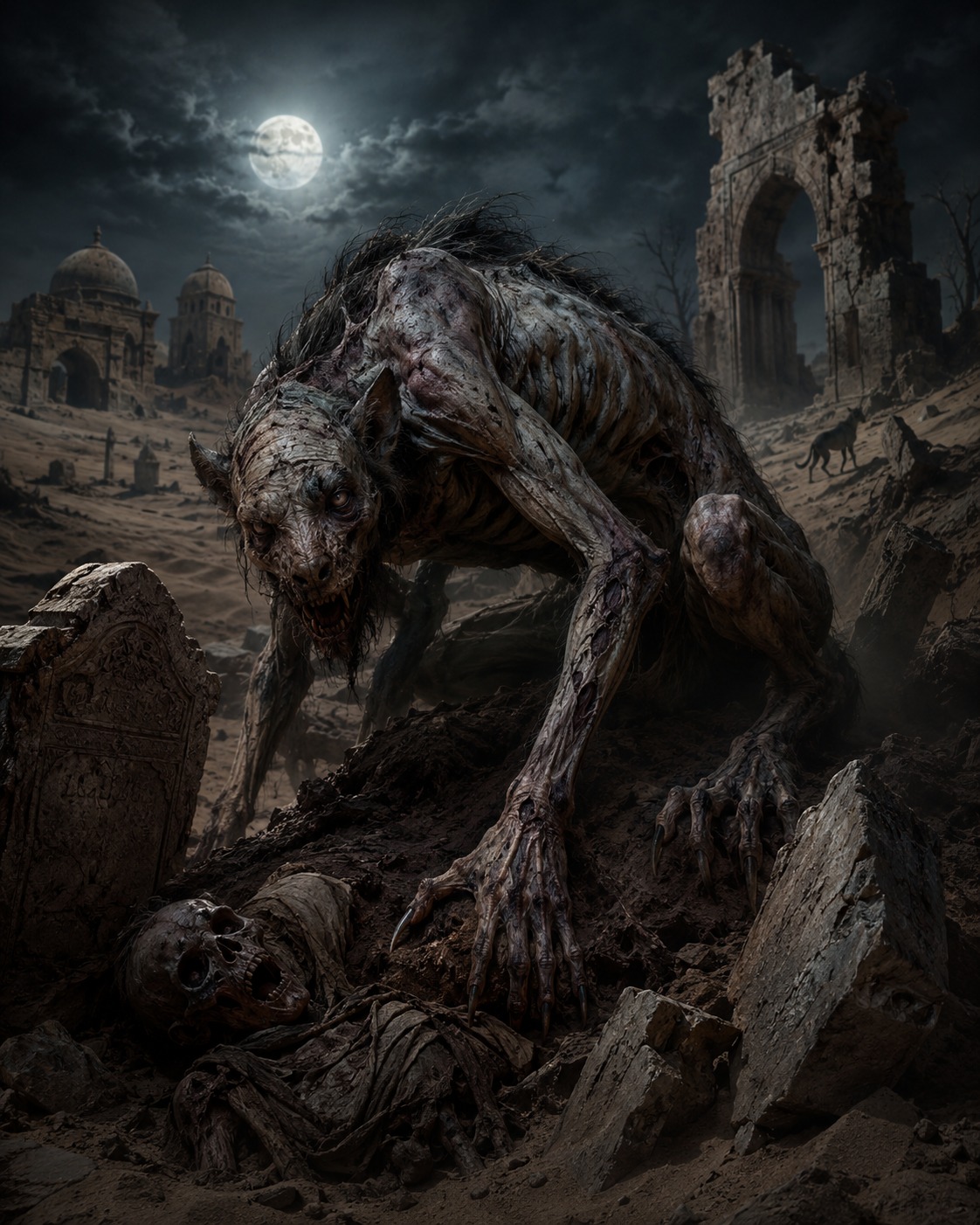
Ghoul
Ghoul · The Corpse-Eater — A Desert Monster That Digs Up and Devours the Dead
Names in Other Languages
 구울한국어
구울한국어Ghoul · 식시귀 — 무덤을 파헤쳐 시체를 먹는 사막의 괴물
 グール日本語
Ghoul · 食屍鬼 — 墓を暴いて死体を食らう砂漠の怪物
 食屍鬼繁體中文
Ghoul · 食屍鬼 — 掘墓食屍的沙漠怪物
 GhulDeutsch
Ghoul · Der Leichenfresser — Ein Wüstenmonster, das die Toten ausgräbt und verschlingt
 GouleFrançais
Ghoul · La mangeuse de cadavres — Un monstre du désert qui déterre et dévore les morts
 GulEspañol
Ghoul · El devoracadáveres — Un monstruo del desierto que desentierra y devora a los muertos
 CarniçalPortuguês
Ghoul · O devorador de cadáveres — Um monstro do deserto que desenterra e devora os mortos
 GhulPolski
Ghoul · Pożeracz trupów — pustynny potwór, który rozkopuje i pożera zmarłych
 ГульРусский
Ghoul · Трупоед — пустынный монстр, что раскапывает и пожирает мёртвых
The Ghoul (English ghoul, from Arabic ghul) is the corpse-eating monster and shape-shifting cannibal of the desert and graveyard, originating in pre-Islamic Bedouin Arabian folklore of the Jahiliyyah (before the sixth century), transmitted through the One Thousand and One Nights (Alf Laylah wa-Laylah, compiled in the ninth century), and established in Western horror canon from the eighteenth century onwards. The etymology lies in Arabic ghul, from the verb ghala ('to seize, to snatch'). In Arabian folklore, the ghoul is a malevolent variety of jinn that haunts the desert to lure and devour travellers, possessing the power to transform into human or animal form (particularly the hyena) and disinterring corpses from graves. Antoine Galland's French translation of the Arabian Nights (1704-1717), William Beckford's Gothic novel Vathek (1786), and Lord Byron's poem The Giaour (1813) introduced the ghoul to Western literature, and H. P. Lovecraft's short story Pickman's Model (1927) and The Dream-Quest of Unknown Kadath (1927) established the modern horror canon of the ghoul as a foundational race of the Cthulhu Mythos.
Origin
The iconographic origin is the pre-Islamic Bedouin Arabian folklore of the Jahiliyyah (before the sixth century). The ghoul is a malevolent variety of jinn (spirit): the earliest text is a poem by Ta'abbata Sharran, a sixth-century Jahiliyyah-era poet, narrating a duel with a ghoul. The ghoul haunts the remote desert paths, misdirecting travellers or luring them in the form of an alluring woman to devour them. The feminine form ghulah (or sila) particularly transforms into an alluring woman to seduce young men. The ninth-century compilation One Thousand and One Nights (Alf Laylah wa-Laylah), in the Tale of Sidi Nu'man, fixed the canonical ghoul iconography: the protagonist's wife Amina is revealed to be a ghoul who disinters and devours corpses by night. After the arrival of Islam in the seventh century, the ghoul was systematised as one variety of jinn in Quran commentaries (tafsir) and in Abbasid encyclopaedias such as the Kitab al-Hayawan (Book of Animals) of al-Jahiz (781-868). Antoine Galland's French translation of the Arabian Nights (1704-1717) and Sir Richard Francis Burton's English translation (1885) established the ghoul in Western canon.
Features
- Haunts the desert, ruins, and graveyards to disinter and devour corpses
- Transforms into human, hyena, or alluring female form
- Lures and devours travellers on remote desert paths
- Classified as a malevolent variety of jinn in Arabian folklore
- The feminine ghulah seduces young men as a recurring motif
- Redefined in modern horror and fantasy as a lower undead race that devours corpses
Stories
The ninth-century Tale of Sidi Nu'man in the One Thousand and One Nights is the decisive literary canon of the ghoul, in which the protagonist's wife Amina is revealed nightly to leave their bed and disinter corpses from the graveyard, becoming the template of all subsequent ghoul representations. William Beckford's Gothic novel Vathek (1786) is the earliest English-language introduction of the ghoul. Lord Byron's poem The Giaour (1813), with the line 'And like the ghoul, must drag thy corse from out the recent grave', fixed the ghoul in the English poetic canon. Sir Richard Francis Burton's sixteen-volume English translation of the Arabian Nights (1885) is the decisive English-language canon. H. P. Lovecraft's short story Pickman's Model and the novella The Dream-Quest of Unknown Kadath, both written in 1927, redefined the ghoul as a foundational race of the Cthulhu Mythos: subterranean cannibal-corpse-eaters of the Boston graveyards, with the additional motif that humans who feast on corpses may themselves transform into ghouls. Gary Gygax's first edition of Dungeons & Dragons (1974) systematised the ghoul as a lower undead race with a paralysing touch, making it the standard ghoul of modern fantasy role-playing games. Ishida Sui's manga Tokyo Ghoul (from 2011) and the 2014 anime introduced the ghoul to Japanese horror.
Weakness
The weaknesses of the ghoul are: (1) light and the sun — in Arabian folklore the ghoul haunts the desert by night and loses its transformative power when exposed to sunlight; (2) the absence of corpses — without corpses to feed on, the ghoul starves, weakens, and eventually perishes; (3) Islamic purification rites — Quranic recitation and the vicinity of mosques restrict the ghoul's activity, and the basmala invocation of the name of Allah is held in folk belief to expel the ghoul; (4) ineffectual as a lone agent — in modern fantasy such as Dungeons & Dragons, the ghoul is classified as a lower undead that hunts in packs, and a lone specimen poses little threat to even mid-level adventurers. The Lovecraftian ghouls of the Cthulhu Mythos operate only in the darkness of subterranean graveyards: in The Dream-Quest of Unknown Kadath, the protagonist Randolph Carter collaborates with a band of ghouls but the ghouls cannot set foot in the sunlit surface world, fixing light as the decisive canonical weakness.
Cultural Significance
The ghoul is not merely a horror icon but a paradigm case of cross-cultural canonisation crossing Arabian, Islamic, and Western Orientalist traditions. The pre-Islamic Jahiliyyah Bedouin desert-spirit belief was systematised into the jinn theology of seventh-century Islam, transmitted by Galland's eighteenth-century and Burton's nineteenth-century translations of the Arabian Nights, passed through European Romanticism and Gothic literature, and settled in the Cthulhu Mythos and Dungeons & Dragons fantasy of the twentieth century, crossing from East to West. Edward Said's 1978 Orientalism is the canonical critical analysis of eighteenth- and nineteenth-century European representations of the East, including the ghoul and jinn iconography of the Galland and Burton translations, as a mechanism of Western Othering. Lovecraft's 1927 reinterpretation of the ghoul, in which the Boston painter Richard Upton Pickman transforms into a ghoul, has been read as a condensation of early-twentieth-century white middle-class American anxieties over race, class, and bodily corruption. Ishida Sui's 2011 Tokyo Ghoul is interpreted as an allegory of social minorities and foreign residents in contemporary Japan, transplanting the Arabian cannibal motif into modern Japanese urban society.
In Popular Culture
- Ta'abbata Sharran's poetry, sixth century Jahiliyyah — earliest textual appearance of the ghoul
- One Thousand and One Nights, Tale of Sidi Nu'man (ninth-century compilation) — decisive canon of the corpse-eating ghoul
- Al-Jahiz, Kitab al-Hayawan (ninth century) — Abbasid systematisation of jinn classification
- William Beckford, Vathek (1786) — earliest English-language introduction of the ghoul
- Lord Byron, The Giaour (1813) — settlement in the English poetic canon
- Sir Richard Francis Burton, English translation of the Arabian Nights (1885) — decisive English-language canon
- H. P. Lovecraft, Pickman's Model and The Dream-Quest of Unknown Kadath (1927) — Cthulhu Mythos ghoul canon
- Gary Gygax, Dungeons & Dragons (1974) — standardisation in modern fantasy role-playing games
- Ishida Sui, Tokyo Ghoul (from 2011) — introduction to modern Japanese manga
Trivia
The Arabic etymology ghul derives from the verb ghala ('to seize, to snatch'), and the first English use of ghoul is in William Beckford's Vathek (1786). The variable star Algol in the constellation Perseus takes its name from the Arabic Ra's al-Ghul ('the head of the ghoul'), the head of Medusa in Perseus mythology rendered as a ghoul in Arabic astronomy; nineteenth-century British astronomers discovered Algol to be an eclipsing binary with a period of about 2.87 days. DC Comics' Batman archvillain Ra's al Ghul, created in 1971 by Dennis O'Neil and Neal Adams, takes his name from this star. In Lovecraft's 1927 The Dream-Quest of Unknown Kadath, the ghouls communicate in the distinctive onomatopoeia 'meep', and the conceit that a human painter who transformed into a ghoul lives in the Boston subterranean graveyards became the canonical foundation of the ghoul as a core race of the Cthulhu Mythos, carried forward by Lovecraft acolytes such as August Derleth. The 2014 Tokyo Ghoul anime was ranked fifth among twenty-first-century Japanese horror anime by IGN, and the manga series has surpassed forty-seven million cumulative copies in print.