Ghost
Ghost · The Wandering Spirit — A Soul Bound to the World by Attachment and Unfinished Story
Names in Other Languages
 유령한국어
유령한국어Ghost · 떠도는 망령 — 미련과 사연에 묶여 이승에 남은 영혼
 幽霊日本語
幽霊日本語Ghost · さまよう亡霊 — 未練と事情に縛られ現世に残った魂
 幽靈繁體中文
Ghost · 遊蕩亡靈 — 為執念與隱情所縛、留於陽世之魂
 GespenstDeutsch
Ghost · Der wandernde Geist — Eine Seele, durch Anhaftung und unvollendete Geschichte an die Welt gebunden
 FantômeFrançais
Ghost · L'esprit errant — Une âme liée au monde par l'attachement et une histoire inachevée
 FantasmaEspañol
Ghost · El espíritu errante — Un alma atada al mundo por el apego y una historia inconclusa
 FantasmaPortuguês
Ghost · O espírito errante — Uma alma presa ao mundo pelo apego e uma história inacabada
 DuchPolski
Ghost · Błąkający się duch — dusza związana ze światem przywiązaniem i niedokończoną historią
 ПривидениеРусский
Ghost · Блуждающий дух — душа, привязанная к миру привязанностью и незавершённой историей
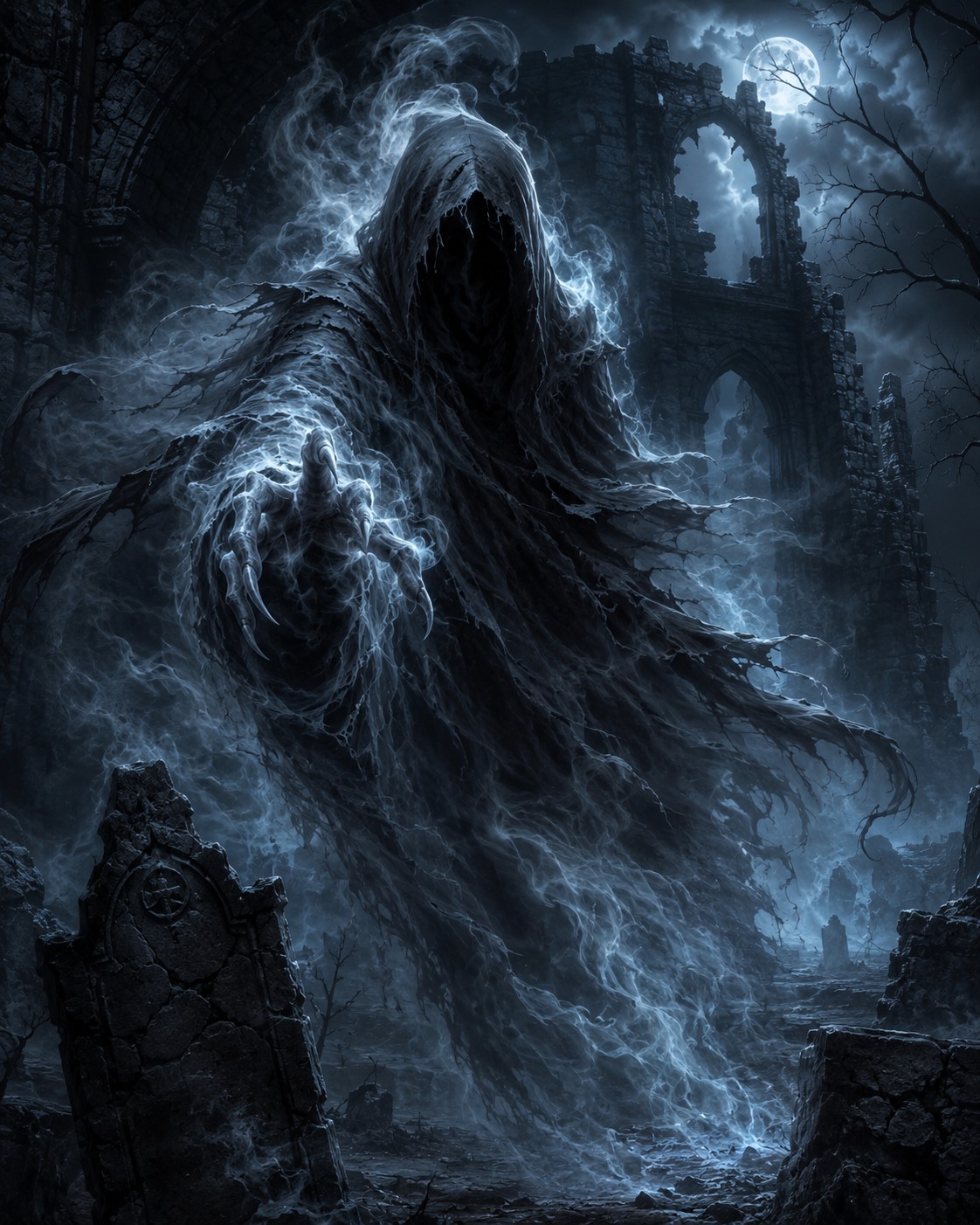
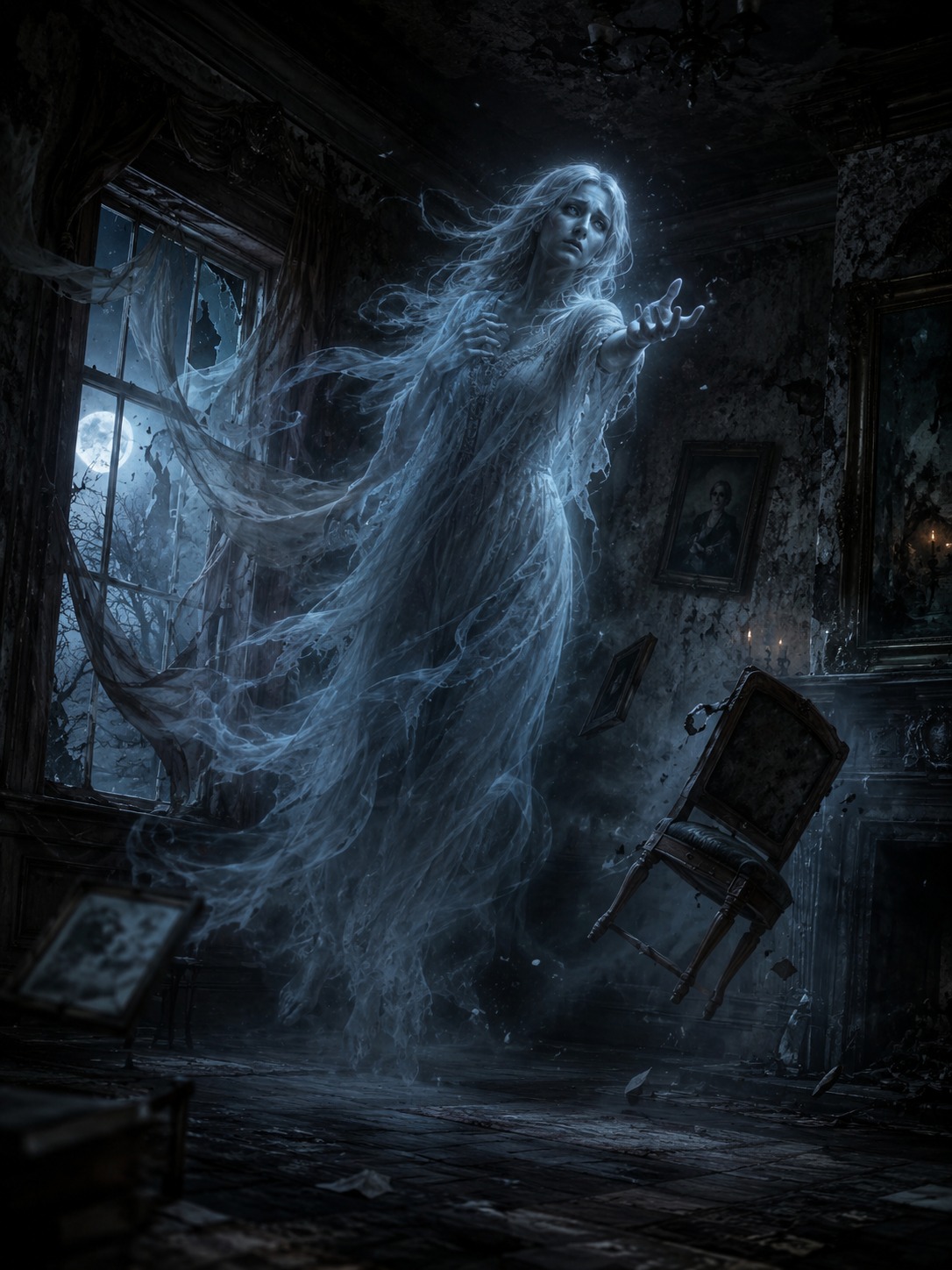
The Ghost (English Ghost, Latin Spectrum) is the soul of the dead that, due to lingering attachment, grudge, or unresolved circumstance, cannot proceed to the afterworld and remains in this world, the canonical iconographic figure of universal worldwide post-mortem belief: transparent or translucent in form, bound to a specific place (haunted houses, old houses), and manifesting through the Poltergeist (German for 'noisy spirit'), cold draught, apparition, sound, and weeping. The English ghost derives from Old English gaast (soul, spirit), and the iconographic origin spans the gidim of Mesopotamia, the akh of ancient Egypt, the psyche and eidolon of ancient Greece, the lar (guardian spirit) and lemur of ancient Rome — universally from the post-mortem soul belief of every civilisation. The decisive Western textual canon is Letter 27 of Book 7 of the Epistulae of Pliny the Younger (61-113 CE) of the late first century CE — in which the Greek philosopher Athenodorus (74 BCE - 7 CE) encounters in a haunted Athens house an old man's ghost rattling chains, and excavates his burial place to grant him post-mortem rest — the decisive Western canon of the first haunted-house ghost story. The ghost of Hamlet's father in William Shakespeare's (1564-1616) tragedy Hamlet (1599-1601) established the English-literary ghost canon, and the Marley and three Spirits of Past, Present, and Future in Charles Dickens's (1812-1870) novella A Christmas Carol (published 19 December 1843) are the decisive work of the Victorian ghost canon.
Origin
The iconographic origin is the post-mortem soul belief of all the ancient civilisations of the world. From the Sumerian gidim (soul of the dead) of Mesopotamia (c. 4500-1900 BCE), the Egyptian akh (soul ascended to heaven) and ka (life force), the Greek psyche (soul) and eidolon (phantom), the Roman lar (family guardian spirit) and lemur (evil spirit), the Chinese hun-po, and the indigenous shamanism of Korea — in which the post-mortem soul wanders this world — the universal iconography settled. The decisive Western textual canon is Letter 27 of Book 7 of the Epistulae of Pliny the Younger (61-113 CE) of the late first century CE: the contemporary Greek Stoic scholar Athenodorus Cananites (74 BCE - 7 CE) lived in a cheaply rented haunted house in Athens and every night met the ghost of an old man rattling chains, finally excavating the underground burial place the ghost had pointed to — and granting the corpse a proper funeral — the decisive Western canon of the first haunted-house ghost story. Medieval English literature systematised ghost stories in the Historia Ecclesiastica Gentis Anglorum (731) of Beda Venerabilis (672-735) and the Canterbury Tales of the fourteenth-century English poet Geoffrey Chaucer (1343-1400), and the ghost of Hamlet's father in Shakespeare's Hamlet of 1599-1601 established the decisive canon of the English-literary ghost. Horace Walpole's (1717-1797) The Castle of Otranto of 1764 — the origin of the English Gothic novel — established the haunted-house ghost canon. Charles Dickens's novella A Christmas Carol (published 19 December 1843 by Chapman and Hall) and the ghost of Marley and the three Spirits of Past, Present, and Future are the decisive work of the Victorian ghost canon, and Henry James's (1843-1916) The Turn of the Screw of 1898 is the canon of the psychological ghost story.
Features
- Transparent or translucent form, bound to a specific place
- Poltergeist phenomena (German: 'noisy spirit', moving objects)
- Cold draught and power outage
- Manifestation through apparition, sound, and weeping
- Transmission of messages, warnings, and prophecies to the living
- Canonical resolution: departure to the afterworld when the bound circumstance is resolved
Stories
Letter 27 of Book 7 of the first-century Pliny the Younger Epistulae and Shakespeare's Hamlet of 1599-1601 are the origins of the Western ghost-literary canon, Horace Walpole's The Castle of Otranto of 1764 established the English Gothic novel ghost canon, and Dickens's A Christmas Carol of 1843 is the decisive work of the Victorian ghost canon. After the Fox sisters of Hydesville, New York, began acting as mediums in 1848, the Spiritualism movement that swept the Anglo-American world in the late nineteenth century established the decisive canon of modern ghost-belief iconography of media, spirit photography, and the seance, and the Society for Psychical Research (SPR), founded in London in 1882, is the origin of academic ghost research. Stanley Kubrick's (1928-1999) 1980 film The Shining (released 23 May 1980 in the United States, based on the Stephen King novel, starring Jack Nicholson) — the ghosts haunting the Overlook Hotel of the Colorado Rocky Mountains — is the decisive work of the modern horror cinema ghost canon. M. Night Shyamalan's 1999 film The Sixth Sense (released 6 August 1999, starring Bruce Willis and Haley Joel Osment), with the line 'I see dead people', settled the twenty-first-century ghost-film canon, and Alejandro Amenabar's 2001 film The Others (released 2 August 2001 in Spain, starring Nicole Kidman) is the canon of the ending-twist ghost film. The Oiwa ghost in the 1825 Kabuki play Tokaido Yotsuya Kaidan by Tsuruya Nanboku (1755-1829) is the canon of the Japanese Kabuki ghost, and the Sadako of Hideo Nakata's 1998 film Ring settled the canon of the Japanese J-Horror ghost.
Weakness
The ghost's weaknesses are: (1) resolution (haewon) of the bound circumstance — the canon of Dickens's 1843 A Christmas Carol, in which Marley's ghost departs after telling Scrooge his story; the decisive weakness in Shakespeare's 1599 Hamlet, in which the ghost of Hamlet's father departs after entrusting his son with revenge; (2) ascertainment of truth — the decisive canon since the Athenodorus canon of Pliny the Younger's first-century Epistulae that the ghost vanishes when its indicated burial place is excavated and properly buried; (3) sacred objects and rites of purification — the canonical weakness of the ghost-evil-spirit pacification by Catholic exorcism since the canon of William Friedkin's 1973 film The Exorcist (based on William Peter Blatty); (4) sunrise and the cock-crow at dawn — the canonical weakness in Act I Scene 1 of Shakespeare's Hamlet, 'It started, like a guilty thing / Upon a fearful summons'; (5) resolution of lingering attachment or promise — the decisive weakness common to East-West ghost canon, in which the living's resolution of the ghost's attachment or promise sends it to the afterworld; (6) the courteous listener — the weakness since Pliny the Younger's first-century canon, in which the ghost is softened before a sincere listener who hears its story; (7) proper burial and funeral — the East-West common pacification canonical weakness, in which the unburied ghost is pacified by proper funeral; (8) absence of physical substance — the decisive weakness that the ghost has no physical substance and therefore direct harm is limited, the canonical iconography of modern horror.
Cultural Significance
The ghost is not merely a horror icon but the canonical iconographic figure of universal human horror that traverses the post-mortem soul belief of all ancient civilisations, medieval Catholic Purgatory doctrine, Shakespeare's 1599 Hamlet, nineteenth-century British Victorian Gothic, the late-nineteenth-century Anglo-American Spiritualism, twentieth-century American horror cinema, and twenty-first-century global J-Horror. The medieval Catholic Purgatory (Purgatorium) doctrine — the post-mortem purification belief settled around the Cluny monastery in the eleventh century — is the theological foundation of European ghost belief, and after Luther's Reformation of 1517, when Protestantism abolished the Purgatory doctrine, ghost belief was degraded as superstition in Protestant England, but Shakespeare's Hamlet — the ambivalence of Catholic Purgatory doctrine and Protestant scepticism — became the decisive canon of English literature. The Spiritualism movement begun with the Fox sisters incident in New York State in 1848 — with eight million adherents in the Anglo-American world by the 1880s — settled Victorian-British Spirit Photography and the seance as the decisive cases of late-nineteenth-century Anglo-American popular culture. The Society for Psychical Research (SPR), founded in London in 1882 by Cambridge University philosopher Henry Sidgwick (1838-1900) and others — the decisive canon of academic ghost research — and its American branch (founded 1885) included William James (1842-1910) and Arthur Conan Doyle (1859-1930). Kubrick's 1980 The Shining, Shyamalan's 1999 The Sixth Sense (worldwide box office of about 670 million dollars), Nakata's 1998 Ring, and the American 2002 remake The Ring (worldwide box office of about 250 million dollars) settled the twenty-first-century global ghost-film canon.
In Popular Culture
- Pliny the Younger, Epistulae 7.27 (first century) — decisive Western canon of the first haunted-house ghost story
- Shakespeare, Hamlet (1599-1601) — decisive English-literary ghost canon
- Horace Walpole, The Castle of Otranto (1764) — origin of the English Gothic novel ghost canon
- Tsuruya Nanboku, Tokaido Yotsuya Kaidan, Oiwa (1825) — Japanese Kabuki ghost canon
- Dickens, A Christmas Carol (1843) — decisive Victorian ghost canon
- Fox sisters Hydesville incident (1848) — origin of the American Spiritualism movement
- Founding of the Society for Psychical Research (1882) — decisive academic ghost research canon
- Henry James, The Turn of the Screw (1898) — psychological ghost story canon
- Stanley Kubrick, The Shining (1980) — decisive modern horror cinema canon
- M. Night Shyamalan, The Sixth Sense (1999) — twenty-first-century ghost-film canon
Trivia
The Sino-East-Asian characters for ghost combine the characters for dark and spirit, meaning 'spirit of the dark place', the canonical East-Asian spelling, and the English ghost derives from the Old English gaast (soul, spirit) — from Proto-Germanic gaistaz (frightened, enraged) — which settled in Middle English as gost around 1340. Letter 27 of Book 7 of the first-century Pliny the Younger's Epistulae, the haunted-house ghost story, is — according to the Oxford classicist R.W. Davies (2018) — the decisive Western canon of the haunted-house iconography, and the decisive prototype of the British Gothic novel after 1700. Charles Dickens's A Christmas Carol (published 19 December 1843 by Chapman and Hall, London) sold out a first edition of 6,000 copies in six days — the decisive bestseller of Victorian Britain — and the canonisation event of Anglo-American Christmas ghost stories in the late nineteenth century. The Fox sisters of Hydesville, Wayne County, New York State (Kate, age 12, and Margaret, age 14), on 31 March 1848 — claiming to communicate with the spirit of a dead peddler through 'raps' — were the decisive origin of the American Spiritualism movement, with eight million Anglo-American adherents by the 1850s. Kubrick's The Shining (released 23 May 1980 in the United States, based on Stephen King's 1977 novel) earned 44.4 million dollars at the American box office, and M. Night Shyamalan's The Sixth Sense (released 6 August 1999 in the United States) earned 672.8 million dollars worldwide and was the number-one American box office of 1999, the decisive canon of the twenty-first-century ghost film. Hideo Nakata's Ring (released 31 January 1998 in Japan, based on Koji Suzuki's 1991 novel of the same name) was remade in the United States in 2002 as The Ring (directed by Gore Verbinski), earning 249.4 million dollars worldwide — the canonisation event of the J-Horror ghost in the global market.