Dullahan
Dullahan · The Headless Horseman — Ireland's Death-Bringing Envoy
Names in Other Languages
 듀라한한국어
Dullahan · 머리 없는 기수 — 죽음을 데려가는 아일랜드의 사자
 デュラハン日本語
Dullahan · 首なし騎手 — 死を連れ去るアイルランドの使者
 無頭騎士繁體中文
Dullahan · 無頭騎士 — 帶走死亡的愛爾蘭使者
 DullahanDeutsch
Dullahan · Der kopflose Reiter — Irlands todbringender Bote
 DullahanFrançais
Dullahan · Le cavalier sans tête — L'envoyé porteur de mort d'Irlande
 DullahanEspañol
Dullahan · El jinete sin cabeza — El enviado portador de muerte de Irlanda
 DullahanPortuguês
Dullahan · O cavaleiro sem cabeça — O enviado portador de morte da Irlanda
 DullahanPolski
Dullahan · Bezgłowy jeździec — irlandzki posłaniec niosący śmierć
 ДуллаханРусский
Dullahan · Безголовый всадник — несущий смерть посланник Ирландии
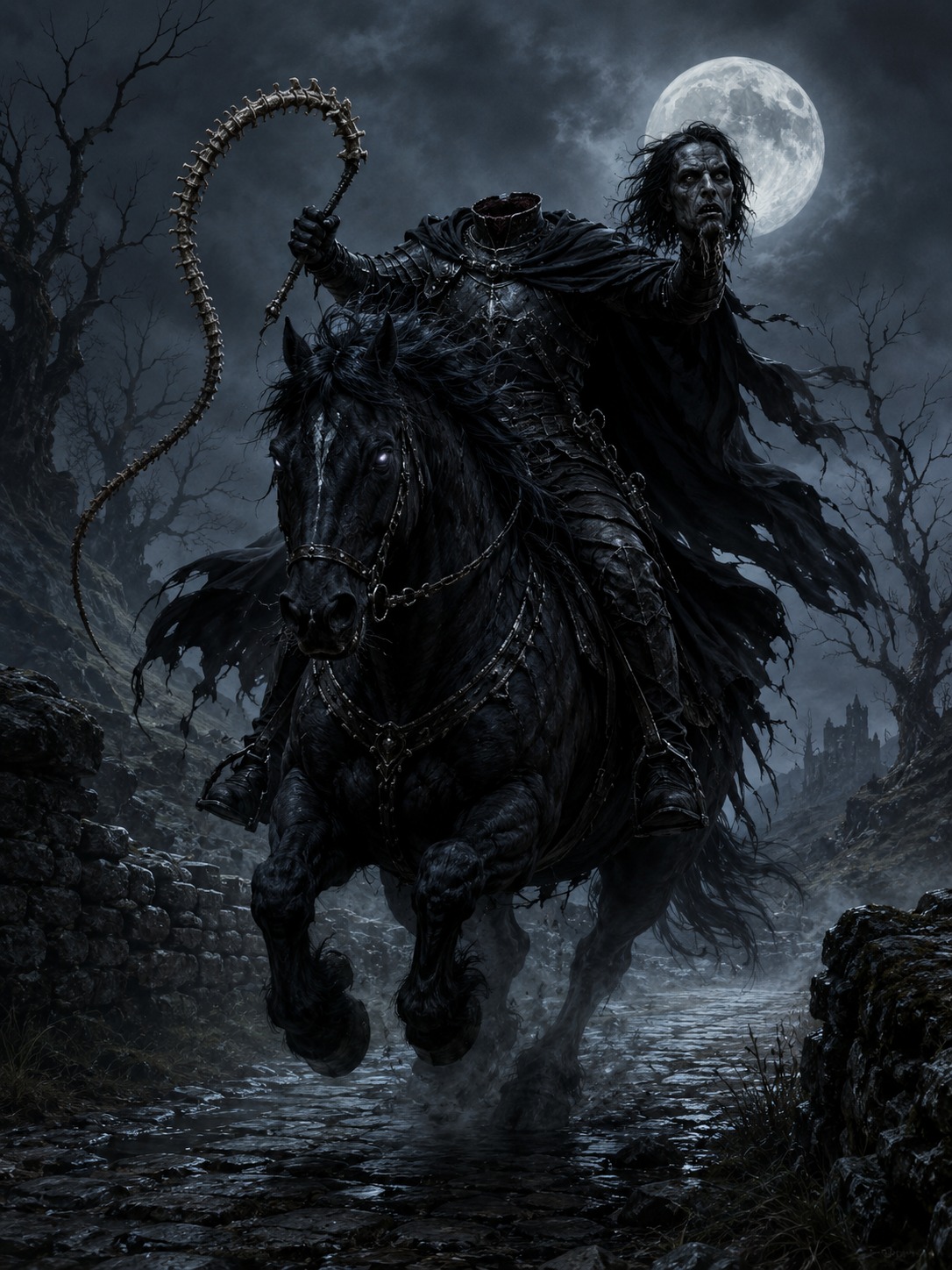
The Dullahan (Irish Dullahan, English Dullahan) is the headless rider on a black horse holding his own severed head in one hand, the canonical iconographic figure of the death-collecting spirit and the executor of fate of Irish Celtic tradition. The etymology derives from the Irish dulachan or dubhlachan — both terms glossed as 'messenger of darkness' or 'headless one' — a vestige of the human-sacrifice belief of pre-Christian Celtic Ireland. The decisive scholarly canon is Thomas Crofton Croker's 1825 Fairy Legends and Traditions of the South of Ireland, which established the canonical visual figure of the headless rider whose severed head emits light, and Lady Wilde's 1887 Ancient Legends, Mystic Charms, and Superstitions of Ireland (mother of Oscar Wilde, 1821-1896), which fixed the canonical behaviour pattern of the dullahan (calling a person's name causes their death; whipping with a human spine; doors opening of their own accord along the path; fear of gold). Washington Irving's November 1820 short story The Legend of Sleepy Hollow — in which a Hessian-mercenary headless rider haunts Sleepy Hollow in the New York Hudson Valley — decisively settled the dullahan iconography in Anglo-American literature, and Tim Burton's 1999 film Sleepy Hollow (starring Johnny Depp and Christopher Walken as the Headless Horseman) completed the modern cinematic canon.
Origin
The iconographic origin is the death-spirit belief of pre-Christian Celtic Ireland (fifth century BC to fifth century AD). The decisive scholarly hypothesis is — proposed by some scholars — the interpretation that the dullahan is a vestige of Celtic human sacrifice offered to the Irish harvest god Crom Dubh ('Black Stooped One'), and the human-sacrifice records of Crom Cruach in the twelfth-century Yellow Book of Lecan and the Book of the Taking of Ireland (Lebor Gabala Erenn) are canonical. Etymologically the term derives from the Irish dulachan ('messenger of darkness') or dubhlachan ('headless one'). The decisive text is the Fairy Legends and Traditions of the South of Ireland in three volumes, published in Britain in 1825 by Thomas Crofton Croker (1798-1854) — translated into German by the Brothers Grimm and disseminated throughout Europe — establishing the visual canon of the headless rider whose severed head emits light. Lady Wilde's 1887 Ancient Legends, Mystic Charms, and Superstitions of Ireland — Jane Francesca Wilde, mother of Oscar Wilde (1821-1896) — established the decisive canon of the dullahan's behaviour: calling a person's name causes their death, whipping with a human spine, doors opening of their own accord along the path, and fear of gold. W. B. Yeats's 1888 Fairy and Folk Tales of the Irish Peasantry succeeded Lady Wilde's canon academically.
Features
- Headless rider holding his own severed head in his hand
- Black horse and a whip made of a human spine (or a black coach with human-spine whip)
- Calling a person's name causes that person to die instantly
- All doors along the path open of their own accord
- Visual iconography of light emitted from the severed head
- Canonical weakness of extreme fear of gold
Stories
Thomas Crofton Croker's 1825 Fairy Legends and Traditions of the South of Ireland and Lady Wilde's 1887 Ancient Legends established the dullahan canon of English literature, and W. B. Yeats's 1888 Fairy and Folk Tales of the Irish Peasantry carried it forward. In the United States, the dullahan iconography was adapted in Washington Irving's (1783-1859) The Legend of Sleepy Hollow in his short-story collection The Sketch Book of Geoffrey Crayon, published in London in June 1820 during his sojourn in Britain — a Hessian-mercenary headless rider (a German mercenary employed by the British during the American Revolutionary War) appearing in the village of Sleepy Hollow in the New York Hudson Valley and pursuing the schoolteacher Ichabod Crane — establishing the decisive canon. The 1949 Disney animated short The Adventures of Ichabod and Mr. Toad, with its segment The Legend of Sleepy Hollow (narrated by Bing Crosby), settled the American children's canon, and Tim Burton's November 1999 film Sleepy Hollow (Johnny Depp as Ichabod Crane and Christopher Walken as the Headless Horseman, produced by Paramount Pictures) completed the modern cinematic canon — a worldwide box-office of 206.7 million US dollars and the Academy Award for Best Art Direction. The light-novel series Durarara!! by Ryohgo Narita (Naritta Ryogo) of April 2004 — with the Irish dullahan Celty Sturluson appearing in Ikebukuro, Tokyo — and the eponymous TV anime that began in January 2010 are the canonical Japanese-light-novel dullahan.
Weakness
The dullahan's weaknesses are: (1) gold — in Lady Wilde's 1887 canon, the dullahan extremely fears gold, and throwing a gold object can immediately drive him off or make him retreat, the decisive canonical weakness iconography; (2) no direct harm to any but the chosen target — the dullahan, as executor of fate, takes only the target whose name has been called, and the canon that he does not directly attack other humans; (3) crossing a sacred bridge — in Washington Irving's The Legend of Sleepy Hollow, the headless rider cannot cross a sacred bridge, an American adaptation of the canon; (4) light (day) — the dullahan is nocturnal and disappears with sunrise; (5) appointed time of death — the fate of the target the dullahan has named is inescapable, so fate itself is rather the essence of the dullahan than its weakness. In Tim Burton's 1999 Sleepy Hollow, the motif that the Headless Horseman attains eternal repose by recovering his own severed head became a modern adaptation, and Celty of the 2010 Japanese anime Durarara!! — a dullahan wandering Tokyo to find her own severed head — became the central weakness in the iconography of the modern Japanese-light-novel dullahan.
Cultural Significance
The dullahan is the canonical iconographic figure of the herald of death that traverses pre-Christian Celtic belief, nineteenth-century Irish folkloristics, Washington Irving's American short story, and twentieth- and twenty-first-century film and Japanese light novels. Thomas Crofton Croker's 1825 Fairy Legends and Traditions of the South of Ireland — translated into German by the Brothers Grimm and published in 1828 as Irische Elfenmaerchen — is the canonical text of British Romantic folkloristics, and Lady Wilde's 1887 canon is analysed as a product of the Gaelic Revival movement of Irish national identity. Washington Irving's 1820 The Legend of Sleepy Hollow — although published before Irving encountered Croker's 1825 canon during his sojourn in Britain — is the American adaptation canon in which the American colonial Hessian-mercenary legend (the mythologisation of the German mercenaries of the British during the American Revolutionary War) fused with the Celtic dullahan iconography. Tim Burton's 1999 Sleepy Hollow film — released to mark the 179th anniversary of the publication of Washington Irving's original of 1820 — completed the decisive cinematic canon, and the 2004 Japanese light-novel series Durarara!! by Ryohgo Narita (cumulative print run of about 7.5 million copies) and the 2010-2016 TV anime — the Irish dullahan Celty appearing in Ikebukuro, Tokyo — established the twenty-first-century Japanese-light-novel dullahan canon.
In Popular Culture
- Thomas Crofton Croker, Fairy Legends and Traditions of the South of Ireland (1825) — decisive English-literary dullahan canon
- Washington Irving, The Legend of Sleepy Hollow (1820) — American adaptation headless-rider canon
- Lady Wilde, Ancient Legends, Mystic Charms, and Superstitions of Ireland (1887) — decisive canon of dullahan behaviour pattern
- W. B. Yeats, Fairy and Folk Tales of the Irish Peasantry (1888) — Irish folkloristic synthesis
- Disney, The Adventures of Ichabod and Mr. Toad (1949) — American children's animation canon
- Tim Burton, Sleepy Hollow (1999) — decisive modern cinematic dullahan canon
- Ryohgo Narita, Durarara!! (2004) — Japanese light-novel dullahan canon
- TV anime Durarara!! (from 2010) — Japanese animation dullahan canon
- American Fox TV drama Sleepy Hollow (2013-2017) — modern American TV adaptation
Trivia
The etymology of dullahan, the Irish dulachan — presumed to derive from the lexical root 'dubh' (black, dark) — first appears in the Oxford English Dictionary as 1825 in Thomas Crofton Croker's Fairy Legends and Traditions of the South of Ireland. The Brothers Grimm (Wilhelm Grimm 1786-1859 and Jacob Grimm 1785-1863) translated Croker's book into German in 1828 as Irische Elfenmaerchen — one of the Grimms' final publications — disseminating the dullahan iconography throughout Germany and Central Europe. The Legend of Sleepy Hollow in Washington Irving's The Sketch Book, published in London on 23 June 1820 — Irving's first American short horror story, an adaptation to America after his exposure to Irish folklore during his sojourn in Britain — is considered the starting point of American literary history, and was included in The Sketch Book together with Rip Van Winkle. Tim Burton's 1999 Sleepy Hollow — a worldwide box-office of 206.7 million US dollars on a one-hundred-million-dollar budget — won the Academy Award for Best Art Direction in 2000 (Rick Heinrichs), and Christopher Walken in the role of the Headless Horseman was filmed with his head erased by computer graphics. Japanese TBS's TV anime Durarara!! Season 1 and 2 (2010 and 2015-2016) exceeded one hundred million cumulative viewers, and the setting of Celty Sturluson as a dullahan from Dublin, Ireland — leading the Irish national tourism office to undertake a Durarara!! collaboration tourism promotion in 2014 — is a canonical case of a Japanese light novel linked to the Irish tourism industry.