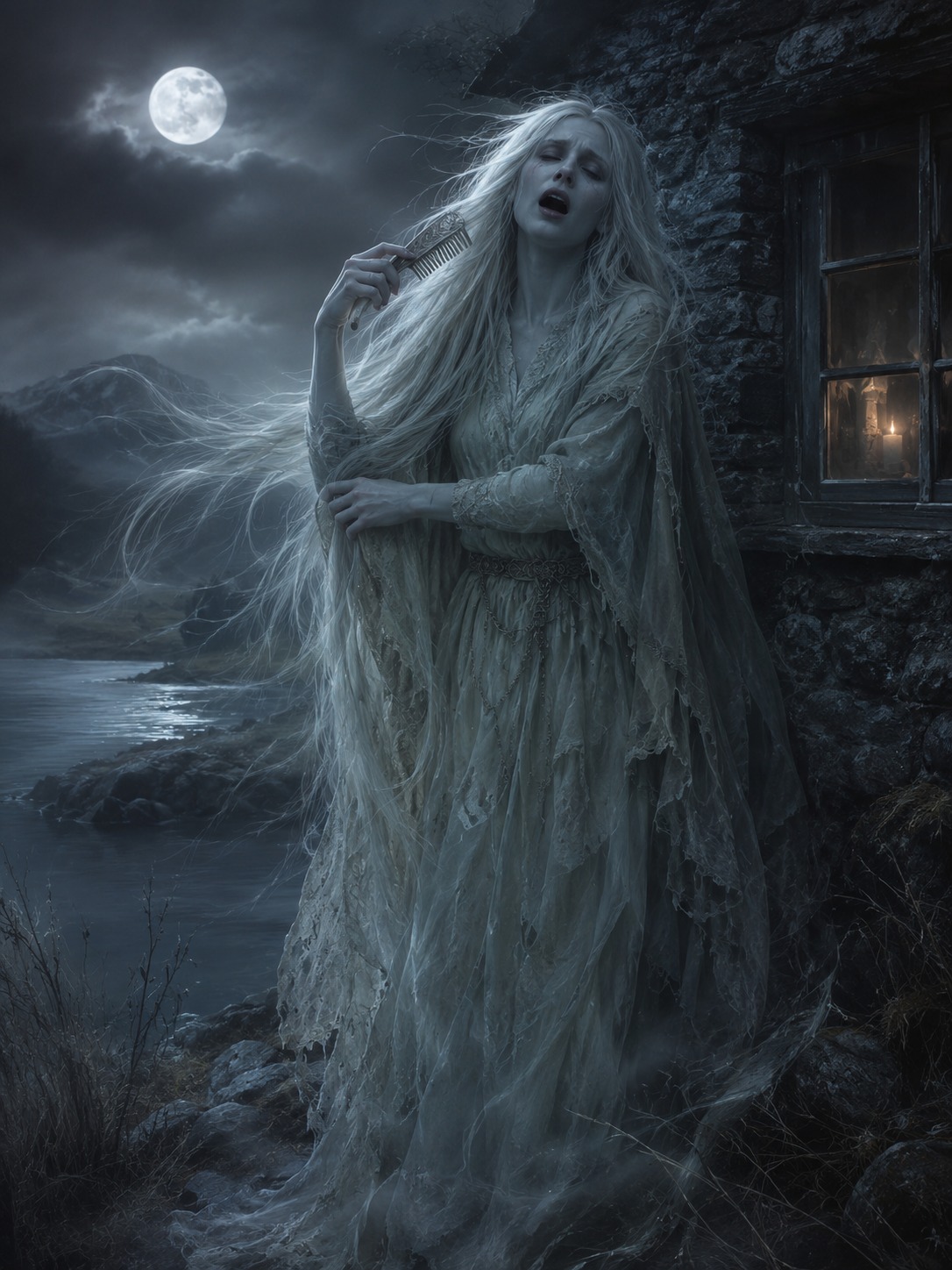
Banshee
Banshee · The Wailing Death-Herald — Lament of Celtic Lore
Names in Other Languages
 밴시한국어
밴시한국어Banshee · 죽음을 예고하는 통곡의 여귀 — 켈트 전승의 비탄
 バンシー日本語
Banshee · 死を予告する慟哭の女妖 — ケルト伝承の悲嘆
 報喪女妖繁體中文
Banshee · 預告死亡的慟哭女妖 — 凱爾特傳說的悲嘆
 BansheeDeutsch
Banshee · Die klagende Todesbotin — Wehklage keltischer Sage
 BansheeFrançais
Banshee · La pleureuse annonciatrice de mort — Lamentation du folklore celte
 BansheeEspañol
Banshee · La plañidera heraldo de muerte — Lamento del folclore celta
 BansheePortuguês
Banshee · A carpideira arauto da morte — Lamento do folclore celta
 BansheePolski
Banshee · Zawodząca zwiastunka śmierci — lament celtyckiej tradycji
 БаншиРусский
Banshee · Стенающая вестница смерти — плач кельтского предания
The Banshee (Irish Gaelic bean sí, Scottish Gaelic bean sìth, 'woman of the fairy mound') is the female spirit of Irish and Scottish Celtic tradition whose chilling wail at night foretells an imminent death in a particular family. She does not cause the death but mourns it in advance, an incarnation of grief itself. The word descends from Old Irish ben síde, with the English form banshee fixed in eighteenth-century usage. Anthropologists trace the figure to the Celtic keening tradition (caoineadh in Irish), in which women mourners wailed the dead at funerals; as the church suppressed keening, its social function was preserved in the supernatural banshee. Thomas Crofton Croker's Fairy Legends and Traditions of the South of Ireland (1825) and W. B. Yeats's Fairy and Folk Tales of the Irish Peasantry (1888) made the banshee a central figure of the Celtic Revival, and Patricia Lysaght's Banshee: The Irish Death Messenger (1986) established the scholarly canon. Marvel Comics' X-Men hero Banshee (1967), Sylvanas Windrunner the Banshee Queen of World of Warcraft (2004), and the Cinemax television series Banshee (2013-2016) have kept the figure in modern popular culture.
Origin
The etymology of banshee is Old Irish ben síde ('woman of the sí, the fairy mound'), evolving through Middle Irish ben sí to modern Irish bean sí. The English form banshee was fixed in the eighteenth century. In Celtic tradition the banshee is variously held to descend from the Tuatha Dé Danann, the mythic race said to inhabit the sí (fairy mounds), or to be the spectral afterlife of a caoineadh (keening) woman, the female mourner of Gaelic funeral tradition. Among the earliest documentary references are seventeenth-century Irish poetry and the household records of Donough MacCarthy of 1652. Thomas Crofton Croker's Fairy Legends and Traditions of the South of Ireland (1825) brought the figure into English-language scholarship; W. B. Yeats's Fairy and Folk Tales of the Irish Peasantry (1888) and The Celtic Twilight (1893) made it central to the Celtic Revival; Patricia Lysaght's Banshee: The Irish Death Messenger (1986), a doctoral study at University College Dublin based on a survey of 1700 Irish households, established the modern scholarly canon.
Features
- Pale woman with long flowing hair, which she combs
- Cloaked in grey or blood-stained robes
- Chilling wail or keening song that foretells imminent death
- Attached to particular families, traditionally the five ancient Irish lineages
- Seen weeping by streams, windows, or near burial mounds
- Does not cause harm; only announces fated death
Stories
The banshee became central to the Celtic Revival of the nineteenth century through Croker (1825) and Yeats (1888, 1893), the latter making her a key visual symbol of Irish national identity. Patricia Lysaght's Banshee (1986) established the academic canon. In modern popular culture, Marvel Comics introduced the X-Men hero Banshee (Sean Cassidy, an Irish mutant with sonic powers) in 1967, Blizzard's World of Warcraft (2004 onward) made Sylvanas Windrunner 'Banshee Queen', the Cinemax series Banshee (2013-2016) used the name for an action drama, and the first edition of Dungeons and Dragons (1974) and its descendants canonised the banshee as a standard incorporeal undead monster. The 2003 film Darkness Falls and many subsequent horror films retain the figure as a fixture of contemporary supernatural fiction.
Weakness
Because the banshee only foretells death and does not cause it, the conventional category of 'weakness' is awkward for her. Celtic folklore does include local variants in which a person who has heard the banshee may delay or avert the fated death by immediate visit to the family burial mound and prayer to ancestors. The banshee is also traditionally limited to the five ancient Gaelic families (O'Neill, O'Brien, O'Connor, O'Grady, Kavanagh), and other lineages were originally outside her remit; Patricia Lysaght's 1986 study argues that the nineteenth-century generalisation to all Irish families arises from Romantic literary expansion. Modern fantasy games have added vulnerabilities to light magic, silver weapons, and holy magic, but these are post-1974 Dungeons-and-Dragons additions absent from the Celtic original.
Cultural Significance
The banshee is not merely a death-omen spirit but the supernatural figuration of the Celtic keening tradition. Caoineadh, the wailing of women mourners at Gaelic funerals, was suppressed by the nineteenth-century Catholic Church and gradually disappeared; Patricia Lysaght argues that the social function of keening was preserved in the supernatural figure of the banshee. W. B. Yeats's Fairy and Folk Tales of the Irish Peasantry (1888) elevated the banshee to a central figure of Irish national identity, and the Celtic Revival movement made her a key visual symbol. Marvel Comics' Irish-mutant hero Banshee (Sean Cassidy, debut 1967) is a case of the Celtic figure entering mainstream Anglophone popular culture; Sylvanas Windrunner's 'Banshee Queen' title in World of Warcraft (2004 onward), the Cinemax action drama Banshee (2013-2016), and the 2003 horror film Darkness Falls extend the iconography.
In Popular Culture
- Thomas Crofton Croker, Fairy Legends and Traditions of the South of Ireland (1825) — first Anglophone diffusion
- W. B. Yeats, Fairy and Folk Tales of the Irish Peasantry (1888) and The Celtic Twilight (1893) — Celtic Revival canon
- Marvel Comics, X-Men no. 28 (1967) — Banshee (Sean Cassidy) as Irish mutant superhero
- Gary Gygax, Dungeons and Dragons first-edition boxed set (1974) — banshee canonised as undead monster
- Patricia Lysaght, Banshee: The Irish Death Messenger (1986) — academic canon
- Blizzard, World of Warcraft (2004 onward) — Sylvanas Windrunner 'Banshee Queen'
- Cinemax, Banshee television series (2013-2016) — modern action drama appropriation
Trivia
The etymology bean sí literally translates as 'woman of the sí', the fairy mound believed to be inhabited by the mythic Tuatha Dé Danann. The Scottish Gaelic form bean sìth is phonologically almost identical. Celtic tradition also includes related death-omen spirits: the Scottish bean-nighe ('washer at the ford'), who washes the blood-stained clothes of the doomed by streams, and the Welsh cyhyraeth, an aural death-omen. Patricia Lysaght's 1986 Banshee: The Irish Death Messenger, based on a survey of approximately 1700 households across Ireland, is the most extensive folklore study of the figure to date. Marvel Comics' superhero Banshee, debuting in X-Men no. 28 (1967), is an Irish mutant with sonic flight and sonic-blast powers; he was killed in the comics shortly before the events of X-Men: Days of Future Past (2014) and therefore did not appear in the film.