Jinn
Spiritual Beings of Arab/Islamic Mythology
Names in Other Languages
 진한국어
진한국어Jinn · 아랍·이슬람 신화의 영적 존재
 ジン日本語
ジン日本語Jinn · Syllairon — 上位の風の精霊
 金恩繁體中文
Jinn · Syllairon — 上位風之精靈
 DschinnDeutsch
Dschinn · Syllairon — Überlegener Windgeist
 DjinnFrançais
Djinn · Syllairon — Esprit du vent supérieur
 GenioEspañol
Genio · Syllairon — Espíritu del viento superior
 GênioPortuguês
Gênio · Syllairon — Espírito do vento superior
 DżinnPolski
Dżinn · Syllairon — Wyższy duch wiatru
 ДжиннРусский
Джинн · Силлайрон — Высший дух ветра
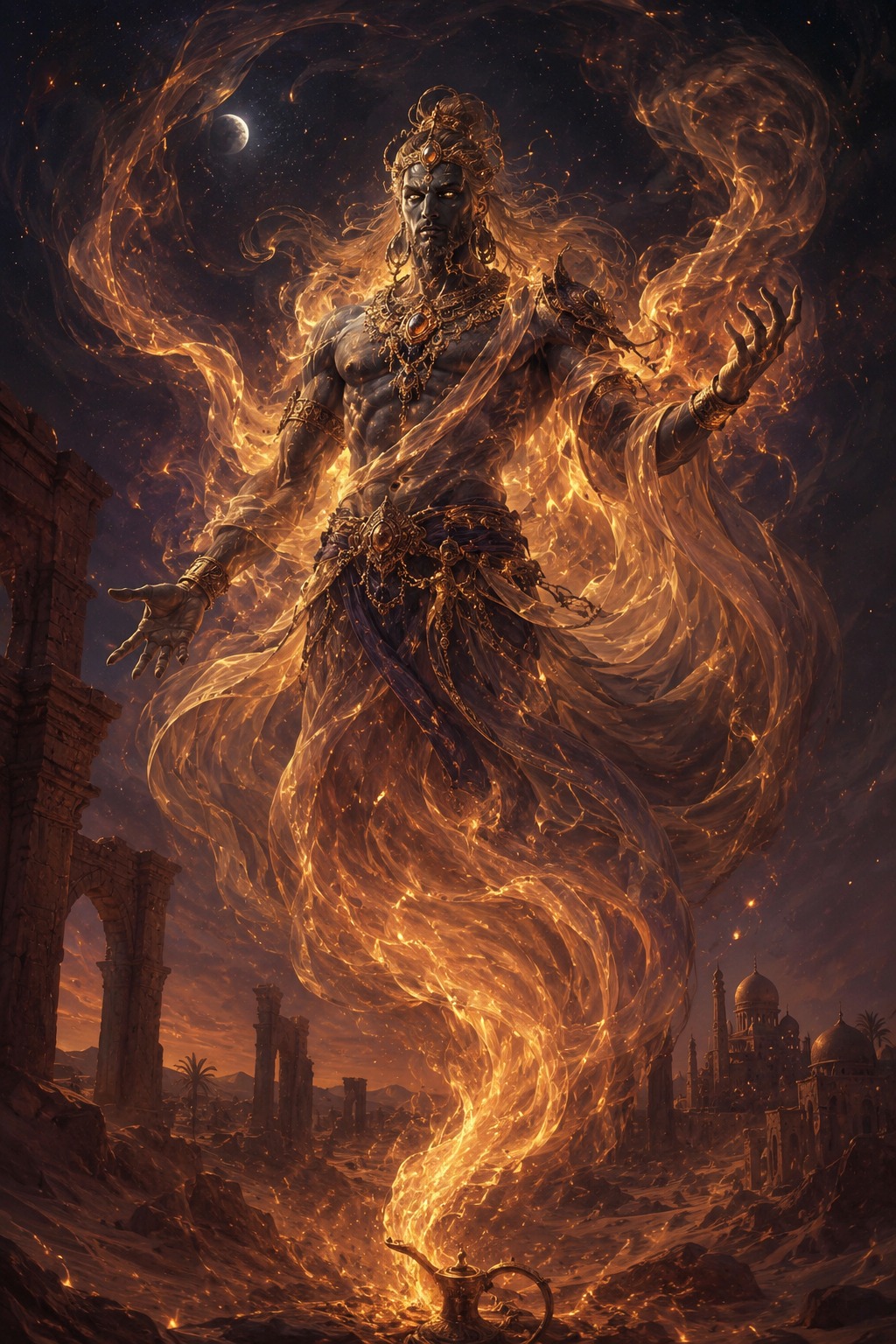
The Jinn (Arabic Jinn, English Jinn or Djinn) is the canonical iconographic figure of the spiritual being of Arab-Islamic mythology, dwelling between humans and angels (mala'ika). The etymology derives from the Arabic root J-N-N (meaning 'hidden, invisible'), and is canonical vocabulary with etymological kinship to the Latin genius (guardian spirit). The decisive textual canon is the canon of Surat al-Jinn (Chapter 72 'The Jinn') of the Quran (Qur'an) revealed to the prophet Muhammad (Muhammad, c. 570-632) by the angel Gabriel c. 610-632 CE — in which the Jinn hear Muhammad's revelation and convert to Islam — the decisive canon, and the canon of Chapter 51 verse 56 of the same Quran — 'I have not created jinn and humans except to worship me' — is the decisive canon of the purpose of the Jinn's existence. The decisive Western canon is the canon of Aladdin's Lamp and the Fisherman and the Jinn of the Alf Layla wa-Layla (One Thousand and One Nights) compiled in the Mamluk dynasty of Arab Syria and Egypt in the 14th-15th centuries, and the French translation Les Mille et une Nuits (12 volumes total) by the French Orientalist Antoine Galland (1646-1715) of 1704-1717 decisively settled the Western Jinn canon, and the Genie (voiced by Robin Williams) of the Disney animated film Aladdin, released on 25 November 1992 in the USA, is the decisive culminating work of the global Jinn canon of the 20th century.
Origin
The iconographic origin began with the desert-spirit worship of pre-Islamic Arab polytheism (Jahiliyya) and was systematised as a decisive canonical being of Islamic theology through the Islamic revelation to the prophet Muhammad c. 610-632 CE. The decisive textual canon is the canon of Surat al-Jinn (Chapter 72) of the Islamic scripture Quran — in which the Jinn hear Muhammad's revelation and convert to Islam — and verses 14-15 of Chapter 55 Ar-Rahman — 'God created humans from clay and Jinn from a smokeless flame (marij min nar)' — the decisive canon. The canon of verses 38-40 of Chapter 27 An-Naml — in which King Solomon (Sulayman) brings the throne of the Queen of Sheba (Bilqis) with the help of the Jinn — and verses 12-13 of Chapter 34 Saba — in which Solomon employs the Jinn to build great bronze structures — is the decisive Solomon-and-Jinn canon. The Book of Animals (Kitab al-Hayawan) of the ninth-century Abbasid-dynasty Islamic theologian Al-Jahiz (c. 776-868) and The Wonders of Creation (Aja'ib al-Makhluqat) of the thirteenth-century Al-Qazwini (Zakariyya al-Qazwini, 1203-1283) established the decisive canon of the five types of Jinn — Jann (common Jinn), Jinn (general Jinn), Shaytan (devil), Ifrit (powerful devil), Marid (most powerful Jinn). The decisive Western iconographic canon is the canons of the Fisherman and the Jinn, Aladdin's Lamp, and Solomon and the Jar-Jinn of the One Thousand and One Nights compiled in the Mamluk dynasty of the Arabs in the 14th-15th centuries, and the French translation by Galland of 1704-1717 and the English translation (16 volumes total) by the British Richard Francis Burton (1821-1890) of 1885-1888 decisively settled the 19th-century Western Jinn canon.
Features
- Born from smokeless flame
- Transforms into various forms (human, animal, monster)
- Powerful magic
- Free will (both good and evil possible)
- Can hold Islamic faith
- Very long lifespan
Stories
The Jinn canon of Surat al-Jinn (Chapter 72), verses 14-15 of Chapter 55 Ar-Rahman, and verses 38-40 of Chapter 27 An-Naml of the Quran revealed to the prophet Muhammad c. 610-632 CE is the decisive origin, and the Book of Animals of the ninth-century Al-Jahiz and the Wonders of Creation of the thirteenth-century Al-Qazwini systematised the canon of the five types of Jinn. The decisive Western iconographic canon is the canons of the Fisherman and the Jinn, Aladdin's Lamp, and Solomon and the Jar-Jinn of the Alf Layla wa-Layla (One Thousand and One Nights) compiled in the Mamluk dynasty of the Arabs in the 14th-15th centuries, and the French translation Les Mille et une Nuits (12 volumes total) by the French Galland of 1704-1717 and the English translation The Book of the Thousand Nights and a Night (16 volumes total, privately published) by the British Richard Burton (1821-1890) of 1885-1888 decisively settled the 19th-century Western Jinn canon. The Tales of the Alhambra of 1819 by the American writer Washington Irving (1783-1859) — depicting the Jinn of the Moorish palace Alhambra in Granada, Spain — settled the Jinn iconography in American literature, and the 1900 novel The Brass Bottle by the British writer F. Anstey (real name Thomas Anstey Guthrie, 1856-1934) became the decisive Jinn canon of Victorian Britain. The 1965-1970 American NBC sitcom I Dream of Jeannie — produced by Sidney Sheldon, starring Barbara Eden — settled the 20th-century American Jinn canon, and the Djinni and Efreeti of the 1977 D&D Monster Manual by Gygax of TSR in the USA — consistent through to 5e (5th Edition) of 2014 — is the decisive canon of the modern fantasy RPG Jinn. The decisive film canon is the Disney animated film Aladdin (directed by John Musker and Ron Clements, with Genie voiced by Robin Williams), released on 25 November 1992 in the USA, with worldwide box office of about 504 million dollars — the decisive culminating work of the global Jinn canon — and the 24 May 2019 live-action film Aladdin (directed by Guy Ritchie, starring Will Smith) established the 21st-century Jinn canon.
Weakness
The Jinn's weaknesses are: (1) Solomon's seal — the decisive sealing canon in the canons of verses 38-40 of Chapter 27 An-Naml and verses 12-13 of Chapter 34 Saba of the Quran and the 14th-15th-century Fisherman and the Jinn of the One Thousand and One Nights that King Solomon's (Sulayman's) magic ring-seal can seal the Jinn in a jar or lamp; (2) the name of God (Allah) — the decisive canon in Islamic theology that a devout prayer calling the name of God weakens and seals the Jinn; (3) iron — the decisive canon in the One Thousand and One Nights and medieval Arab folklore that the Jinn is weak against iron (with kinship to Western fairy canon); (4) salt — the canon in medieval Arab folklore that the Jinn fears salt; (5) devout humans — the canon of Surat al-Jinn of the Quran that the Jinn can convert to Islam and weaken before devout humans; (6) sealed vessels — the decisive canonical weakness in the One Thousand and One Nights that the Jinn trapped in a jar, lamp, or brass bottle must grant the wishes of the one who frees it; (7) limited wishes — the canon in the Aladdin's Lamp of the One Thousand and One Nights that the Jinn of the lamp grants only limited wishes — usually three; (8) light and sacred verses — Islamic amulets (ta'widh) and Quranic verses weaken the Jinn. The 3-wish and wish-limitation rules of the Genie of the 1992 Disney film Aladdin (no killing, no resurrecting the past, no making one fall in love, no infinite renewal of wishes) is the decisive canon of the 20th-century global Jinn canon rules, and the canonical ending of the film — in which the Genie attains freedom through Aladdin's third wish — is the decisive canon.
Cultural Significance
The Jinn is not merely a spiritual-being icon but the canonical iconographic figure of the Arab-Western spiritual-being canon traversing pre-Islamic Arab polytheistic desert-spirit belief, the Quran of the prophet Muhammad c. 610-632 CE, the ninth-century Al-Jahiz's Book of Animals, the thirteenth-century Al-Qazwini's Wonders of Creation, the 14th-15th-century One Thousand and One Nights, the 1704-1717 French Galland translation, the 1885-1888 British Burton translation, the 1965 American I Dream of Jeannie, the 1977 D&D Monster Manual, and the 1992 Disney Aladdin. The Quran revealed to the prophet Muhammad (c. 570-632, active in Mecca and Medina) by the angel Gabriel c. 610-632 CE — 114 chapters in total — is the decisive scripture of Islam, and Surat al-Jinn (Chapter 72 'The Jinn', 28 verses in total) systematising the Jinn as a decisive canonical being of Islamic theology is the decisive event. The One Thousand and One Nights (Alf Layla wa-Layla) compiled in the Mamluk dynasty of Arab Syria and Egypt in the 14th-15th centuries — absorbing the Persian original Hazar Afsan (Thousand Tales) and Arab-Indian-Egyptian-Greek canons — is the decisive canon of Arab medieval literature, and the French translation Les Mille et une Nuits (12 volumes total) by the French Galland (1646-1715) of 1704-1717 — with Aladdin's Lamp and Ali Baba and the Forty Thieves added from the oral narration of the Syrian historian Hanna Diyab — is the decisive canon of 18th-century European Orientalism. The 1819 Tales of the Alhambra of the American writer Washington Irving (1783-1859) and the 1885-1888 English translation (16 volumes total) of the One Thousand and One Nights by the British Richard Burton (1821-1890) are evaluated as the decisive canon of Victorian-British Orientalism, and the 25 November 1992 Disney Aladdin (directed by John Musker and Ron Clements, with Genie voiced by Robin Williams, 90 minutes, worldwide box office of about 504 million dollars) became the decisive culminating work of the 20th-century global Jinn canon.
In Popular Culture
- Quran, Surat al-Jinn (Chapter 72) (c. 610-632 CE) — decisive canonical chapter of the Jinn
- Quran, Chapter 55 Ar-Rahman verses 14-15 — decisive canon of Jinn creation
- Quran, Chapter 27 An-Naml verses 38-40 — Solomon-and-Jinn canon
- Al-Jahiz, Book of Animals (ninth century) — Islamic-theological Jinn canon
- Al-Qazwini, Wonders of Creation (thirteenth century) — canon of five-type Jinn classification
- One Thousand and One Nights (14th-15th centuries) — Arab decisive canon of Fisherman and Jinn and Aladdin's Lamp
- Antoine Galland French translation (1704-1717) — decisive Western settlement of Jinn canon
- Richard Burton English translation (1885-1888) — Victorian-British Jinn canon
- American sitcom I Dream of Jeannie (1965-1970) — 20th-century American Jinn canon
- Disney Aladdin (1992) — decisive global Jinn cinematic canon
Trivia
The Arabic Jinn (Jinn) — the noun form of the root J-N-N (meaning 'hidden, invisible') — means 'the hidden one, the invisible one', and is canonical vocabulary with recognised etymological kinship to the Latin genius (guardian spirit). The English Jinn (first attested in 1684), Djinn (1825), and Genie (1655 from French genie) are canonical vocabulary, and the 1655 French genie — borrowed from the Latin genius (guardian spirit) — settled as the canonical translation of the Arabic jinn in Galland's French translation of the One Thousand and One Nights of 1704-1717. The Quran revealed to the prophet Muhammad (c. 570-632) by the angel Gabriel c. 610-632 CE — 114 chapters in total — is the decisive scripture of Islam, and the Jinn — as the intermediate being between humans and angels — appears in over 30 chapters. The five types of Jinn — Jann, Jinn, Shaytan, Ifrit, Marid — is the classification canon of the ninth-century Al-Jahiz and the thirteenth-century Al-Qazwini, and the decisive theological canon was established in verse 34 of Chapter 2 Al-Baqara of the Quran — that Iblis (Iblis), who disobeyed when God commanded the angels to bow to Adam, was a Jinn and not an angel. The French translation (12 volumes total, Paris Barbin Press) of the One Thousand and One Nights by the French Orientalist Antoine Galland (1646-1715) of 1704-1717 — with Aladdin's Lamp and Ali Baba and the Forty Thieves added from the oral narration of the Maronite Christian Hanna Diyab (Hanna Diyab, 1688-1763) of Aleppo, Syria, whom Galland heard in Paris in 1709 — became the decisive canon of 18th-century European Orientalism. The Genie voiced by Robin Williams (1951-2014) in the 25 November 1992 Disney Aladdin is the decisive culminating work of the 20th-century global Jinn — being the first improvisational comedy-ad-lib voice acting in Disney history — and recorded a worldwide box office of about 504 million dollars.
Related

Ariel
Air Spirit from Shakespeare's The Tempest

Sylph
Air Spirit of Paracelsus

Suzaku
Suzaku · 朱雀 — Sacred Red Bird of the South

Ifrit
Fire Jinn of Arab/Islamic Mythology

Agni
Agni — Sacred Messenger of the Flame

Sylphide
Small Sylph from Pope's The Rape of the Lock

Ignis Fatuus
Latin 'Foolish Fire,' Scientific Name for Will-o'-the-Wisp
Cinder Sprite
Small Flame Spirit Dwelling in Embers

Salamander
Fire Spirit of Paracelsus

Fire-drake
Fire Dragon of Beowulf and Norse Myth

Phoenix Spirit
Spirit Form of the Immortal Phoenix
Kagutsuchi
Kagutsuchi · 軻遇突智 — King of the Destructive Flame