Agni
Agni — Sacred Messenger of the Flame
Names in Other Languages
 아그니한국어
Agni — 신성한 불꽃의 사자
 アグニ日本語
Agni — 神聖な炎の使者
 阿耆尼繁體中文
Agni · 神聖火焰的使者
 AgniDeutsch
Agni — Heiliger Bote der Flamme
 AgniFrançais
Agni — Messager Sacré de la Flamme
 AgniEspañol
Agni — Mensajero Sagrado de la Llama
 AgniPortuguês
Mensageiro sagrado da chama
 AgniPolski
Agni — Święty Posłaniec Płomienia
 АгниРусский
Agni — Священный Вестник Пламени
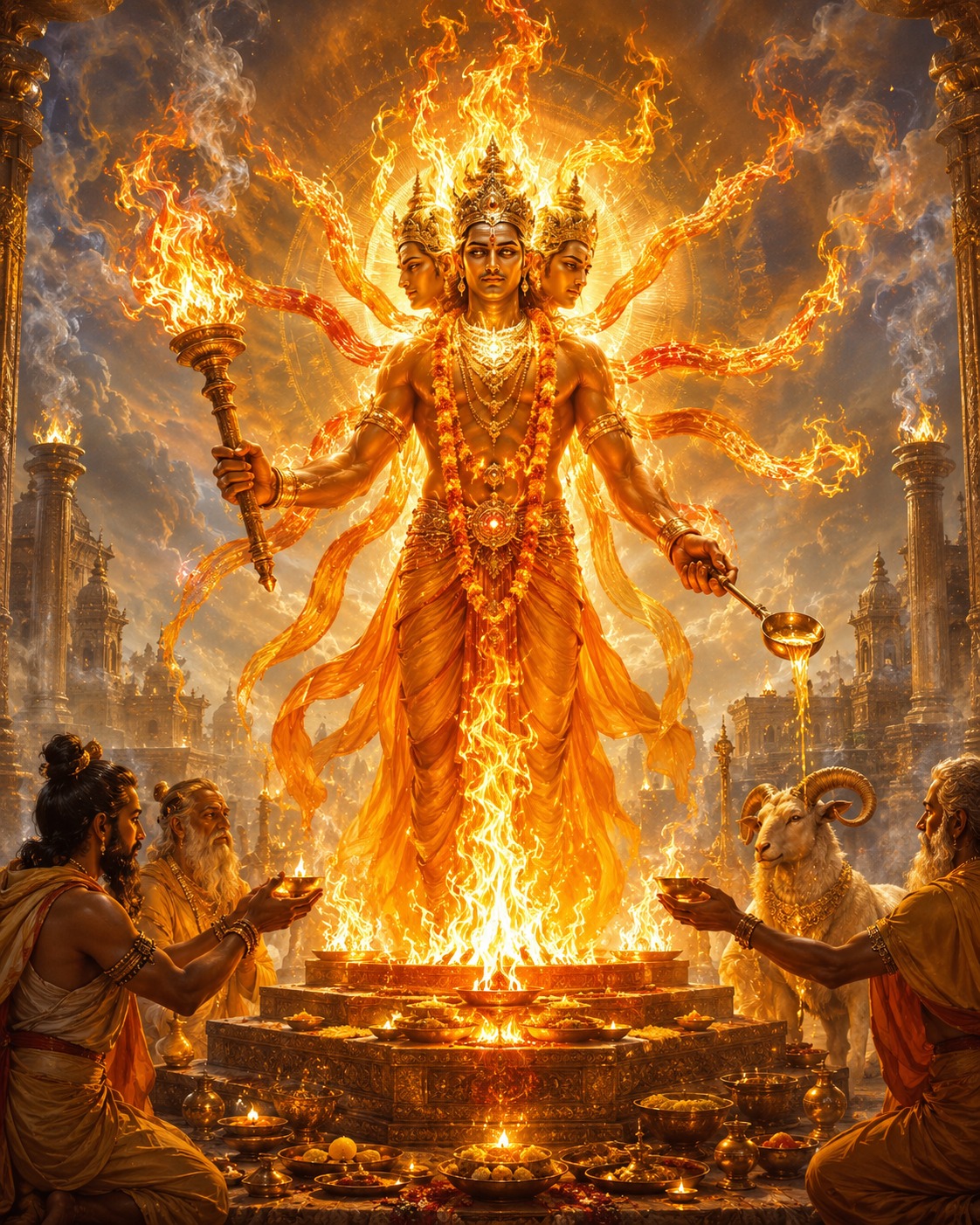
Agni (Sanskrit Agni) is the decisive canonical iconographic figure of the god of fire and the sacred messenger linking gods and humans in Indian Vedic mythology. The etymology is the Sanskrit agni ('fire'), derived from the Indo-European root h1ngnis ('fire'), cognate with the Latin ignis, the Lithuanian ugnis, and the Russian ogon ('fire') — the decisive canonical vocabulary. With the iconography of a polycephalic form having three heads and seven tongues — holding a torch and a ladle in both hands — and various sacred vehicles such as a ram, horse, and parrot — the decisive canonical iconography. The decisive canon is the c. 1500-1200 BCE Indian Vedic-era Rigveda (Rigveda) — Book 1.1 first hymn 'agnim ile purohitam' ('I praise Agni, the household priest') — the decisive canon. Among the 1,028 hymns in 10 books of the Rigveda, over 200 are dedicated to Agni — the most praised god after Indra (Indra) — and the decisive canonical mediator of the yajna (Vedic fire ritual), in which the offerings of humans to the gods (cows, grains, clarified butter, ghee) are burned by his flames and delivered to the gods — the cosmic decisive canonical iconography. In later Hinduism, the decisive canon of the southeastern guardian among the 8 directional guardians (Astadikpalas), and the Katen of Japanese Buddhism is the direct adoption of Agni.
Origin
The iconographic origin is the primitive fire-worship of the Indo-European language family, and the etymology Sanskrit agni — derived from the Indo-European root h1ngnis ('fire') — is the decisive canonical vocabulary cognate with the Latin ignis, the Lithuanian ugnis, the Russian ogon, the English ignite, and the English ignition. The decisive textual canon is the Rigveda (Rigveda) of the c. 1500-1200 BCE Indian Vedic era — the Saraswati-Sindhu river basin of northern India — Book 1.1 first hymn 'agnim ile purohitam yajnasya devam rtvijam' ('I praise Agni, the household priest, the divine priest of the ritual and the hotri') — the decisive canon, and among the 1,028 hymns in 10 books of the Rigveda, over 200 are dedicated to Agni, the most praised god after Indra (Indra, 250 hymns). The c. 6th-century-BCE Sanskrit Shatapatha Brahmana (Satapatha Brahmana, Brahmana of a hundred paths) decisively systematised the canon of yajna (Vedic fire ritual) of Agni, and the c. 5th-3rd-century-BCE Mahabharata (Mahabharata, Mahabharata) and Ramayana (Ramayana, Ramayana) established the mythological canon of Agni as the decisive epic canon. In later Hindu Purana (Purana) canon, the canon of the southeastern guardian among the 8 directional guardians (Astadikpalas) was settled.
Features
- Polycephalic form with three heads and seven tongues
- Holds a torch and a ladle (sruk) in both hands
- Sacred vehicles such as a ram, horse, and parrot
- Decisive mediator of the yajna ritual
- Simultaneously governs purification and annihilation
- Southeastern guardian among the 8 directional guardians
Stories
The c. 1500-1200 BCE Rigveda — Book 1.1 first hymn — Agni decisive canon and over 200 hymns are the decisive origin, and the c. 6th-century-BCE Shatapatha Brahmana systematised the decisive canon of the yajna (yajna) ritual. The decisive later canon is the c. 5th-3rd-century-BCE Mahabharata and Ramayana epic canon, and in later Hindu Purana (Purana) canon, the canon of the southeastern guardian among the 8 directional guardians (Astadikpalas) was settled. The Katen of Japanese Buddhism — the 8th-century Japanese Heian-era mandala — is the decisive canonical direct adoption of Agni, and the Sacred Books of the East (Sacred Books of the East) series of the 1879 British Sanskrit scholar Max Muller (Max Muller, 1823-1900) — Oxford — is the decisive 19th-century Western scholarly canon. The Agni (Agni) of the 1985 D&D Legends & Lore (Legends & Lore) by Gary Gygax of TSR in the USA and the magic 'Fira/Firaga/Fire' of the Final Fantasy series of Square (Square) of Japan released on 18 December 1987 are modern video-game canons. The decisive 21st-century canon is the Agni (Agni) missile series — the decisive canon of Indian defence — of the Indian DRDO (Defence Research and Development Organisation) test-launched in India on 22 May 1989, and the Marvel Studios film Avengers: Infinity War (Avengers: Infinity War) (directed by the Russo Brothers, worldwide box office about 2.048 billion dollars) released in the USA on 6 April 2018 — the scene of Thor's new weapon Stormbreaker creation — is the 21st-century global film canon.
Weakness
Agni's weaknesses are: (1) defiled flame — the decisive canonical weakness that a fire lit in an impure place annihilates Agni's purifying ability — the decisive canon; (2) a spirit-priest who has lost purity — in the ritual canon, if the spirit-priest becomes impure, a contract with Agni is impossible — the decisive canon; (3) wrong ritual — in the Vedic ritual canon, wrong rituals — that is, wrong mantras and wrong offerings — invoke Agni's wrath — the decisive canon; (4) strong water — in the four-element canon, strong rain and floods weaken Agni's fire; (5) balance with Indra — in the Vedic canon, Indra (thunder) and Agni (fire) are mutually complementary, but when one is strong, the other is weak — the decisive canon; (6) absence of light — the theological binding of darkness and light in the Vedic canon — the decisive canon; (7) sacred sealing — the sealing of sacred mantras in the Purana canon — the decisive canon; (8) environmental binding — environmentally bound to the southeastern direction in the 8 directional guardian canon — the decisive canon. The decisive canonical finale is the cremation hymn of the c. 1500-1200 BCE Rigveda Book 10.16 — Agni delivering the human soul to the divine realm — the decisive death-ritual canon, and in later Hindu canon, all bodies are cremated by Agni's flames and delivered to the divine realm — the decisive Vedic canon.
Cultural Significance
Agni is not merely a fire-god icon but the canonical iconographic figure of the decisive Indo-pan-Asian fire canon, traversing the c. 1500-1200 BCE Rigveda, the c. 6th-century-BCE Shatapatha Brahmana, the c. 5th-3rd-century-BCE Mahabharata and Ramayana, the later Hindu Purana, the 8th-century Japanese Heian-era Katen mandala, the 1879 Max Muller's Sacred Books of the East, the 1985 D&D Legends & Lore, and the 2014 Indian ISRO Agni missile series. The decisive textual canon is the Rigveda (Rigveda) of the c. 1500-1200 BCE Indian Vedic era — the Saraswati-Sindhu river basin of northern India — 10 books, 1,028 hymns — Book 1.1 first hymn 'agnim ile purohitam' ('I praise Agni, the household priest') — the decisive canon, and over 200 hymns are dedicated to Agni — the most praised god after Indra (Indra, 250 hymns) — the decisive canon. The c. 6th-century-BCE Sanskrit Shatapatha Brahmana (Satapatha Brahmana) decisively systematised the canon of yajna (Vedic fire ritual), and the c. 5th-3rd-century-BCE Mahabharata (Mahabharata) and Ramayana (Ramayana) epic canon — the mythological canon of Agni — is the decisive canon. In later Hindu Purana canon, the canon of the southeastern guardian among the 8 directional guardians (Astadikpalas) was settled, and the Katen (Katen) of the 12 deities (Junitten) in the 8th-century Japanese Heian-era mandala (Garbhakosa-mandala and Vajradhatu-mandala) is the decisive canonical direct adoption of Agni. The decisive 21st-century canon is the Agni (Agni) missile series — the decisive canon of Indian defence — test-launched in India on 22 May 1989, and the Marvel Studios film Avengers: Infinity War (Avengers: Infinity War) (directed by the Russo Brothers, worldwide box office about 2.048 billion dollars) released in the USA on 6 April 2018 — the scene of Thor's new weapon Stormbreaker creation — is the 21st-century global film canon.
In Popular Culture
- Rigveda Book 1.1 first hymn (c. 1500-1200 BCE) — decisive origin canon
- Rigveda over 200 hymns (c. 1500-1200 BCE) — decisive Vedic canon
- Shatapatha Brahmana yajna ritual (c. 6th century BCE) — decisive ritual canon
- Mahabharata, Ramayana (c. 5th-3rd centuries BCE) — decisive epic canon
- 8th-century Japanese Heian-era Katen mandala — decisive East Asian adaptation
- Max Muller, Sacred Books of the East (1879) — decisive Western scholarly canon
- TSR D&D Legends & Lore, Agni (1985) — decisive fantasy RPG canon
- ISRO Agni missile series (1989) — decisive Indian defence canon
- Marvel film Avengers: Infinity War (2018) — decisive 21st-century global film canon
- Square Final Fantasy series (1987-) — decisive video-game canon
Trivia
The etymology Sanskrit agni of Agni (Agni) — derived from the Indo-European root h1ngnis ('fire') — is the decisive canonical vocabulary cognate with the Latin ignis (ignis, 'fire'), the Lithuanian ugnis, the Russian ogon (ogon, 'ogon'), the English ignite (to ignite), and the English ignition (ignition). The decisive textual canon is the Rigveda (Rigveda) of the c. 1500-1200 BCE Indian Vedic era — the Saraswati-Sindhu river basin of northern India — 10 books, 1,028 hymns — Book 1.1 first hymn 'agnim ile purohitam yajnasya devam rtvijam hotaram ratnadhatamam' ('I praise Agni, the household priest, the divine priest of the ritual, and the hotri, the giver of the greatest jewels') — the decisive canon, and over 200 hymns are dedicated to Agni — the most praised god after Indra (Indra, 250 hymns). The c. 6th-century-BCE Sanskrit Shatapatha Brahmana (Satapatha Brahmana, Brahmana of a hundred paths) decisively systematised the canon of yajna (Vedic fire ritual), and in later Hindu Purana (Purana) canon, the canon of the southeastern guardian among the 8 directional guardians (Astadikpalas) — Vishnu, Indra, Varuna, Kubera, Ishana, Niriti, Vayu, Agni — was settled. The Katen (Katen) of the 12 deities (Junitten) in the 8th-century Japanese Heian-era — Garbhakosa-mandala and Vajradhatu-mandala — is the decisive canonical direct adoption of Agni. The decisive 21st-century canon is the Agni (Agni) missile series (Agni-I, II, III, IV, V) of the Indian DRDO (Defence Research and Development Organisation) test-launched at Balasore, Odisha state, India on 22 May 1989 — the decisive canon of Indian defence — and in the Marvel Studios film Avengers: Infinity War (Avengers: Infinity War) (directed by Anthony and Joe Russo Brothers, worldwide box office about 2.048 billion dollars) released in the USA on 6 April 2018, the scene of Thor's new weapon Stormbreaker creation — the decisive visual canon of the sacred flame of Indian mythology Agni — is the 21st-century global film canon.
Related

Fire-drake
Fire Dragon of Beowulf and Norse Myth

Logi
Logi — Spirit of the Consuming Flame

Suzaku
Suzaku · 朱雀 — Sacred Red Bird of the South

Ifrit
Fire Jinn of Arab/Islamic Mythology
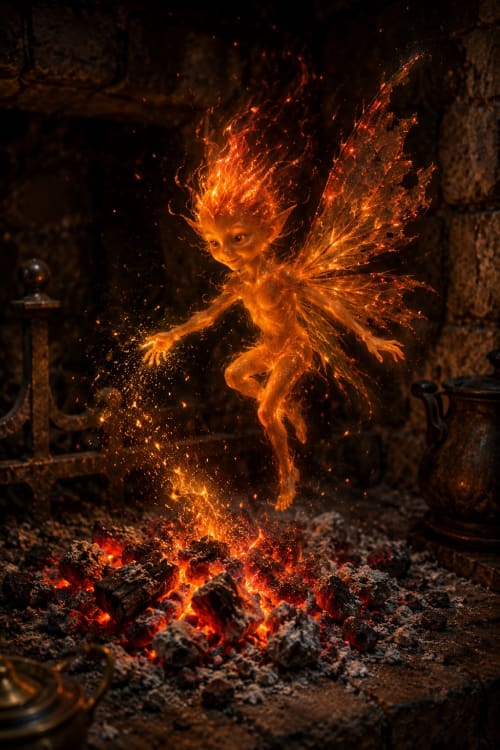
Cinder Sprite
Small Flame Spirit Dwelling in Embers

Salamander
Fire Spirit of Paracelsus
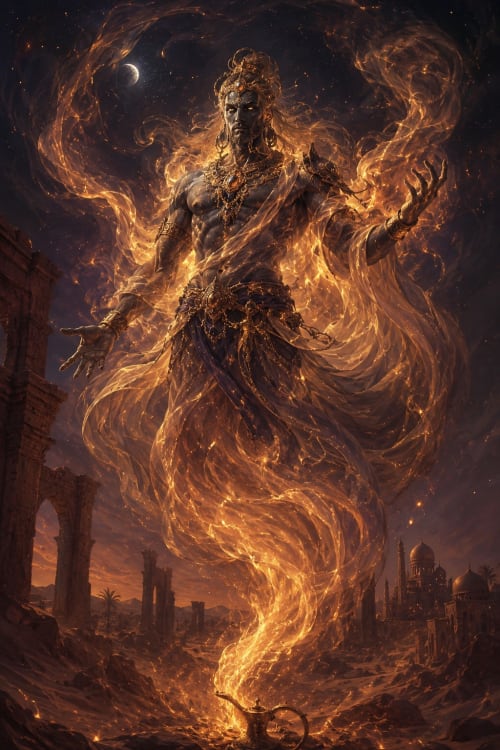
Jinn
Spiritual Beings of Arab/Islamic Mythology

Phoenix Spirit
Spirit Form of the Immortal Phoenix
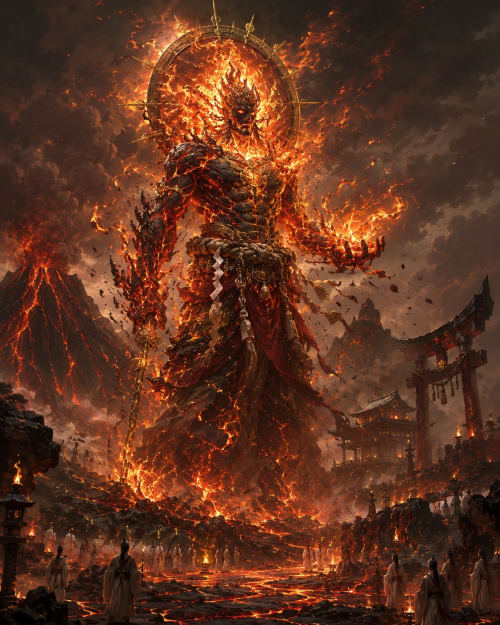
Kagutsuchi
Kagutsuchi · 軻遇突智 — King of the Destructive Flame

Ignis Fatuus
Latin 'Foolish Fire,' Scientific Name for Will-o'-the-Wisp