Hamadryad
Greek Tree Spirit Bound to a Single Tree
Names in Other Languages
 하마드리아드한국어
Hamadryad · 특정 나무에 결속된 그리스 신화의 정령
 ハマドリュアス日本語
Hamadryad — 森の中位精霊
 哈瑪德律阿得斯繁體中文
Hamadryad — 森林中位精靈
 HamadryadeDeutsch
Hamadryad — Mittlerer Waldgeist
 HamadryadeFrançais
Hamadryad — Esprit Forestier Intermédiaire
 HamadríadeEspañol
Hamadryad — Espíritu Forestal Intermedio
 HamadríadePortuguês
Hamadryad — Espírito Florestal Intermediário
 HamadriadaPolski
Hamadryad — Pośredni Duch Lasu
 ГамадриадаРусский
Hamadryad — Средний Лесной Дух
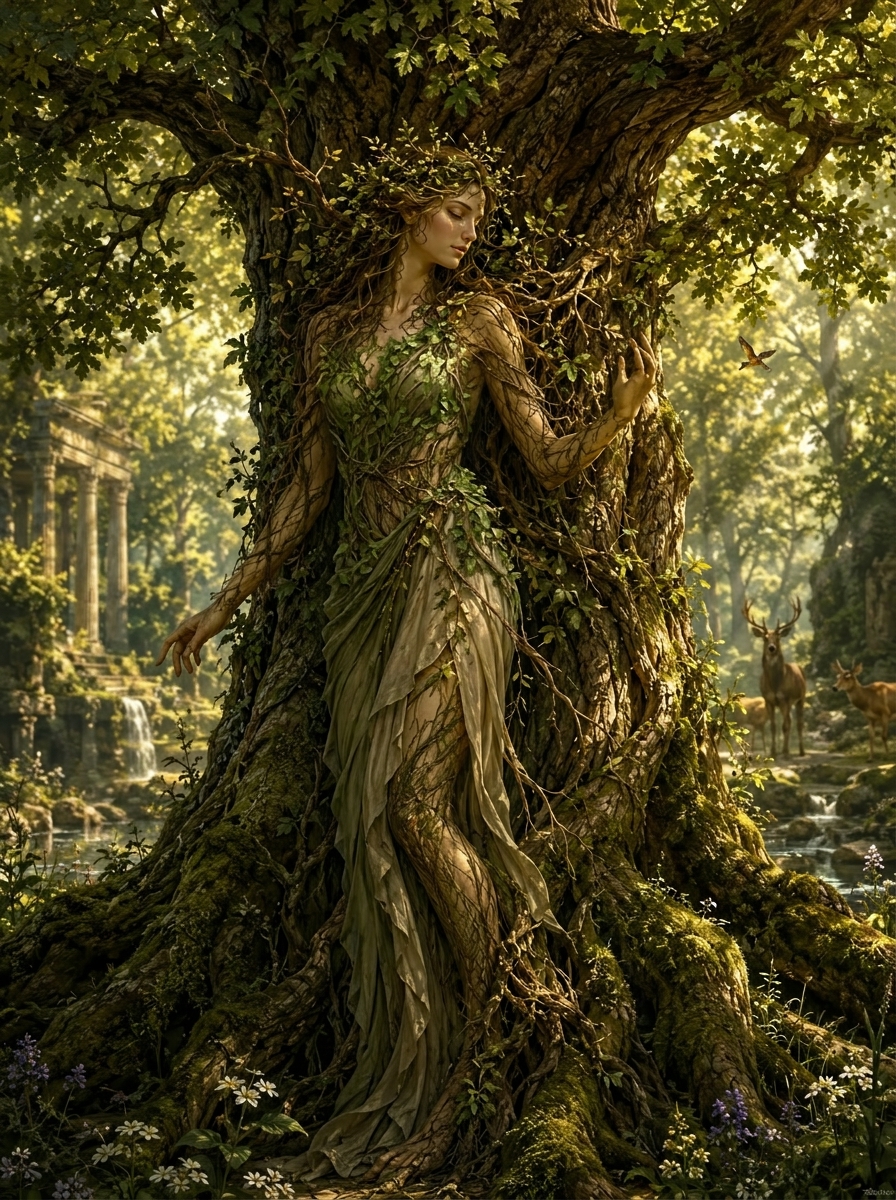
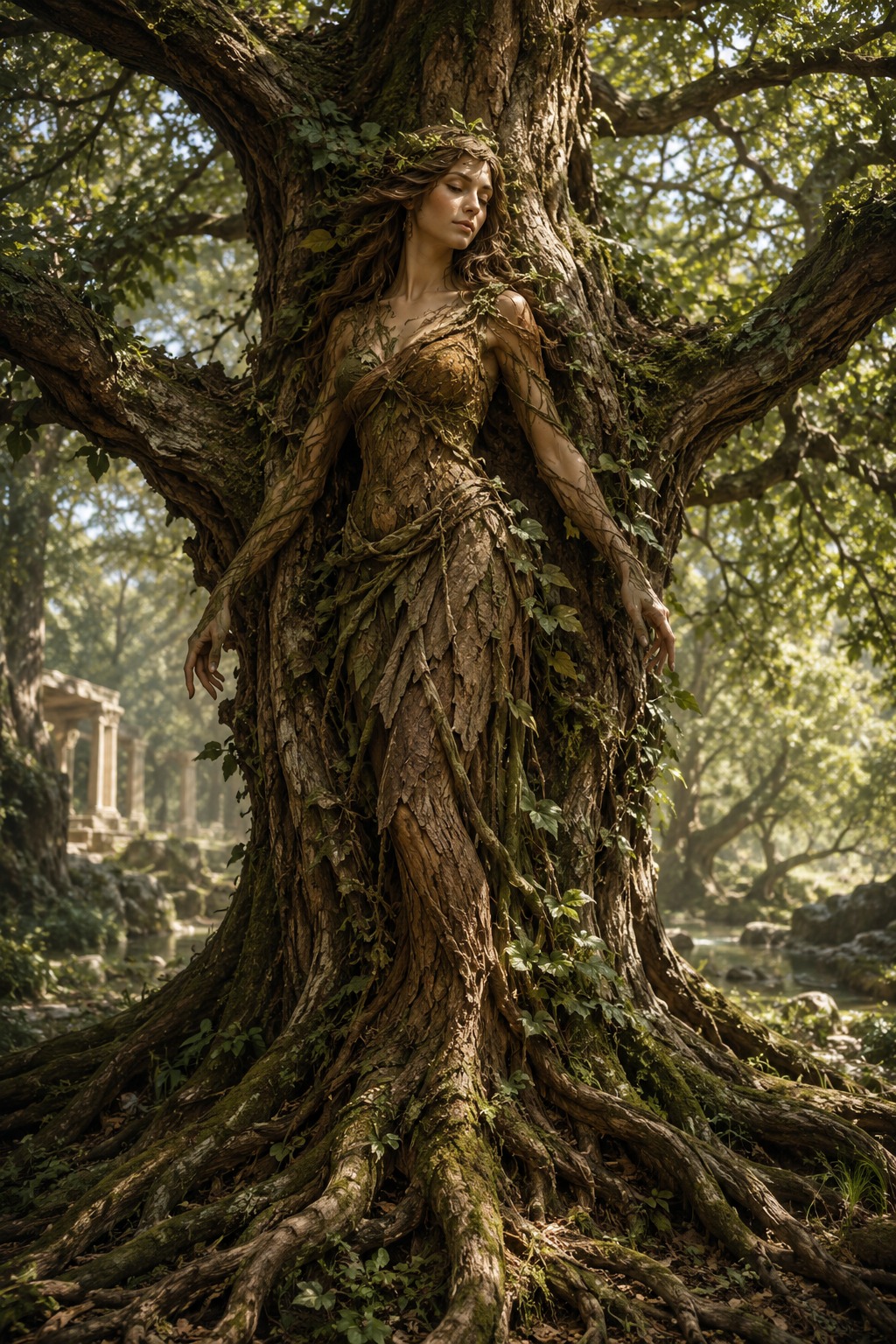
The Hamadryad (Greek Hamadryas, plural Hamadryades, English Hamadryad) is the canonical tree-spirit iconography of Greek mythology — unlike the general Dryad, permanently bound to a single specific tree — sharing the lifespan and fate of that tree as the decisive canon. The etymology is the compound of the Greek hama ('with, together') and drys ('oak, tree'), meaning 'with the tree' — the decisive canonical vocabulary — and while the general Dryad (Dryas) is a free spirit dwelling in all trees, the Hamadryad is the decisive adaptation canon permanently bound to a single tree. The decisive textual canon is the fragmentary canon of the Precepts of Chiron of the c. 700 BCE Greek poet Hesiod (Hesiodos) — quoted by the c. 1st-century Greek writer Plutarch (Ploutarchos) in Chapter 11 of On the Decay of Oracles (De Defectu Oraculorum) — that the Hamadryad's lifespan equals nine generations of crows (about 9 years times 9 equals 81 years), and the canon of lines 476-485 of Book 2 of the Argonautica (Argonautika) of the 4th-3rd-century-BCE Alexandrian poet Apollonius Rhodius (Apollonios Rhodios, 295-215 BCE) — in which the Phrygian shepherd Laelaps does not cut down the Hamadryad's oak, and the Hamadryad blesses him — is the decisive canon. The decisive Latin-literary canon is the canon of lines 738-878 of Book 8 of the Metamorphoses of the Roman poet Ovid (Publius Ovidius Naso, 43 BCE - 17 CE) of c. 8 CE — the decisive canonical tragedy in which the Thessalian king Erysichthon (Erysichthon) cuts down a great oak of Demeter's sacred grove and kills the Hamadryad, and Demeter sends the spirit of hunger Limos (Limos) to punish him with eternal hunger so that he ultimately eats himself.
Origin
The iconographic origin is the Greek sacred-tree (dendron hieron) belief of the 8th-7th centuries BCE, and the earliest textual canon is the fragmentary canon of the Precepts of Chiron of Hesiod of c. 700 BCE — quoted in Chapter 11 415C of Plutarch's On the Decay of Oracles of the 1st century CE — the Hamadryad-lifespan canon. The Greek etymology Hamadryas is the compound of hama ('with, together') and drys ('oak, tree'), meaning 'with the tree', and the Laelaps canon decisively appears in lines 476-485 of Book 2 of the Argonautica of Apollonius Rhodius of the 3rd century BCE. In Section 78 of Book 3 of the Deipnosophistae of the Greek grammarian Athenaeus (Athenaios) of c. 200 CE — quoting a fragmentary poem of Pherenicus of Heraclea — the canon of the eight Hamadryad sisters — Karya (walnut tree), Balanos (oak), Kraneia (cornel), Morea (mulberry), Aigeiros (poplar), Ptelea (elm), Ampelos (vine), Sykea (fig tree) — is the decisive canon of Greek-mythological systematisation. The decisive Latin-literary canon is the Erysichthon-Hamadryad canon of lines 738-878 of Book 8 of Ovid's Metamorphoses of c. 8 CE, and the Hamadryad also decisively appears in lines 460-466 of Book 4 of the Georgics of the 1st-century-BCE Roman poet Virgil (Vergilius, 70-19 BCE) and in lines 62-63 of Book 10 of Virgil's Eclogues.
Features
- Permanently bound to a single specific tree
- Lives and dies with the lifespan of the tree
- Absolutely protects her own tree
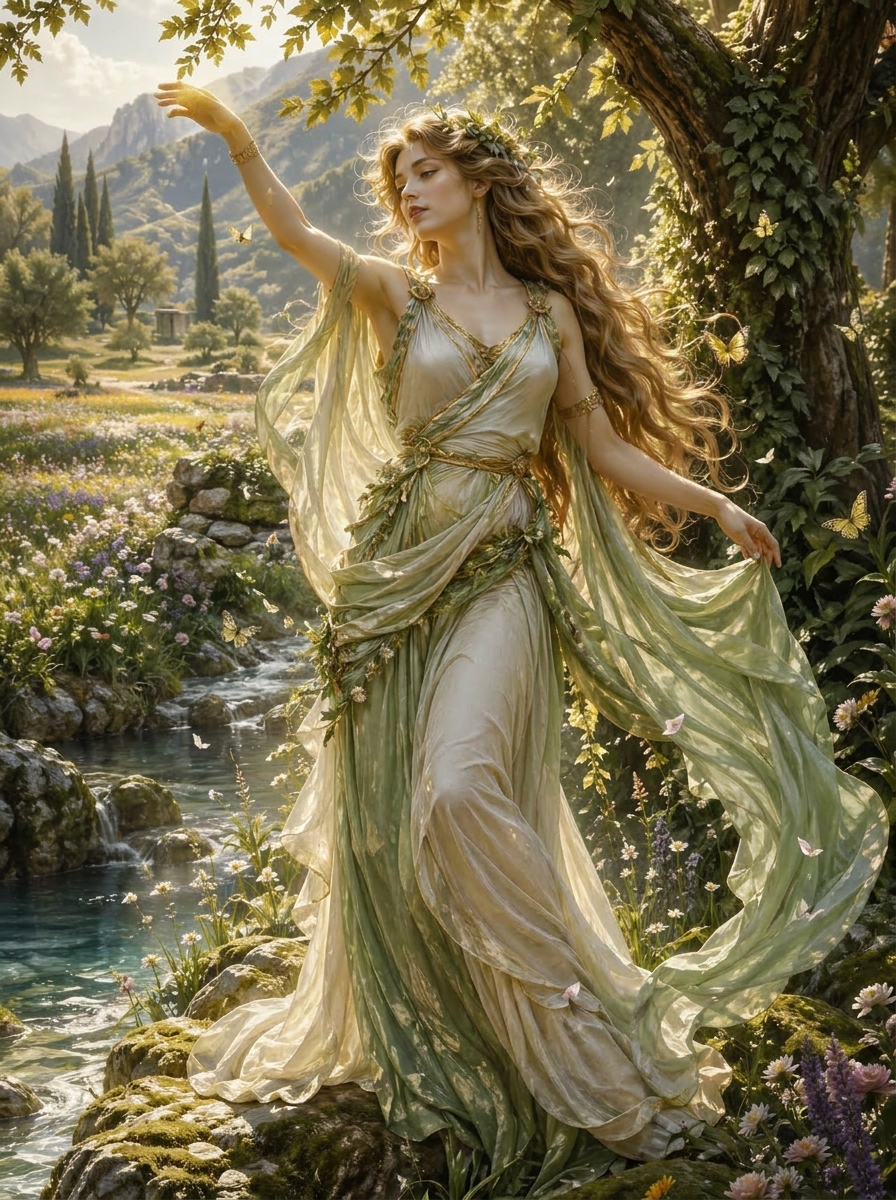
- Sacred and graceful human female form
- Cannot dwell anywhere other than that tree
- Lifespan equals nine generations of crows (about 81 years) canon
Stories
The Hamadryad-lifespan canon of the fragmentary Precepts of Chiron of c. 700 BCE Hesiod and the Laelaps canon of lines 476-485 of Book 2 of the Argonautica of the 3rd-century-BCE Apollonius Rhodius are the decisive origin, and the decisive literary canon is the Erysichthon-Hamadryad tragedy of lines 738-878 of Book 8 of Ovid's Metamorphoses of c. 8 CE. The canon of the eight Hamadryad sisters of Section 78 of Book 3 of c. 200 CE Athenaeus's Deipnosophistae is the decisive canon of Greek-mythological systematisation, and Renaissance Italy — the 1499 Hypnerotomachia Poliphili of Polifilo and the c. 1597 paintings of the Caravaggio era — settled the Renaissance Hamadryad visual-adaptation canon. The 1820 Ode to a Nightingale of the British poet John Keats (1795-1821) — 'light-winged Dryad of the trees' first line — is the decisive English-literary canon, and the 22 June 1937 Jungle Peace of the American naturalist William Beebe (1877-1962) canonised the scientific name Ophiophagus hannah (the English name of the king cobra) as 'Hamadryad' in medicine and zoology. The Dryad of the 1977 D&D Monster Manual by Gary Gygax of TSR in the USA — consistent through to 5e (5th Edition) of 2014, with the Hamadryad as an adaptation — is the decisive canon of the modern fantasy RPG, and the Dryad (deer-leg adaptation) of Blizzard's Warcraft III of 5 November 2002 is the 21st-century global game-adaptation canon.
Weakness
The Hamadryad's weaknesses are: (1) cutting down or death of her tree — the most decisive canonical weakness, that the Hamadryad is permanently bound to a single tree, the decisive canon in lines 738-878 of Book 8 of Ovid's Metamorphoses of c. 8 CE in which Erysichthon cuts down the oak of Demeter's sacred grove and kills the Hamadryad; (2) Demeter's wrath — the decisive retributive canon in the canon of Book 8 of Ovid's Metamorphoses that Demeter sends the spirit of hunger Limos (Limos) to the killer of the Hamadryad to punish him with eternal hunger; (3) environmental binding — stronger environmental binding than the general Dryad, with the decisive canon that the Hamadryad cannot dwell anywhere other than that tree; (4) extinction of the species — when all trees of the species become extinct, the entire Hamadryad species weakens and vanishes; (5) human reckless logging — the most vulnerable decisive weakness to human logging and forest destruction; (6) flow of time — the canonical lifespan weakness in the fragmentary canon of Hesiod's Precepts of Chiron that the Hamadryad's lifespan equals nine generations of crows — one generation of crows being 9 years times 9 equals 81 years; (7) wrath of the gods — the canon of transformation according to the Olympian gods' decisions in the transformation tales; (8) sacred sealing rite — the canon in Greek-mythological nature-spirit canon that the wrath of the goddess Artemis transforms the Hamadryad. The decisive canonical finale of the Latin-literary tragedy in lines 771-775 of Book 8 of Ovid's Metamorphoses of c. 8 CE — in which the Hamadryad dies appealing to Demeter.
Cultural Significance
The Hamadryad is not merely a tree-spirit icon but the canonical iconographic adaptation figure of the Greek-Western nature-spirit canon, traversing the c. 700 BCE Hesiod's Precepts of Chiron, the 3rd-century-BCE Apollonius Rhodius's Argonautica, the c. 8 CE Ovid's Metamorphoses, the 1st-century Virgil's Georgics and Eclogues, the c. 200 CE Athenaeus's Deipnosophistae, the 1499 Polifilo's Hypnerotomachia Poliphili, the 1820 John Keats's Ode to a Nightingale, the 1937 William Beebe's Jungle Peace, and the 1977 D&D fantasy RPG. In the Greek-mythological nature-spirit belief of the Mycenaean civilization of the Greek Bronze Age (3000-1200 BCE), the decisive environmental canon of the permanently bound spirit of the sacred tree (dendron hieron) became the decisive canon of Greek Bronze Age nature-spirit belief. The decisive literary canon is the Erysichthon-Hamadryad tragedy of lines 738-878 of Book 8 of Ovid's Metamorphoses of c. 8 CE — as the decisive canon of Greco-Roman Environmental Justice and nature protection — frequently cited as a canonical text of Ecocriticism in the late 20th century. The 22 June 1937 Jungle Peace of the American naturalist William Beebe (1877-1962) is the decisive event in which the scientific name Ophiophagus hannah was canonised as the English 'Hamadryad' (the English name of the king cobra) in medicine and zoology, and the Dryad of the 1977 D&D Monster Manual by Gygax of TSR in the USA — consistent through to 5e (5th Edition) of 2014 — is the decisive canon of the modern fantasy RPG nature-spirit. The first line 'light-winged Dryad of the trees' of the May 1820 Ode to a Nightingale of the British poet John Keats (1795-1821) — a poem written in one hour in the garden of Hampstead in London — is the decisive 19th-20th-century English-literary canon.
In Popular Culture
- Hesiod, Precepts of Chiron fragment (c. 700 BCE) — decisive Hamadryad-lifespan canon
- Apollonius Rhodius, Argonautica, Book 2 lines 476-485 (3rd century BCE) — Laelaps canon
- Virgil, Georgics, Book 4 lines 460-466 (1st century BCE) — Latin decisive canon
- Ovid, Metamorphoses, Book 8 lines 738-878 (c. 8 CE) — decisive Erysichthon-Hamadryad tragedy
- Athenaeus, Deipnosophistae, Book 3 Section 78 (c. 200 CE) — decisive eight Hamadryad sisters canon
- Plutarch, On the Decay of Oracles, Chapter 11 (1st century CE) — lifespan quotation canon
- Polifilo, Hypnerotomachia Poliphili (1499) — Renaissance visual canon
- Keats, Ode to a Nightingale (1820) — decisive English-literary poetic canon
- William Beebe, Jungle Peace (1937) — king cobra zoological canon
- Gygax, D&D Monster Manual, Dryad (1977) — fantasy RPG canon
Trivia
The Greek etymology Hamadryas of Hamadryad — the compound of hama ('with, together') and drys ('oak, tree'), meaning 'with the tree' — and the plural Hamadryades and English Hamadryad (first attested in 1555) settled as the decisive canonical vocabulary. In the fragmentary canon of Hesiod's Precepts of Chiron of c. 700 BCE — quoted in Chapter 11 415C of Plutarch's On the Decay of Oracles of the 1st century CE — the Hamadryad's lifespan equals nine generations of crows — one generation of crows being 9 years times 9 equals 81 years — the decisive canonical record. In Section 78 of Book 3 of c. 200 CE Athenaeus's Deipnosophistae — quoting a fragmentary poem of Pherenicus of Heraclea — the decisive canon of the eight Hamadryad sisters — Karya (walnut tree), Balanos (oak), Kraneia (cornel), Morea (mulberry), Aigeiros (poplar), Ptelea (elm), Ampelos (vine), Sykea (fig tree) — is the decisive canon of Greek-mythological systematisation. The Erysichthon (Greek Erysichthon, 'the one who breaks the earth') canon of lines 738-878 of Book 8 of Ovid's Metamorphoses of c. 8 CE — as the decisive canon of Greek-mythological punishment for the violation of nature — is frequently cited as a canonical text of Ecocriticism in the late 20th century. The May 1820 Ode to a Nightingale of the British poet John Keats (1795-1821), written in one hour in the garden of Hampstead in London — the first stanza 'light-winged Dryad of the trees' — is the decisive English-literary poetic canon, and the 22 June 1937 Jungle Peace of the American naturalist William Beebe (1877-1962) is the decisive event in which the scientific name Ophiophagus hannah was canonised as the English 'Hamadryad' (the English name of the king cobra) in medicine and zoology.