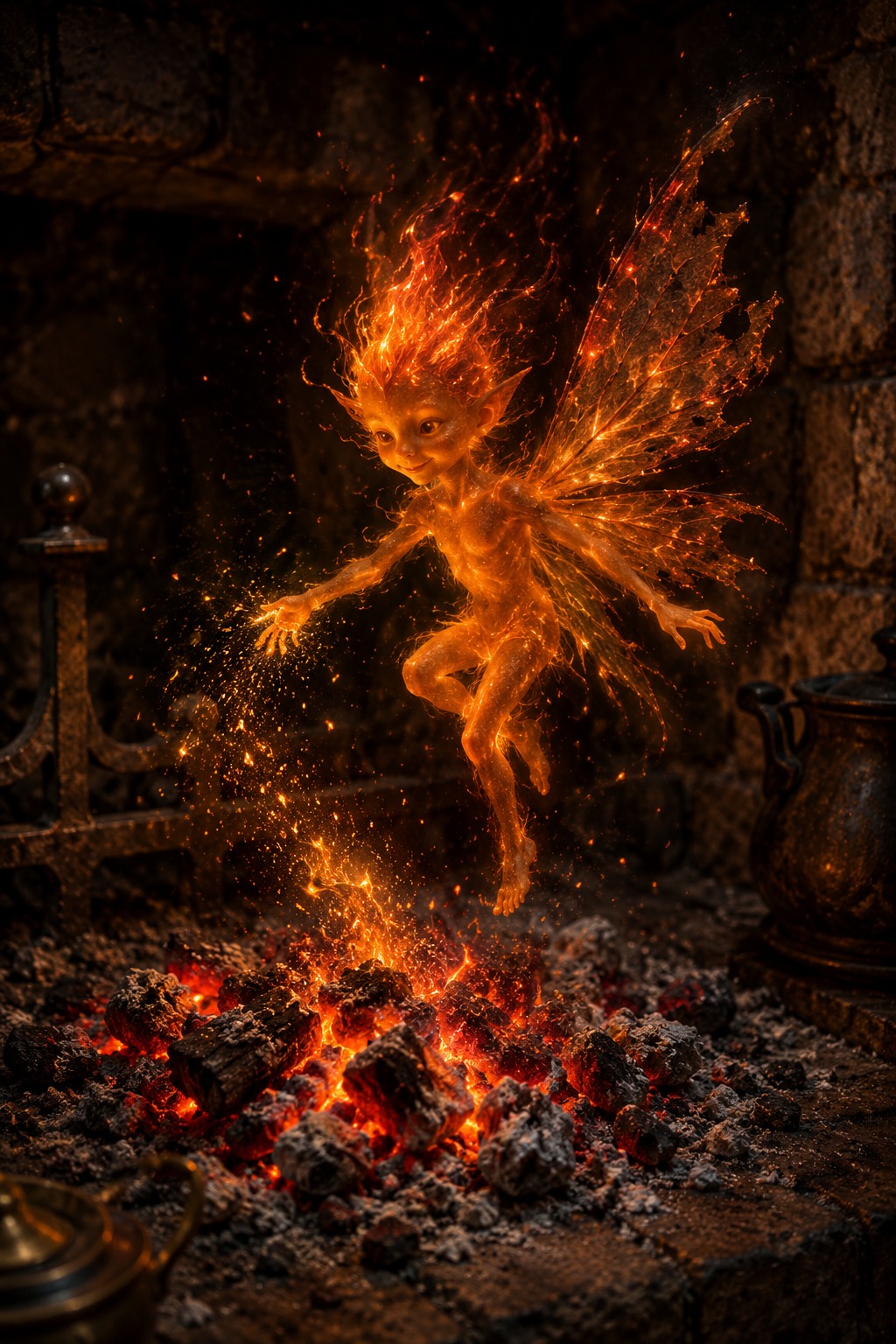
Cinder Sprite
LesserSmall Flame Spirit Dwelling in Embers
The Cinder Sprite (English Cinder Sprite, Latin Spiritus Cineris) is the small flame spirit that dwells in the cinder (ash-ember), depicted as a palm-sized winged humanoid — a decisive canonical adaptation of Western flame-spirit iconography. The etymology combines the Latin cinis ('ash, cinder'), source of English cinder (Middle English sinder of c. 1290), and the Latin spiritus ('soul, breath'), source of English sprite (Middle English sprite of 1303 via Old French esprit). The iconographic origin is the fusion of (1) the ancient Roman household-hearth (focus) protective beliefs of Lar (household guardian) and Vesta (hearth goddess) and (2) the four-element-spirit canon in the 1566 Latin treatise A Book of Nymphs, Sylphs, Pygmies, and Salamanders (Liber de Nymphis, Sylphis, Pygmaeis et Salamandris) by the Swiss physician-alchemist Paracelsus (Theophrastus Bombastus von Hohenheim, 1493-1541), whose flame spirit is the Salamander. The decisive literary canon is the sprite Puck of William Shakespeare's (1564-1616) 1595 comedy A Midsummer Night's Dream — Robin Goodfellow of English folklore — which established the English-literary sprite canon, and the Fire Mephit and Salamander canon of the 1977 Monster Manual of Dungeons & Dragons (D&D) by Gary Gygax (1938-2008) of TSR in the USA is the decisive iconography of the modern fantasy RPG flame-spirit canon.