Kobold
Kobold · The Dragon-Serving Little Folk — Masters of Traps
Names in Other Languages
 코볼트한국어
Kobold · 드래곤을 섬기는 소형 종족 — 함정의 명수
 コボルト日本語
Kobold · 竜に仕える小型種族 — 罠の名手
 狗頭人繁體中文
Kobold · 侍奉巨龍之小型種族 — 陷阱名手
 KoboldDeutsch
Kobold · Das drachendienende kleine Volk — Meister der Fallen
 KoboldFrançais
Kobold · Le petit peuple au service des dragons — Maîtres des pièges
 KoboldEspañol
Kobold · El pueblo pequeño al servicio de los dragones — Maestros de las trampas
 KoboldPortuguês
Kobold · O povo pequeno a serviço dos dragões — Mestres das armadilhas
 KoboldPolski
Kobold · Mały lud w służbie smoków — mistrzowie pułapek
 КобольдРусский
Kobold · Малый народ на службе драконов — мастера ловушек
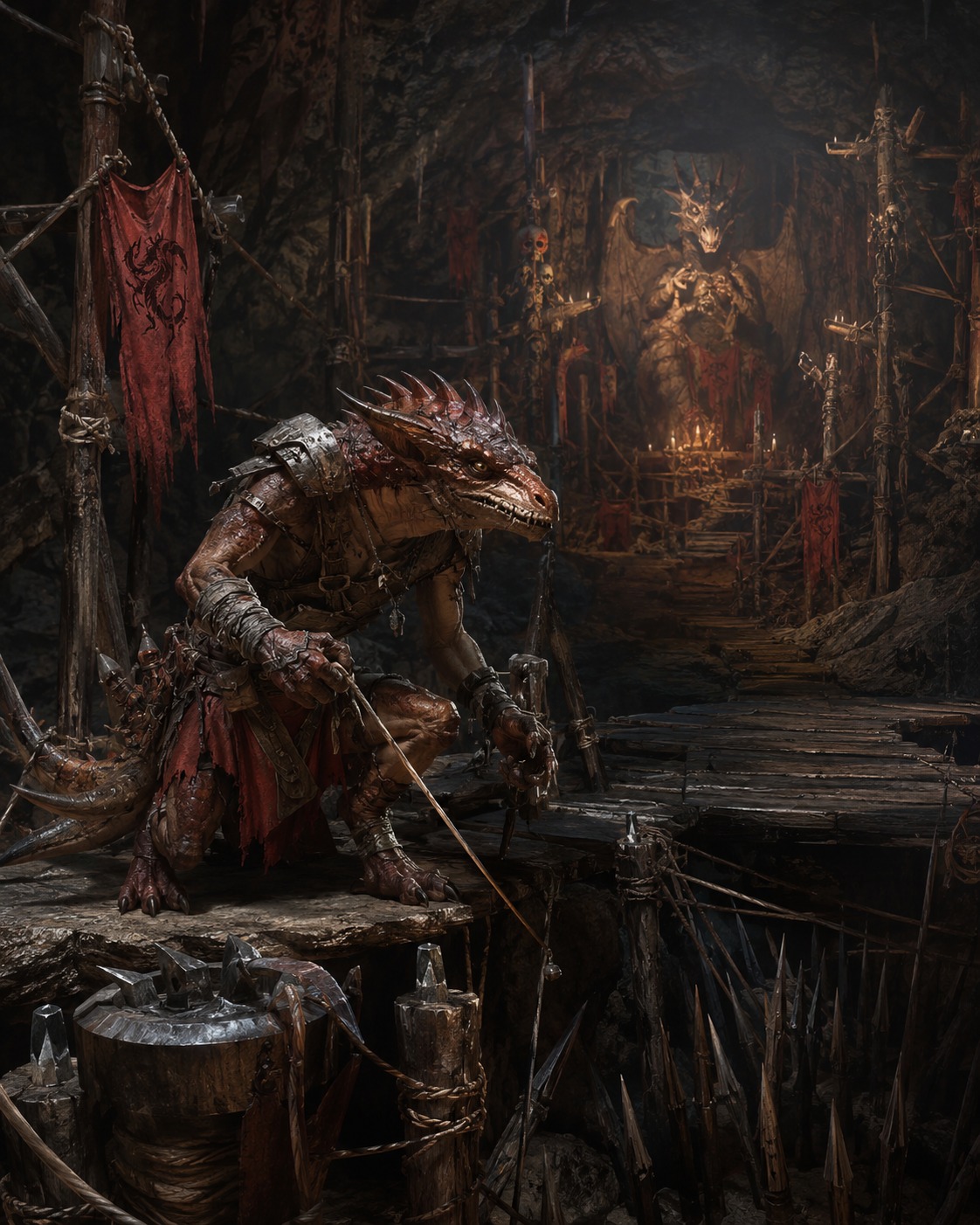
The kobold is a small reptilian, dog-like humanoid race introduced by Gary Gygax and Dave Arneson in the 1974 Dungeons & Dragons original boxed set and codified in the 1977 AD&D Monster Manual as a Lawful Evil (Challenge Rating 1/8) cave-dwelling trapsmith race that worships dragons. The name descends from sixteenth-century German mining folklore, where 'Kobold' was a mine-haunting sprite blamed for arsenic poisoning of silver-ore miners, attested in Georgius Agricola's 'De re metallica' (Leipzig, 1556), book six, under the form 'cobaltus'; the chemical element cobalt was later named after the same sprite by the Swedish chemist Georg Brandt in 1735. In fifth-edition Dungeons & Dragons the kobold stands sixty to ninety centimetres tall, with red-brown, dark blue-green or black scales, small horns, a thin tail and a body proportioned as a miniature dragon — 'Volo's Guide to Monsters' (2016) and 'Fizban's Treasury of Dragons' (2021) codify that kobolds hatch from dragon eggs or are otherwise a magical by-product of the dragon. Kobolds live in tribal warrens of fifty to two hundred members in mines, caves and underground labyrinths and give blind religious devotion to a dragon overlord or a great kobold chieftain. They specialise in elaborate traps — spinning blades, slippery slopes, falling stones, poison gas, deadfall pits — and although individual combat power is minimal (5 HP, AC 12 at Challenge Rating 1/8), their numbers, cunning and precise ambushes make them a persistent threat.
Origin
The direct textual source is the 1974 TSR D&D 'Monsters & Treasure' booklet in the original boxed set; the cave dwelling, dragon worship, Lawful Evil alignment and trap specialisation were fixed by Gary Gygax in the AD&D Monster Manual of 1977. The etymological root is sixteenth-century German mining folklore: 'Kobold' was the mine sprite that German miners blamed for tormenting them and ruining ore veins. The locus classicus is Georgius Agricola's 'De re metallica' (Leipzig, 1556), book six, which records the name 'cobaltus' for the trickster ore-spirit; miners who thought they had silver ore found it released arsenic fumes when smelted and ascribed the poisoning to the kobold. The chemical element cobalt was named after the same sprite by the Swedish chemist Georg Brandt (1694-1768) in 1735. The fullest folkloric treatment is Jacob Grimm's 'Deutsche Mythologie' (1835). The D&D reptilian and miniature-dragon iconography was Gygax's deliberate divergence from the related gnome to give the kobold its own identity, and the 'Fizban's Treasury of Dragons' (2021) canon now makes kobolds a magical by-product of the dragon, hatched from a dragon's discarded scale or egg as the 'urd' species.
Features
- Sixty to ninety centimetres tall, miniature reptilian humanoid proportioned as a small dragon
- Red-brown, dark blue-green or black scales, small horns, thin tail
- Tribal warrens of fifty to two hundred in mines, caves and underground labyrinths
- Blind religious devotion to a dragon overlord or great kobold chieftain
- Master of traps — spinning blades, slippery slopes, falling stones, poison gas, deadfall pits
- Challenge Rating 1/8 (5 HP, AC 12) in fifth edition; Lawful Evil; individual combat power minimal
Stories
The standard low-level 'trap dungeon' antagonist of tabletop role-playing campaigns, used to dramatise the cunning of the underdog, the strength of numbers and the blind devotion of the weak to the strong (the dragon). The same name has been carried over to the kobold tribal cards of 'Magic: The Gathering' (from 1993), the Dracky line of Enix's 'Dragon Quest' series (from 1986), the kobold miners of Blizzard's 'World of Warcraft' (from 2004) and even the 'Heinzelmännchen' of Cologne folklore, which shares the same German mining-folk substrate.
Weakness
Individual combat power is very low and kobolds are cowardly: when the chieftain or the dragon overlord is removed, the warren collapses. The Sunlight Sensitivity trait of the fifth-edition Monster Manual — the kobold has disadvantage in direct sunlight — preserves the original sixteenth-century mine-sprite fear of light. Outside their trap corridors, kobolds are essentially helpless in open battle; if an adventurer bypasses the trap route, their entire tactical advantage evaporates.
Cultural Significance
The figure is one of the best-known cases in which sixteenth-century European folklore — the German miners' interpretation of arsenic poisoning as the work of a mine sprite — entered both modern chemistry (the metal cobalt) and modern fantasy gaming (the D&D kobold), via Jacob Grimm's nineteenth-century folklore corpus.
In Popular Culture
TSR D&D original boxed set (1974), AD&D Monster Manual (1977), fifth-edition Monster Manual (2014), 'Volo's Guide to Monsters' (2016), 'Fizban's Treasury of Dragons' (2021), Georgius Agricola's 'De re metallica' (Leipzig, 1556) for the etymology, Jacob Grimm's 'Deutsche Mythologie' (1835), the kobold tribal cards of 'Magic: The Gathering' (from 1993), the Dracky line of Enix's 'Dragon Quest' series (from 1986), the kobold miners of Blizzard's 'World of Warcraft' (from 2004) and the 'Heinzelmännchen' of Cologne folklore.
Trivia
The chemical element cobalt was named in 1735 by the Swedish chemist Georg Brandt after the same kobold mine sprite that German miners of the sixteenth century blamed for arsenic poisoning, making 'kobold' and 'cobalt' the most famous etymological pair in mineralogy. 'Fizban's Treasury of Dragons' (2021) elaborated the lore so that kobolds are magical by-products of the dragon — hatched from discarded scales or eggs as the 'urd' species — a controversial reading among long-time D&D players.