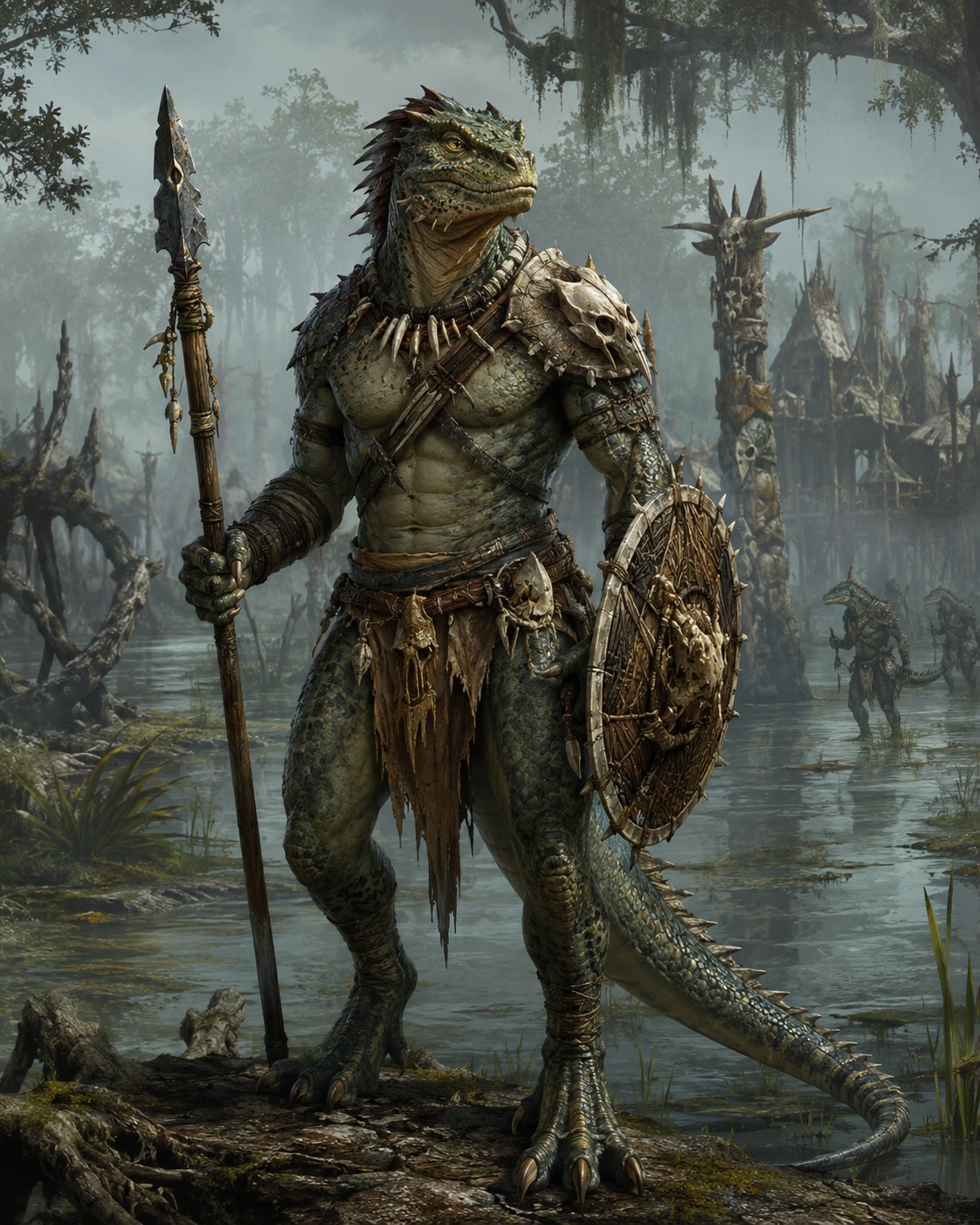
Lizardfolk
Lizardfolk · The Lizard People — Cold-Blooded Tribal Warriors of the Marsh
Names in Other Languages
 리저드맨한국어
Lizardfolk · 도마뱀 인간 — 늪지의 냉혈 부족 전사
 リザードマン日本語
Lizardfolk · トカゲ人間 — 沼地の冷血部族戦士
 蜥蜴人繁體中文
Lizardfolk · 蜥蜴人 — 沼澤的冷血部族戰士
 EchsenvolkDeutsch
Lizardfolk · Das Echsenvolk — Kaltblütige Stammeskrieger des Sumpfes
 Hommes-lézardsFrançais
Lizardfolk · Le peuple lézard — Guerriers tribaux au sang froid du marais
 Hombres lagartoEspañol
Lizardfolk · El pueblo lagarto — Guerreros tribales de sangre fría del pantano
 Povo lagartoPortuguês
Lizardfolk · O povo lagarto — Guerreiros tribais de sangue frio do pântano
 JaszczuroludziePolski
Lizardfolk · Lud jaszczurów — zimnokrwiści plemienni wojownicy bagien
 ЛюдоящерыРусский
Lizardfolk · Народ ящеров — холоднокровные племенные воины болот
Lizardfolk (originally 'Lizardman') are a reptilian humanoid race with scaled skin, lizard-like heads and thick tails, introduced by Gary Gygax in 'Greyhawk: Supplement I to Dungeons & Dragons' (1972) and codified as a swamp-tribe warrior race in the AD&D Monster Manual (1977); the name was changed to the gender-neutral 'Lizardfolk' in the fifth-edition Monster Manual (2014). They stand 180 to 210 centimetres tall, weigh 120 to 180 kilograms with a muscular build, and bear green-grey, olive or teal scales, a lizard's head with yellow eyes and slit pupils, and a thick tail of one metre or more for balance and melee strikes. They live in swamps, wetlands and mangrove river basins in tribes of two hundred to four hundred members under a matriarch or shaman, hatch from eggs, and are cold-blooded — slowing in cold climates. Their psychology, most fully codified in 'Volo's Guide to Monsters' (2016), is that of the 'cold pragmatist': they prioritise survival, utility and resource efficiency over emotion, never breaking a promise but interpreting its terms in favour of their kind. The same lineage is recognisable in the Lizardmen army of Warhammer Fantasy (Games Workshop, from 1989) with its Slann, Saurus and Skink hierarchy, and in the Sleestak of the NBC television series 'Land of the Lost' (1974-1976), which directly influenced the AD&D design.
Origin
The direct textual source is Gary Gygax's 'Greyhawk: Supplement I to Dungeons & Dragons' (1972), with the swamp-tribe form fixed in the AD&D Monster Manual (1977) at Challenge Rating 1 and Neutral alignment. The mythic substrate is the global reptilian-humanoid corpus — Mesopotamian seven Uanna fish-men on the tablets from Ashurbanipal's library (seventh century BCE), the snake-bodied figures of the Chinese Han-era 'Shen Yi Jing', the Indo-Vedic Nāga and the Zulu 'Lizard People' tradition — combined with the swamp-reptile races of late-nineteenth and early-twentieth-century pulp science fiction, including the green Martians of Edgar Rice Burroughs's 'A Princess of Mars' (1912) and the Deep Ones of H.P. Lovecraft's 'The Temple' (1925). The most direct visual influence on the 1977 AD&D design was the Sleestak race of the 1974-1976 NBC television series 'Land of the Lost' produced by Sid and Marty Krofft. The psychological canon — cold pragmatism — was elaborated in 'Volo's Guide to Monsters' (2016) by Mike Mearls and others.
Features
- Muscular reptilian humanoid, 180-210 centimetres tall, 120-180 kilograms
- Green-grey, olive or teal scales; lizard head with yellow eyes and slit pupils
- Thick tail of one metre or more for balance and melee strikes
- Tribal society of 200-400 in swamps, wetlands and mangrove basins, led by a matriarch
- Egg-laying, cold-blooded — slows in cold climates
- Cold-pragmatist psychology: survival, utility and resource efficiency over emotion
Stories
Standard antagonist or potential ally for swamp-environment tabletop campaigns, often used as the focal point for diplomacy and misunderstanding stories built around their alien value system. The same iconography has been borrowed for the Lizardmen army of Warhammer Fantasy, the Argonian race of Bethesda's 'The Elder Scrolls' series (from 1994) and the lizardfolk non-player characters of Square Enix's 'Final Fantasy XIV' (from 2010).
Weakness
Cold-blooded physiology leaves them vulnerable to cold climates and noticeably sluggish in winter (as codified in the fifth-edition 'Volo's Guide'). Their pragmatic mindset makes them poor at the emotional diplomacy of human societies and prone to tribal isolation. Some derivative games give them extra fire damage vulnerability beyond the standard.
Cultural Significance
The figure is a composite of indigenous Mesopotamian, Indo-Aryan and African reptilian-humanoid traditions overlaid with the swamp-creature motifs of pulp science fiction, channelled through D&D into the post-1980 English-language fantasy mainstream; in the twenty-first century the 'cold-pragmatist' framing has become a standard contrastive lens against human-centric ethical assumptions.
In Popular Culture
Gary Gygax's 'Greyhawk: Supplement I' (1972), the AD&D Monster Manual (1977), the fifth-edition Monster Manual (2014), 'Volo's Guide to Monsters' (2016), the Lizardmen army of Warhammer Fantasy (Games Workshop, from 1989), the Argonians of Bethesda's 'The Elder Scrolls' series (from 1994), the lizardfolk NPCs of Square Enix's 'Final Fantasy XIV' (from 2010), and the Sleestak of NBC's 'Land of the Lost' (1974-1976).
Trivia
'Volo's Guide to Monsters' (2016) added that lizardfolk craft furniture from the hides of enemies they have eaten, an example often cited as the most shocking expression of their cold pragmatism. The 1977 AD&D Monster Manual illustration was by David Trampier and remained the visual template for the Warhammer Fantasy Lizardmen army of 1989.