Goblin
Goblin · The Cunning Little Folk — Raiders Who Live by Numbers and Guile
Names in Other Languages
 고블린한국어
Goblin · 교활한 소형 부족 — 수와 잔꾀로 살아가는 약탈자
 ゴブリン日本語
Goblin · 狡猾な小型部族 — 数と小知恵で生きる略奪者
 哥布林繁體中文
Goblin · 狡猾的小型部族 — 以數量與小聰明維生的掠奪者
 GoblinDeutsch
Goblin · Das listige kleine Volk — Räuber, die von Zahl und List leben
 GobelinFrançais
Goblin · Le petit peuple rusé — Pillards vivant du nombre et de la ruse
 GoblinEspañol
Goblin · El pueblo pequeño astuto — Saqueadores que viven del número y la astucia
 GoblinPortuguês
Goblin · O povo pequeno astuto — Saqueadores que vivem do número e da astúcia
 GoblinPolski
Goblin · Przebiegły mały lud — rabusie żyjący z liczby i sprytu
 ГоблинРусский
Goblin · Хитрый малый народ — налётчики, живущие числом и уловкой
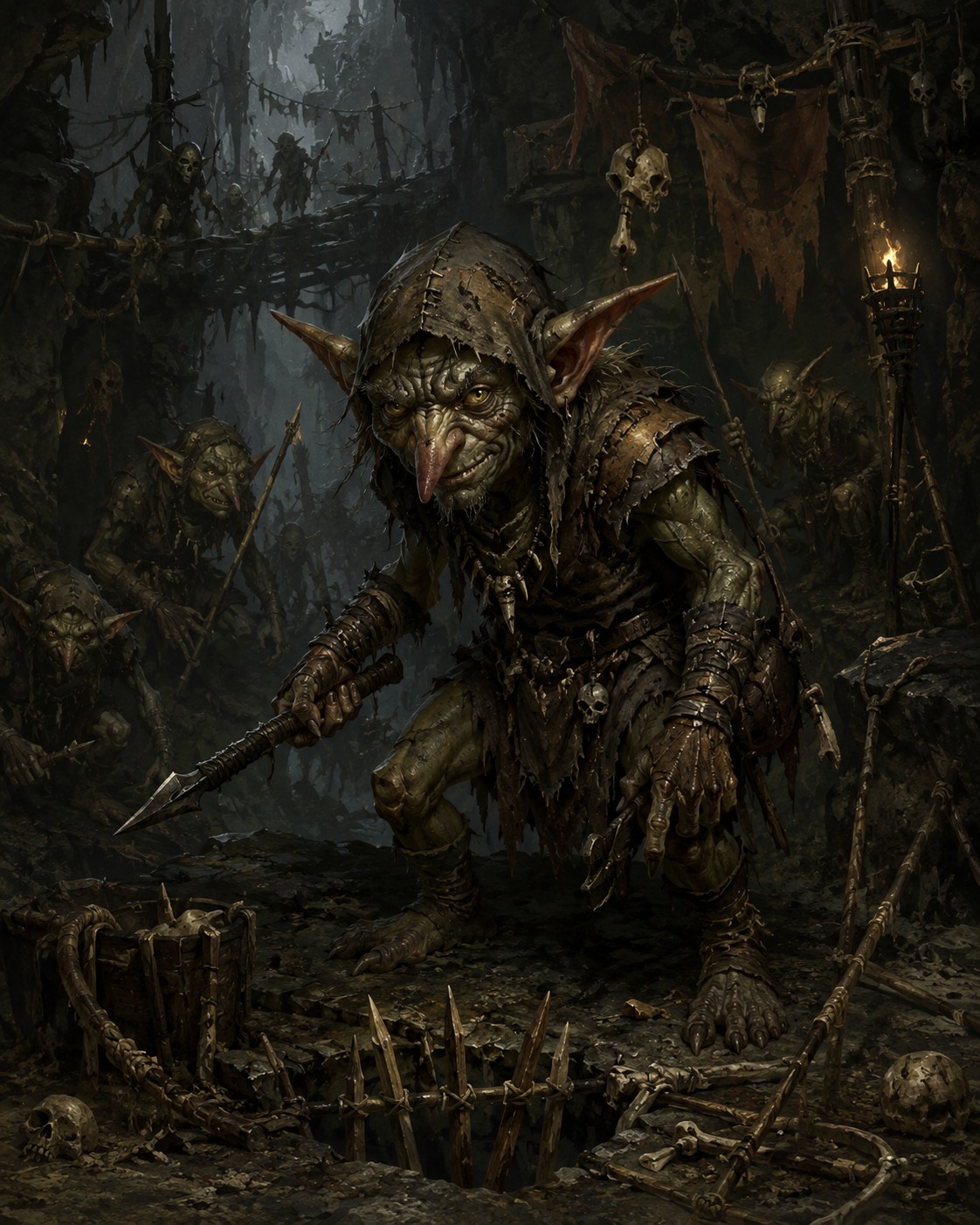
The goblin is the most pervasive 'small raiding humanoid' of modern Anglophone fantasy, descended from the spiteful little fairies of medieval European folklore and codified through three textual layers: the Victorian children's literature of Christina Rossetti's 'Goblin Market' (1862) and George MacDonald's 'The Princess and the Goblin' (Edinburgh, 1872), J.R.R. Tolkien's 'The Hobbit' (1937) — chapters four to six, the Goblins of the Misty Mountains — and the 1974 Dungeons & Dragons original boxed set by Gary Gygax and Dave Arneson. Goblins stand ninety to one hundred and twenty centimetres tall with wiry, sinewy bodies, oversized ears and noses, yellow-green or ashen skin, yellow eyes and sharp canines. They live in tribal warrens in caves, ruins and dark forests, surviving on traps, ambushes and raids. Their individual combat power is low — Challenge Rating 1/4 (7 hit points, AC 15) in the fifth-edition D&D Monster Manual (2014) — but their numbers, cunning and improvisation make them an enduring threat. Their alignment was fixed as Neutral Evil in the 1977 AD&D Monster Manual and remains so. The same lineage appears in the Greenskins of Warhammer Fantasy (from 1983), the Gringotts goblins of J.K. Rowling's 'Harry Potter' (1997 onward), the Kezan goblins of Blizzard's 'World of Warcraft' (2004 onward) and the post-colonial readings of R.F. Kuang's 'Babel' (2022).
Origin
The direct etymology is the twelfth- to thirteenth-century Old French 'gobelin' ('small malicious sprite'), borrowed as Middle English 'gobelyn' in the fourteenth century and settling as 'goblin' by Shakespeare's day; it is widely held to descend from Latin 'cobalus' (Greek 'kobalos', a mine-haunting sprite that torments miners), cognate with the German 'kobold' of mining folklore. The modern fantasy archetype is fixed by the Victorian-era pair of Christina Rossetti's poem 'Goblin Market' (1862) and George MacDonald's children's novel 'The Princess and the Goblin' (Edinburgh, 1872), which directly influenced Tolkien. Tolkien locked the iconography into place in 'The Hobbit' (1937), chapters four to six, and from the 1951 second edition used 'goblin' and 'orc' as synonyms — an identification that runs through 'The Lord of the Rings' (1954-55). This Tolkienian goblin entered the 1974 TSR D&D original boxed set under Gygax and Arneson and was codified in the 1977 AD&D Monster Manual as the textbook weak humanoid (CR 1/4, Neutral Evil). The design has been carried unchanged through the 1990 Monstrous Compendium, the 2000 third-edition Monster Manual and the 2014 fifth-edition Monster Manual.
Features
- Ninety to one hundred and twenty centimetres tall, wiry build
- Yellow-green or ashen skin, oversized ears and nose, yellow eyes
- Sharp canines; fights with curved daggers and short bows in raiding parties
- Lives in tribal warrens in caves, ruins and dark forests
- Overwhelms by numbers, traps, ambushes and raiding tactics
- Challenge Rating 1/4, Neutral Evil, subordinate to hobgoblin overlords in D&D
Stories
Functions as the canonical weak-mob raider party of tabletop role-playing campaigns and as a stock figure for narratives about underdog cunning, mass threat and the perspective of a despised race. Modern adaptations differentiate the goblin by profession — the bankers and metalsmiths of Gringotts in 'Harry Potter', the merchants and engineers of the Kezan goblins in 'World of Warcraft', the orc-aligned Greenskins of Warhammer.
Weakness
Low individual combat strength and a cowardly streak: when the chieftain (hobgoblin or goblin boss) falls, the warband disintegrates. Greed and infighting are recurrent self-defeats, and some derivative games adopt Tolkien's 'sunlight-vulnerable orc' trait for the goblin as well.
Cultural Significance
The figure is a fusion of Victorian children's literature (MacDonald) and Tolkienian modernism, channelled through D&D to become the standard 'small raider race' of post-1980 English-language fantasy; in twenty-first-century writing — R.F. Kuang's 'Babel' (2022), the works of N.K. Jemisin — it is increasingly read as a colonial allegory of the despised race.
In Popular Culture
Christina Rossetti's 'Goblin Market' (1862), George MacDonald's 'The Princess and the Goblin' (1872), J.R.R. Tolkien's 'The Hobbit' (1937), TSR's D&D original boxed set (1974), the AD&D Monster Manual (1977), the fifth-edition Monster Manual (2014), J.K. Rowling's 'Harry Potter and the Philosopher's Stone' (1997), Blizzard's 'World of Warcraft' (2004- ), Games Workshop's Warhammer Fantasy (1983- ) and R.F. Kuang's 'Babel' (2022).
Trivia
English 'goblin' and German 'kobold' both descend from Latin 'cobalus' / Greek 'kobalos'; the metal 'cobalt' takes its name from 'kobold's ore', after sixteenth-century German miners who believed the mine spirit kobold tormented them. Tolkien deliberately used 'goblin' and 'orc' as synonyms from the 1951 second edition of 'The Hobbit' onward, and that identification carried directly into 'The Lord of the Rings' (1954-55).