Vritra
Indian Vedic Drought Dragon
Names in Other Languages
 브리트라한국어
Vritra · 인도 베다 신화의 가뭄의 악룡
 ヴリトラ日本語
Vritra · インド・ヴェーダ神話の旱魃の悪竜
 弗栗多繁體中文
Vritra · 印度吠陀神話的旱魃惡龍
 VritraDeutsch
Dürre-Dämonendrache der vedischen Mythologie Indiens
 VritraFrançais
Dragon démoniaque de la sécheresse de la mythologie védique indienne
 VritraEspañol
Dragón demoníaco de la sequía de la mitología védica india
 VritraPortuguês
Dragão demoníaco da seca da mitologia védica indiana
 VritraPolski
Demoniczny smok suszy indyjskiej mitologii wedyjskiej
 ВритраРусский
Vritra · Демонический дракон засухи ведийской мифологии Индии
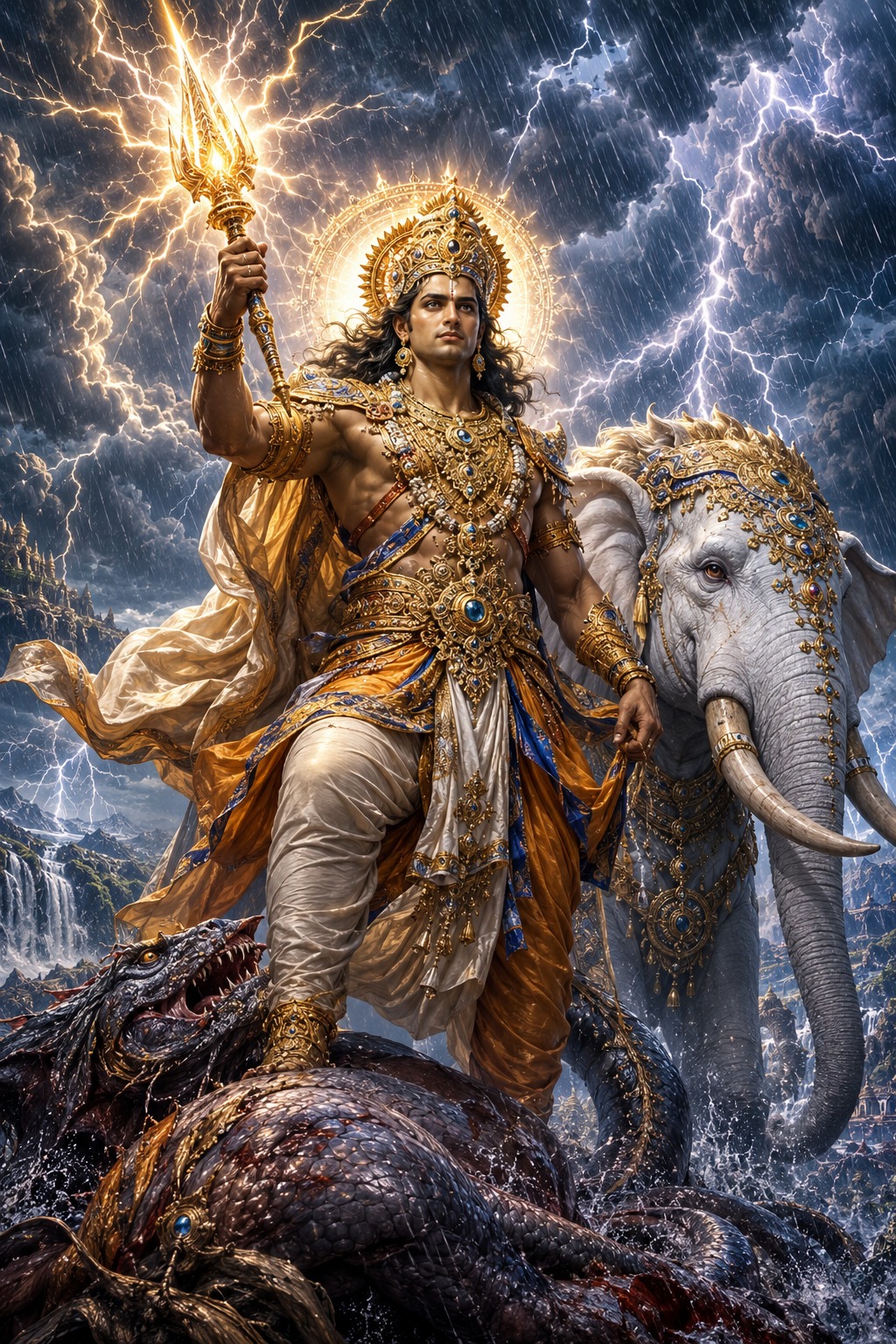
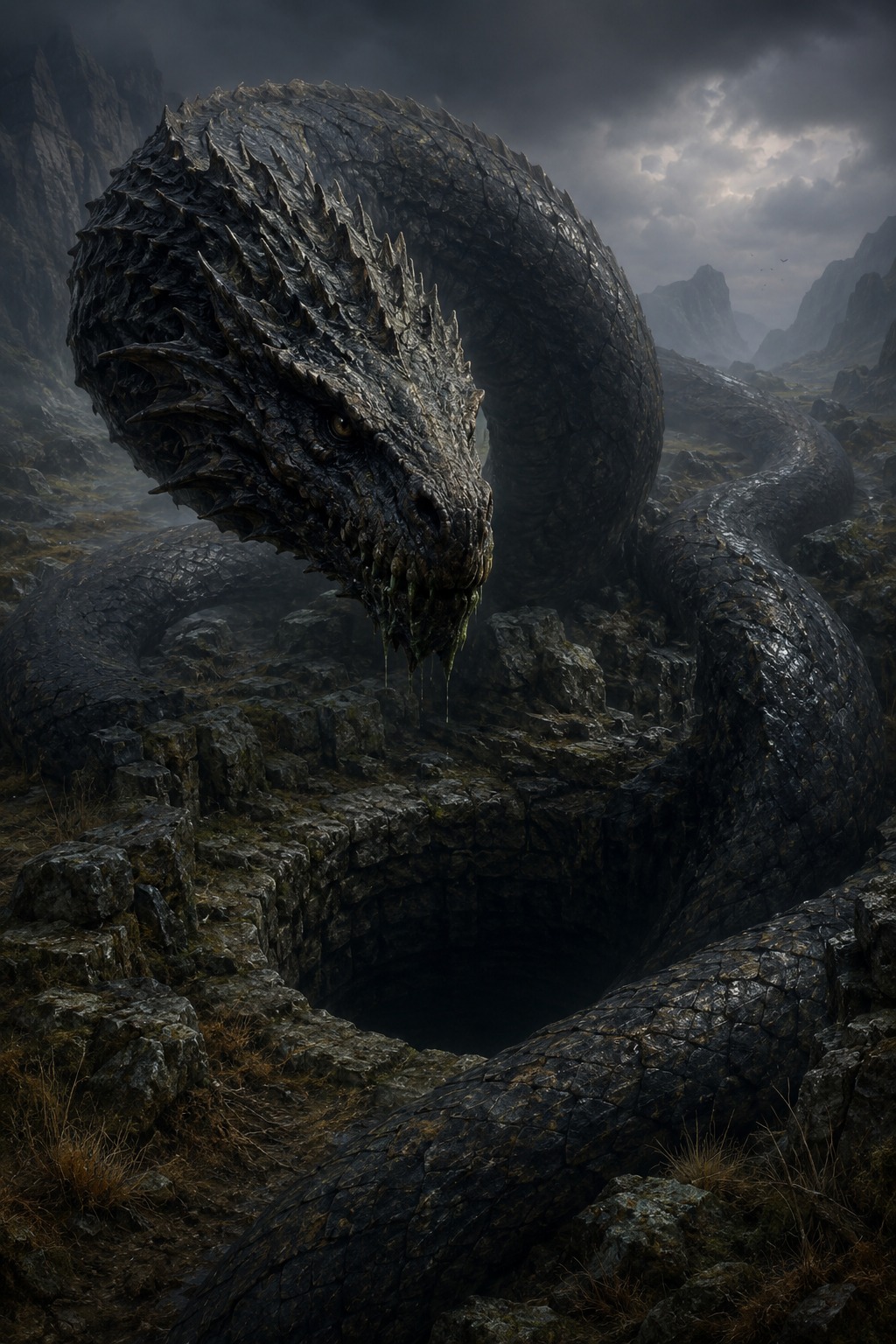
Vritra (Sanskrit Vṛtra) is the most powerful evil dragon-serpent of Vedic Indian mythology and the oldest canonical instance of the Indo-European Chaoskampf motif (storm-god against many-headed serpent) in the surviving textual record. The Sanskrit name itself derives from the verb-root vṛ ('to cover, enclose'), meaning 'the enveloper, the obstructer', and Vritra is represented as a great legless serpent (ahi, 'snake') or as a mountain coiled around all the world's waters. He is the embodiment of drought: by wrapping his body around the seven great rivers (Sapta Sindhu) of the Indian subcontinent, he holds the waters captive and inflicts thirst and death on humankind. He dwells inside a fortress of ninety-nine concentric strongholds (pura). The thunder-god Indra is his eternal enemy, and the Indra-Vritra duel is the central battle of the Vedic corpus, narrated most fully in Rigveda 1.32 — Indra is given the vajra ('thunderbolt' or 'diamond mace') forged by the divine smith Tvaṣṭṛ, breaks the ninety-nine strongholds, and cleaves Vritra's head; the seven rivers held captive in Vritra's body burst forth and bring the Indian subcontinent to life. In later Hindu retellings (Mahābhārata, Bhāgavata Purāṇa), Vritra is recast as the brother of Tvaṣṭṛ's son Viśvarūpa, originally Indra's friend, slain by divine treachery, which charges Indra with the sin of brahmahatyā ('the killing of a brahmin').
Origin
The direct textual source is the Rigveda (compiled c. 1500-1200 BCE by Indo-Aryan tribes settled in the Punjab), with the Indra-Vritra duel scattered across Mandalas 1, 2, 3, 4, 6 and 10; the fullest battle account is in Rigveda 1.32, fifteen verses long, often called the very essence of Vedic Indra-hymnody. Comparative mythology classifies the story as the oldest extant instance of the Indo-European Chaoskampf — Indra against Vritra, Greek Zeus against Typhon, Norse Thor against Jörmungandr, Mesopotamian Marduk against Tiamat, Hittite Teshub against Illuyanka — a classification refined by Georges Dumézil (1898-1986) in 'Ouranós-Váruna' (1934) and 'Loki' (1948) and by Calvert Watkins (1933-2013) in 'How to Kill a Dragon: Aspects of Indo-European Poetics' (Oxford University Press, 1995). The later Hindu transformation — the killing of Tvaṣṭṛ's son Viśvarūpa, and Indra's resulting sin of brahmahatyā — appears in the Mahābhārata (compiled first to fourth centuries CE), in the Bhāgavata Purāṇa (eighth to tenth centuries) and in the Viṣṇu Purāṇa.
Features
- Great legless serpent (ahi) or coiled mountain in form
- Sanskrit name 'the enveloper, the obstructer' (from the root vṛ, 'to cover')
- Personification of drought, holding the seven great rivers (Sapta Sindhu) prisoner in his body
- Dwells inside ninety-nine concentric fortresses (pura)
- Eternal antagonist of Indra; canonical case of the storm-god-against-serpent Chaoskampf
- Slain only by the divine vajra of Indra, with the head as his weak point
Stories
The Vritra myth originally served as a Vedic explanation of monsoon drought and rainfall on the Indian subcontinent and now stands as the textbook earliest instance of Indo-European Chaoskampf in the comparative mythology of Dumézil and Watkins. Modern derivatives include the Vritra bosses of Atlus's 'Megami Tensei' series and the playable character Vritra in Hi-Rez Studios's 'Smite' (2014).
Weakness
Vritra's decisive weak point is his head, vulnerable only to the divine vajra forged by Tvaṣṭṛ. The ninety-nine concentric strongholds are formidable, but a later variant in the Mahābhārata explains that Indra entered through foam at twilight — neither water nor solid, neither day nor night, neither man nor beast — to bypass the wards.
Cultural Significance
The myth is read in comparative mythology as the oldest canonical example of the Indo-European Chaoskampf motif (storm-god versus serpent), with parallels in Greek Zeus against Typhon, Norse Thor against Jörmungandr, Mesopotamian Marduk against Tiamat and Hittite Teshub against Illuyanka. It is treated as the foundational mythic explanation of drought and rainfall in the Indo-Aryan tradition.
In Popular Culture
Rigveda 1.32 (c. 1500-1200 BCE), Indra-Vritra hymns across Rigveda Mandalas 1, 2, 3, 4, 6 and 10, the Udyoga Parva of the Mahābhārata (first to fourth centuries CE), the Bhāgavata Purāṇa (eighth to tenth centuries), Georges Dumézil's 'Ouranós-Váruna' (1934) and 'Loki' (1948), Calvert Watkins's 'How to Kill a Dragon' (Oxford University Press, 1995), Atlus's 'Megami Tensei' series Vritra and Hi-Rez Studios's 'Smite' (2014) Vritra.
Trivia
The Mahābhārata's Udyoga Parva narrates that after killing Vritra, Indra was so weighed down by the sin of brahmahatyā that he hid for a long time inside the stem of a lotus, a passage often cited as the founding instance of the 'hero's guilt' motif in Indian mythology. The vajra was later absorbed into Buddhist iconography as a symbol of indestructibility and awakening, providing the prototype of the ritual sceptre still used in Tibetan Buddhism.