
Smaug
Tolkien's Gold-Hoarding Fire Dragon
Names in Other Languages
 스마우그한국어
Smaug · J.R.R. 톨킨 『호빗』의 황금 탐욕의 화룡
 スマウグ日本語
Smaug · J.R.R.トールキン『ホビット』の黄金に憑かれた火竜
 史矛革繁體中文
Smaug · J.R.R.托爾金《哈比人》的貪金火龍
 SmaugDeutsch
Goldgieriger Feuerdrache aus J.R.R. Tolkiens „Der Hobbit“
 SmaugFrançais
Dragon de feu avide d’or du « Hobbit » de J.R.R. Tolkien
 SmaugEspañol
Dragón de fuego ávido de oro de «El Hobbit» de J.R.R. Tolkien
 SmaugPortuguês
Dragão de fogo ávido por ouro de «O Hobbit», de J.R.R. Tolkien
 SmaugPolski
Żądny złota smok ognisty z „Hobbita” J.R.R. Tolkiena
 СмаугРусский
Smaug · Алчный до золота огненный дракон из «Хоббита» Дж. Р. Р. Толкина
Smaug — also styled the Golden, the Magnificent, the Tremendous — is the gold-greedy fire-drake of J.R.R. Tolkien's 'The Hobbit, or There and Back Again' (George Allen & Unwin, London, 1937) and the direct visual template for every modern fantasy dragon that sleeps on a hoard. He is a great crimson-scaled, bat-winged, two-legged fire-drake (so, strictly by the heraldic taxonomy, a wyvern), who descended on the Dwarf kingdom of Durin's Folk under the Lonely Mountain (Erebor) around the year 2770 of the Third Age, slaughtered Thrór's line, drove out the survivors and lay down on the looted hoard — including the Arkenstone of Thráin. About one hundred and seventy years later, in the events of 'The Hobbit', the hobbit Bilbo Baggins, thirteen Dwarves under Thorin Oakenshield and the wizard Gandalf travel to the mountain; Bilbo's conversation with Smaug in chapter twelve ('Inside Information') reveals the single bare patch over Smaug's left breast. A thrush carries the secret to Bard the Bowman of Esgaroth, whose ancestral Black Arrow strikes the spot, and Smaug falls dead into the Long Lake. His death triggers the Battle of the Five Armies that ends the novel.
Origin
The direct source is J.R.R. Tolkien's 'The Hobbit, or There and Back Again', first published on 21 September 1937 by George Allen & Unwin, London, growing out of stories Tolkien told his children while he was Rawlinson and Bosworth Professor of Anglo-Saxon at Pembroke College, Oxford, in 1930-1936. Tolkien's own 1937 watercolour 'Conversation with Smaug' (Bodleian Library, Tolkien Collection, MS Tolkien Drawings 30), showing Bilbo before the coiled dragon, is the iconographic standard. Tolkien himself acknowledged the mythic models in Letter 25 (1937): the dragon Fáfnir of the Old Norse 'Völsunga saga' — the Bilbo / Smaug conversation directly mirrors the Sigurd / Fáfnir colloquy — and the old hoard-dragon of the closing portion of the Old English 'Beowulf' (lines 2200-3182), the subject of Tolkien's 1936 British Academy lecture 'Beowulf: The Monsters and the Critics'. The figure was later filmed by Peter Jackson in 'The Hobbit' trilogy (2012-14), with Benedict Cumberbatch performing both motion capture and voice.
Features
- Great crimson-scaled, bat-winged, two-legged fire-drake (a wyvern by strict heraldry)
- Single bare patch over the left breast — his only physical weak point
- Held the Lonely Mountain (Erebor) and Durin's Folk for about one hundred and seventy years
- Modern prototype of the hoard-sleeping dragon
- Archaic, vainglorious diction; susceptible to flattery and to slips of pride
- Killed by the Black Arrow of Bard the Bowman of Esgaroth
Stories
Direct visual and narrative template for every modern fire-dragon: the D&D Red Dragon of the 1977 AD&D Monster Manual onward, Drogon of HBO's 'Game of Thrones', Alduin and the boss dragons of 'Skyrim', the dragons of the 'Dragon Age' series. The hoard-sleeping motif was absorbed into the D&D colour-coded chromatic taxonomy by 'Deities & Demigods' (1980).
Weakness
The single bare patch over the left breast and Smaug's vainglory — boasting his greatness to Bilbo, he gives away the very location of that weak spot. The two together are Tolkien's synthesis of the underside-vulnerability of the Norse Fáfnir and the proud-monster slip of the Indo-European Chaoskampf tradition.
Cultural Significance
Smaug is Tolkien's 1937 modern synthesis of the Norse Fáfnir, the Old English Beowulf hoard-dragon and the dragon of the medieval European bestiaries (the Aberdeen Bestiary, twelfth century). Of any single character, he is the most thoroughly absorbed into post-1980 English-language fantasy — D&D, Dragonlance, 'Magic: The Gathering', 'Game of Thrones', 'Skyrim'.
In Popular Culture
J.R.R. Tolkien's 'The Hobbit' (1937), Tolkien's own watercolour 'Conversation with Smaug' (1937, Bodleian Library), the Erebor chronicle in the appendices to 'The Lord of the Rings' (1955), the 1977 Rankin/Bass animated 'Hobbit' (Arthur Rankin Jr.), Peter Jackson's live-action 'Hobbit' trilogy (2012-14) with Benedict Cumberbatch, the 1980 D&D 'Deities & Demigods' and 'Magic: The Gathering's' Shivan Dragon (1993).
Trivia
The name 'Smaug' is the strong past tense of the Proto-Germanic verb 'smúgan' (to squeeze through a hole), an etymology Tolkien himself gave in a 1937 letter to the Observer. Tolkien specified the pronunciation as 'Smowg' (/smaʊɡ/), though Peter Jackson's films use 'Smahg' (/smɔːɡ/). Benedict Cumberbatch said in interviews that he prepared by studying Komodo dragons at London Zoo before recording the motion-capture sessions.
Related
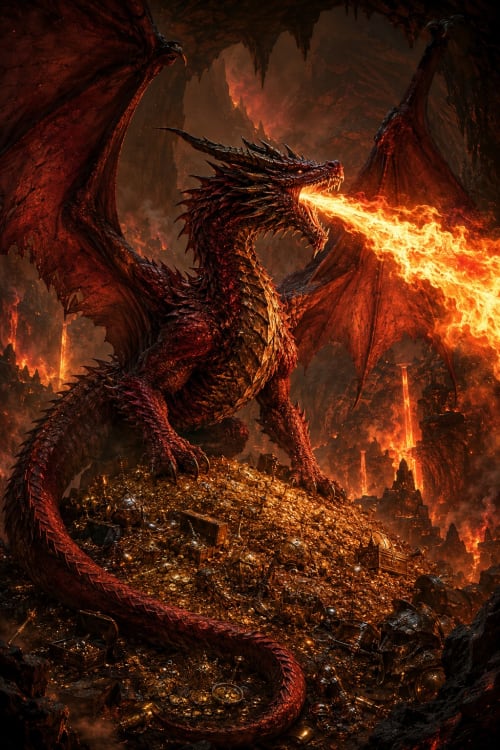
Red Dragon
The Tyrant of Flame
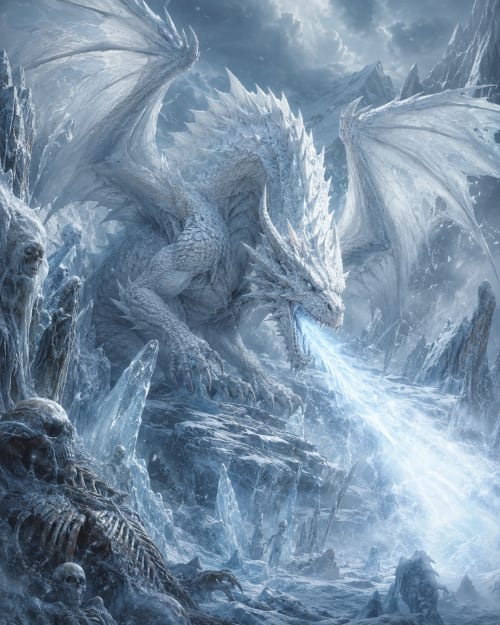
White Dragon
Hunter of the Frozen Wastes
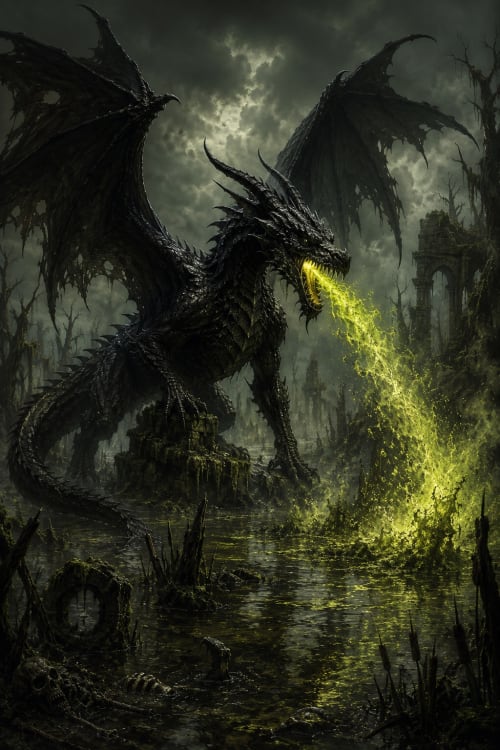
Black Dragon
Acidic Tyrant of the Swamps

Wyvern
Wyvern · Type of Dragon — Legendary two-legged, winged reptilian creature
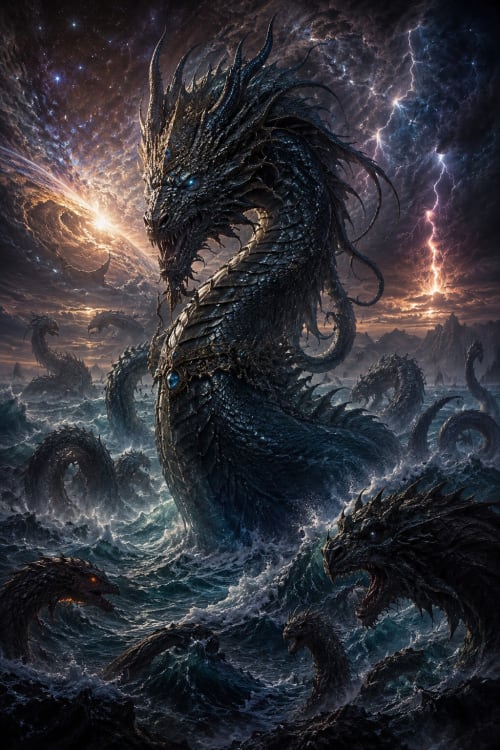
Tiamat
Primordial Sea Dragon of Mesopotamian Myth
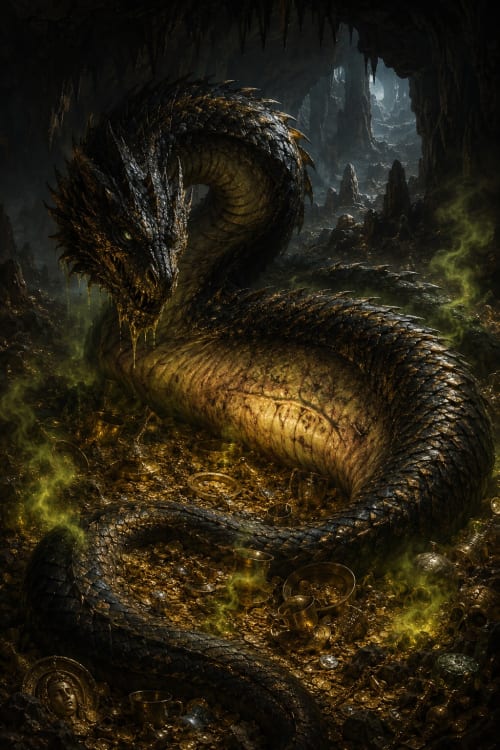
Fafnir
Cursed Treasure Dragon of Norse Myth
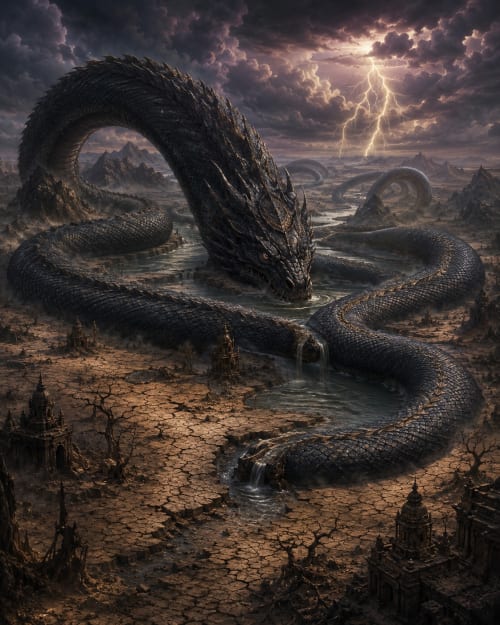
Vritra
Indian Vedic Drought Dragon
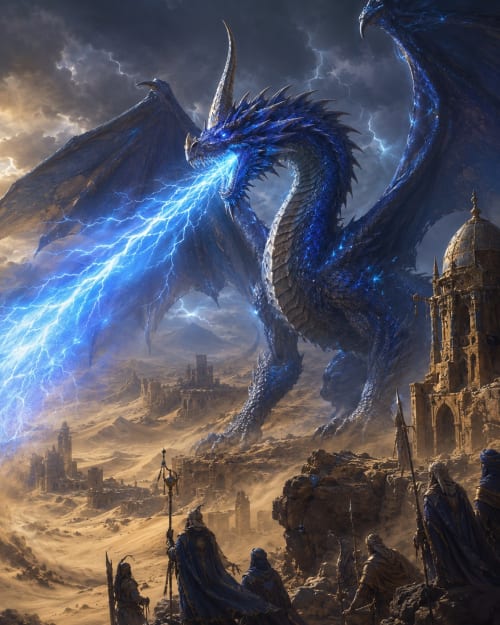
Blue Dragon
Lightning Lord of the Desert
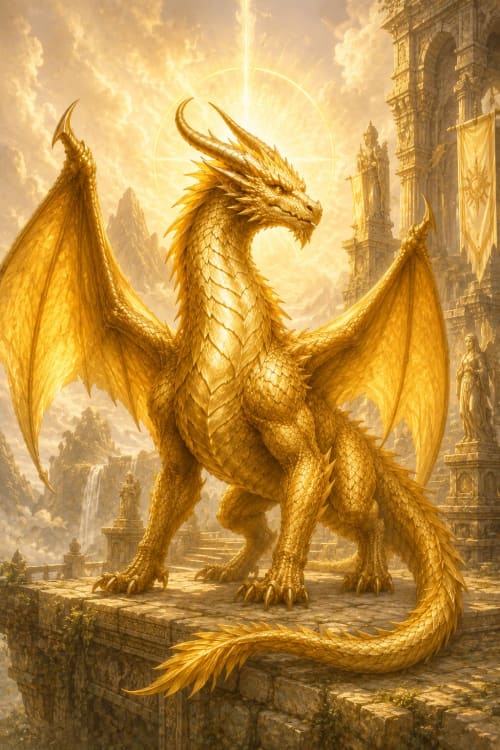
Gold Dragon
The Golden Guardian of Justice
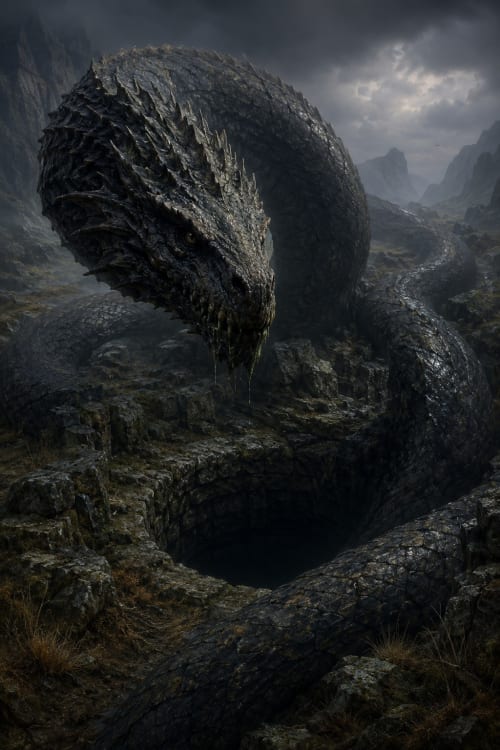
Wyrm
The Limbless Ancient Dragon
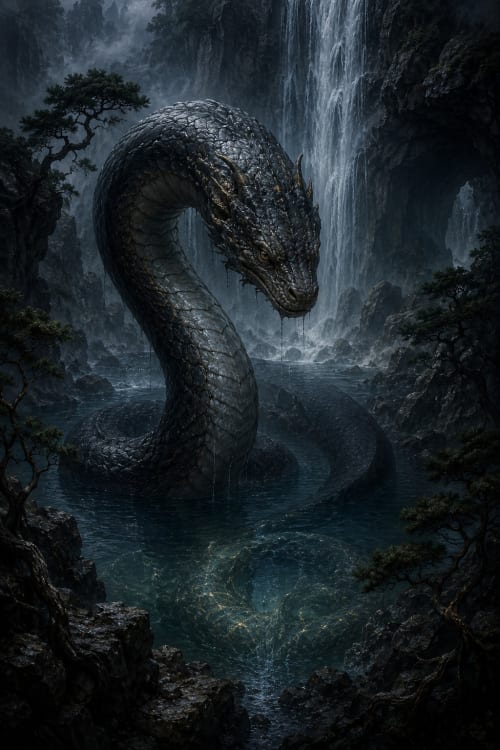
Imugi
The Aspiring Dragon
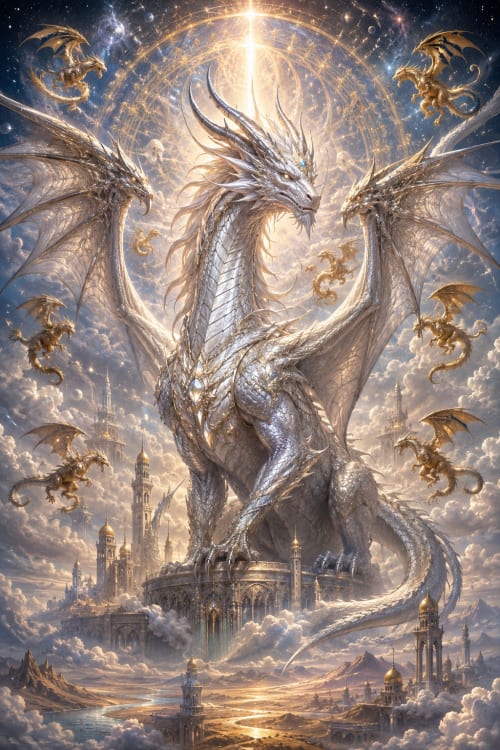
Bahamut
Arabian Cosmic Fish + D&D Platinum Dragon of Justice