
Bahamut
Arabian Cosmic Fish + D&D Platinum Dragon of Justice
Names in Other Languages
 바하무트한국어
Bahamut · 아라비아 신화 + D&D 정의의 백금룡
 バハムート日本語
Bahamut · アラビア神話の宇宙魚 + D&D 正義の白金竜
 巴哈姆特繁體中文
Bahamut · 阿拉伯神話宇宙巨魚 + D&D 正義白金龍
 BahamutDeutsch
Arabischer Kosmosfisch + D&D-Platindrache der Gerechtigkeit
 BahamutFrançais
Poisson cosmique arabe + Dragon de platine de la justice (D&D)
 BahamutEspañol
Pez cósmico árabe + Dragón platino de la justicia (D&D)
 BahamutPortuguês
Peixe cósmico árabe + Dragão de platina da justiça (D&D)
 BahamutPolski
Arabska ryba kosmiczna + Platynowy smok sprawiedliwości (D&D)
 БахамутРусский
Bahamut · Арабская космическая рыба + платиновый дракон справедливости (D&D)
Bahamut joins two unrelated traditions under one name. The first is the colossal cosmological fish of medieval Arabic cosmography, attested in the thirteenth-century ʿAjāʾib al-makhlūqāt of Zakariyyā al-Qazwīnī (1203-1283) and in the 'Pearl of Wonders' of Ibn al-Wardī, swimming beneath the bull Kuyūthā and bearing the seven layers of the world; Jorge Luis Borges transmitted the tradition to a Western audience through 'El Libro de los seres imaginarios' (Manuel Peña, Buenos Aires, 1957). The second is the Platinum Dragon of Dungeons & Dragons, introduced by Gary Gygax in 'Supplement III: Eldritch Wizardry' (TSR, 1976) and developed across the AD&D 'Monster Manual' (1977), 'Deities & Demigods' (1980), 'Draconomicon' (1990) and the fifth-edition 'Monster Manual' (2014) and 'Fizban's Treasury of Dragons' (2021). The D&D Bahamut is the platinum-scaled god of justice, honour and truth, king of the five metallic dragons (gold, silver, copper, bronze, brass), escorted by seven ancient gold dragons, given to walking the world as a humble human sage and locked in eternal opposition to the chromatic queen Tiamat.
Origin
The direct textual source is al-Qazwīnī's thirteenth-century cosmography, where Bahamut is a vast fish whose Arabic name derives from 'baḥr' (sea); the form diverged from the biblical Behemoth of Job 40 to become the maritime giant of Arab cosmology. Borges's 'Manual de zoología fantástica' (1957), later expanded into 'El Libro de los seres imaginarios', carried the entry into twentieth-century Spanish and English letters, with Norman Thomas di Giovanni's English version appearing in 1969. The D&D Bahamut was named in Gygax's 'Eldritch Wizardry' supplement of 1976 and codified as a dragon-god by James Ward's 'Deities & Demigods' (1980); 'Fizban's Treasury of Dragons' (2021) recast him as one of the first-world metallic ancestors who upheld the cosmos in its earliest age.
Features
- Platinum scales over a body more than sixty metres long
- King of the five metallic dragons — gold, silver, copper, bronze and brass
- Escorted by seven ancient gold dragons as personal guard
- Walks the world disguised as an elderly human sage
- Eternally opposed to Tiamat, queen of the five chromatic dragons
- Canonised as god of justice, honour and truth from 'Eldritch Wizardry' (1976) onward
Stories
Serves as the patron deity and ultimate mentor of lawful-good heroes in tabletop campaigns; his platinum scales and seven gold escorts are stock iconography for an end-of-campaign revelation. The Arabic substrate is cited in literary-fantasy writing in the lineage of Borges and Italo Calvino.
Weakness
'Deities & Demigods' notes that Bahamut's intense sense of justice can be exploited by feigned repentance, and the cosmic balance pacts of D&D restrict him to direct intervention only at moments of decisive crisis.
Cultural Significance
The name spans four cultural layers — biblical Behemoth, Arabic cosmography, Borgesian fantastic literature, and D&D mythology — and is routinely cited as a textbook case of religious-literary-gaming transmission.
In Popular Culture
Al-Qazwīnī's 'ʿAjāʾib al-makhlūqāt' (thirteenth century), Borges's 'El Libro de los seres imaginarios' (1957), D&D 'Eldritch Wizardry' (1976), 'Deities & Demigods' (1980), 'Draconomicon' (1990), fifth-edition 'Monster Manual' (2014), 'Fizban's Treasury of Dragons' (2021), and the recurring summoned dragon 'Bahamut' of the 'Final Fantasy' series from the 1990 Famicom 'III' onward.
Trivia
Bahamut's 'Mega Flare' breath in 'Final Fantasy' has been a fixture since the 1990 Famicom 'III'; the English-language pronunciation alternates between 'BAH-ha-moot' and 'buh-HAY-mut'.
Related
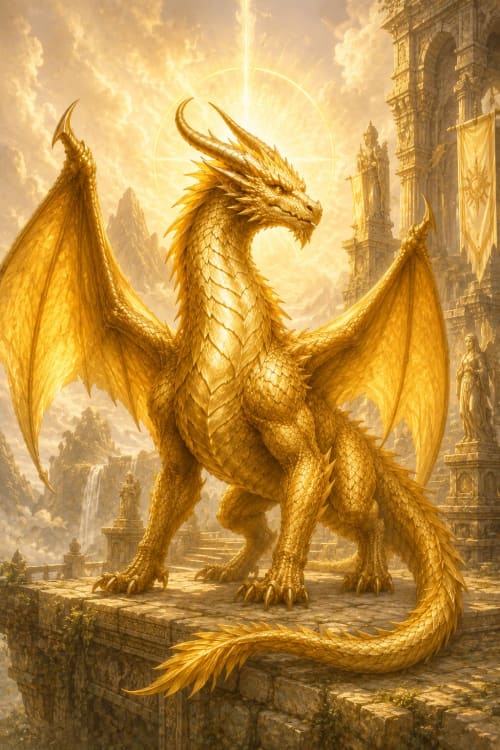
Gold Dragon
The Golden Guardian of Justice
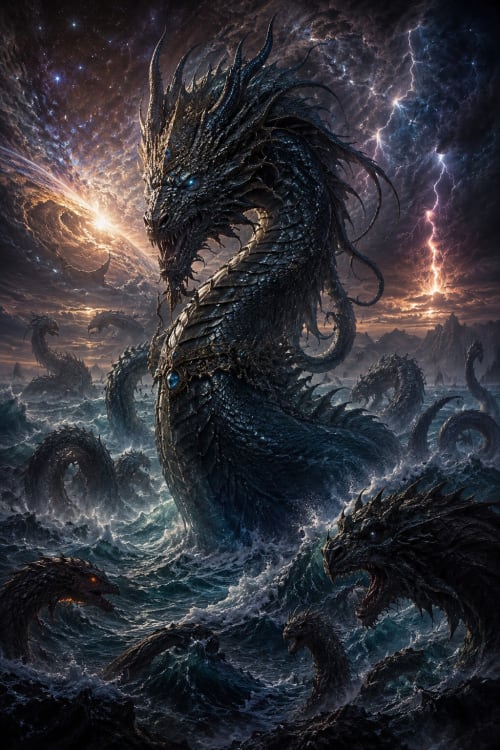
Tiamat
Primordial Sea Dragon of Mesopotamian Myth
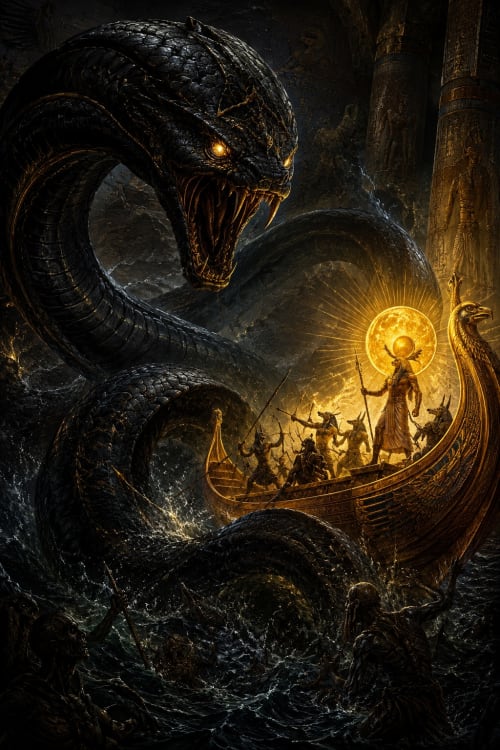
Apophis
Egyptian Cosmic Serpent of Darkness and Chaos

Long
The Imperial Dragon of Chinese Myth
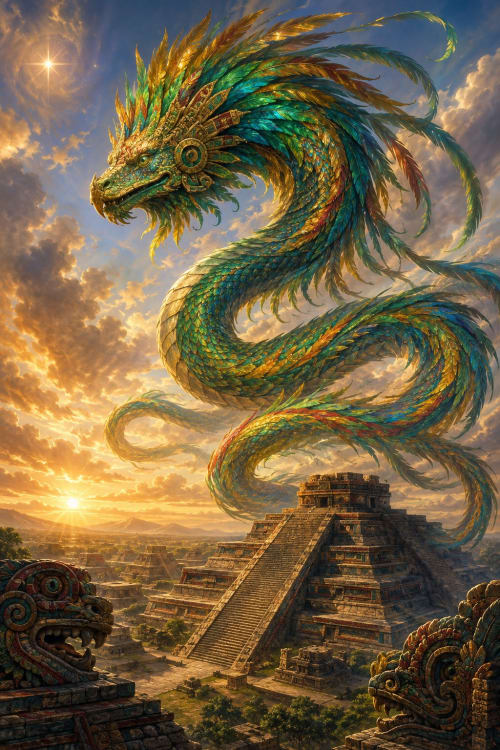
Quetzalcoatl
The Feathered Serpent

Azure Dragon
靑龍 · Eastern Guardian of the Four Symbols
Fafnir
Cursed Treasure Dragon of Norse Myth

Vritra
Indian Vedic Drought Dragon
Lernaean Hydra
Nine-Headed Marsh Monster
Wyrm
The Limbless Ancient Dragon
Yamata-no-Orochi
八岐大蛇 · Eight-Headed Serpent of Japanese Myth

Imugi
The Aspiring Dragon