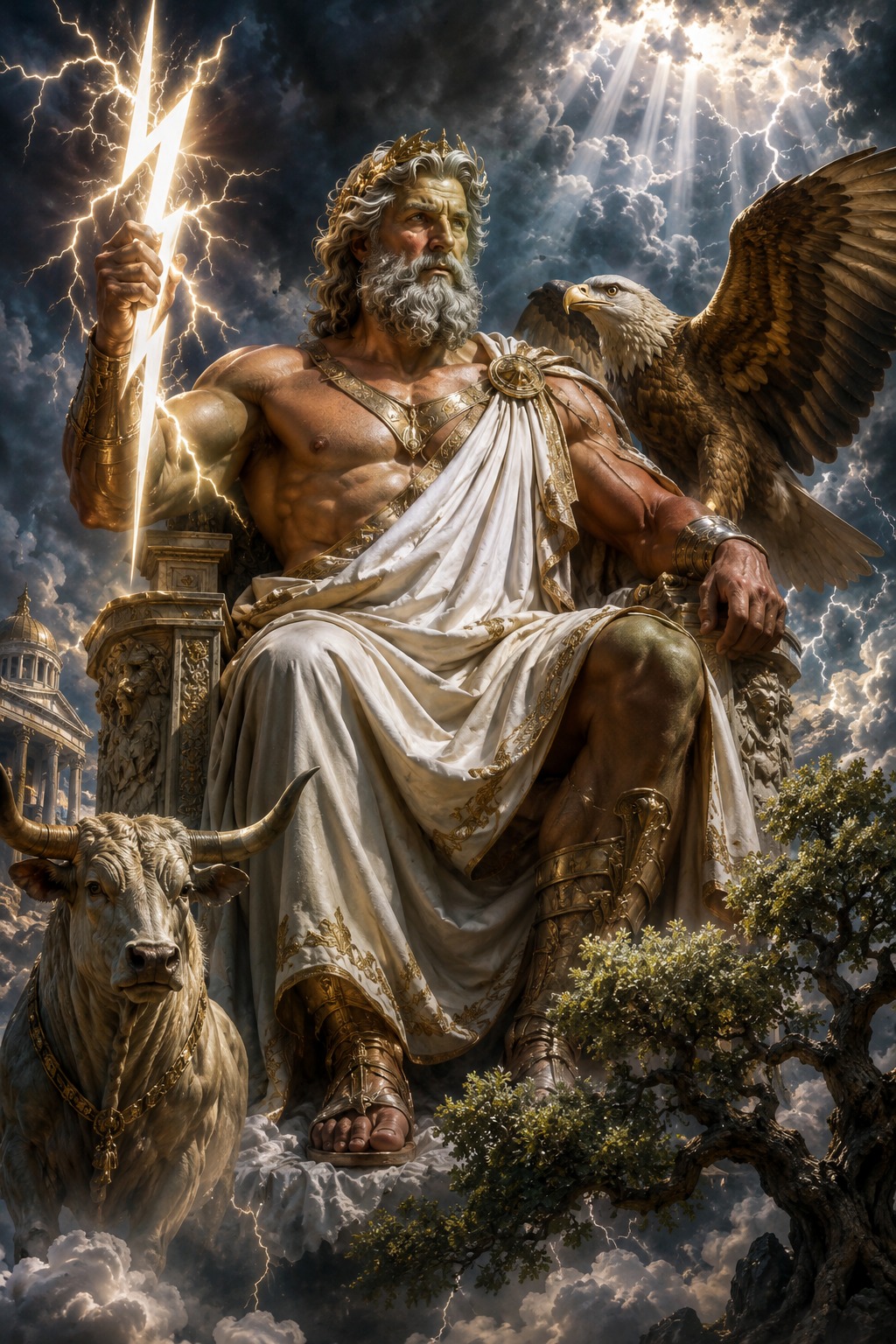
Zeus
Zeus· King of Olympus God of Sky and Thunder
Names in Other Languages
 제우스한국어
Zeus· 올림포스의 주신 하늘과 번개의 왕
 ゼウス日本語
Zeus· オリンポス主神 天空と雷の王
 宙斯繁體中文
Zeus· 奧林匹斯主神 天空與雷霆之王
 ZeusDeutsch
Zeus · Herrscher des Olymp — Gott des Himmels und Donners
 ZeusFrançais
Zeus · Roi de l'Olympe — Dieu du ciel et de la foudre
 ZeusEspañol
Zeus· Rey del Olimpo Dios del cielo y del rayo
 ZeusPortuguês
Zeus· Rei do Olimpo Deus do céu e do raio
 ZeusPolski
Zeus· Władca Olimpu bóg nieba i piorunów
 ЗевсРусский
Zeus· Царь Олимпа бог неба и грома
Zeus (Ancient Greek Zeus, Latin Iuppiter Jupiter) is the supreme god of Greek mythology — the decisive canon, the god of the sky, thunder, and lightning, the head of the 12 Olympian gods, and the decisive canonical iconographic figure as the youngest son of Kronos (Kronos) and Rhea (Rhea) who deposed his father and took the sovereignty of the universe. The etymology is the decisive canonical vocabulary derived from the Proto-Indo-European *dyeu- (light, sky), cognate with the Latin Iuppiter (*dyeu-pater 'sky father') and the Sanskrit Dyaus Pita. The decisive textual canon is the Mycenaean Linear B clay tablet inscriptions 'di-we (di-we, dative of Zeus)' and 'di-wo (di-wo, genitive of Zeus)' of the Bronze Age Mycenaean civilisation, and the Theogony (Theogony) lines 453-506 of Hesiod (Hesiod) of c. 8th-7th century BCE — the decisive canon in which Kronos swallowed his children but mother Rhea hid Zeus in Mount Ida (Ida) or the Dikte (Dikte) cave of Crete (Krete) and saved him — and lines 617-720 — the decisive canon of the 10-year Titanomachy (Titanomachia) — and lines 820-880 — the decisive canon of the duel with the giant monster Typhon (Typhon) — and lines 881-887 — the decisive canon of receiving the sky by lot — and Books 1.493-611, 8.5-27, and 14.292-353 of Homer's Iliad of c. 8th century BCE.
Origin
The iconographic origin is the Mycenaean Linear B clay tablet inscriptions 'di-we (di-we, dative of Zeus)' and 'di-wo (di-wo, genitive of Zeus)' of the Bronze Age Mycenaean civilisation (c. 1450-1200 BCE) — the decisive origin canon, and the decisive textual canon is the Theogony (Theogony) lines 453-491 of Hesiod (Hesiod) of c. 8th-7th century BCE — the decisive canon in which Kronos, fearing the prophecy of Gaia and Ouranos, swallows his children — and lines 492-506 — the decisive canon in which mother Rhea, with the help of Gaia, hid Zeus in Mount Ida (Ida) or the Dikte (Dikte) cave of Crete (Krete) when she gave birth to him, and made Kronos swallow a stone wrapped in swaddling clothes instead. Lines 617-720 — the decisive canon in which Zeus rescued his siblings, received the weapons of thunder, lightning, and the thunderbolt (keraunos) from the Kyklopes (Kyklopes), and won the 10-year Titanomachy (Titanomachia) — and lines 820-880 — the decisive canon in which he won the final duel with the giant monster Typhon (Typhon) born of Gaia. Lines 881-887 — the decisive canon of receiving the sky by lot with Poseidon (Poseidon) and Hades (Hades), and giving the sea to Poseidon and the underworld to Hades — and Book 1 lines 493-611 of Homer's Iliad of c. 8th century BCE — the decisive canon of Thetis's (Thetis) supplication — and Book 8 lines 5-27 — the decisive canon of the test of the 'golden chain (chrysea seire)' — and Book 14 lines 292-353 — the decisive canon of Hera's seduction.
Features
- Mature dignified bearded male god
- Thunderbolt keraunos (keraunos) in his right hand
- Golden eagle, oak tree, and bull as symbols
- Shield aigis (aigis) — an invincible shield made by Hephaistos
- Transforms into swan, bull, golden rain, and eagle according to mood
- Main sacred sites — Olympia (Olympia) and Mount Ida of Crete
Stories
The Bronze Age Mycenaean Linear B 'di-we/di-wo' is the decisive origin, and the decisive textual canon is Hesiod Theogony lines 453-506, 617-720, 820-880, and 881-887 of c. 8th-7th century BCE and Homer Iliad Books 1, 8, and 14 and Odyssey Book 1 lines 22-95 of c. 8th century BCE. The decisive religious and art canon is the Temple of Zeus at Olympia (Temple of Zeus at Olympia) at Olympia (Olympia) in Greece of 472-456 BCE — about 64.1x27.7 m, Doric style — and the chryselephantine Statue of Zeus at Olympia (Statue of Zeus at Olympia) of c. 435 BCE by Pheidias (Pheidias) — about 12.4 m — one of the Seven Wonders of the Ancient World. The decisive canon as the protector of oaths and hospitality (xenia), used to explain natural phenomena such as storms and droughts, and the decisive canon of granting legitimacy to city-states and serving as the founder of heroic families. The Bibliotheca (Bibliotheke) Book 1 chapters 1-7 of Pseudo-Apollodorus of c. 1st century BCE — the decisive mythological canon — and the Metamorphoses (Metamorphoses) Books 1-3 of Ovid (Publius Ovidius Naso) of c. 1st century CE — the decisive Latin canon. The decisive 21st-century canon is the Zeus voiced by Rip Torn (Rip Torn) of the Disney film Hercules (Hercules) released in the USA on 27 June 1997, the Zeus played by Liam Neeson (Liam Neeson) of the film Clash of the Titans (Clash of the Titans) (directed by Louis Leterrier) released in the USA on 2 April 2010, the Zeus played by Sean Bean (Sean Bean) of the film Percy Jackson (Percy Jackson) released on 12 February 2010, and the Zeus played by Russell Crowe (Russell Crowe) of the film Thor: Love and Thunder (Thor: Love and Thunder) released on 8 July 2022 are the 21st-century decisive global film canon.
Weakness
Zeus's weaknesses are: (1) infidelity — the decisive canonical weakness — the decisive canon of Hera's (Hera) anger caused by his endless infidelities — the decisive canon of affairs with Leda (Leda, transformed into swan), Europa (Europa, transformed into bull), Danae (Danae, golden rain), Alkmene (Alkmene), Io (Io), Semele (Semele), and Kallisto (Kallisto); (2) submission to fate (Moirai) — the decisive canon — the decisive canon in the c. 1st century mythological canon in which he eventually submitted to the fate of the Moirai (Moirai); (3) target of children's conspiracy — the decisive canon — the decisive canon in the c. 1st century Pseudo-Apollodorus canon in which Hera, Poseidon, and Athena conspired against him; (4) revolt of the giants — the decisive canon of the duel with Typhon (Typhon) in Hesiod Theogony lines 820-880; (5) binding of the promise — the decisive canon; (6) domestic strife with Hera — the decisive canon of Homer Iliad Book 1; (7) binding of the sacred domain — the decisive canon; (8) weight of the universe — the decisive canon. The decisive canonical finale is the decisive mythological canon of Hesiod Theogony lines 881-929 of c. 8th-7th century BCE — Zeus swallowed Metis (Metis), and Athena (Athena) was born from his head fully armed, establishing the eternal order of the universe.
Cultural Significance
Zeus is not merely a chief-god icon but the canonical iconographic figure of the decisive Greek canon, traversing the Bronze Age Mycenaean Linear B 'di-we/di-wo', the c. 8th-7th century BCE Hesiod Theogony lines 453-506, 617-720, 820-880, and 881-887, the c. 8th century BCE Homer Iliad Books 1, 8, and 14, Odyssey Book 1, the 472-456 BCE Temple of Zeus at Olympia, the c. 435 BCE Pheidias chryselephantine Statue of Zeus at Olympia, the c. 1st century BCE Pseudo-Apollodorus Bibliotheca Book 1 chapters 1-7, the c. 1st century CE Ovid Metamorphoses Books 1-3, the 1980 D&D Deities & Demigods, the 1997 Disney Hercules, the 2010 Clash of the Titans, and the 2022 Thor: Love and Thunder. The Mycenaean Linear B clay tablet inscriptions 'di-we (di-we)' and 'di-wo (di-wo)' of the Bronze Age Mycenaean civilisation (c. 1450-1200 BCE) are the decisive origin, and they settled as the decisive canon in Hesiod's Theogony of c. 8th-7th century BCE — the decisive canon in which Kronos swallowed his children but mother Rhea hid Zeus in Mount Ida or the Dikte cave of Crete and saved him — and the decisive canon of the 10-year Titanomachy and the duel with Typhon. The decisive religious canon is the Temple of Zeus at Olympia (Temple of Zeus at Olympia) at Olympia (Olympia) in Greece of 472-456 BCE — about 64.1x27.7 m, Doric style — and the chryselephantine Statue of Zeus at Olympia (Statue of Zeus at Olympia) of c. 435 BCE by Pheidias (Pheidias) of Greece — about 12.4 m — one of the Seven Wonders of the Ancient World — is the decisive art canon, and the ancient Olympic Games held every 4 years at Olympia (starting 776 BCE) dedicated to Zeus is the decisive religious canon. The decisive 21st-century canon is the Zeus played by Russell Crowe (Russell Crowe, born 7 April 1964 in Wellington, New Zealand) of the Marvel Studios film Thor: Love and Thunder (Thor: Love and Thunder) (directed by Taika Waititi, Disney, worldwide box office about 760 million dollars) released in the USA on 8 July 2022 — the 21st-century decisive global film canon.
In Popular Culture
- Mycenaean Linear B inscription 'di-we/di-wo' (Bronze Age) — decisive origin canon
- Hesiod Theogony lines 453-506, 617-720, 820-880, 881-887 (c. 8th-7th century BCE) — decisive origin canon
- Homer Iliad Books 1, 8, 14 (c. 8th century BCE) — decisive heroic-epic canon
- Homer Odyssey Book 1 lines 22-95 (c. 8th century BCE) — decisive epic canon
- Temple of Zeus at Olympia (472-456 BCE) — decisive religious-architecture canon
- Pheidias chryselephantine Statue of Zeus at Olympia (c. 435 BCE) — decisive art canon
- Pseudo-Apollodorus Bibliotheca Book 1 chapters 1-7 (c. 1st century BCE) — decisive mythological canon
- Ovid Metamorphoses Books 1-3 (c. 1st century CE) — decisive Latin canon
- TSR D&D Deities & Demigods, Zeus (1980) — decisive fantasy RPG canon
- Disney film Hercules, Zeus Rip Torn (1997) — 21st-century decisive film canon
- Film Thor: Love and Thunder, Zeus Russell Crowe (2022) — 21st-century decisive film canon
Trivia
The etymology of Zeus (Zeus) is the decisive canonical vocabulary derived from the Proto-Indo-European *dyeu- (light, sky), cognate with the Latin Iuppiter (*dyeu-pater 'sky father') and the Sanskrit Dyaus Pita. The aliases Olympios (Olympios), Zeus Horkios (Horkios, 'of oaths'), Xenios (Xenios, 'of hospitality'), Phoinikios (Phoinikios), and Nephelegeretes (Nephelegeretes, 'cloud-gatherer') are the decisive canonical vocabulary. The decisive textual canon is the Mycenaean Linear B clay tablet inscriptions 'di-we (di-we)' and 'di-wo (di-wo)' of the Bronze Age Mycenaean civilisation and the Theogony (Theogony) lines 453-506 of Hesiod (Hesiod) of c. 8th-7th century BCE — the decisive canon in which Kronos (Kronos) swallowed his children but mother Rhea (Rhea) hid Zeus in Mount Ida (Ida) or the Dikte (Dikte) cave of Crete (Krete) and saved him. Lines 617-720 — the decisive canon in which he won the 10-year Titanomachy (Titanomachia) with the thunder, lightning, and thunderbolt (keraunos) received from the Kyklopes (Kyklopes) — and lines 820-880 — the decisive canon in which he won the duel with the giant monster Typhon (Typhon) born of Gaia. Lines 881-887 — the decisive canon of receiving the sky by lot with Poseidon and Hades — and Book 8 lines 5-27 of Homer's Iliad of c. 8th century BCE — the decisive canon of the test of the 'golden chain (chrysea seire)' — 'even if all the gods grip one end and pull, they cannot drag me down' — and Book 14 lines 292-353 — the decisive canon in which Hera borrowed the kestos himas (kestos himas) to seduce Zeus on Mount Ida. The decisive canon of Zeus's infidelity and transformation — transforming into a swan to father Helen (Helen) and Kastor and Polydeukes (Dioskouroi) with Leda (Leda), transforming into a bull to take Europa (Europa) to Crete and fathering Minos (Minos) and Rhadamanthys (Rhadamanthys), transforming into golden rain to father Perseus (Perseus) with Danae (Danae), and fathering Heracles (Heracles) with Alkmene (Alkmene). The chryselephantine Statue of Zeus at Olympia (Statue of Zeus at Olympia) of c. 435 BCE by the Greek sculptor Pheidias (Pheidias, c. 480-430 BCE) — about 12.4 m — one of the Seven Wonders of the Ancient World — is the decisive art canon, and the Zeus played by Russell Crowe (Russell Crowe, born 7 April 1964 in Wellington, New Zealand) of the Marvel Studios film Thor: Love and Thunder (Thor: Love and Thunder) (directed by Taika Waititi, Disney) released in the USA on 8 July 2022 is the 21st-century decisive global film canon.