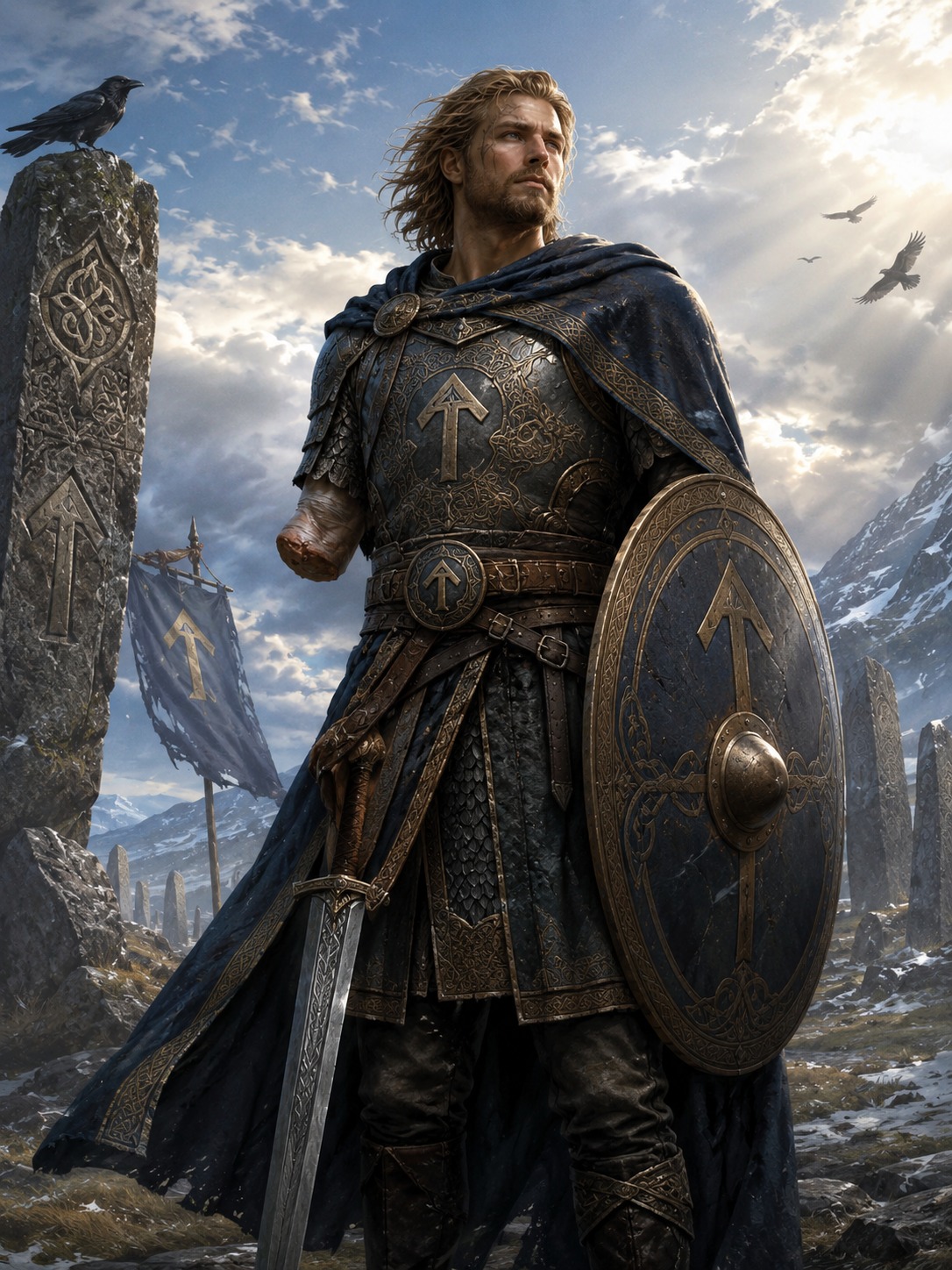
Tyr
Tyr · Norse God of War, Justice, and Oaths
Names in Other Languages
 티르한국어
티르한국어Tyr · 북유럽 전쟁·정의·맹세의 신
 テュール日本語
Tyr · 北欧戦争・正義・誓約の神
 提爾繁體中文
Tyr · 北歐戰爭、正義與誓約之神
 TyrDeutsch
Tyr · Nordischer Gott des Krieges, der Gerechtigkeit und der Eide
 TýrFrançais
Týr · Dieu nordique de la guerre, de la justice et des serments
 TyrEspañol
Tyr · Dios nórdico de la guerra, la justicia y los juramentos
 TyrPortuguês
Tyr · Deus nórdico da guerra, da justiça e dos juramentos
 TýrPolski
Týr · Nordycki bóg wojny, sprawiedliwości i przysiąg
 ТюрРусский
Tyr · Скандинавский бог войны, справедливости и клятв
Tyr (Old Norse Tyr, Proto-Germanic Tiwaz) is the decisive canonical god of war, justice, law, and oaths of the Aesir (Aesir) in Norse mythology, and the decisive canonical iconographic figure who lost his right hand by putting it in the mouth of the giant wolf Fenrir (Fenrir) as a pledge to bind him with the sacred chain Gleipnir (Gleipnir). The etymology Proto-Germanic Tiwaz ('god, sky god') is derived from the Proto-Indo-European deywos ('shining sky god'), cognate with the Latin deus (god), the Greek Zeus, and the Sanskrit dyaus pitar ('sky father') — the decisive canonical vocabulary. The English Tuesday (Old English Tiwesdaeg, 'Tiw's day'), the German Dienstag, and the Norwegian tirsdag are the decisive canonical vocabulary of Tyr, and the rune T Tiwaz (Tiwaz Rune) is the decisive canon of his name. The decisive textual canon is the Prose Edda (Prose Edda) of c. 1220 of the early 13th-century Icelandic poet-historian Snorri Sturluson (Snorri Sturluson, 1179-1241) — Gylfaginning (Gylfaginning) chapters 25 and 34 — the decisive Tyr canon and the Fenrir binding canon — and the Poetic Edda (Poetic Edda) Hymiskvida (Hymiskvida) of the c. 1270 Codex Regius manuscript is the decisive poetic canon of Tyr.
Origin
The iconographic origin is the Proto-Germanic sky-war god Tiwaz worship of the Germanic Bronze-Iron Age (c. 2000 BCE - 1st century CE), and the etymology Tiwaz is derived from the Proto-Indo-European deywos ('shining sky god'), cognate with the Latin deus, the Greek Zeus, and the Sanskrit dyaus pitar — the decisive canonical vocabulary. The decisive Roman-era canon of Tyr is chapter 9 of the c. 1st-century Roman historian Tacitus (Cornelius Tacitus, c. 56-120) Germania (Germania) — the decisive canon that the Germanic tribes identified Tyr with Mars (Mars, Roman war god). The decisive textual canon is the Prose Edda (Prose Edda) of c. 1220 of the early 13th-century Icelandic — Reykholt — Snorri Sturluson (Snorri Sturluson, 1179-1241) — chapter 25 of Gylfaginning (Gylfaginning) — the decisive canon in which Tyr, as 'the bravest one (djarfastr)', loses his right hand by putting it in Fenrir's mouth as a pledge to bind him — and chapter 34 — the Fenrir binding canon. The Hymiskvida (Hymiskvida) of the Poetic Edda (Poetic Edda) of the c. 1270 Codex Regius (Codex Regius) manuscript is the decisive poetic canon that Tyr is the son of the giant Hymir (Hymir).
Features
- Young-to-middle-aged male god with the dignity of a warrior
- One-handed god without a right hand
- Sword and shield symbols
- Rune T Tiwaz is his name
- Sacrificed his right hand during Fenrir's binding
- Mutual destruction with Garmr at Ragnarok
Stories
Chapter 9 of the 1st-century Tacitus Germania — the Germanic-Mars identification canon — and the Fenrir binding canon in Snorri Sturluson Prose Edda Gylfaginning chapters 25 and 34 of c. 1220 — the decisive mythological canon in which Tyr puts his right hand in the wolf's mouth as a pledge and loses it — are the decisive origin. The Hymiskvida of the Poetic Edda of the c. 1270 Codex Regius manuscript is the decisive poetic canon, and the 19th-century Germanic-nationalism revival — the 1835 Deutsche Mythologie of the German scholar Jacob Grimm (Jacob Grimm, 1785-1863) and the 1856 German prose Edda translation of Karl Simrock — is the decisive 19th-century scholarly canon. The 1851-1856 Balder Dead of the British poet Matthew Arnold and the 1876 Bayreuth premiere of Der Ring des Nibelungen of the German composer Richard Wagner (Richard Wagner, 1813-1883) opera tetralogy is the decisive 19th-century musical canon. The decisive modern canon is the Tyr (Tyr) of the 1980 D&D Deities & Demigods (Deities & Demigods) by TSR in the USA and the Tyr canon adaptation of the 1985 Japanese manga and 1998 Korean Amelit game Ragnarok Online, and the decisive 21st-century canon is the dead one-handed Tyr of God of War (God of War) (directed by Cory Barlog, Santa Monica Studio) released by Sony Interactive Entertainment in the USA on 20 April 2018 — the decisive Norse canon integrated through the series — and the living Tyr of the sequel God of War Ragnarok released on 9 November 2022 — the 21st-century global decisive video-game canon.
Weakness
Tyr's weaknesses are: (1) lack of one hand — the decisive canonical weakness in the 1220 Snorri Gylfaginning canon, in which during Fenrir's binding, he loses his right hand by putting it in the wolf's mouth as a pledge — unable to wield two-handed weapons — the decisive canon; (2) fate of Ragnarok — the most decisive canonical weakness in the 1220 Snorri Gylfaginning chapter 51 and the 1270 Poetic Edda Voluspa canon, in which at Ragnarok Tyr mutually destroys with the hellhound Garmr (Garmr) — the decisive mythological canon; (3) Fenrir's wrath — the decisive canon that at Ragnarok when Fenrir is freed, Fenrir never forgets Tyr's old betrayal; (4) weakness of oaths — the justice god Tyr cannot break his own oath — the decisive canonical weakness; (5) Garmr's chains — before Ragnarok Garmr is bound at the entrance of Gnipahellir (Gnipahellir) cave — the decisive canon — and when freed, mutually destroys with Tyr; (6) Odin's authority — Tyr, though the bravest of the Aesir, is under Odin's authority — the decisive canon; (7) son of the giant Hymir — the complexity of giant lineage in the 1270 Hymiskvida canon that Tyr's father is the giant Hymir; (8) honour of the warrior — the binding of sacred honour — the decisive canon. The decisive canonical finale is chapter 51 of the 1220 Snorri Gylfaginning — the decisive mythological canon in which at Ragnarok Tyr and Garmr kill each other — mutual destruction.
Cultural Significance
Tyr is not merely a war-god icon but the canonical iconographic figure of the decisive Germanic-Norse canon, traversing chapter 9 of the 1st-century Tacitus Germania, the early 13th-century c. 1220 Snorri Sturluson Prose Edda, the c. 1270 Codex Regius manuscript Poetic Edda, the 1835 Jacob Grimm Deutsche Mythologie, the 1876 Wagner Der Ring des Nibelungen, the 1980 D&D Deities & Demigods, and the 2018 God of War. The Proto-Germanic sky-war god Tiwaz worship of the Germanic Bronze-Iron Age (c. 2000 BCE - 1st century CE) is the decisive canon recorded in chapter 9 of the c. 1st-century Roman historian Tacitus (Cornelius Tacitus, c. 56-120) Germania (Germania) — the Germanic tribes most worship Mars (Mars), Mercurius (Mercurius), Hercules (Hercules), and Isis (Isis) — and the decisive textual canon is the Prose Edda (Prose Edda) of c. 1220 of the early 13th-century Icelandic — Reykholt — Snorri Sturluson (Snorri Sturluson, born c. 1179 in Hvammur, Iceland, assassinated 23 September 1241 at Reykholt, Iceland by order of King Haakon IV of Norway) — chapter 25 of Gylfaginning (Gylfaginning) — the decisive canon in which Tyr, as 'the bravest one (djarfastr)', loses his right hand by putting it in the wolf's mouth as a pledge to bind Fenrir. The Hymiskvida (Hymiskvida) of the Poetic Edda (Poetic Edda) of the c. 1270 Codex Regius (Codex Regius) manuscript is the decisive poetic canon that Tyr is the son of the giant Hymir (Hymir), and the English Tuesday (Old English Tiwesdaeg, 'Tiw's day'), the German Dienstag, and the Norwegian tirsdag are the decisive canon of Tyr that settled in everyday vocabulary up to the 21st century. The Tyr (Tyr) of the 1980 D&D Deities & Demigods (Deities & Demigods) by TSR in the USA — consistent through to 5e (5th Edition) of 2014 — is the decisive canon of modern fantasy RPG, and the decisive 21st-century canon is the dead one-handed Tyr of God of War (God of War) (directed by Cory Barlog, Santa Monica Studio, Metacritic 94) released by Sony Interactive Entertainment in the USA on 20 April 2018 and the living Tyr of the sequel God of War Ragnarok (directed by Eric Williams) released on 9 November 2022 — the 21st-century decisive global video-game canon.
In Popular Culture
- Tacitus Germania chapter 9 (1st century CE) — decisive Roman-era canon
- Snorri Sturluson Prose Edda Gylfaginning chapters 25 and 34 (c. 1220) — decisive origin canon
- Codex Regius manuscript Poetic Edda Hymiskvida (c. 1270) — decisive poetic canon
- Jacob Grimm Deutsche Mythologie (1835) — decisive 19th-century scholarly canon
- Richard Wagner Der Ring des Nibelungen (1876) — decisive 19th-century musical canon
- TSR D&D Deities & Demigods, Tyr (1980) — decisive fantasy RPG canon
- Sony God of War, dead Tyr (2018) — 21st-century decisive video-game canon
- Sony God of War Ragnarok, Tyr (2022) — 21st-century decisive video-game canon
Trivia
The Proto-Germanic Tiwaz of Tyr (Tyr) is derived from the Proto-Indo-European deywos ('shining sky god'), cognate with the Latin deus (god), the Greek Zeus, and the Sanskrit dyaus pitar ('sky father') — the decisive canonical vocabulary. The English Tuesday is derived from the Old English Tiwesdaeg ('Tiw's day'), and the German Dienstag, the Norwegian tirsdag, the Swedish tisdag, and the Danish tirsdag settled in everyday vocabulary up to the 21st century — the decisive canonical vocabulary, and the rune T Tiwaz (Tiwaz Rune, 17th of the Elder Futhark) is the decisive canon of his name. The decisive textual canon is the Prose Edda (Prose Edda) of c. 1220 of the early 13th-century Icelandic — Reykholt — Snorri Sturluson (Snorri Sturluson, born c. 1179, died 23 September 1241) — chapter 25 of Gylfaginning (Gylfaginning) — the decisive canon in which Tyr, as 'the bravest one (djarfastr)', puts his right hand in the wolf's mouth as a pledge to bind the giant wolf Fenrir (Fenrir) with the sacred chain Gleipnir (Gleipnir), promising that it will not break, and Fenrir, realising he cannot break the chain, bites off Tyr's right hand. In chapter 51 of the 1220 Snorri Gylfaginning and the Voluspa (Voluspa) of the 1270 Poetic Edda — the Ragnarok canon — Tyr mutually destroys with the hellhound Garmr (Garmr) — the decisive canon, and Gleipnir is the decisive canon made by the dwarves of Svartalfheim (Svartalfheim) from 6 impossible materials (cat's footstep, woman's beard, mountain's roots, bear's sinews, fish's breath, bird's spittle). The dead one-handed Tyr of God of War (God of War) (directed by Cory Barlog, Santa Monica Studio, Metacritic 94, worldwide sales about 23 million) released by Sony Interactive Entertainment in the USA on 20 April 2018 and the living Tyr (played by Ryan Hurst) of the sequel God of War Ragnarok (directed by Eric Williams, Metacritic 94, worldwide sales about 15 million) released on 9 November 2022 are the 21st-century decisive global video-game canon.