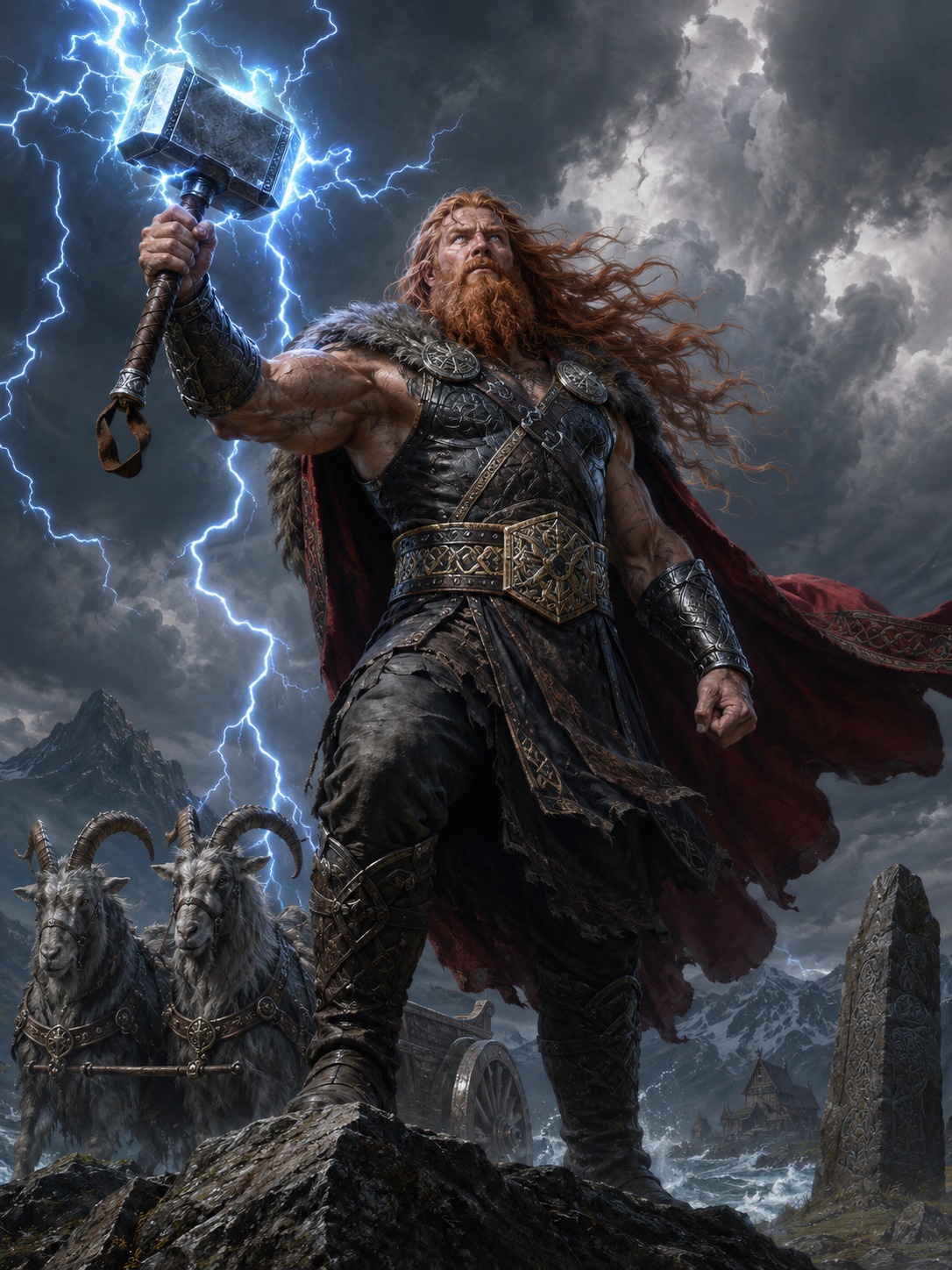
Thor
Thor · Norse God of Thunder — Protector of Mankind
Names in Other Languages
 토르한국어
토르한국어Thor · 북유럽 천둥의 신 — 인류의 수호자
 トール日本語
Thor · 北欧雷神 — 人類の守護者
 索爾繁體中文
Thor · 北歐雷神 — 人類守護者
 ThorDeutsch
Thor · Nordischer Donnergott — Beschützer der Menschen
 ThorFrançais
Thor · Dieu nordique du tonnerre — Protecteur de l'humanité
 ThorEspañol
Thor · Dios nórdico del trueno — Protector de la humanidad
 ThorPortuguês
Thor · Deus nórdico do trovão — Protetor da humanidade
 ThorPolski
Thor · Nordycki bóg piorunów — Obrońca ludzkości
 ТорРусский
Thor · Скандинавский бог грома — Защитник человечества
Thor (Old Norse Thorr, Proto-Germanic Thunraz 'thunder') is the god of thunder, lightning, storms, strength, and fertility of Norse mythology — the decisive canon, the son of Odin (Odin) and the earth goddess Jord (Jord), married to Sif (Sif) — the decisive canonical iconographic figure. The etymology is the decisive canonical vocabulary derived from the Old Norse Thorr or Proto-Germanic Thunraz ('thunder'), cognate with the English Thursday (Old English Thunresdaeg, 'Thunor's day'), the German Donnerstag, and the Latin Tonans (epithet of Jupiter, 'thundering'). The decisive textual canon is chapter 9 of the Germania (Germania) of the c. 1st-century Roman historian Tacitus (Cornelius Tacitus, c. 56-120) — the decisive Roman-era canon of Donar (Donar, later Thor) identified by the Germanic tribes with Hercules (Hercules) — and the Prose Edda (Prose Edda) of c. 1220 of the early 13th-century Icelandic poet-historian Snorri Sturluson (Snorri Sturluson, 1179-1241) — chapters 21 (introduction), 25, 28 (Mjollnir), 42-48 (Utgarda-Loki, Skrymir episode), and 50 (Jormungandr fishing) of Gylfaginning (Gylfaginning) — the decisive canon — and the Voluspa (Voluspa), Thrymskvida (Thrymskvida), Hymiskvida (Hymiskvida), Harbardsljod (Harbardsljod), and Alvissmal (Alvissmal) of the Poetic Edda (Poetic Edda) of the c. 1270 Codex Regius (Codex Regius) manuscript are the decisive poetic canon. The decisive canonical iconography of the hammer Mjollnir (Mjollnir) — a weapon that returns when thrown — and the chariot drawn by two goats Tanngnjostr (Tanngnjostr) and Tanngrisnir (Tanngrisnir).
Origin
The iconographic origin is chapter 9 of the Germania (Germania) of the c. 1st-century Roman historian Tacitus (Cornelius Tacitus, c. 56-120) — the decisive Roman-era canon of Donar (Donar) identified by the Germanic tribes with Hercules (Hercules), and the decisive textual canon is the Prose Edda (Prose Edda) of c. 1220 of the early 13th-century Icelandic — Reykholt — Snorri Sturluson (Snorri Sturluson, 1179-1241) — chapter 21 of Gylfaginning (Gylfaginning) — the decisive canon in which Thor is the son of Odin and the earth goddess Jord (Jord), and married to Sif (Sif) — and chapter 28 — the decisive canon of the hammer Mjollnir (Mjollnir) made by the dwarves Sindri (Sindri) and his brother Brokkr-Eitri (Brokkr-Eitri) with a short handle and returning when thrown — and chapters 42-48 — the decisive canon in which Thor was deceived by the illusions of Utgarda-Loki (Utgarda-Loki) giant and lifted the giant cat (transformation of Jormungandr) — and the decisive canon in which he could not untie the bag of Skrymir (Skrymir) giant. Chapter 50 — the decisive canon in which Thor fished the giant serpent Jormungandr (Jormungandr) using the head of an ox as bait from the boat of the giant Hymir (Hymir) — and the 1270 Thrymskvida — the decisive canon in which the giant Thrymr (Thrymr) stole Mjollnir and demanded Freya, and as a result Thor disguised himself as a bride to recover Mjollnir.
Features
- Massive muscular male god with red beard
- Hammer Mjollnir (Mjollnir) — a thunder weapon that returns when thrown
- Belt Megingjord (Megingjord, 'doubles strength')
- Iron gloves Jarngreipr (Jarngreipr)
- Chariot drawn by two goats Tanngnjostr and Tanngrisnir
- Protects gods and humans from the giant race (jotunn)
Stories
Chapter 9 of the 1st-century Tacitus Germania — the Germanic-Hercules identification canon — and the thunder-god worship of the 9th-11th century Norse Viking mythology is the decisive origin, and the decisive textual canon is chapters 21, 25, 28, 42-48, and 50 of Snorri Sturluson Prose Edda Gylfaginning of c. 1220 and the Voluspa, Thrymskvida, Hymiskvida, Harbardsljod, and Alvissmal of the Poetic Edda of the c. 1270 Codex Regius manuscript. The decisive canon in which during the Viking Age (8th-11th century) he was the most popular god, with Mjollnir-shaped amulets used in weddings, oaths, and house consecrations, and thunder was interpreted as his wrath, and the 19th-century Germanic-nationalism revival — the 1835 Deutsche Mythologie of Jacob Grimm and the 1856 German prose Edda translation of Karl Simrock — is the decisive 19th-century scholarly canon. The Donner (Donner, Thor) of the opera tetralogy Der Ring des Nibelungen of Richard Wagner premiered at the Bayreuth Festspielhaus on 13-17 August 1876 is the decisive 19th-century musical canon, and the Thor of the 1980 D&D Deities & Demigods (Deities & Demigods) by TSR in the USA is the decisive fantasy RPG canon. The decisive 21st-century canon is the Thor played by Chris Hemsworth (Chris Hemsworth, born 11 August 1983 in Melbourne, Australia) of the Marvel Studios film Thor (Thor) (directed by Kenneth Branagh, Disney) released in the USA on 6 May 2011, and the 2012 Avengers, 2013 Thor: The Dark World, 2017 Thor: Ragnarok (directed by Taika Waititi), 2018 Infinity War, 2019 Endgame, and the 8 July 2022 Thor: Love and Thunder (Thor: Love and Thunder) are the 21st-century decisive global film canon.
Weakness
Thor's weaknesses are: (1) simplicity and impulsiveness — the decisive canonical weakness — the decisive canon of being easily deceived by the giants' tricks — the Utgarda-Loki episode of the 1220 Snorri Gylfaginning chapters 42-48 — the decisive canon; (2) fate of Ragnarok — the most decisive canonical weakness — chapter 51 of the 1220 Snorri Gylfaginning and the 1270 Voluspa canon — the decisive canon in which at Ragnarok he mutually destroys (mutual annihilation) with the giant serpent Jormungandr (Jormungandr) — the decisive canon in which Thor kills Jormungandr with Mjollnir but dies after 9 steps from its venom; (3) Skrymir's bag — the decisive canon in the 1220 Snorri Gylfaginning chapter 45 in which Thor could not untie the bag of the giant Skrymir; (4) Utgarda-Loki's illusion — the decisive canon in which he could not lift the giant cat (transformation of Jormungandr); (5) wrestling with the old woman — the decisive canon of wrestling with the old woman (personification of old age); (6) binding of promise — the decisive canon; (7) binding of the sacred domain — the decisive canon; (8) eternal enmity with the giant race — the decisive canon. The decisive canonical finale is chapter 51 of the 1220 Snorri Gylfaginning and the 1270 Voluspa — the decisive mythological canon in which at Ragnarok Thor kills the giant serpent Jormungandr with Mjollnir but dies after 9 steps from its venom.
Cultural Significance
Thor is not merely a thunder-god icon but the canonical iconographic figure of the decisive Norse canon, traversing chapter 9 of the 1st-century Tacitus Germania, the chapters 21, 25, 28, 42-48, and 50 of the Snorri Sturluson Prose Edda Gylfaginning of c. 1220 of the early 13th century, the c. 1270 Codex Regius manuscript Poetic Edda Voluspa, Thrymskvida, Hymiskvida, Harbardsljod, and Alvissmal, the 1835 Jacob Grimm Deutsche Mythologie, the 1876 Wagner Der Ring des Nibelungen Donner, the 1980 D&D Deities & Demigods, and the 2011 Marvel film Thor. Chapter 9 of the Germania of the c. 1st-century Roman historian Tacitus (Cornelius Tacitus, c. 56-120) — the decisive canon of the Germanic tribes identifying Donar (Donar) with Hercules (Hercules) — and the thunder-god worship of the 9th-11th century Norse Viking mythology settled as the decisive canon in Gylfaginning (Gylfaginning) of the Prose Edda (Prose Edda) of c. 1220 of the early 13th-century Icelandic — Reykholt — Snorri Sturluson (Snorri Sturluson, born c. 1179 in Hvammur, Iceland, assassinated 23 September 1241 at Reykholt, Iceland by order of King Haakon IV of Norway). The decisive mythological canon is the decisive canon in which Thor is the son of Odin and the earth goddess Jord, married to Sif (Sif), with the hammer Mjollnir (Mjollnir) and the chariot drawn by two goats Tanngnjostr and Tanngrisnir, protecting gods and humans from the giant race (jotunn). The decisive 21st-century canon is the Thor played by Chris Hemsworth (Chris Hemsworth, born 11 August 1983 in Melbourne, Australia) of the Marvel Studios film Thor (Thor) (directed by Kenneth Branagh, Disney, worldwide box office about 449 million dollars) released in the USA on 6 May 2011, and the 3 November 2017 Thor: Ragnarok (Thor: Ragnarok) (directed by Taika Waititi, worldwide box office about 855 million dollars), and the 8 July 2022 Thor: Love and Thunder (Thor: Love and Thunder) (directed by Taika Waititi) are the 21st-century decisive global film canon.
In Popular Culture
- Tacitus Germania chapter 9 (1st century CE) — decisive Roman-era canon
- Snorri Sturluson Prose Edda Gylfaginning chapters 21, 25, 28, 42-48, 50 (c. 1220) — decisive origin canon
- Codex Regius manuscript Poetic Edda Voluspa, Thrymskvida, Hymiskvida, Harbardsljod, Alvissmal (c. 1270) — decisive poetic canon
- Jacob Grimm Deutsche Mythologie (1835) — decisive 19th-century scholarly canon
- Richard Wagner Der Ring des Nibelungen, Donner (1876) — decisive 19th-century musical canon
- TSR D&D Deities & Demigods, Thor (1980) — decisive fantasy RPG canon
- Marvel film Thor, Chris Hemsworth (2011) — 21st-century decisive film canon
- Marvel film Avengers, Chris Hemsworth (2012) — 21st-century decisive film canon
- Marvel film Thor: Ragnarok, Chris Hemsworth (2017) — 21st-century decisive film canon
- Marvel film Thor: Love and Thunder, Chris Hemsworth (2022) — 21st-century decisive film canon
Trivia
The etymology of Thor (Thorr) is the decisive canonical vocabulary derived from the Old Norse Thorr or Proto-Germanic Thunraz ('thunder'), cognate with the English Thursday (Old English Thunresdaeg, 'Thunor's day'), the German Donnerstag, and the Latin Tonans (epithet of Jupiter, 'thundering'). The aliases Asa-Thor (Asa-Thor, 'Thor of the Aesir'), Oku-Thor (Oku-Thor, 'Thor of the cart'), and Vingthor (Vingthor, 'Thor of the war') are the decisive canonical vocabulary. The decisive textual canon is chapter 9 of the Germania of the c. 1st-century Roman historian Tacitus — the decisive canon of the Germanic tribes identifying Donar (Donar) with Hercules (Hercules) — and the Prose Edda (Prose Edda) of c. 1220 of the early 13th-century Icelandic — Reykholt — Snorri Sturluson (Snorri Sturluson, born c. 1179, died 23 September 1241) — chapters 21 and 25 of Gylfaginning (Gylfaginning) — the decisive canon in which Thor is the son of Odin and the earth goddess Jord (Jord), and married to Sif (Sif). Chapter 28 — the decisive canon of the hammer Mjollnir (Mjollnir) made by the dwarves Sindri (Sindri) and brother Brokkr-Eitri (Brokkr-Eitri) with a short handle and returning when thrown — and chapters 42-48 — the decisive canon of being deceived by the illusions of Utgarda-Loki (Utgarda-Loki) giant. Chapter 50 — the decisive canon in which Thor fished the giant serpent Jormungandr (Jormungandr) using the head of an ox as bait from the boat of the giant Hymir (Hymir) — and the 1270 Thrymskvida — the decisive canon in which the giant Thrymr (Thrymr) stole Mjollnir and demanded Freya, and as a result Thor disguised himself as a bride in Freya's clothes to recover Mjollnir. The 1270 Hymiskvida (Hymiskvida) — episode of Thor and the giant Hymir's cauldron — and the Harbardsljod (Harbardsljod) — the decisive canon of the verbal contest between Thor and Odin — and the Alvissmal (Alvissmal) — the decisive canon of the wisdom contest with the dwarf Alviss. The Thor played by Chris Hemsworth (Chris Hemsworth, born 11 August 1983 in Melbourne, Australia, height about 190cm) of the Marvel Studios film Thor (Thor) (directed by Kenneth Branagh, Disney) released in the USA on 6 May 2011 is the 21st-century decisive global film canon, and the 3 November 2017 Thor: Ragnarok (directed by Taika Waititi) and the 8 July 2022 Thor: Love and Thunder are the 21st-century decisive global film canon.