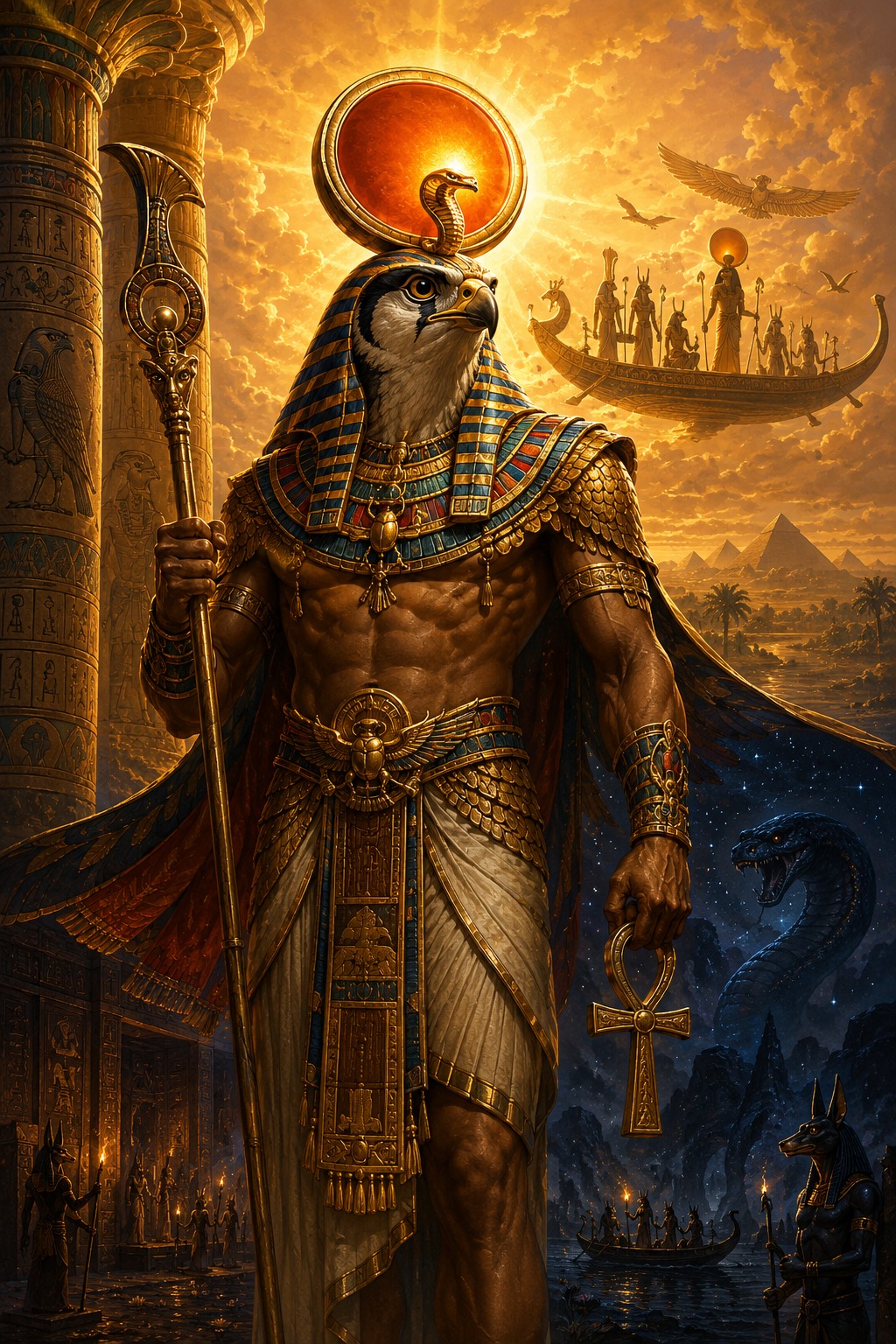
Ra
Ra · Egyptian Sun God — Creator and King of the Gods
Names in Other Languages
 라한국어
라한국어Ra· 이집트 태양신 만물의 창조주이자 왕
 ラー日本語
ラー日本語Ra· エジプト太陽神 万物の創造主にして王
 拉繁體中文
拉繁體中文Ra· 埃及太陽神 萬物創造主與王
 ReDeutsch
Re · Ägyptischer Sonnengott — Schöpfer und König der Götter
 RêFrançais
Rê · Dieu solaire égyptien — Créateur et roi des dieux
 RaEspañol
Ra · Dios solar egipcio — Creador y rey de los dioses
 RáPortuguês
Rá· Deus solar egípcio Criador e rei dos deuses
 RePolski
Re· Egipski bóg słońca Stwórca i król bogów
 РаРусский
Ra· Египетский бог солнца Творец и царь богов
Ra (Egyptian Ra or Re, 'sun') is the decisive canonical sun-god, creator, and king of the gods of ancient Egyptian mythology — the Heliopolis (Heliopolis, Egyptian Iunu, 'city of the pillar') theology — and the decisive canonical iconographic figure, who rose by himself from Nun (Nun), the primordial chaos sea, and as the ancestor of the Heliopolis Ennead (Ennead) of Shu (Shu), Tefnut (Tefnut), Geb (Geb), Nut (Nut), Osiris (Osiris), Isis (Isis), Seth (Seth), and Nephthys (Nephthys). The etymology is the decisive canonical vocabulary of the Egyptian Ra ('sun'), and during the New Kingdom 18th dynasty (1550-1292 BCE) he merged with the god Amun of Thebes to become Amun-Ra (Amun-Ra), the supreme god — the decisive canon. The decisive textual canon is the Pyramid Texts (Pyramid Texts) of c. 2400-2300 BCE — Old Kingdom 5th-6th dynasty — the decisive canon of the inside of the pyramids of Unas (Unas, 2375-2345 BCE) and Pepi I (Pepi I) — and the Coffin Texts (Coffin Texts) of c. 2100-1700 BCE Middle Kingdom — and the Book of the Dead (Book of the Dead) and the Amduat (Amduat) of c. 1550 BCE New Kingdom are the decisive canon. The pharaoh's title 'son of Ra (sa-Ra)' and the decisive canonical iconography of a falcon head with sun disc and the Uraeus (Uraeus) cobra.
Origin
The iconographic origin is the sun-worship of Heliopolis (Heliopolis, Egyptian Iunu 'city of the pillar') of c. 2890 BCE 2nd dynasty period — the decisive origin, and the decisive textual canon is the Pyramid Texts (Pyramid Texts) of c. 2400-2300 BCE — Old Kingdom 5th dynasty — the decisive canon of about 759 spells inside the pyramid of Unas (Unas, reigned 2375-2345 BCE) in Saqqara — and the decisive canon of the pyramids of Pepi I (Pepi I) and Teti (Teti) of the 6th dynasty. The Coffin Texts (Coffin Texts) of c. 2100-1700 BCE Middle Kingdom — about 1,185 spells — and the Book of the Dead (Book of the Dead) of c. 1550 BCE New Kingdom 18th dynasty — about 192 spells — are the decisive funerary canon. The decisive canon in which Ra rose by himself from Nun (Nun), the primordial chaos sea, was born on the 'Benben (Benben) stone', and produced Shu (Shu, air) and Tefnut (Tefnut, moisture) by masturbation or saliva, and they produced Geb (Geb, earth) and Nut (Nut, sky), and they produced Osiris (Osiris), Isis (Isis), Seth (Seth), and Nephthys (Nephthys) — the Heliopolis Ennead (Ennead). The decisive canon in which every day Ra rose in the east riding the solar boat Mandjet (Mandjet, the day boat) and set in the west, and at night sailed the 12 hours of the underworld Duat (Duat) in the Mesektet (Mesektet, the night boat) and battled the giant serpent Apep (Apep, Apophis) every night.
Features
- Falcon head with sun disc (with Uraeus cobra coiled)
- Sceptre (heka) and ankh (ankh) cross
- Day solar boat Mandjet (Mandjet) and night underworld boat Mesektet (Mesektet)
- Battle with the giant serpent Apep (Apep) every night
- Pharaoh's title 'son of Ra (sa-Ra)'
- Merged with Amun during New Kingdom 18th dynasty to become Amun-Ra
Stories
The sun-worship of Heliopolis of c. 2890 BCE 2nd dynasty is the decisive origin, and the decisive textual canon is the Pyramid Texts of c. 2400-2300 BCE Old Kingdom 5th-6th dynasty (pyramids of Unas, Pepi I, Teti), the Coffin Texts of c. 2100-1700 BCE Middle Kingdom, and the Book of the Dead, Amduat, and Litany of Ra of c. 1550 BCE New Kingdom. The Great Pyramid of Giza (Great Pyramid of Giza, about 146.6 m) of Khufu (Khufu, reigned 2589-2566 BCE) of c. 2580 BCE — Old Kingdom 4th dynasty — and the pyramids of Khafre (Khafre) and Menkaure (Menkaure) are the decisive religious-architecture canon of Ra, and the Litany of Ra (Litany of Ra) and Amduat (Amduat) of the Deir el-Bahari (Deir el-Bahari) temple of Queen Hatshepsut (Hatshepsut) of the 1473-1458 BCE — New Kingdom 18th dynasty — are the decisive canon. The Ra temple of Heliopolis (Heliopolis, Egyptian Iunu) and the Obelisk (Obelisk) of Senusret I (Senusret I) of 1971-1929 BCE — Middle Kingdom 12th dynasty — about 20.4 m — are the decisive architectural canon, and the temporary shift to the Aten (Aten) cult of Amenhotep IV (Amenhotep IV, later Akhenaten Akhenaten, reigned 1353-1336 BCE) of the New Kingdom 18th dynasty is the decisive religious canon. The translation of The Egyptian Book of the Dead (The Egyptian Book of the Dead) of E. A. Wallis Budge (E. A. Wallis Budge, 1857-1934) of 1894 in the United Kingdom is the decisive 19th-century scholarly canon, and the Ra (villain) played by Jaye Davidson (Jaye Davidson) of the film Stargate (Stargate) (directed by Roland Emmerich, MGM) released in the USA on 28 October 1994 and the Winged Dragon of Ra (The Winged Dragon of Ra) of Yu-Gi-Oh! (Yugi-O) of September 1996 Japan are the 21st-century decisive global canon.
Weakness
Ra's weaknesses are: (1) aging — the decisive canonical weakness in the New Kingdom Myth of Ra and Isis (Myth of Ra and Isis) — the decisive canon in which Ra appears aged, drooling and trembling; (2) Isis's secret name — the most decisive canonical weakness in the New Kingdom Myth of Ra and Isis — the decisive canon in which Isis (Isis) created a poisonous snake from Ra's saliva, had it bite Ra, and then learned Ra's secret name (true name) and took part of his power; (3) threat of Apep — the decisive canon of being threatened with death every night by the giant serpent Apep (Apep) or Apophis (Apophis) — the decisive canon of battle each hour of the 12 hours of the Duat; (4) rebellion of humanity — the decisive canon in the New Kingdom Book of the Heavenly Cow (Book of the Heavenly Cow) in which when humanity rebelled against Ra, Ra sent Sekhmet (Sekhmet, lion-headed goddess — a form of Hathor Hathor) and almost annihilated humanity; (5) shift to Aten in the New Kingdom — the decisive canon of the temporary deposition by Amenhotep IV (Akhenaten) of 1353-1336 BCE; (6) daily death and resurrection — the decisive canon; (7) binding of Heliopolis — the decisive canon; (8) binding of the sacred domain — the decisive canon. The decisive canonical finale is the New Kingdom Myth of Ra and Isis — the decisive mythological canon in which Ra eventually became aged, climbed onto Nut's back, and withdrew to the realm of the sky, leaving his grandson Horus (Horus) to become the king of the earth.
Cultural Significance
Ra is not merely a sun-god icon but the canonical iconographic figure of the decisive Egyptian canon, traversing the c. 2890 BCE 2nd dynasty Heliopolis sun worship, the c. 2580 BCE 4th dynasty Khufu Great Pyramid of Giza, the c. 2400-2300 BCE Old Kingdom 5th-6th dynasty Pyramid Texts, the c. 2100-1700 BCE Middle Kingdom Coffin Texts, the c. 1550 BCE New Kingdom Book of the Dead and Amduat, the 1473-1458 BCE Hatshepsut Deir el-Bahari temple Litany of Ra, the 1353-1336 BCE Akhenaten Aten cult, the 1894 E. A. Wallis Budge Egyptian Book of the Dead, the 1980 D&D Deities & Demigods, the 1994 film Stargate, and the 1996 Yu-Gi-Oh! Winged Dragon of Ra. The decisive textual canon is the Pyramid Texts (Pyramid Texts) of c. 2400-2300 BCE — Old Kingdom 5th dynasty — the decisive canon of about 759 spells inside the pyramid of Unas (Unas, reigned 2375-2345 BCE) in Saqqara — and the Book of the Dead (Book of the Dead) of c. 1550 BCE New Kingdom 18th dynasty — about 192 spells — and the Amduat (Amduat) — the decisive funerary canon. The decisive canon in which Ra rose by himself from Nun (Nun), the primordial chaos sea, was born on the 'Benben (Benben) stone', and is the ancestor of the Heliopolis Ennead (Ennead) of Shu (Shu), Tefnut (Tefnut), Geb (Geb), Nut (Nut), Osiris (Osiris), Isis (Isis), Seth (Seth), and Nephthys (Nephthys), and the decisive canon in which every day he crossed the sky of the day in the solar boat Mandjet (Mandjet), and at night sailed the 12 hours of the Duat (Duat) in the Mesektet (Mesektet) and battled the giant serpent Apep (Apep) every night. The decisive 21st-century canon is the Ra (villain) played by Jaye Davidson (Jaye Davidson, born 21 September 1968 in California, USA) of the film Stargate (Stargate) (directed by Roland Emmerich, MGM, worldwide box office about 196.5 million dollars) released in the USA on 28 October 1994, and 'the Winged Dragon of Ra (The Winged Dragon of Ra)' — one of the three Egyptian Gods — of Yu-Gi-Oh! (Yugi-O) by Kazuki Takahashi (Takahashi Kazuki) of September 1996 Japan is the 21st-century decisive global canon.
In Popular Culture
- Old Kingdom 5th-6th dynasty Pyramid Texts (c. 2400-2300 BCE) — decisive origin canon
- Middle Kingdom Coffin Texts (c. 2100-1700 BCE) — decisive funerary canon
- New Kingdom Book of the Dead (c. 1550 BCE) — decisive funerary canon
- New Kingdom Amduat (c. 1550 BCE) — decisive underworld canon
- Hatshepsut Litany of Ra (1473-1458 BCE) — decisive New Kingdom canon
- Khufu Great Pyramid of Giza (c. 2580 BCE) — decisive architectural canon
- E. A. Wallis Budge The Egyptian Book of the Dead (1894) — decisive 19th-century scholarly canon
- TSR D&D Deities & Demigods, Ra (1980) — decisive fantasy RPG canon
- Film Stargate, Ra Jaye Davidson (1994) — 21st-century decisive film canon
- Kazuki Takahashi Yu-Gi-Oh! Winged Dragon of Ra (1996) — 21st-century decisive Japanese manga canon
Trivia
The etymology of Ra (Ra) is the decisive canonical vocabulary of the Egyptian Ra ('sun'), and the aliases 'Atum (Atum, evening Ra)', 'Khepri (Khepri, dawn Ra)', 'Ra-Horakhty (Ra-Horakhty, Ra of the two horizons)', and 'Amun-Ra (Amun-Ra, New Kingdom period)' are the decisive canonical vocabulary. The decisive textual canon is the Pyramid Texts (Pyramid Texts) of c. 2400-2300 BCE — Old Kingdom 5th dynasty Unas (Unas) and 6th dynasty Pepi I (Pepi I) — the decisive canon of about 759 spells inside the pyramids in Saqqara. The decisive mythological canon in which Ra rose by himself from Nun (Nun), the primordial chaos sea, was born on the 'Benben (Benben) stone', and produced Shu (Shu, air) and Tefnut (Tefnut, moisture) by masturbation or saliva, and the decisive canon of the Heliopolis Ennead (Ennead) in which they produced Geb (Geb, earth) and Nut (Nut, sky), and they produced Osiris, Isis, Seth, and Nephthys. The decisive canon in which every day Ra rose in the east from Nut's mouth riding the solar boat Mandjet (Mandjet, the day boat) and after sailing the sky for 12 hours, set in the west in Nut's womb, and at night sailed the 12 hours of the underworld Duat (Duat) in the Mesektet (Mesektet, the night boat) and battled the giant serpent Apep (Apep, Apophis) every night. The decisive canon of the New Kingdom Myth of Ra and Isis (Myth of Ra and Isis) in which Isis (Isis) created a poisonous snake from Ra's saliva, had it bite Ra, and then learned Ra's secret name and took part of his power, and the decisive canon of the Book of the Heavenly Cow (Book of the Heavenly Cow) in which humanity rebelled against Ra. The Ra (villain, alien being) played by Jaye Davidson (Jaye Davidson, born 21 September 1968 in California, USA) of the film Stargate (Stargate) (directed by Roland Emmerich, MGM, worldwide box office about 196.5 million dollars) released in the USA on 28 October 1994 is the 21st-century decisive global film canon, and 'the Winged Dragon of Ra (The Winged Dragon of Ra)' — one of the three Egyptian Gods — of Yu-Gi-Oh! (Yugi-O) by Kazuki Takahashi (Takahashi Kazuki, 1961-2022) of September 1996 Japan is the 21st-century decisive Japanese manga canon.