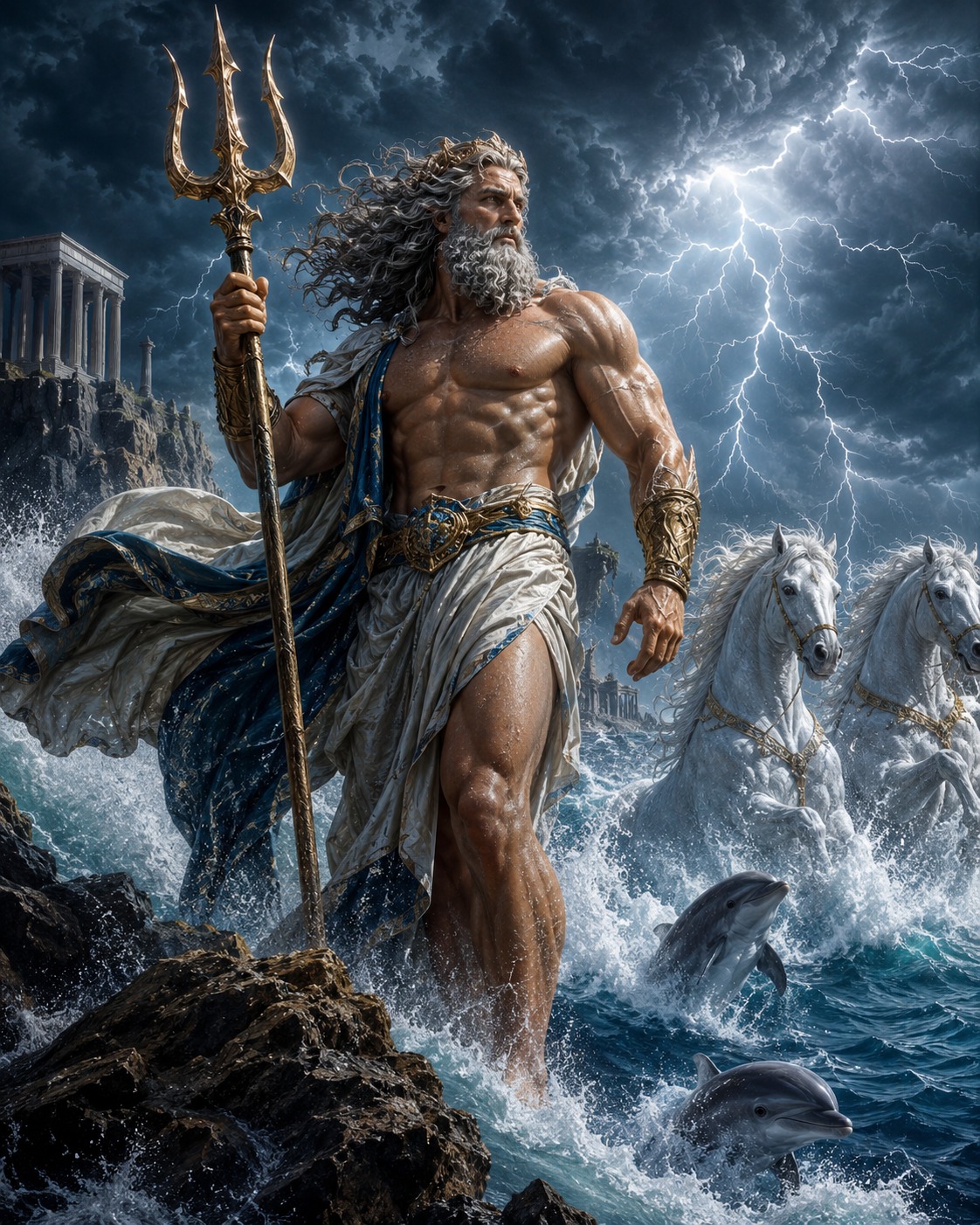
Poseidon
Poseidon · Greek God of the Sea — Earth-Shaker and Lord of Horses
Names in Other Languages
 포세이돈한국어
Poseidon · 그리스 바다의 신 — 지진과 말의 신
 ポセイドン日本語
Poseidon · ギリシャ海神 — 地震と馬の神
 波塞冬繁體中文
Poseidon · 希臘海神 — 地震與馬之神
 PoseidonDeutsch
Poseidon · Griechischer Meeresgott — Erderschütterer und Herr der Pferde
 PoséidonFrançais
Poséidon · Dieu grec de la mer — Ébranleur de la terre et seigneur des chevaux
 PoseidónEspañol
Poseidón · Dios griego del mar — Sacudidor de la tierra y señor de los caballos
 PoseidonPortuguês
Poseidon · Deus grego do mar — Sacudidor da terra e senhor dos cavalos
 PosejdonPolski
Posejdon · Grecki bóg morza — Wstrząsacz ziemi i pan koni
 ПосейдонРусский
Poseidon · Греческий бог моря — Колебатель земли и владыка коней
Poseidon (Ancient Greek Poseidon, Latin Neptunus) is the decisive canonical god of the sea, earthquakes, and horses among the 12 Olympian gods of Greek mythology, and the decisive canonical iconographic figure as the son of Kronos (Kronos) and Rhea (Rhea), elder brother of Zeus (Zeus), and brother of Hades (Hades). The etymology Greek Poseidon is the decisive canonical vocabulary as the compound of 'pos- (lord) and da- (earth)', meaning 'lord of the earth', and the aliases Gaieochos (Gaieochos, 'earth-shaker'), Enosigaios (Enosigaios, 'earth-quaker'), Hippios (Hippios, 'of horses'), and Asphaleios (Asphaleios, 'of safety') are the decisive canonical vocabulary. The decisive textual canon is the Theogony (Theogony) lines 453-491 of Hesiod (Hesiod) of c. 8th-7th century BCE — the decisive canon in which Kronos swallows his children — and lines 881-885 — the decisive canon in which Zeus, Poseidon, and Hades divided the sky, sea, and underworld by lot. The Iliad (Iliad) Book 15 lines 184-217 of Homer (Homer) of c. 8th century BCE — the decisive canon of Poseidon's protest about the lot — and the Odyssey (Odyssey) Book 1 lines 20-25 — the decisive canon of Poseidon's wrath against Odysseus (Odysseus) — are the decisive heroic-epic canon.
Origin
The iconographic origin is the Bronze Age Mycenaean civilisation (c. 1600-1100 BCE) Mycenaean Linear B clay tablet inscription 'po-se-da-o' (Poseidon, the most frequently mentioned god) — the decisive origin canon, and the decisive textual canon is the Theogony (Theogony) lines 453-491 of Hesiod (Hesiod) of c. 8th-7th century BCE — the decisive canon in which Kronos (Kronos), fearing the prophecy of Gaia (Gaia) and Ouranos (Ouranos), swallows his children — and the decisive canon in which Metis's (Metis) emetic causes Kronos to vomit out his children — and lines 881-885 — the decisive canon in which the three brothers Zeus (Zeus), Poseidon (Poseidon), and Hades (Hades) divided the sky, sea, and underworld by lot (kleros) — and the decisive canon that the earth (Gaia) is shared by the three. The Iliad (Iliad) Book 15 lines 184-217 of Homer (Homer) of c. 8th century BCE — the decisive canon in which Iris (Iris), with Zeus's command, tried to compel Poseidon, who protested that he was equal to Zeus — and the Odyssey (Odyssey) Book 1 lines 20-25 — the decisive canon in which Odysseus (Odysseus) blinded the eye of Poseidon's only son Cyclops Polyphemos (Polyphemos), and the resulting 10-year wrath of Poseidon.
Features
- Mature male god with wild waves-like hair and beard
- Wields a trident (triaina)
- Accompanied by white horses, dolphins, and bulls
- Causes earthquakes and tsunamis when angered
- Blue cloak and bronze chariot
- Sacred horses dedicated at temenos (sacred precinct)
Stories
The Bronze Age Mycenaean 'po-se-da-o' (Poseidon, the most frequently mentioned god) inscription is the decisive origin, and the decisive textual canon is Hesiod Theogony lines 453-491 and 881-885 of c. 8th-7th century BCE, Homer Iliad Book 15 lines 184-217 and Odyssey Book 1 lines 20-25 of c. 8th century BCE, and Pseudo-Apollodorus Bibliotheca Book 3 chapter 14 section 1 (contest with Athena for the patronage of Athens) of c. 1st century BCE — the decisive canon. The Homeric Hymns (Homeric Hymns) No. 22 Hymn to Poseidon of c. 7th-6th century BCE is the decisive religious canon, and the Temple of Poseidon at Sounion (Temple of Poseidon at Sounion) — Doric style, c. 14.7m high — at Cape Sounion (Cape Sounion) of Athens of c. 444 BCE is the decisive art canon. The eastern pediment of the Parthenon (Parthenon) on the Athenian Acropolis by Pheidias (Pheidias) of 438 BCE — the contest between Poseidon and Athena for the patronage of Athens — is the decisive sculpture canon, and the Greek bronze statue Artemision Bronze (Artemision Bronze) — c. 2.09m, excavated near Cape Artemision off the island of Euboea in 1928 — of c. 460 BCE is the decisive art canon. The decisive 21st-century canon is the King Triton (King Triton), son of Poseidon, of the Disney film The Little Mermaid (The Little Mermaid) released in the USA on 17 November 1989, and the father Poseidon of Percy (Percy Jackson) of Percy Jackson & the Olympians: The Lightning Thief of Rick Riordan published in the USA on 28 June 2005 — the 21st-century decisive global canon, and the US film Clash of the Titans (Clash of the Titans) (directed by Louis Leterrier) of 26 March 2010 is also the decisive canon.
Weakness
Poseidon's weaknesses are: (1) absolute retaliation for insults — the decisive canonical weakness in the c. 8th-century-BCE Homer Odyssey Book 1 lines 20-25 — the decisive canon in which when Odysseus (Odysseus) blinded the eye of his only son Cyclops Polyphemos (Polyphemos), he hindered Odysseus's homecoming for 10 years; (2) defeat in the contest for the patronage of Athens — the decisive canon in the c. 1st-century-BCE Pseudo-Apollodorus Bibliotheca Book 3 chapter 14 section 1 — in the contest for the patronage of Athens, Poseidon offered a salt spring with his trident and Athena gave the olive tree, and as a result, lost to Athena in the vote of Kekrops (Kekrops) or the 12 gods — the decisive canon and eternal resentment; (3) defeat in the Trojan War — the decisive canon in the c. 8th-century-BCE Homer Iliad canon in which when Laomedon (Laomedon) did not pay for the building of the Trojan walls, Poseidon was on the Greek side but the canon of the fall of Troy; (4) frequent involvement in pride disputes — the decisive canon; (5) binding of the lot — the c. 8th-7th-century-BCE Hesiod Theogony lines 881-885 — bound to the sea by the lot — the decisive canon; (6) Zeus's authority — Poseidon received the sea by Zeus's lot — the decisive canon; (7) capriciousness — capriciousness and quick anger — the decisive canonical weakness; (8) binding of the sacred domain — the decisive canon. The decisive canonical finale is the decisive mythological canon of the c. 8th-century-BCE Homer Odyssey — the 10-year hindrance of Odysseus's (Odysseus) homecoming.
Cultural Significance
Poseidon is not merely a sea-god icon but the canonical iconographic figure of the decisive Greek-Roman canon, traversing the Bronze Age Mycenaean 'po-se-da-o' inscription, the c. 8th-7th-century-BCE Hesiod Theogony, the c. 8th-century-BCE Homer Iliad and Odyssey, the c. 7th-6th-century-BCE Homeric Hymns No. 22, the c. 444 BCE Temple of Poseidon at Sounion, the 438 BCE Pheidias Parthenon east pediment, the c. 460 BCE Artemision Bronze, the c. 1st-century-BCE Pseudo-Apollodorus Bibliotheca, the 1989 Disney The Little Mermaid, and the 2005 Rick Riordan Percy Jackson. The Bronze Age Mycenaean civilisation (c. 1600-1100 BCE) Mycenaean Linear B clay tablet inscription 'po-se-da-o' (Poseidon) is the decisive origin, and the decisive mythological canon is the c. 8th-7th-century-BCE Hesiod Theogony lines 453-491 — the decisive canon in which Kronos swallows his children — and lines 881-885 — the decisive canon in which the three brothers Zeus, Poseidon, and Hades divided the sky, sea, and underworld by lot. The Bibliotheca (Bibliotheke) Book 3 chapter 14 section 1 of Pseudo-Apollodorus (Pseudo-Apollodorus) of c. 1st century BCE — the decisive canon in which in the contest for the patronage of Athens, Poseidon offered a salt spring at the Acropolis (Erechtheion well) with his trident and Athena gave the olive tree, and as a result, Athena won in the vote of Kekrops (Kekrops) or the 12 gods. The Temple of Poseidon at Sounion (Temple of Poseidon at Sounion) — Doric style, c. 14.7m high — at Cape Sounion (Cape Sounion, 70km southeast of Athens) of c. 444 BCE is the decisive art canon, and the Greek bronze statue Artemision Bronze (Artemision Bronze) — c. 2.09m high, excavated from the sea near Cape Artemision off the island of Euboea (Euboea) of Greece in 1928 — of c. 460 BCE — National Archaeological Museum of Athens — is the decisive art canon. The decisive 21st-century canon is the King Triton (King Triton), son of Poseidon, of the Disney film The Little Mermaid (The Little Mermaid) released in the USA on 17 November 1989, and the father Poseidon of Percy (Percy Jackson) of Rick Riordan (Rick Riordan) Percy Jackson & the Olympians: The Lightning Thief published in the USA on 28 June 2005 — the 21st-century decisive global canon.
In Popular Culture
- Mycenaean Linear B 'po-se-da-o' (Bronze Age) — decisive origin canon (most frequently mentioned)
- Hesiod Theogony lines 453-491 and 881-885 (c. 8th-7th century BCE) — decisive birth and lot canon
- Homer Iliad Book 15 and Odyssey Book 1 (c. 8th century BCE) — decisive heroic-epic canon
- Homeric Hymns No. 22 Hymn to Poseidon (c. 7th-6th century BCE) — decisive religious canon
- Temple of Poseidon at Sounion (c. 444 BCE) — decisive art canon
- Pheidias Parthenon east pediment (438 BCE) — decisive sculpture canon
- Greek bronze statue Artemision Bronze (c. 460 BCE) — decisive art canon
- Pseudo-Apollodorus Bibliotheca Book 3 chapter 14 section 1 (c. 1st century BCE) — decisive Athens-patronage-contest canon
- Disney film The Little Mermaid, King Triton (1989) — 21st-century decisive global canon
- Rick Riordan Percy Jackson & the Olympians (2005-2024) — 21st-century decisive young-adult novel and film canon
Trivia
The etymology Greek Poseidon is the decisive canonical vocabulary as the compound of 'pos- (lord) and da- (earth, Gaia)', meaning 'lord of the earth', and the aliases Gaieochos (Gaieochos, 'earth-shaker'), Enosigaios (Enosigaios, 'earth-quaker'), Hippios (Hippios, 'of horses'), Asphaleios (Asphaleios, 'of safety'), and Petraios (Petraios, 'of rocks') are the decisive canonical vocabulary. The iconographic origin is the Bronze Age Mycenaean civilisation (c. 1600-1100 BCE) Mycenaean Linear B clay tablet inscription 'po-se-da-o' — and in the Mycenaean era was the most frequently mentioned god — the decisive canon. The decisive textual canon is the Theogony (Theogony) lines 453-491 of Hesiod (Hesiod) of c. 8th-7th century BCE — the decisive canon in which Kronos (Kronos), fearing the prophecy of Gaia and Ouranos, swallows his children — and lines 881-885 — the decisive canon in which the three brothers Zeus (Zeus), Poseidon (Poseidon), and Hades (Hades) divided the sky, sea, and underworld by lot (kleros). The c. 8th-century-BCE Homer Iliad Book 15 lines 184-217 — the decisive canon in which Poseidon protested that he was equal to Zeus — and the Odyssey Book 1 lines 20-25 — the decisive canon in which Odysseus (Odysseus) blinded the eye of his only son Cyclops Polyphemos (Polyphemos), resulting in 10 years of wrath. The Temple of Poseidon at Sounion (Temple of Poseidon at Sounion) at Cape Sounion (Cape Sounion, 70km southeast of Athens) of c. 444 BCE — Doric style, c. 14.7m high — 16 columns (originally 34) — is the decisive art canon, and the Greek bronze statue Artemision Bronze (Artemision Bronze) — c. 2.09m high, excavated from the sea near Cape Artemision off the island of Euboea of Greece in 1928 — of c. 460 BCE — National Archaeological Museum of Athens — is the decisive art canon. The King Triton (King Triton), son of Poseidon, of the Disney film The Little Mermaid (The Little Mermaid) released in the USA on 17 November 1989 and the father Poseidon of Percy (Percy Jackson) of Rick Riordan (Rick Riordan) Percy Jackson & the Olympians: The Lightning Thief published in the USA on 28 June 2005 are the 21st-century decisive global canon.