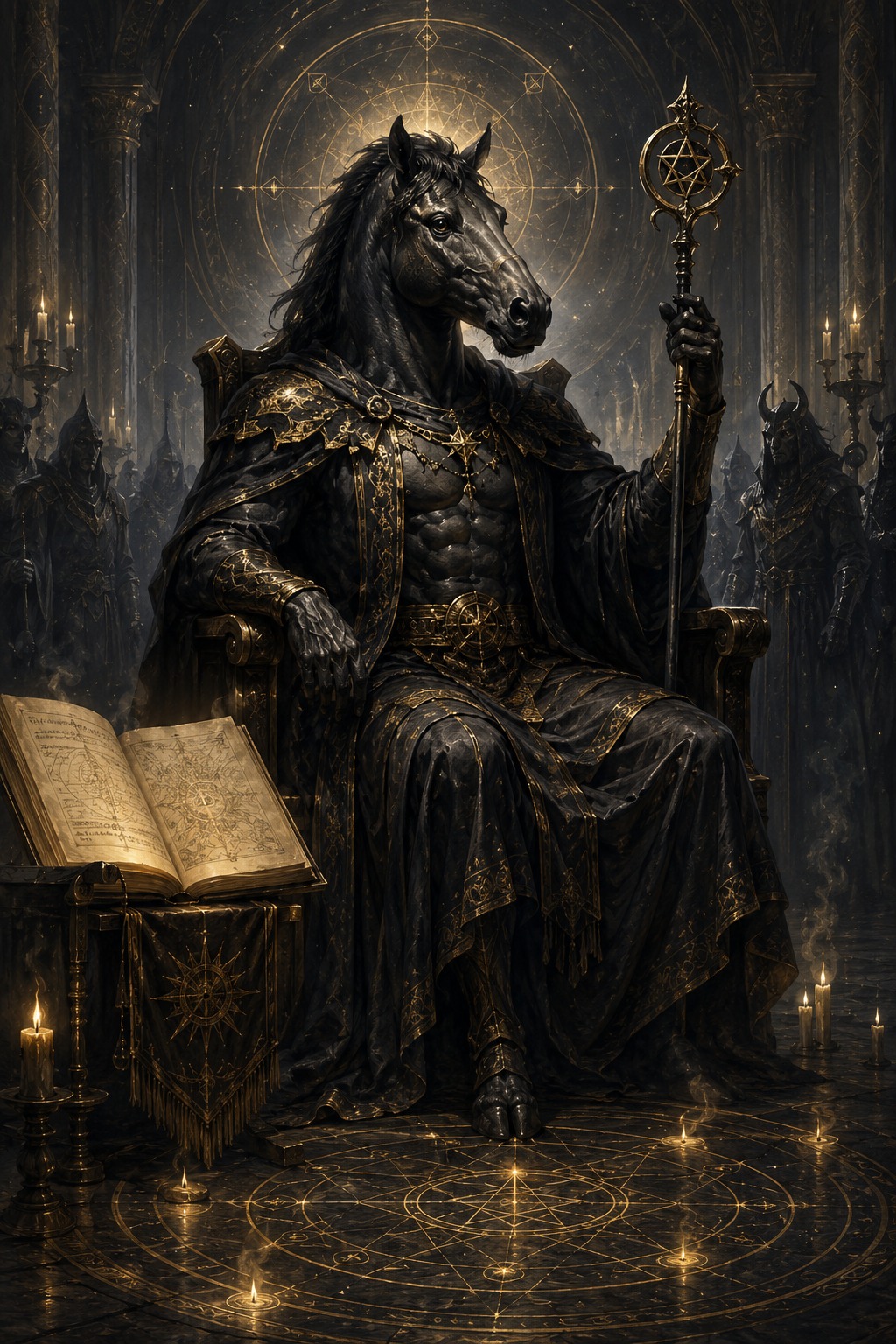
Orobas
Orobas · 55th of Solomon's 72 Spirits — Horse-Headed Prince of Truth
Names in Other Languages
 오로바스한국어
Orobas· 솔로몬의 72귀신 제55위 말의 머리를 가진 진실의 대공
 オロバス日本語
Orobas· ソロモンの72魔神第55位 馬頭の真実の大公
 歐若博司繁體中文
Orobas· 所羅門72魔神第55位 馬首之真實大公
 OrobasDeutsch
Orobas · 55. der 72 Geister Salomos — Pferdeköpfiger Fürst der Wahrheit
 OrobasFrançais
Orobas · 55e des 72 esprits de Salomon — Prince à tête de cheval, esprit de vérité
 OrobasEspañol
Orobas · 55º de los 72 espíritus de Salomón — Príncipe cabezacaballo de la verdad
 OrobasPortuguês
Orobas · 55º dos 72 espíritos de Salomão — Príncipe cabeça-de-cavalo da verdade
 OrobasPolski
Orobas · 55. z 72 duchów Salomona — Książę o końskiej głowie, duch prawdy
 ОробасРусский
Orobas · 55-й из 72 духов Соломона — Лошадиноголовый князь истины
Orobas (Latin Orobas) is the 55th demon of the 72 demons of Solomon (Goetia) — the decisive canon — of the rank of Great Prince — the decisive canonical iconographic figure with a horse's head and a human body, or a complete horse, an honest demon who never lies. Aliases — Orobas (Orobas), Prince of Truth, Horse-headed Demon, Gentlemanly Demon, 55th Spirit of Solomon — are the decisive canonical vocabulary. The decisive textual canon is the decisive origin canon of Pseudomonarchia Daemonum (Pseudomonarchia Daemonum, 'The False Hierarchy of Demons') by the German physician and occult writer Johann Weyer (Johann Weyer, 1515-1588) of 1577, and the decisive canon of Spirit 55 Orobas in Part I Goetia of the Lesser Key of Solomon (Lesser Key of Solomon, Lemegeton) of the 17th century. The decisive uniqueness canon is the decisive canon as a 'gentlemanly' demon clearly favorable to the summoner unlike the other 71 demons and never lying — the decisive canon summoned in Solomonic magic to receive the oracle of truth.
Origin
The etymological origin is the decisive canon of the theory that it is related to the Latin 'Oros (mouth)' — the decisive canon interpreted as 'mouth that speaks the truth'. The decisive origin textual canon is the decisive origin canon of Pseudomonarchia Daemonum (Pseudomonarchia Daemonum, 'The False Hierarchy of Demons') by the German physician Johann Weyer (Johann Weyer, 1515-1588, disciple of Heinrich Cornelius Agrippa) of 1577 — the decisive canon added by Weyer as an appendix to his De Praestigiis Daemonum (De Praestigiis Daemonum, 'On the Illusions of Demons') (first edition 1563, appendix added 1577). The decisive Solomonic magic canon is the decisive canon of Spirit 55 Orobas in Part I Goetia (Goetia, hierarchy of 72 spirits) of the Lesser Key of Solomon (Lesser Key of Solomon, Lemegeton Clavicula Salomonis) of the 17th century — the decisive canon settled with the publication of the English translation The Goetia: The Lesser Key of Solomon the King by the English occult writer Samuel Liddell MacGregor Mathers (Samuel Liddell MacGregor Mathers, 1854-1918, founder of the Hermetic Order of the Golden Dawn) and Aleister Crowley (Aleister Crowley, 1875-1947) of 1904. The decisive uniqueness canon is the decisive canon of 'Orobas protects the summoner from other spirits' and 'never insults or deceives the summoner' — the decisive canon evaluated as the most friendly demon among the 72 demons.
Features
- Giant horse's head and human body
- Or in the form of a complete horse
- Honest demon who never lies gentlemanly demon
- Great Prince commanding 20 legions of demons
- Main axis 55th of the 72 demons of Solomon
- Power — bestowing knowledge of the truth of past, present, future, divine nature, and the mystery of creation
Stories
The decisive origin canon of Spirit 55 in Pseudomonarchia Daemonum by Johann Weyer of 1577 and Part I Goetia of the Lesser Key of Solomon of the 17th century, and the decisive canon summoned in Solomonic magic to receive the oracle of truth. The decisive canon that taught the truths of the facts of the past, the secrets of the present, the possibilities of the future, and the divine essence, and also the decisive canon that had the power to protect the summoner from other demons, being used as an escort of magical rituals. The decisive canon that also promised the bestowal of honor and dignity. The decisive 20th-century occult canon is the decisive canon of the English translation The Goetia by Mathers and Crowley of 1904, and the decisive 21st-century literature/game canon is the decisive 21st-century global canon of Orobas in the Japanese game series Megami Tensei (Megami Tensei) from 1987 and various 21st-century demon-themed games and literature.
Weakness
Orobas's weaknesses are: (1) the nature of never lying — the decisive canonical weakness — the decisive canon of speaking even the truth that the summoner does not want to hear — the decisive canon of the burden of truth; (2) binding of the Seal of Solomon — the decisive canonical weakness — the decisive canon that he is dangerous like other demons if summoned without the Seal of Solomon and the correct ritual; (3) binding of the magic circle — the decisive canonical weakness — the decisive canon of being bound inside the magic circle drawn by the summoner; (4) binding of truth — the decisive canon of the binding of being unable to speak falsehood; (5) binding of 20 legions — the decisive canon; (6) binding of the sacred domain — the decisive canon; (7) binding of the protection of the summoner — the decisive canon of the duty to protect the summoner; (8) binding of time — the decisive canon from the time of Solomon. The decisive canonical finale is the decisive mythological canon of politely receiving the permission of the summoner and returning to his place when the ritual of summoning ends.
Cultural Significance
Orobas is not merely a 72-demon icon but the canonical iconographic figure of the decisive Solomonic magic canon, traversing Pseudomonarchia Daemonum by Johann Weyer of 1577, Part I Goetia of the Lesser Key of Solomon of the 17th century, the English translation The Goetia by Mathers and Crowley of 1904, and the occult traditions of the Hermetic Order of the Golden Dawn of the 20th century. The etymological origin settled as the decisive canon of the theory that it is related to the Latin 'Oros (mouth)' — interpreted as 'mouth that speaks the truth'. The decisive origin textual canon is the decisive origin canon of Pseudomonarchia Daemonum (Pseudomonarchia Daemonum, 'The False Hierarchy of Demons') by the German physician and occult writer Johann Weyer (Johann Weyer, born 6 June 1515 in Grave, Netherlands, died 24 February 1588 in Tecklenburg, Germany) of 1577 — the decisive canon added by Weyer as an appendix to his De Praestigiis Daemonum (De Praestigiis Daemonum, first edition 1563, appendix added 1577). The decisive Solomonic magic canon is the decisive canon of Spirit 55 Orobas in Part I Goetia (Goetia, hierarchy of 72 spirits) of the Lesser Key of Solomon (Lesser Key of Solomon, Lemegeton Clavicula Salomonis) of the mid-17th century — the decisive canon of the decisive uniqueness as a 'gentlemanly' demon clearly favorable to the summoner unlike the other 71 demons and never lying. The decisive 20th-century occult canon is the decisive canon of the English translation The Goetia: The Lesser Key of Solomon the King (published 1904) by the English occult writer Samuel Liddell MacGregor Mathers (Samuel Liddell MacGregor Mathers, 1854-1918, founder of the Hermetic Order of the Golden Dawn) and Aleister Crowley (Aleister Crowley, born 12 October 1875 in England, died 1 December 1947 in Hastings, England), and the decisive uniqueness canon is the decisive canon of 'Orobas protects the summoner from other spirits' and 'never insults or deceives the summoner' — the decisive canon evaluated as the most friendly demon among the 72 demons. The decisive power canon is the decisive canon of teaching the truths of the facts of the past, the secrets of the present, the possibilities of the future, and the divine essence, and the decisive canon of teaching the mystery of the creation of heaven and earth, protecting the summoner, and bestowing honor and dignity.
In Popular Culture
- Johann Weyer Pseudomonarchia Daemonum (Pseudomonarchia Daemonum) 1577 — decisive origin textual canon
- Lesser Key of Solomon (Lesser Key of Solomon Lemegeton) Part I Goetia Spirit 55 17th century — decisive Solomonic magic canon
- English translation The Goetia (The Goetia) by Samuel Mathers and Aleister Crowley 1904 — decisive 20th-century occult canon
- Occult tradition of the Hermetic Order of the Golden Dawn 20th century — decisive occult tradition canon
- Iconography of a horse's head and human body, or complete horse — decisive iconographic canon
- Great Prince commanding 20 legions of demons — decisive hierarchy canon
- Power of protecting the summoner from other spirits — decisive uniqueness canon
- Power of the oracle of truth of past, present, and future — decisive power canon
- Teaching of the mystery of the creation of heaven and earth — decisive power canon
- 21st-century game Megami Tensei series Orobas — decisive 21st-century global canon
Trivia
The etymology of Orobas (Latin Orobas) is the decisive canonical vocabulary of the theory that it is related to the Latin 'Oros (mouth)' — the decisive canon interpreted as 'mouth that speaks the truth', and aliases Orobas (Orobas), Prince of Truth, Horse-headed Demon, Gentlemanly Demon, 55th Spirit of Solomon are the decisive canonical vocabulary. The decisive origin textual canon is the decisive origin canon of Pseudomonarchia Daemonum (Pseudomonarchia Daemonum, 'The False Hierarchy of Demons') by the German physician and occult writer Johann Weyer (Johann Weyer, born 6 June 1515 in Grave, Netherlands, died 24 February 1588 in Tecklenburg, Germany, disciple of Heinrich Cornelius Agrippa) of 1577 — the decisive canon added by Weyer as an appendix to his De Praestigiis Daemonum (De Praestigiis Daemonum, 'On the Illusions of Demons', first edition 1563, appendix added 1577), and the entry on Orobas reads 'Orobas is a great prince. He at first appears like a horse, but in the form of a man at the command of the conjurer. He teaches the truth of past, present, and future, and the divine nature and the creation of the world. He very faithfully protects the conjurer from the insults of other spirits. He bestows dignities and prelacies, and reconciles the friendship of friends and foes. He commands 20 legions of spirits'. The decisive Solomonic magic canon is the decisive canon of Spirit 55 Orobas in Part I Goetia (Goetia, hierarchy of 72 spirits) of the Lesser Key of Solomon (Lesser Key of Solomon, Lemegeton Clavicula Salomonis, compiled c. 1641) of the mid-17th century, and the decisive 20th-century occult canon is the decisive canon of the English translation The Goetia: The Lesser Key of Solomon the King (published 1904, republished 1995) by the English occult writer Samuel Liddell MacGregor Mathers (Samuel Liddell MacGregor Mathers, born 8 January 1854 in London, England, died 20 November 1918 in Paris, France, founder of the Hermetic Order of the Golden Dawn in 1888) and Aleister Crowley (Aleister Crowley, born 12 October 1875 in Warwickshire, England, died 1 December 1947 in Hastings, England). The decisive uniqueness canon is the decisive canon of 'Orobas protects the summoner from other spirits' and 'never insults or deceives the summoner' and 'an honest demon who never lies' — the decisive canon evaluated as the most friendly demon among the 72 demons. The decisive power canon is the decisive canon of teaching the truths of the facts of the past, the secrets of the present, the possibilities of the future, and the divine essence, the decisive canon of teaching the mystery of the creation of heaven and earth, protecting the summoner, bestowing honor and dignity, and reconciling the friendship of friends and foes, and the decisive iconographic canon is the decisive canon of a 'beautiful and noble horse's head' — the decisive canon contrasting with the terrifying appearances of other demons, and the decisive 21st-century game canon is the decisive global canon of Orobas in the Japanese game Megami Tensei (Megami Tensei) series from 1987.