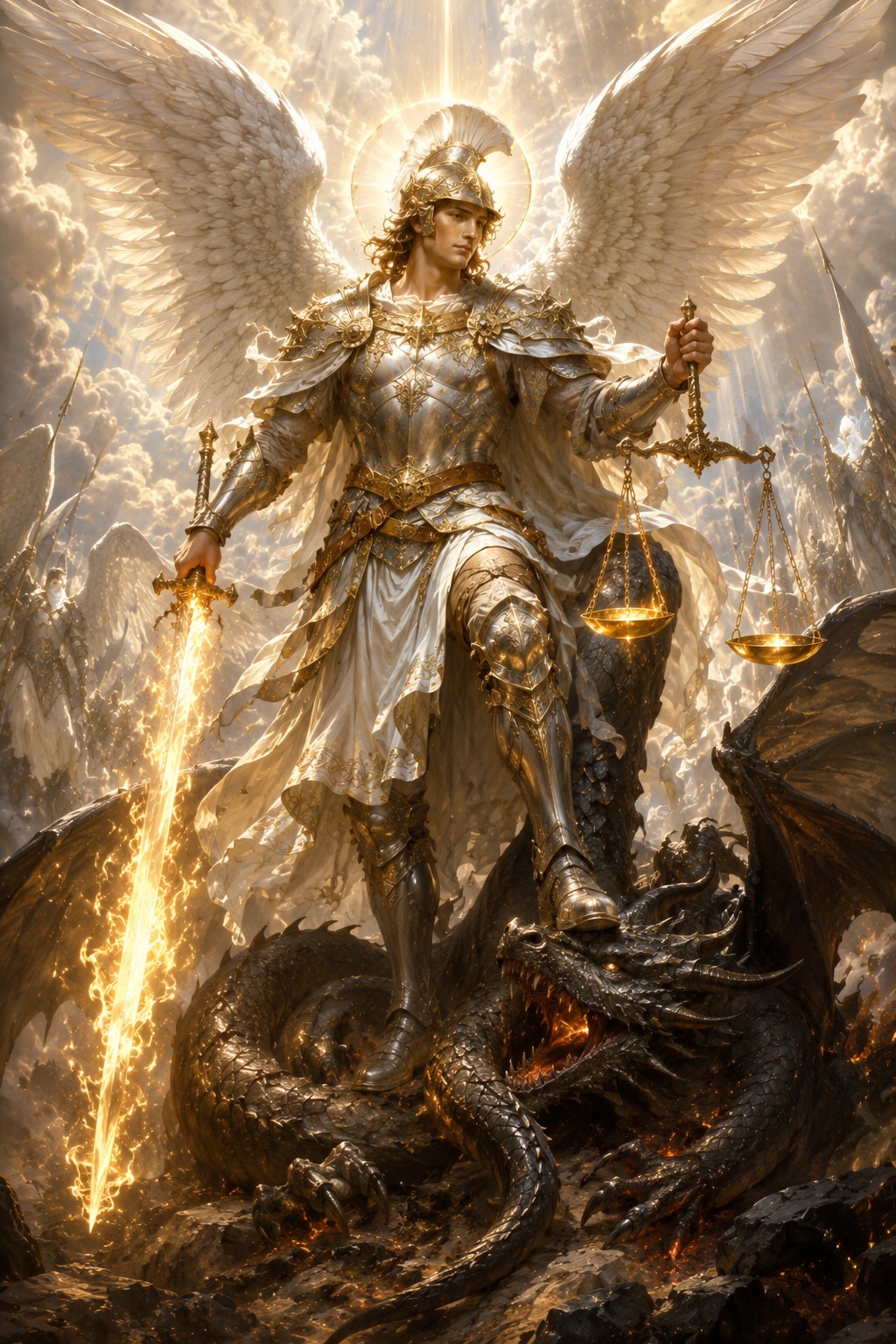
Michael
Michael · Archangel — Captain of the Heavenly Host, Vanquisher of Satan
Names in Other Languages
 미카엘한국어
Michael · 대천사장 — 천군의 사령관, 사탄을 패퇴시킨 자
 ミカエル日本語
Michael · 大天使長 — 天軍の総司令、サタンを打ち倒した者
 米迦勒繁體中文
Michael · 大天使長 — 天軍統帥,擊敗撒旦者
 MichaelDeutsch
Michael · Erzengel — Anführer der himmlischen Heerscharen, Bezwinger Satans
 MichelFrançais
Michel · Archange — Chef des armées célestes, vainqueur de Satan
 MiguelEspañol
Miguel · Arcángel — Capitán de las huestes celestiales, vencedor de Satanás
 MiguelPortuguês
Miguel · Arcanjo — Capitão das hostes celestiais, vencedor de Satanás
 MichałPolski
Michał · Archanioł — Wódz zastępów niebieskich, pogromca Szatana
 МихаилРусский
Michael · Архангел — Вождь небесного воинства, низвергший Сатану
Michael (Hebrew Mikha'el, Greek Mikhael, Latin Michael, Arabic Mikail) is the decisive canonical archangel chief of Judaism, Christianity, and Islam — three decisive canonical religions. The etymology is the decisive canonical vocabulary of the Hebrew 'mi-ka-El' — 'who is like God (quis ut Deus)'. The decisive textual canon is the Old Testament Book of Daniel (Daniel) 10:13, 10:21, and 12:1 of c. 2nd century BCE — 167-164 BCE — the decisive canon in which Michael is 'one of the chief princes' and 'the protector of the children of Israel' — and the New Testament Revelation (Revelation) 12:7-9 of c. 1st century CE — the decisive canon in which Michael had 'war in heaven' and defeated the great dragon (dragon), namely the 'ancient serpent' Satan (Satan), and his minion angels, and threw them out of heaven. The Mikail (Mikail) of the c. 7th century Islamic Qur'an (Qur'an) 2:98 — the angel of rain and plants — is the decisive canonical iconography. The decisive canonical iconography of the warrior angel in armor and helmet, trampling Satan (dragon) with a flaming sword or spear, and holding scales (scales) for weighing souls in one hand.
Origin
The iconographic origin is the Persian-angel-faith influence of the c. 6th century BCE Babylonian Exile period, and the decisive textual canon is the Old Testament Book of Daniel (Daniel) 10:13 of c. 2nd century BCE — 167-164 BCE — the persecution period of Antiochus IV Epiphanes — the decisive canon in which the angel who fought the Persian monarch for 21 days said 'Michael (Michael), your prince' — and 10:21 — the decisive canon of 'Michael, your prince' — and 12:1 — 'the great prince Michael shall arise — at the time of trouble' — the decisive eschatological canon. The New Testament Revelation (Revelation) 12:7-9 of c. 1st century CE — the decisive canon of 'there was war in heaven (en orano polemos): Michael and his angels fought against the dragon; and the dragon fought and his angels, and prevailed not; neither was their place found any more in heaven. And the great dragon was cast out, that ancient serpent, called the devil and Satan' — and New Testament Jude (Jude) 9 — the decisive canon in which 'Michael the archangel, when contending with the devil he disputed about the body of Moses'. The c. 3rd-1st century BCE apocryphal 1 Enoch (1 Enoch) 9:1, 20:5, 40:9, and 71 — the decisive canon establishing Michael as one of the four archangels (along with Gabriel, Raphael, and Uriel).
Features
- Warrior angel in armor and helmet
- Tramples Satan (dragon) with a flaming sword or spear
- Scales (scales) for weighing souls in one hand
- Eagle wings or white feathered wings
- Feast of Michaelmas (Michaelmas) on 29 September
- Patron saint of warriors, knights, police, and soldiers
Stories
The Persian-angel-faith influence of the c. 6th century BCE Babylonian Exile period is the decisive origin, and the decisive textual canon is the Old Testament Book of Daniel 10:13, 10:21, and 12:1 of c. 2nd century BCE and the New Testament Revelation 12:7-9, Jude 9, and the c. 3rd-1st century BCE apocryphal 1 Enoch. The Mikail (Mikail) of the c. 7th century Islamic Qur'an 2:98 — the angel of rain and plants — and the 9-rank angel canon of the De Caelesti Hierarchia (De Caelesti Hierarchia) of Pseudo-Dionysius the Areopagite (Pseudo-Dionysius the Areopagite) of c. 5th century Syria are the decisive canon. The Byzantine mosaic of the Basilica of San Vitale (San Vitale) in Ravenna (Ravenna), Italy of c. 6th century — about 526-547 CE — is the decisive 6th-century art canon, and Mont Saint-Michel (Mont Saint-Michel) in Normandy, France of the 8th century is the decisive 8th-century architectural canon. The St. Michael Slays the Dragon (St. Michael Slays the Dragon) by Raphael Sanzio (Raffaello Sanzio, 1483-1520) of 1505 — Louvre — and the Great St. Michael (Great St. Michael) by Raphael of 1518 — about 268x160cm — Louvre — and the Archangel Michael by Guido Reni (Guido Reni, 1575-1642) of 1636-1638 — Santa Maria della Concezione dei Cappuccini (Santa Maria della Concezione dei Cappuccini) in Rome — about 296x202cm — are the decisive art canon. The Michael of the 1980 D&D Deities & Demigods (Deities & Demigods) by TSR in the USA and the film Michael (Michael) (directed by Nora Ephron, New Line Cinema, starring John Travolta) released in the USA on 25 December 1996 and the Michael of Season 5 of the Netflix series Lucifer (Lucifer) (Tom Ellis playing dual roles) started in the USA in 2020 are the 21st-century decisive video canon.
Weakness
Michael's weaknesses are: (1) limitation as an archangel — the decisive canonical weakness — although he is an archangel, he is not God, so he must follow God's command — the decisive canon; (2) need for God's direct intervention — the decisive canon that in the final battle of Revelation, evil cannot be eternally eliminated without God's direct intervention; (3) eternal confrontation with Satan — the decisive canon in the c. 1st century CE Revelation 12:7-9 and Jude 9 — the decisive canon of dispute with Satan; (4) weight of eschatology — the decisive canon of 'time of trouble' in the c. 2nd century BCE Daniel 12:1; (5) protection of Israel — the decisive canon; (6) binding of hierarchy — although he is the head of the four archangels, the decisive canon of the angelic hierarchy; (7) binding of the sacred domain — the decisive canon; (8) eternity of Satan — the decisive canon. The decisive canonical finale is Revelation 12:7-9 of c. 1st century CE — the decisive canon in which Michael defeated the dragon, namely the ancient serpent, the devil, Satan, and threw it out of heaven, and Revelation 19 — the decisive canon of the final eschatology.
Cultural Significance
Michael is not merely an angel icon but the canonical iconographic figure of the decisive Judaism-Christianity-Islam canon, traversing the c. 2nd century BCE Old Testament Daniel 10:13, 10:21, and 12:1, the c. 3rd-1st century BCE apocryphal 1 Enoch, the c. 1st century CE New Testament Revelation 12:7-9 and Jude 9, the c. 5th century Pseudo-Dionysius De Caelesti Hierarchia, the 6th-century Ravenna San Vitale mosaic, the 7th-century Qur'an, the 8th-century Mont Saint-Michel, the 1505 Raphael St. Michael Slays the Dragon, the 1518 Raphael Great St. Michael, the 1636-1638 Guido Reni Archangel Michael, the 1980 D&D Deities & Demigods, and the 1996 film Michael. The Persian-angel-faith influence of the c. 6th century BCE Babylonian Exile (Babylonian Exile, 586-538 BCE) period settled as the decisive canon in the Old Testament Book of Daniel (Daniel) 10:13 of c. 2nd century BCE — 167-164 BCE — the persecution period of Antiochus IV Epiphanes — 'Michael, your prince' — and 12:1 — 'the great prince Michael shall arise'. The c. 1st century CE — c. 95 CE — New Testament Revelation (Revelation) 12:7-9 — 'war in heaven' — the decisive canon in which Michael defeated the great dragon, namely the ancient serpent, Satan, and threw him out of heaven — is the decisive canon, and the Great St. Michael (Saint Michael Vanquishing Satan) by Raphael Sanzio of 1518 — about 268x160cm — Louvre — and the Archangel Michael by Guido Reni of 1636-1638 — about 296x202cm — are the decisive art canon. Mont Saint-Michel (Mont Saint-Michel) in Normandy, France of the 8th century — c. 708 CE — is the decisive 8th-century architectural canon, and St. Michael's Mount (St. Michael's Mount) in Cornwall, England — beginning c. 1086 — is the decisive 11th-century architectural canon. The decisive 21st-century canon is the Michael of the film Michael (Michael) (directed by Nora Ephron, New Line Cinema, starring John Travolta, worldwide box office about 119.1 million dollars) released in the USA on 25 December 1996, and the Michael of Season 5 of the Netflix series Lucifer (Lucifer) (Tom Ellis playing dual roles) started in the USA on 21 August 2020 are the 21st-century decisive global video canon.
In Popular Culture
- Old Testament Book of Daniel 10:13, 10:21, 12:1 (c. 2nd century BCE) — decisive origin canon
- Apocryphal 1 Enoch 9, 20, 40, 71 (c. 3rd-1st century BCE) — decisive apocryphal canon
- New Testament Revelation 12:7-9 (c. 1st century CE) — decisive eschatological canon
- New Testament Jude 9 (c. 1st century CE) — decisive New Testament canon
- Qur'an 2:98 (7th century) — decisive Islamic canon
- Pseudo-Dionysius De Caelesti Hierarchia (c. 5th century) — decisive angelology canon
- Ravenna San Vitale Basilica mosaic (6th century) — decisive Byzantine canon
- Mont Saint-Michel (8th century) — decisive architectural canon
- Raphael Great St. Michael (1518) — decisive Renaissance canon
- Guido Reni Archangel Michael (1636-1638) — decisive Baroque canon
Trivia
The etymology of Michael (Michael) is the decisive canonical vocabulary of the Hebrew Mikha'el — 'mi (who) — ka (is like) — El (God)' — 'who is like God (quis ut Deus)', and the Greek Mikhael, Latin Michael, and Arabic Mikail are the decisive canonical vocabulary. The decisive textual canon is the Old Testament Book of Daniel (Daniel) 10:13 of c. 2nd century BCE — 167-164 BCE — the persecution period of Antiochus IV Epiphanes (Antiochus IV Epiphanes) — the decisive canon in which after Daniel mourned for 21 days, an angel said 'the prince of Persia withstood me 21 days, but Michael, your prince, came to help me' — and 10:21 — the decisive canon of 'none stands with me in these things except Michael, your prince' — and 12:1 — the decisive eschatological canon of 'at that time shall the great prince Michael, who protects your people, stand up, at the time of trouble'. The c. 1st century CE — c. 95 CE — New Testament Revelation (Revelation) 12:7-9 — the decisive canon of 'there was war in heaven (en orano polemos): Michael and his angels fought against the dragon; and the dragon fought and his angels, and prevailed not; neither was their place found any more in heaven. And the great dragon was cast out, that ancient serpent, called the devil and Satan'. Michaelmas (Michaelmas, Feast of St. Michael) on 29 September is the decisive canon, and the 8th century — c. 708 CE — Mont Saint-Michel (Mont Saint-Michel) in Normandy, France and the 11th century — c. 1086 — St. Michael's Mount (St. Michael's Mount) in Cornwall, England are the decisive architectural canon. The Great St. Michael (Saint Michael Vanquishing Satan) by Raphael Sanzio of 1518 — about 268x160cm — Louvre — and the Archangel Michael by Guido Reni of 1636-1638 — Santa Maria della Concezione dei Cappuccini in Rome — about 296x202cm — are the decisive art canon, and the Michael of the film Michael (Michael) (directed by Nora Ephron, New Line Cinema, starring John Travolta) released in the USA on 25 December 1996 is the 21st-century decisive global canon.