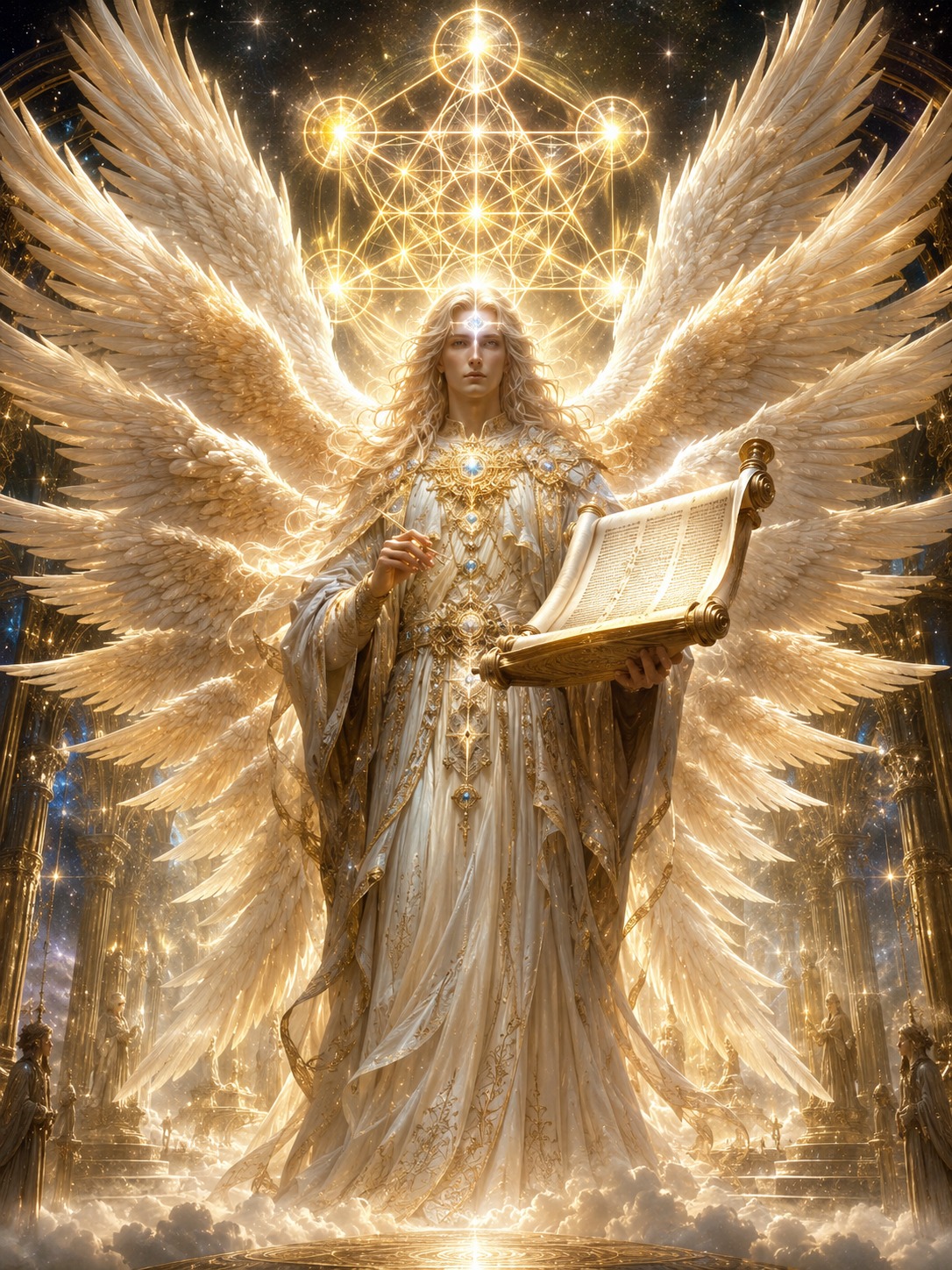
Metatron
Metatron · Scribe of Heaven — Voice of God and Recorder of Divine Acts
Names in Other Languages
 메타트론한국어
Metatron · 하늘의 서기관 — 신의 입과 신성한 기록의 천사
 メタトロン日本語
Metatron · 天界の書記 — 神の口、神聖な記録の天使
 梅塔特隆繁體中文
Metatron · 天界書記 — 神之口,神聖記錄之天使
 MetatronDeutsch
Metatron · Schreiber des Himmels — Stimme Gottes und Verzeichner heiliger Taten
 MétatronFrançais
Métatron · Scribe du ciel — Voix de Dieu et chroniqueur des actes divins
 MetatrónEspañol
Metatrón · Escriba del cielo — Voz de Dios y registrador de los actos divinos
 MetatronPortuguês
Metatron · Escriba do céu — Voz de Deus e registrador dos atos divinos
 MetatronPolski
Metatron · Pisarz Niebios — Głos Boga i kronikarz boskich czynów
 МетатронРусский
Metatron · Писец Небес — Уста Бога и летописец священных деяний
Metatron (Hebrew Mēṭāṭrōn, Greek Metatrōn) is one of the highest-ranking angels of the Jewish Kabbalah and apocryphal tradition — the decisive canonical iconographic figure called 'the one who stands closest to God', 'Lesser YHVH', 'Prince of the Presence (Sar ha-Panim)', and 'heavenly scribe'. The etymology derives from Greek meta (beyond, near) + thronos (throne) — 'the one who stands beside the throne' — or Greek metator (messenger, guide). Aliases Yahoel, Sar ha-Panim, Sar ha-Olam ('Prince of the World'), Mitatron, and Lesser YHVH are the decisive canonical vocabulary. The decisive textual canon is 3 Enoch (Sefer Hekhalot) chapters 4-16 of c. 5th-6th century CE in which the human Enoch ascended to heaven and was transformed into Metatron, and Babylonian Talmud Hagigah 15a of the 4th-6th century in which Elisha ben Abuyah (Aher) saw Metatron sitting in heaven and was misled into the 'two powers in heaven' heresy. The decisive Zohar by Moses de Leon of the 1280s — Kabbalah — in which Metatron is the angel of Kether of the Tree of Life (Sephirot), and Metatron (the voice of God) played by Alan Rickman of the film Dogma (directed by Kevin Smith) released in the USA on 12 November 1999 is the 21st-century decisive video canon.
Origin
The iconographic origin is Genesis (Bereshit) 5:24 — 'And Enoch walked with God: and he was not; for God took him' — the myth of Enoch's ascension. The decisive textual canon is 3 Enoch (Sefer Hekhalot, the core text of Merkabah mysticism) chapters 4-16 of c. 5th-6th century CE in which the human Enoch, after his ascension, was transformed into Metatron with 36 or 72 pairs of giant wings of light and 365,000 eyes. The decisive Babylonian Talmud Hagigah 15a of the 4th-6th century in which when 4 rabbis entered the heavenly garden (Pardes), Elisha ben Abuyah (Aher) saw Metatron sitting beside God's throne and was misled into the 'two powers in heaven' heresy, losing his faith, after which Metatron received 60 lashes of fire (pulsa de-nura) from God to 'show that none may sit in heaven'. The decisive Babylonian Talmud Sanhedrin 38b of the 4th-6th century, and the decisive Zohar by Moses de Leon of Spain of the 1280s in which Metatron is the angel of Kether (Crown) of the Tree of Life (Sephirot) of Kabbalah.
Features
- 36 or 72 pairs of giant wings of light and 365,000 eyes
- Records all events in the eternal book (Sefer ha-Razim, Akashic records)
- God's name (YHVH) inscribed on his forehead
- Metatron's Cube (sacred geometry) symbol
- Angel of Kether of the Kabbalah Tree of Life
- Aliases — 'Lesser YHVH' and 'Prince of the Presence (Sar ha-Panim)'
Stories
The Enoch ascension myth of Genesis 5:24 is the decisive origin, and the decisive textual canon is 3 Enoch chapters 4-16 of c. 5th-6th century CE, Babylonian Talmud Hagigah 15a and Sanhedrin 38b of the 4th-6th century, and Zohar by Moses de Leon of the 1280s. Called upon in mystical meditation and Kabbalah initiation rituals, prayed when seeking God's message or knowledge of one's spiritual destiny. As the angel of Kether (Crown) of the Tree of Life (Sephirot), Metatron serves as the bridge between God and humans, and Metatron's Cube is the canon of sacred geometry. The decisive grimoire canon of Metatron in The Magus of 1801 by Francis Barrett, and the decisive art canon of the Metatron iconography in the Dictionnaire Infernal of 1818 by Collin de Plancy. The decisive 21st-century canon is Metatron (the voice of God) played by Alan Rickman of the film Dogma (directed by Kevin Smith, View Askew) released in the USA on 12 November 1999, and Metatron played by Curtis Armstrong of the TV series Supernatural Seasons 8-11 by USA CW from 2013 to 2017 — the decisive global video canon.
Weakness
Metatron's weaknesses are: (1) being originally human — 3 Enoch chapters 4-16 — there is rank conflict with other originally-angelic beings because he was originally Enoch transformed after ascension; (2) the 'two powers' heresy — Babylonian Talmud Hagigah 15a — after Elisha ben Abuyah (Aher) saw Metatron sitting in heaven and was misled into the 'two powers in heaven' heresy, Metatron received 60 lashes of fire (pulsa de-nura) from God; (3) excessive emphasis on his authority — in some rabbinic traditions, his authority is excessively emphasized, summoning the 'two powers' heresy and being rebuked by God; (4) binding of God's command — acting only by God's command as scribe; (5) binding of hierarchy — being lower than God despite 'Lesser YHVH'; (6) binding of the book — recording the eternal book; (7) binding of the sacred domain — heaven; (8) binding of transformation — being transformed from human into angel. The decisive canonical finale is Babylonian Talmud Hagigah 15a — because Metatron's sitting beside God's throne summoned the heresy of misunderstanding, he received 60 lashes of fire and 'showed that none may sit in heaven'.
Cultural Significance
Metatron is the canonical iconographic figure of the decisive Jewish canon, traversing the Enoch ascension of Genesis 5:24, c. 5th-6th century CE 3 Enoch chapters 4-16, 4th-6th century Babylonian Talmud Hagigah 15a and Sanhedrin 38b, 1280s Moses de Leon Zohar, 1801 Francis Barrett The Magus, 1818 Collin de Plancy Dictionnaire Infernal, 1987 TSR D&D Deities & Demigods, 1999 film Dogma, and 2013-2017 CW Supernatural. The iconographic origin is Genesis 5:24 — 'And Enoch walked with God: and he was not; for God took him' — the myth of Enoch's ascension settled as the canon of the transformation of the human Enoch in 3 Enoch chapters 4-16 of c. 5th-6th century CE. The decisive mythological canon is Babylonian Talmud Hagigah 15a of the 4th-6th century in which when 4 rabbis (Shimon ben Zoma, Shimon ben Zakkai, Elisha ben Abuyah, Rabbi Akiva) entered the heavenly garden (Pardes), Elisha ben Abuyah (Aher) saw Metatron sitting beside God's throne and was misled into the 'two powers in heaven' heresy, losing his faith, after which Metatron received 60 lashes of fire from God. The decisive Kabbalah canon is Metatron as the angel of Kether (Crown) of the Tree of Life (Sephirot) in the Zohar (Book of Splendor) by Moses de Leon (c. 1240-1305) of Spain of the 1280s, and the decisive 21st-century canon is Metatron (the voice of God) played by Alan Rickman (born 21 February 1946 in London, died 14 January 2016 in London) of the film Dogma (directed by Kevin Smith, View Askew) released in the USA on 12 November 1999, and Metatron (God's scribe) played by Curtis Armstrong (born 27 November 1953 in Detroit, USA) of the TV series Supernatural Season 8 episode 22 through Season 11 by USA CW from 2013 to 2017 — the decisive global video canon.
In Popular Culture
- Genesis 5:24 Enoch ascension — decisive origin canon
- 3 Enoch (Sefer Hekhalot) chapters 4-16 transformation of Enoch (c. 5th-6th century CE) — decisive origin canon
- Babylonian Talmud Hagigah 15a 'two powers' heresy (4th-6th century) — decisive Jewish canon
- Babylonian Talmud Sanhedrin 38b Metatron (4th-6th century) — decisive Jewish canon
- Moses de Leon Zohar Kabbalah angel of Kether (1280s) — decisive Kabbalah canon
- Francis Barrett The Magus (1801) — decisive grimoire canon
- Collin de Plancy Dictionnaire Infernal (1818) — decisive art canon
- TSR D&D Deities & Demigods, Metatron (1987) — decisive fantasy RPG canon
- Film Dogma, Metatron Alan Rickman (1999) — 21st-century decisive film canon
- CW TV series Supernatural, Metatron Curtis Armstrong (2013-2017) — 21st-century decisive TV canon
Trivia
The etymology of Metatron (Hebrew Mēṭāṭrōn) derives from Greek meta (beyond, near) + thronos (throne) — 'the one who stands beside the throne' — or Greek metator (messenger, guide), and aliases Yahoel, Sar ha-Panim, Sar ha-Olam, Mitatron, Lesser YHVH, and heavenly scribe are the decisive canonical vocabulary. The iconographic origin is Genesis 5:24 — 'And Enoch walked with God: and he was not; for God took him'. The decisive textual canon is 3 Enoch (Sefer Hekhalot, the core text of Merkabah mysticism) chapters 4-16 of c. 5th-6th century CE in which the human Enoch, after ascension, was transformed into Metatron with 36 or 72 pairs of giant wings of light and 365,000 eyes, and Babylonian Talmud Hagigah 15a of the 4th-6th century in which 4 rabbis entered the heavenly garden (Pardes), Elisha ben Abuyah (Aher) saw Metatron sitting beside God's throne and was misled into the 'two powers in heaven' heresy, losing his faith, after which Metatron received 60 lashes of fire (pulsa de-nura) from God. The decisive Kabbalah canon is Metatron as the angel of Kether (Crown) of the Tree of Life (Sephirot) in the Zohar (Book of Splendor) by Moses de Leon (c. 1240-1305) of Spain of the 1280s, and Metatron's Cube is the decisive canon of sacred geometry consisting of 13 circles and 78 straight lines. The decisive art canon is the Metatron iconography of The Magus of 1801 by Francis Barrett and the Dictionnaire Infernal of 1818 by Collin de Plancy (1793-1881). The decisive 21st-century canon is Metatron (the voice of God) played by Alan Rickman of the film Dogma (directed by Kevin Smith, View Askew) released in the USA on 12 November 1999, and Metatron (God's scribe) played by Curtis Armstrong of the TV series Supernatural Season 8 episode 22 through Season 11 by USA CW from 2013 to 2017 — the 21st-century decisive global video canon.