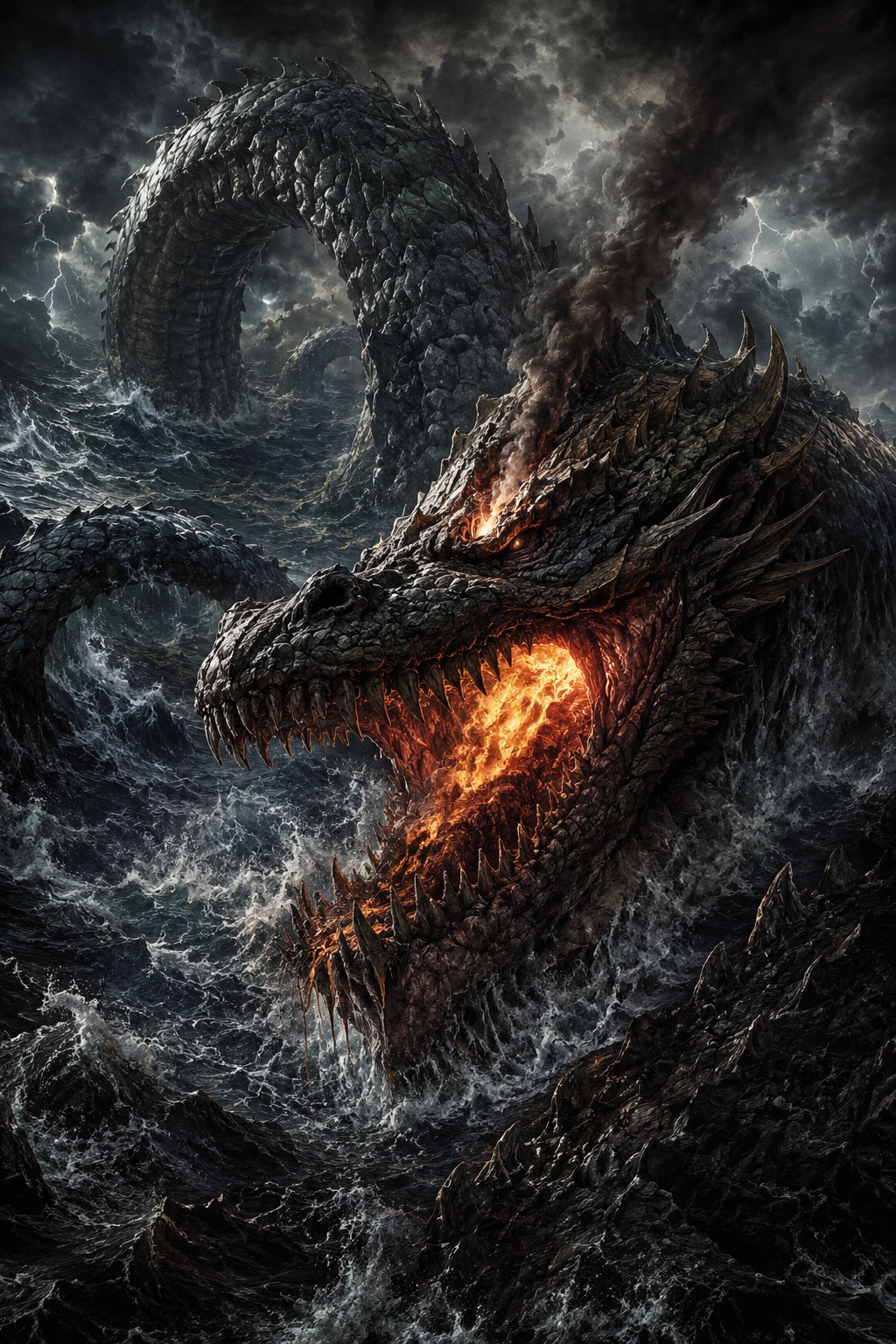
Leviathan
Leviathan· Vast Sea Monster Prince of Envy
Names in Other Languages
 레비아탄한국어
Leviathan· 바다의 거대 괴수 질투의 대공
 レビアタン日本語
Leviathan· 海の巨大怪獣 嫉妬の大公
 利維坦繁體中文
Leviathan· 巨海怪獸 嫉妒大公
 LeviathanDeutsch
Leviathan · Riesiges Meeresungeheuer — Fürst des Neides
 LéviathanFrançais
Léviathan · Vaste monstre marin — Prince de l'envie
 LeviatánEspañol
Leviatán · Vasto monstruo marino — Príncipe de la envidia
 LeviatãPortuguês
Leviatã · Vasto monstro marinho — Príncipe da inveja
 LewiatanPolski
Lewiatan · Olbrzymi morski potwór — Książę zazdrości
 ЛевиафанРусский
Leviathan· Огромный морской зверь Князь зависти
Leviathan (Hebrew Liwyāṯān, Greek Leviathan, Latin Leviathan) is the great sea monster of the Old Testament — the decisive canon, the demon that developed into the Archduke of Envy in the Christian tradition — the decisive canonical iconographic figure of 'the coiling one', derived from the Hebrew 'lawah' meaning 'to twist, coil'. The aliases Liwyāṯān, Lotan (Ugaritic prototype), sea serpent, piercing serpent, and nachash bariach are the decisive canonical vocabulary. The decisive textual canon is the decisive origin canon of the 7-headed sea chaos monster Lotan (Lotan, ltn) in the Baal Cycle (Baal Cycle) of Ugarit (Ugarit) of c. 13th century BCE, and the decisive canon of the invincible sea monster that only God could subdue in Job (Job) 41:1-34 (40:25-41:26 in the Hebrew text) of c. 6th-4th century BCE. The decisive canon of the slaying of Leviathan at the 'end of days' in Isaiah (Isaiah) 27:1, Psalm (Psalm) 74:14 and 104:26, and the decisive canon of Leviathan and Behemoth (Behemoth) in the Babylonian Talmud Bava Batra (Bava Batra) 74b-75a of the 4th-6th century.
Origin
The etymological origin is the decisive origin canon of 'the coiling one' derived from the Hebrew 'lawah' meaning 'to twist, coil', and the iconographic origin is the decisive origin canon of Baal (Baal) slaying the 7-headed sea chaos monster Lotan (Lotan, ltn) in the Baal Cycle (Baal Cycle) KTU 1.5 of Ugarit (Ugarit, present-day Ras Shamra in Syria) of c. 13th century BCE. The decisive textual canon is the decisive canon of God's words to Job in Job (Job) 41:1-34 (40:25-41:26 in the Hebrew text) of c. 6th-4th century BCE — 'Canst thou draw out leviathan with a hook? or his tongue with a cord which thou lettest down?' 'His scales are his pride, shut up together as with a close seal' 'By his neesings a light doth shine, and his eyes are like the eyelids of the morning' 'Out of his mouth go burning lamps, and sparks of fire leap out' 'When he raiseth up himself, the mighty are afraid' — and the decisive canon of the 'end of days' in Isaiah (Isaiah) 27:1 — 'In that day the Lord with his sore and great and strong sword shall punish leviathan the piercing serpent, even leviathan that crooked serpent; and he shall slay the dragon that is in the sea'. The decisive canon of Psalm 74:14 — 'Thou brakest the heads of leviathan in pieces' — and 104:26 — 'There is that leviathan, whom thou hast made to play therein' — and the decisive canon in the Babylonian Talmud Bava Batra (Bava Batra) 74b-75a of the 4th-6th century in which Leviathan (sea) and Behemoth (land) fight in the Messianic era and become the feast food of the righteous.
Features
- Giant sea serpent or crocodile-like scaled monster
- 7 heads (Ugaritic Lotan prototype) or crooked serpent
- Fire from mouth, smoke from nose (Job 41:19-20)
- Scales harder than shields — all human weapons are like straw to him
- The sea boils where he passes
- Archduke of 'Envy (Envy)' among the Seven Deadly Sins — paired with Behemoth (land)
Stories
The Lotan (Lotan) of the Baal Cycle of Ugarit of c. 13th century BCE is the decisive origin, and the decisive textual canon is Job 41:1-34, Isaiah 27:1, Psalm 74:14 and 104:26 of c. 6th-4th century BCE, and the Babylonian Talmud Bava Batra 74b-75a of the 4th-6th century. The decisive canon called upon as a metaphor for uncontrollable natural force and envy, and the decisive political-philosophical canon in which the political philosophy work Leviathan (Leviathan) of 1651 by the English Thomas Hobbes (Thomas Hobbes, 1588-1679) used him as a metaphor for the absolute state and influenced the history of political thought. The decisive canon as the embodiment of great evil in eschatology, and the decisive canon of the 'Seven Princes of Hell' by Peter Binsfeld (Peter Binsfeld) of 1589 — in which Leviathan is assigned as the prince of 'Envy (Invidia, Envy)'. The decisive canon of the giant sea monster Leviathan in Paradise Lost (Paradise Lost) Book 1 lines 200-208 of John Milton (John Milton) of 1667, and the decisive art canon of the Leviathan iconography in the Dictionnaire Infernal (Dictionnaire Infernal) of 1818 by Collin de Plancy (Collin de Plancy). The decisive 21st-century canon is the decisive fantasy RPG canon of Leviathan in the 1977 USA TSR Monster Manual (Monster Manual), the decisive canon of the Russian film Leviathan (Leviathan) (directed by Andrey Zvyagintsev) first screened at the Cannes Film Festival on 23 May 2014, the Skin Game (Skin Game) by Jim Butcher published in the USA in June 2014, and the TV series Lucifer (Lucifer) by USA Fox and Netflix from 2017 to 2021 — the 21st-century decisive global video canon.
Weakness
Leviathan's weaknesses are: (1) God's hand — the decisive canonical weakness — the decisive canon of the c. 6th-4th century BCE Job 41 — the invincible sea monster that only God could subdue, with all human weapons being like straw to him; (2) the Messianic era of the eschaton — the decisive canonical weakness — the decisive canon of Isaiah 27:1 — 'In that day the Lord with his sore and great and strong sword shall punish leviathan the piercing serpent'; (3) combat with Behemoth — the decisive canon of the 4th-6th century Babylonian Talmud Bava Batra 74b-75a — in the Messianic era he fights Behemoth and is eventually slaughtered by God to become the feast food of the righteous; (4) Baal's slaying — the decisive origin canon of c. 13th century BCE Ugaritic Baal Cycle KTU 1.5 — Baal slaying the 7-headed Lotan; (5) Psalm's breaking — the decisive canon of Psalm 74:14 — 'Thou brakest the heads of leviathan in pieces'; (6) binding of the sea — the decisive canon of being trapped in the sea; (7) binding of the sacred domain — the decisive canon; (8) binding of the envy of the Seven Deadly Sins — the decisive canon. The decisive canonical finale is the decisive mythological canon of the 4th-6th century Babylonian Talmud Bava Batra 74b-75a — in the Messianic era, Leviathan (sea) and Behemoth (land) fight and are slaughtered by God to become the eschatological feast food of the righteous.
Cultural Significance
Leviathan is not merely a sea-monster icon but the canonical iconographic figure of the decisive Judeo-Christian canon, traversing the c. 13th century BCE Ugaritic Baal Cycle KTU 1.5 Lotan, the c. 6th-4th century BCE Job 41:1-34, Isaiah 27:1, Psalm 74:14 and 104:26, the 4th-6th century Babylonian Talmud Bava Batra 74b-75a, the 1589 Peter Binsfeld 'Seven Princes of Hell', the 1651 Thomas Hobbes Leviathan, the 1667 John Milton Paradise Lost Book 1 lines 200-208, the 1818 Collin de Plancy Dictionnaire Infernal, the 1977 TSR D&D Monster Manual, and the 2014 film Leviathan. The etymological origin is the decisive canon of 'the coiling one' derived from the Hebrew 'lawah' meaning 'to twist, coil', and the iconographic origin settled as the decisive canon in Baal (Baal) slaying the 7-headed sea chaos monster Lotan (Lotan, ltn) in the Baal Cycle (Baal Cycle) KTU 1.5 of Ugarit (Ugarit, present-day Ras Shamra in Syria) of c. 13th century BCE. The decisive mythological canon is the decisive canon of the invincible sea monster that only God could subdue in Job (Job) 41:1-34 (40:25-41:26 in the Hebrew text) of c. 6th-4th century BCE — with scales harder than shields, fire from mouth, and smoke from nose — and the decisive canon in the Babylonian Talmud Bava Batra (Bava Batra) 74b-75a of the 4th-6th century in which Leviathan (sea) and Behemoth (land) fight in the Messianic era and become the feast food of the righteous. The decisive political-philosophical canon is the decisive canon of the political philosophy work Leviathan (Leviathan) of 1651 by the English Thomas Hobbes (Thomas Hobbes, 1588-1679) using him as a metaphor for the absolute state, and the decisive 17th-century English-literary canon of the giant sea monster Leviathan in Paradise Lost (Paradise Lost) Book 1 lines 200-208 of the English John Milton (John Milton, 1608-1674) of 1667. The decisive 21st-century canon is the decisive fantasy RPG canon of Leviathan in the 1977 USA TSR Monster Manual (Monster Manual), the decisive canon of the Russian film Leviathan (Leviathan) (directed by Andrey Zvyagintsev (Andrey Zvyagintsev), winner of the 2014 Cannes Film Festival Best Screenplay, 2015 Academy Award for Best Foreign Language Film nominee) first screened at the Cannes Film Festival on 23 May 2014, and the mention of Leviathan in the TV series Lucifer (Lucifer) (Seasons 1-6) by USA Fox (Fox) and Netflix from 2017 to 2021 — the 21st-century decisive global video canon.
In Popular Culture
- Ugaritic Baal Cycle KTU 1.5 Lotan (Lotan, ltn) (c. 13th century BCE) — decisive origin canon
- Job 41:1-34 (Hebrew text 40:25-41:26) (c. 6th-4th century BCE) — decisive origin canon
- Isaiah 27:1 end-of-days Leviathan (c. 8th-6th century BCE) — decisive canon
- Psalm 74:14 and 104:26 (c. 6th-4th century BCE) — decisive canon
- 1 Enoch 60:7-9 and 2 Baruch 29:4 (c. 2nd century BCE) — decisive apocryphal canon
- Babylonian Talmud Bava Batra 74b-75a (4th-6th century) — decisive Jewish canon
- Peter Binsfeld 'Seven Princes of Hell' Leviathan=Envy (1589) — decisive grimoire canon
- Thomas Hobbes Leviathan (1651) — decisive political-philosophical canon
- John Milton Paradise Lost Book 1 lines 200-208 (1667) — decisive 17th-century English-literary canon
- Collin de Plancy Dictionnaire Infernal Leviathan iconography (1818) — decisive art canon
- Film Leviathan directed by Andrey Zvyagintsev (2014) — 21st-century decisive film canon
Trivia
The etymology of Leviathan (Hebrew Liwyāṯān) is the decisive canonical vocabulary of 'the coiling one' derived from the Hebrew 'lawah' meaning 'to twist, coil', and the Greek Leviathan, Latin Leviathan, and aliases Liwyāṯān, Lotan (Lotan, Ugaritic prototype), sea serpent (sea serpent), piercing serpent (piercing serpent), and nachash bariach (nachash bariach) are the decisive canonical vocabulary. The iconographic origin is the decisive origin canon of Baal (Baal) slaying the 7-headed sea chaos monster Lotan (Lotan, ltn) in the Baal Cycle (Baal Cycle) KTU 1.5 of Ugarit (Ugarit, present-day Ras Shamra in Syria) of c. 13th century BCE. The decisive textual canon is the decisive canon of God's words to Job in Job (Job) 41:1-34 (40:25-41:26 in the Hebrew text) of c. 6th-4th century BCE — 'Canst thou draw out leviathan with a hook?' 'His scales are his pride, shut up together as with a close seal' 'Out of his mouth go burning lamps, and sparks of fire leap out' 'When he raiseth up himself, the mighty are afraid' — and the decisive canon of the eschaton in Isaiah (Isaiah) 27:1 and the decisive canon of Psalm (Psalm) 74:14 — 'Thou brakest the heads of leviathan in pieces' — and 104:26. The decisive canon in the Babylonian Talmud Bava Batra (Bava Batra) 74b-75a of the 4th-6th century in which Leviathan (sea) and Behemoth (land, Behemoth) fight in the Messianic era and are slaughtered by God to become the eschatological feast food of the righteous, and the decisive canon of the German Peter Binsfeld (Peter Binsfeld, 1545-1598)'s 'Seven Princes of Hell' of 1589 in which Leviathan is assigned as the prince of 'Envy (Invidia, Envy)'. The decisive political-philosophical canon is the decisive canon of the political philosophy work Leviathan (Leviathan, or The Matter, Forme and Power of a Common-Wealth Ecclesiasticall and Civil) of 1651 by the English Thomas Hobbes (Thomas Hobbes, born 5 April 1588 in Westport, England, died 4 December 1679 in Derbyshire, England) using him as a metaphor for the absolute state and influencing the history of political thought, and the decisive 17th-century English-literary canon of 'the great Leviathan, sleeping by the rim of Norway, dreaming, his huge bulk by the cold North Sea' in Paradise Lost (Paradise Lost) Book 1 lines 200-208 of the English John Milton (John Milton, 1608-1674) of 1667. The decisive canon of the Leviathan iconography of the French Collin de Plancy (Collin de Plancy, 1793-1881)'s Dictionnaire Infernal (Dictionnaire Infernal) of 1818 is the decisive art canon, and the Russian film Leviathan (Leviathan) (directed by Andrey Zvyagintsev (Andrey Zvyagintsev, born 6 February 1964 in Novosibirsk, Russia), winner of the 2014 Cannes Film Festival Best Screenplay, 2015 Academy Award for Best Foreign Language Film nominee) first screened at the Cannes Film Festival on 23 May 2014 is the 21st-century decisive global film canon.