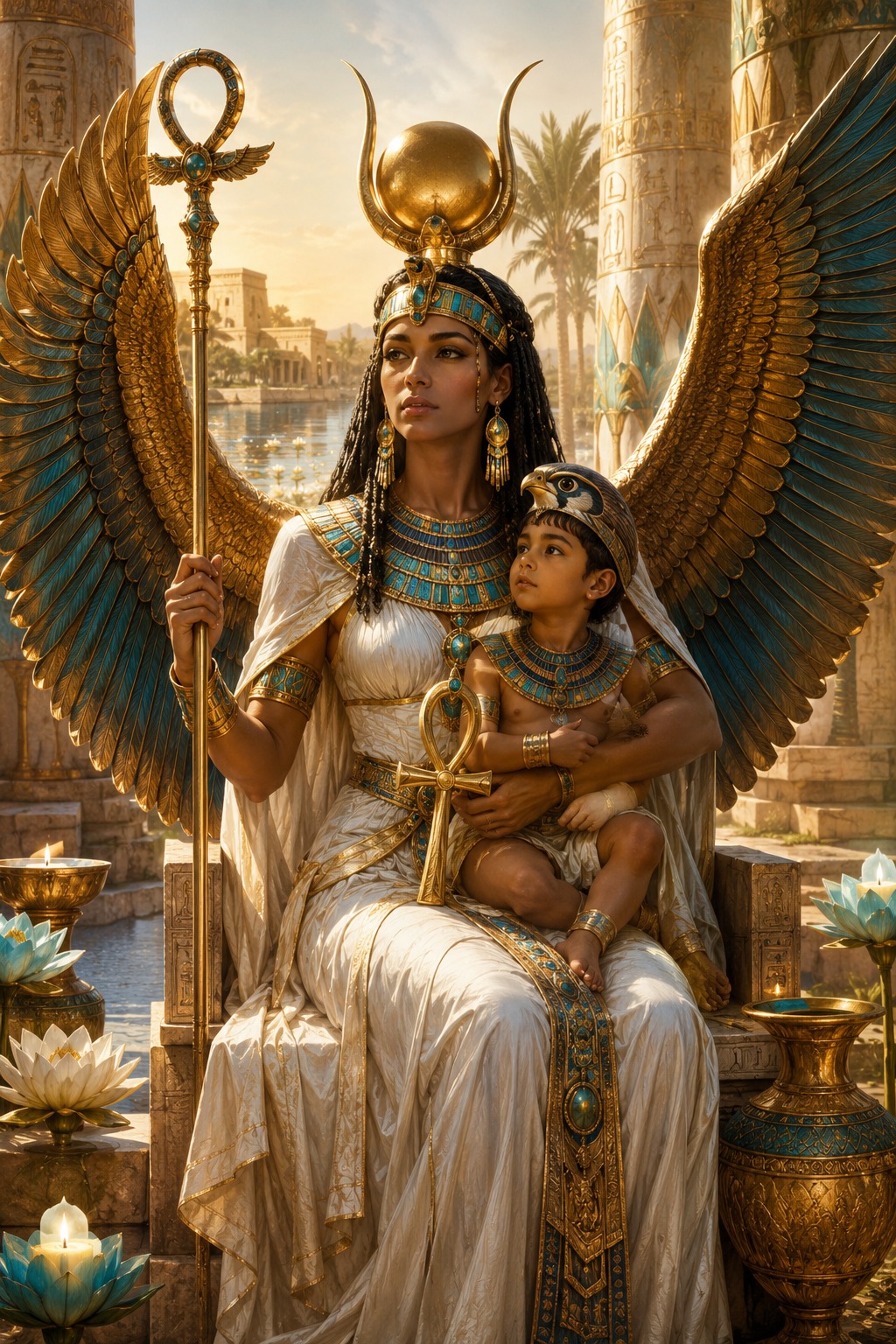
Isis
Isis · Egyptian Goddess of Magic and Motherhood — Goddess of Ten Thousand Names
Names in Other Languages
 이시스한국어
Isis· 이집트 마법과 모성의 여신 만 가지 이름의 여신
 イシス日本語
Isis· エジプト魔術と母性の女神 万の名を持つ女神
 伊西斯繁體中文
Isis· 埃及魔法與母性女神 萬名之女神
 IsisDeutsch
Isis · Ägyptische Göttin der Magie und Mutterschaft — Göttin der zehntausend Namen
 IsisFrançais
Isis · Déesse égyptienne de la magie et de la maternité — Déesse aux dix mille noms
 IsisEspañol
Isis · Diosa egipcia de la magia y la maternidad — Diosa de los diez mil nombres
 ÍsisPortuguês
Ísis · Deusa egípcia da magia e da maternidade — Deusa dos dez mil nomes
 IzydaPolski
Izyda · Egipska bogini magii i macierzyństwa — Bogini dziesięciu tysięcy imion
 ИсидаРусский
Isis · Египетская богиня магии и материнства — Богиня десяти тысяч имён
Isis (Egyptian Iset or Aset, Greek Isis, Latin Isis) is the goddess of magic, healing, motherhood, and kingship of ancient Egyptian mythology — the decisive canon, the daughter of Geb (Geb) and Nut (Nut) of the Heliopolitan Ennead (Ennead), the sister and wife of Osiris (Osiris), and the mother of Horus (Horus) — the decisive canonical iconographic figure. The etymology of the Egyptian Iset (Aset) is 'throne (throne)' — the decisive canon as the personification of the throne — and the aliases Aset (Aset), Auset (Auset), Weret-hekau (Weret-hekau, 'Great Sorceress'), Mut-netjeret (Mut-netjeret, 'Mother of God'), and Anima Versatilis (Anima Versatilis, 'goddess of ten thousand names') are the decisive canonical vocabulary. The decisive textual canon is the decisive origin canon of the Pyramid Texts (Pyramid Texts) of Unas (Unas) of the Old Kingdom 5th dynasty of c. 2400-2300 BCE, and the decisive canon of 'Isis and the Secret Name of Ra (Isis and the Secret Name of Ra)' of the Turin Papyrus (Turin Papyrus) of the New Kingdom of c. 1250 BCE. The De Iside et Osiride (De Iside et Osiride) of Plutarch (Plutarchos) of c. 100 CE of the c. 1st century CE and the decisive canon of the 'goddess of ten thousand names' in Book 11 of the Metamorphoses (Metamorphoses) of Apuleius (Apuleius) of c. 170 CE.
Origin
The iconographic origin is the decisive origin canon of the personification of the throne of the Predynastic period (c. 3200 BCE), and the decisive textual canon is the decisive origin canon of Isis (Iset) of the Pyramid Texts (Pyramid Texts) of Unas (Unas) of the Old Kingdom 5th dynasty of c. 2400-2300 BCE in Saqqara, and the decisive canon of Isis of the Coffin Texts (Coffin Texts) of the Middle Kingdom of c. 2100-1700 BCE and the Book of the Dead (Book of the Dead) of the New Kingdom of c. 1550 BCE. The decisive magic canon is the decisive canon of 'Isis and the Secret Name of Ra (Isis and the Secret Name of Ra)' of the Turin Papyrus (Turin Papyrus, Papyrus Turin 1993) of the New Kingdom 19th dynasty of c. 1250 BCE — Isis made a serpent from Ra's (Ra) saliva and had it bite Ra, then said she would heal him if he told her his secret name, and obtained the secret name of Ra and gained part of his power. The decisive Greek-Latin canon is the decisive canon of the De Iside et Osiride (De Iside et Osiride) chapters 12-20 and 54-58 of the Greek Plutarch (Plutarch, 46-119) of c. 100 CE of the c. 1st century CE — the prototype of the faithful wife who searched for the body of the murdered Osiris and the mother who protected the young Horus from Seth (Seth) — and the decisive canon of Isis's 'I am the mother of all things, mistress of all elements' and the 'goddess of ten thousand names (myrionymos)' in Book 11 of Metamorphoses (Metamorphoses, Golden Ass) of Apuleius (Apuleius) of c. 170 CE.
Features
- Throne (Iset) headdress or sun disk between cow horns (Hathor's influence)
- Protects Horus with hawk's wings
- Magic wand and ankh (ankh)
- Mother and child statue holding the young Horus (Harpokrates) (Isis lactans) — prototype of the Madonna
- Main temple Temple of Isis at Philae (Philae)
- Star Sirius (Sothis) and the annual flooding of the Nile
Stories
The personification of the throne of the Predynastic period is the decisive origin, and the decisive textual canon is the Pyramid Texts of Unas of the Old Kingdom 5th dynasty of c. 2400-2300 BCE, the Turin Papyrus 'Isis and the Secret Name of Ra' of the New Kingdom of c. 1250 BCE, the De Iside et Osiride of Plutarch of c. 1st century CE, and Book 11 of Metamorphoses of Apuleius of c. 170 CE. The decisive canon called upon in healing spells, detoxification, and protection rituals for mothers and children, and the decisive canon in which during the Greco-Roman period (4th century BCE-6th century CE) she became the central goddess of mystery cults (Isis Mysteries), and initiation rituals spread beyond Egypt. The decisive canon in which fishermen and sailors also called upon her for safety (Isis Pelagia, 'Isis of the sea'), and the decisive canon in which she was identified with the star Sirius (Sothis) and foretold the annual flooding of the Nile. The decisive temple is the decisive canon of the Temple of Isis at Philae (Temple of Isis at Philae) from 380-362 BCE to 537 CE — about 240 m in length — the last Egyptian temple closed by the edict of the Byzantine Emperor Justinian I in 537 CE. The Isis of the film Stargate (Stargate) (directed by Roland Emmerich) released in the USA on 28 October 1994, the fusion iconography of Hathor played by Elodie Yung (Elodie Yung) of the film Gods of Egypt (Gods of Egypt) (directed by Alex Proyas) released in the USA on 26 February 2016, and the TV series American Gods (American Gods) (based on Neil Gaiman, Seasons 1-3) by USA Starz from 2017 to 2021 are the 21st-century decisive video canon.
Weakness
Isis's weaknesses are: (1) the death of her husband — the decisive canonical weakness — the decisive canon of the c. 1st century CE Plutarch De Iside et Osiride chapters 13-19 — the sorrow of the mother who searched for the body scattered into 14 pieces after Seth (Seth) murdered Osiris; (2) flight of the young Horus — the decisive canonical weakness — the decisive canon of the c. 1st century CE Plutarch De Iside et Osiride chapters 16-17 — hid the young Horus in the marshes of Khemmis (Khemmis) and continued endless flight and transformation when Seth targeted the young Horus; (3) binding of the lost phallus — the decisive canon of the phallus among the 14 pieces being eaten by a fish and lost, so she made a golden phallus; (4) binding of Ra's secret name — the decisive canon of the c. 1250 BCE Turin Papyrus — made a serpent from Ra's saliva and had it bite Ra and obtained the secret name; (5) binding of Khemmis — the decisive canon of the marshes; (6) binding of motherhood — the decisive canon of binding with the young Horus; (7) binding of the sacred domain — the decisive canon of the Philae temple; (8) binding with Sirius — the decisive canon of foretelling the annual flooding of the Nile. The decisive canonical finale is the decisive mythological canon of the Temple of Isis at Philae (Philae) being closed by the edict of the Byzantine Emperor Justinian I in 537 CE — the last Egyptian temple.
Cultural Significance
Isis is not merely a motherhood-goddess icon but the canonical iconographic figure of the decisive Egyptian canon, traversing the Predynastic period throne personification, the c. 2400-2300 BCE Old Kingdom 5th dynasty Unas's Pyramid Texts, the c. 2100-1700 BCE Middle Kingdom Coffin Texts, the c. 1550 BCE New Kingdom Book of the Dead, the c. 1250 BCE New Kingdom Turin Papyrus 'Isis and the Secret Name of Ra', the Temple of Isis at Philae from 380-362 BCE to 537 CE, the c. 1st century CE Plutarch De Iside et Osiride chapters 12-20 and 54-58, Book 11 of c. 170 CE Apuleius Metamorphoses, the 1994 film Stargate, the 2016 film Gods of Egypt, and the 2017-2021 Starz American Gods. The personification of the throne of the Predynastic period (c. 3200 BCE) settled as the decisive canon in the Pyramid Texts of Unas of the Old Kingdom 5th dynasty of c. 2400-2300 BCE. The decisive mythological canon is the decisive canon of the De Iside et Osiride (De Iside et Osiride) chapters 12-20 of the Greek Plutarch (Plutarchos, 46-119) of c. 1st century CE — after Seth murdered Osiris, Isis searched for and gathered the body scattered into 14 pieces, mummified it, and resurrected it to conceive Horus — and the decisive canon of chapters 16-17 — hid the young Horus in the marshes of Khemmis and protected him from Seth's threat. The decisive canon in which the mother and child statue (Isis lactans, 'Isis breastfeeding') of Isis holding the young Horus became the prototype of the Madonna icon of later Virgin Mary and infant Jesus. The decisive temple canon is the Temple of Isis at Philae (Temple of Isis at Philae) — about 240 m in length — the decisive canon active for about 900 years from the start of the Ptolemaic dynasty of 380-362 BCE to its closure by the edict of the Byzantine Emperor Justinian I in 537 CE — the decisive canon of the last Egyptian temple. The decisive 21st-century canon is the Isis of the film Stargate (Stargate) (directed by Roland Emmerich, MGM, worldwide box office about 196.5 million dollars) released in the USA on 28 October 1994, the Hathor (fusion with Isis) played by Elodie Yung (Elodie Yung, born 22 February 1981 in Paris, France) of the film Gods of Egypt (Gods of Egypt) (directed by Alex Proyas, Lionsgate) released in the USA on 26 February 2016, and the TV series American Gods (American Gods) (based on Neil Gaiman, Seasons 1-3) by USA Starz from 2017 to 2021 — the 21st-century decisive global video canon.
In Popular Culture
- Predynastic period throne personification (c. 3200 BCE) — decisive origin canon
- Old Kingdom 5th dynasty Unas's Pyramid Texts (c. 2400-2300 BCE) — decisive origin canon
- Middle Kingdom Coffin Texts (c. 2100-1700 BCE) — decisive funerary canon
- New Kingdom Book of the Dead (c. 1550 BCE) — decisive Book-of-the-Dead canon
- New Kingdom Turin Papyrus 'Isis and the Secret Name of Ra' (c. 1250 BCE) — decisive magic canon
- Temple of Isis at Philae (380-362 BCE to 537 CE) — decisive temple-architecture canon
- Plutarch De Iside et Osiride chapters 12-20 and 54-58 (c. 1st century CE) — decisive Greek-Latin canon
- Apuleius Metamorphoses Book 11 'goddess of ten thousand names' (c. 170 CE) — decisive Latin canon
- TSR D&D Deities & Demigods, Isis (1980) — decisive fantasy RPG canon
- Film Stargate, Isis (1994) — 21st-century decisive film canon
- Starz TV series American Gods (2017-2021) — 21st-century decisive TV canon
Trivia
The etymology of Isis (Egyptian Iset or Aset) is the Egyptian Iset (Aset) — 'throne (throne)' — the decisive canon as the personification of the throne — and the Greek Isis, Latin Isis, and aliases Aset (Aset), Auset (Auset), Weret-hekau (Weret-hekau, 'Great Sorceress'), Mut-netjeret (Mut-netjeret, 'Mother of God'), myrionymos (myrionymos, 'goddess of ten thousand names'), and Isis Pelagia (Isis Pelagia, 'Isis of the sea') are the decisive canonical vocabulary. The decisive textual canon is the decisive origin canon of Isis (Iset) of the Pyramid Texts (Pyramid Texts) of Unas (Unas, reigned 2375-2345 BCE) of the Old Kingdom 5th dynasty of c. 2400-2300 BCE in Saqqara, and the decisive magic canon is the decisive canon of 'Isis and the Secret Name of Ra (Isis and the Secret Name of Ra)' of the Turin Papyrus (Turin Papyrus, Papyrus Turin 1993) of the New Kingdom 19th dynasty of c. 1250 BCE — Isis made a serpent from old Ra's (Ra) saliva and had it bite Ra, then said she would heal him if he told her his secret name, and obtained the secret name of Ra and gained part of his power. The decisive canon of the De Iside et Osiride (De Iside et Osiride) chapters 12-20 of the Greek Plutarch (Plutarchos, c. 46 born in Chaeronea, died c. 119) of c. 100 CE of the c. 1st century CE — after Seth (Seth) murdered Osiris, Isis searched for and gathered the body scattered into 14 pieces, mummified it, and resurrected it to conceive Horus (Horus) — and the decisive canon of hiding the young Horus in the marshes of Khemmis (Khemmis) and protecting him from Seth's threat, and the decisive canon of 'I am the mother of all things, mistress of all elements, the first-born of all the ages, chief of the celestial powers, queen of the dead, first of those in heaven, goddess of ten thousand names (myrionymos)' in Book 11 of Metamorphoses (Metamorphoses, Golden Ass) of Apuleius (Apuleius, c. 124-170) of c. 170 CE. The decisive canon in which the mother and child statue (Isis lactans, 'Isis breastfeeding') of Isis holding the young Horus (Harpokrates) became the prototype of the Madonna (Madonna) icon of later Virgin Mary and infant Jesus, and the decisive canon of the Temple of Isis at Philae (Temple of Isis at Philae) of Philae (Philae, the current Agilkia Island of the Aswan Dam of Egypt) — about 240 m in length — active for about 900 years from the start of the Ptolemaic dynasty of 380-362 BCE to its closure by the edict of the Byzantine Emperor Justinian I in 537 CE — the last Egyptian temple. The decisive canon of being identified with the star Sirius (Sothis) and foretelling the annual flooding of the Nile, and the TV series American Gods (American Gods) (based on Neil Gaiman (Neil Gaiman), Seasons 1-3, 26 episodes) by USA Starz from 30 April 2017 to 21 March 2021 — the 21st-century decisive global video canon.