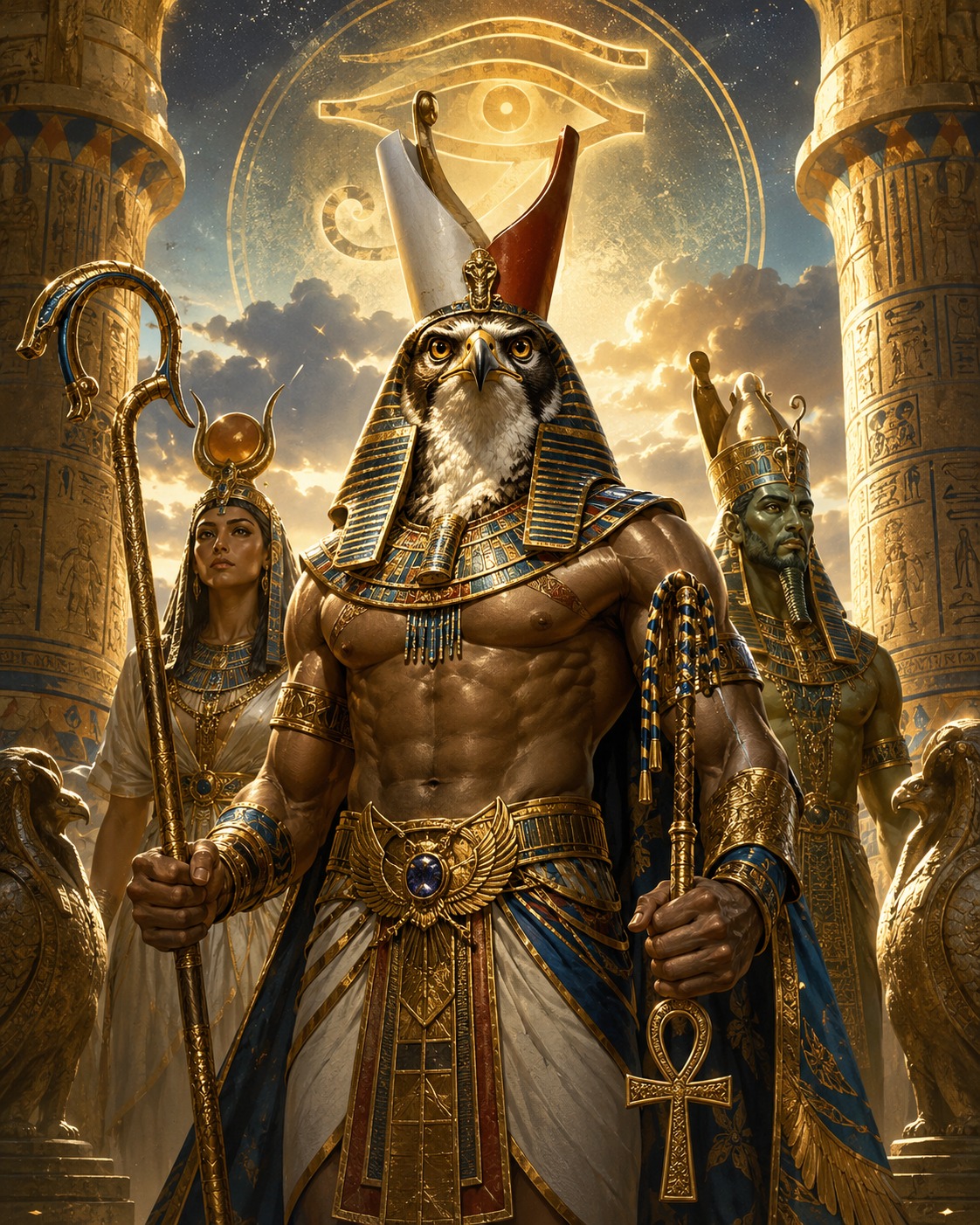
Horus
Horus · Egyptian God of Sky and Kingship — Falcon-Eyed Restorer of Justice
Names in Other Languages
 호루스한국어
Horus· 이집트 하늘·왕권의 신 매의 눈을 가진 정의의 회복자
 ホルス日本語
Horus· エジプト天空・王権の神 鷹の眼を持つ正義の回復者
 荷魯斯繁體中文
Horus· 埃及天空與王權之神 鷹眼正義之復辟者
 HorusDeutsch
Horus · Ägyptischer Gott des Himmels und Königtums — Falkenäugiger Wiederhersteller der Gerechtigkeit
 HorusFrançais
Horus · Dieu égyptien du ciel et de la royauté — Restaurateur de la justice aux yeux de faucon
 HorusEspañol
Horus · Dios egipcio del cielo y la realeza — Restaurador de la justicia con ojos de halcón
 HórusPortuguês
Hórus · Deus egípcio do céu e da realeza — Restaurador da justiça com olhos de falcão
 HorusPolski
Horus · Egipski bóg nieba i władzy królewskiej — Sokole-oki przywrócik sprawiedliwości
 ГорРусский
Horus · Египетский бог неба и царской власти — Восстановитель справедливости с соколиными глазами
Horus (Egyptian Ḥr Hor, Greek Hōros) is the god of the sky, kingship, and justice of ancient Egyptian mythology — the decisive canon, the son of Osiris (Osiris) and Isis (Isis), the decisive canonical iconographic figure who became the legitimate king of Egypt after an 80-year throne struggle with his uncle Seth (Seth). The etymology of the Egyptian Ḥr is the decisive canonical vocabulary of 'the high one' or 'the distant one', and the aliases Heru (Heru), Hor (Hor), Hor-sa-Iset (Hor-sa-Iset, 'Horus son of Isis'), Hor-wer (Hor-wer, 'Horus the Great'), Hor-akhti (Hor-akhti, 'Horus of the two horizons'), and Harpokrates (Harpokrates, 'Horus the Child') are the decisive canonical vocabulary. The decisive textual canon is the decisive origin canon of the Pyramid Texts (Pyramid Texts) of Unas (Unas) of the Old Kingdom 5th dynasty of c. 2400-2300 BCE, and the decisive canon of the 80-year struggle of the 'Contendings of Horus and Seth (Contendings of Horus and Seth)' of the Chester Beatty Papyrus I (Chester Beatty Papyrus I) of the New Kingdom 20th dynasty period of Rameses V of c. 1250 BCE. The De Iside et Osiride (De Iside et Osiride) chapters 12-20 and 54-58 of Plutarch (Plutarchos) of c. 100 CE of the Greek 1st century CE — the decisive Greek-Latin canon.
Origin
The iconographic origin is the falcon (Falcon) faith of the Predynastic period (c. 3200 BCE) — the decisive origin canon — and the falcon iconography of the Narmer Palette (Narmer Palette) of c. 3100 BCE is the decisive origin canon. The decisive textual canon is the Pyramid Texts (Pyramid Texts) of Unas of the Old Kingdom 5th dynasty of c. 2400-2300 BCE in Saqqara — the decisive canon in which Horus resurrected the dead Osiris — and the decisive canon of the Eye of Horus Wedjat (Wedjat). The Coffin Texts (Coffin Texts) of the Middle Kingdom of c. 2100-1700 BCE and the Book of the Dead (Book of the Dead) of the New Kingdom of c. 1550 BCE of the canon of Horus, and the decisive mythological canon is the 'Contendings of Horus and Seth (Contendings of Horus and Seth)' of the Chester Beatty Papyrus I (Chester Beatty Papyrus I) of the New Kingdom 20th dynasty period of Rameses V of c. 1250 BCE — the decisive canon in which after an 80-year throne struggle in the divine court, Horus reclaimed the throne of Egypt and Seth was banished to the desert. The De Iside et Osiride (De Iside et Osiride) chapters 12-20 and 54-58 of the Greek Plutarch (Plutarchos) of c. 100 CE of c. 1st century CE — the decisive canon of Horus's childhood and the conflict with Seth — and the Temple of Edfu (Temple of Edfu) of the Ptolemaic dynasty of c. 237-57 BCE — the decisive temple canon of Horus.
Features
- Falcon-headed with the double crown Pschent (Pschent) of Upper and Lower Egypt
- Was-scepter (was-scepter), flail (flail), and ankh (ankh)
- Eye of Horus Wedjat (Wedjat) — symbol of protection and restoration
- Transforms into a white falcon or falcon form
- Main temple Temple of Edfu (Edfu), Heliopolis
- The living pharaoh is the incarnation of Horus
Stories
The Predynastic falcon faith and the falcon iconography of the c. 3100 BCE Narmer Palette are the decisive origin, and the decisive textual canon is the Pyramid Texts of Unas of the Old Kingdom 5th dynasty of c. 2400-2300 BCE, the 'Contendings of Horus and Seth' of the Chester Beatty Papyrus I of the New Kingdom 20th dynasty period of Rameses V of c. 1250 BCE, and the De Iside et Osiride chapters 12-20 and 54-58 of Plutarch of c. 100 CE. The decisive canon as the sacred legitimacy of the living pharaoh — the enthroned king was 'Horus', and the decisive canon of the 'Eye of Horus (Eye of Horus, Wedjat)' amulet as the most widely produced amulet as a symbol of protection and healing. The decisive canon called upon in rituals praying for the restoration of just kingship, and the decisive temple canon of the Temple of Horus at Edfu (Edfu) of the Ptolemaic dynasty of c. 237-57 BCE — about 137 m in length. The decisive 21st-century canon is the Horus of the film Stargate (Stargate) (directed by Roland Emmerich, MGM) released in the USA on 28 October 1994, and the Horus played by Brenton Thwaites (Brenton Thwaites) of the film Gods of Egypt (Gods of Egypt) (directed by Alex Proyas, Lionsgate) released in the USA on 26 February 2016 — the 21st-century decisive global film canon.
Weakness
Horus's weaknesses are: (1) endless conflict with Seth — the decisive canonical weakness — the decisive canon of the 80-year throne struggle in the divine court in the c. 1250 BCE Chester Beatty Papyrus I; (2) lost left eye — the decisive canonical weakness — the decisive canon in which he lost his left eye in battle with Seth, and Thoth (Thoth) restored it, becoming the Wedjat (Wedjat); (3) flight in childhood — the decisive canonical weakness — the decisive canon of the c. 1st century CE Plutarch De Iside et Osiride chapters 16-17 — his mother Isis hid him in the marshes of Khemmis (Khemmis) and raised him, and his childhood was a continuous succession of flight and transformation under Seth's endless threat; (4) binding of scorpion poison — the decisive canon in which he was bitten by a scorpion in childhood and nearly died, but was restored by the magic of Isis and Thoth; (5) binding of the Eye of Horus — the decisive canon of losing and recovering it; (6) binding of the divine court — the decisive canon of the 80-year struggle; (7) binding of the sacred domain — the decisive canon of the Temple of Edfu; (8) binding with the pharaoh — the decisive canon of being the incarnation of the living king. The decisive canonical finale is the decisive mythological canon of the c. 1250 BCE Chester Beatty Papyrus I — after the 80-year struggle, by the judgement of the gods, Horus reclaimed the throne of Egypt and Seth was banished to the desert.
Cultural Significance
Horus is not merely a kingship-god icon but the canonical iconographic figure of the decisive Egyptian canon, traversing the Predynastic period falcon faith, the c. 3100 BCE Narmer Palette, the c. 2400-2300 BCE Old Kingdom 5th dynasty Unas's Pyramid Texts, the c. 2100-1700 BCE Middle Kingdom Coffin Texts, the c. 1550 BCE New Kingdom Book of the Dead, the c. 1250 BCE New Kingdom Rameses V period Chester Beatty Papyrus I 'Contendings of Horus and Seth', the c. 237-57 BCE Ptolemaic dynasty Temple of Edfu, the c. 1st century CE Plutarch De Iside et Osiride chapters 12-20 and 54-58, the 1980 TSR D&D Deities & Demigods, the 1994 film Stargate, and the 2016 film Gods of Egypt. The falcon (Falcon) faith of the Predynastic period (c. 3200 BCE) settled as the decisive canon in the falcon iconography of the Narmer Palette (Narmer Palette) of c. 3100 BCE and the Pyramid Texts of Unas of the Old Kingdom 5th dynasty of c. 2400-2300 BCE. The decisive mythological canon is the 'Contendings of Horus and Seth (Contendings of Horus and Seth)' of the Chester Beatty Papyrus I (Chester Beatty Papyrus I, about 16 columns) of the New Kingdom 20th dynasty period of Rameses V of c. 1250 BCE — the decisive canon in which after an 80-year throne struggle in the divine court, Horus reclaimed the throne of Egypt and Seth was banished to the desert. The decisive temple canon is the Temple of Horus at Edfu (Temple of Edfu) of the Ptolemaic dynasty of c. 237-57 BCE — about 137 m in length, 36 m in width, with pylons about 36 m high — the best-preserved temple in Egypt — the decisive canon, and the canon of Horus at Heliopolis. The decisive 21st-century canon is the Horus played by Brenton Thwaites (Brenton Thwaites, born 10 August 1989 in Cairns, Australia) of the film Gods of Egypt (Gods of Egypt) (directed by Alex Proyas, Lionsgate, worldwide box office about 150.9 million dollars) released in the USA on 26 February 2016 — the 21st-century decisive global film canon.
In Popular Culture
- Predynastic period falcon faith (c. 3200 BCE) — decisive origin canon
- Narmer Palette falcon iconography (c. 3100 BCE) — decisive origin canon
- Old Kingdom 5th dynasty Unas's Pyramid Texts (c. 2400-2300 BCE) — decisive Old Kingdom canon
- Middle Kingdom Coffin Texts (c. 2100-1700 BCE) — decisive funerary canon
- New Kingdom Book of the Dead (c. 1550 BCE) — decisive Book-of-the-Dead canon
- Chester Beatty Papyrus I 'Contendings of Horus and Seth' (c. 1250 BCE) — decisive mythological canon
- Ptolemaic dynasty Temple of Edfu (c. 237-57 BCE) — decisive temple-architecture canon
- Plutarch De Iside et Osiride chapters 12-20, 54-58 (c. 1st century CE) — decisive Greek-Latin canon
- TSR D&D Deities & Demigods, Horus (1980) — decisive fantasy RPG canon
- Film Stargate, Horus (1994) — 21st-century decisive film canon
- Film Gods of Egypt, Horus Brenton Thwaites (2016) — 21st-century decisive film canon
Trivia
The etymology of Horus (Egyptian Ḥr Hor) is the decisive canonical vocabulary of 'the high one' or 'the distant one', and the Greek Hōros, Latin Horus, and aliases Heru (Heru), Hor-sa-Iset (Hor-sa-Iset, 'Horus son of Isis'), Hor-wer (Hor-wer, 'Horus the Great'), Hor-akhti (Hor-akhti, 'Horus of the two horizons'), and Harpokrates (Harpokrates, 'Horus the Child') are the decisive canonical vocabulary. The iconographic origin is the falcon (Falcon) faith of the Predynastic period (c. 3200 BCE) — the decisive origin canon — and the falcon iconography of the Narmer Palette (Narmer Palette) of c. 3100 BCE is the decisive origin canon. The decisive textual canon is the Pyramid Texts (Pyramid Texts) of Unas (Unas, reigned 2375-2345 BCE) of the Old Kingdom 5th dynasty of c. 2400-2300 BCE in Saqqara — the decisive canon in which Horus resurrected the dead Osiris, and the 'Contendings of Horus and Seth (Contendings of Horus and Seth)' of the Chester Beatty Papyrus I (Chester Beatty Papyrus I, about 16 columns) of the New Kingdom 20th dynasty period of Rameses V of c. 1250 BCE — the decisive canon in which after an 80-year throne struggle in the divine court, Horus reclaimed the throne of Egypt and Seth was banished to the desert. The De Iside et Osiride (De Iside et Osiride) chapters 12-20 and 54-58 of the Greek Plutarch (Plutarchos) of c. 1st century CE — the decisive canon of Horus's childhood and the conflict with Seth — and the 'Eye of Horus (Eye of Horus, Wedjat Wedjat)' — the decisive canon in which his left eye lost in the battle with Seth was restored by Thoth (Thoth) — the decisive canon of the most widely produced amulet as a symbol of protection and healing. The decisive canon in which the living pharaoh was the incarnation of Horus and the 'Horus name (Horus name)' was the oldest of the 5 royal titles. The Temple of Horus at Edfu (Temple of Edfu) of the Ptolemaic dynasty of c. 237-57 BCE — about 137 m in length — is the decisive temple canon, and the Horus played by Brenton Thwaites (Brenton Thwaites) of the film Gods of Egypt (Gods of Egypt) (directed by Alex Proyas) released in the USA on 26 February 2016 is the 21st-century decisive global film canon.