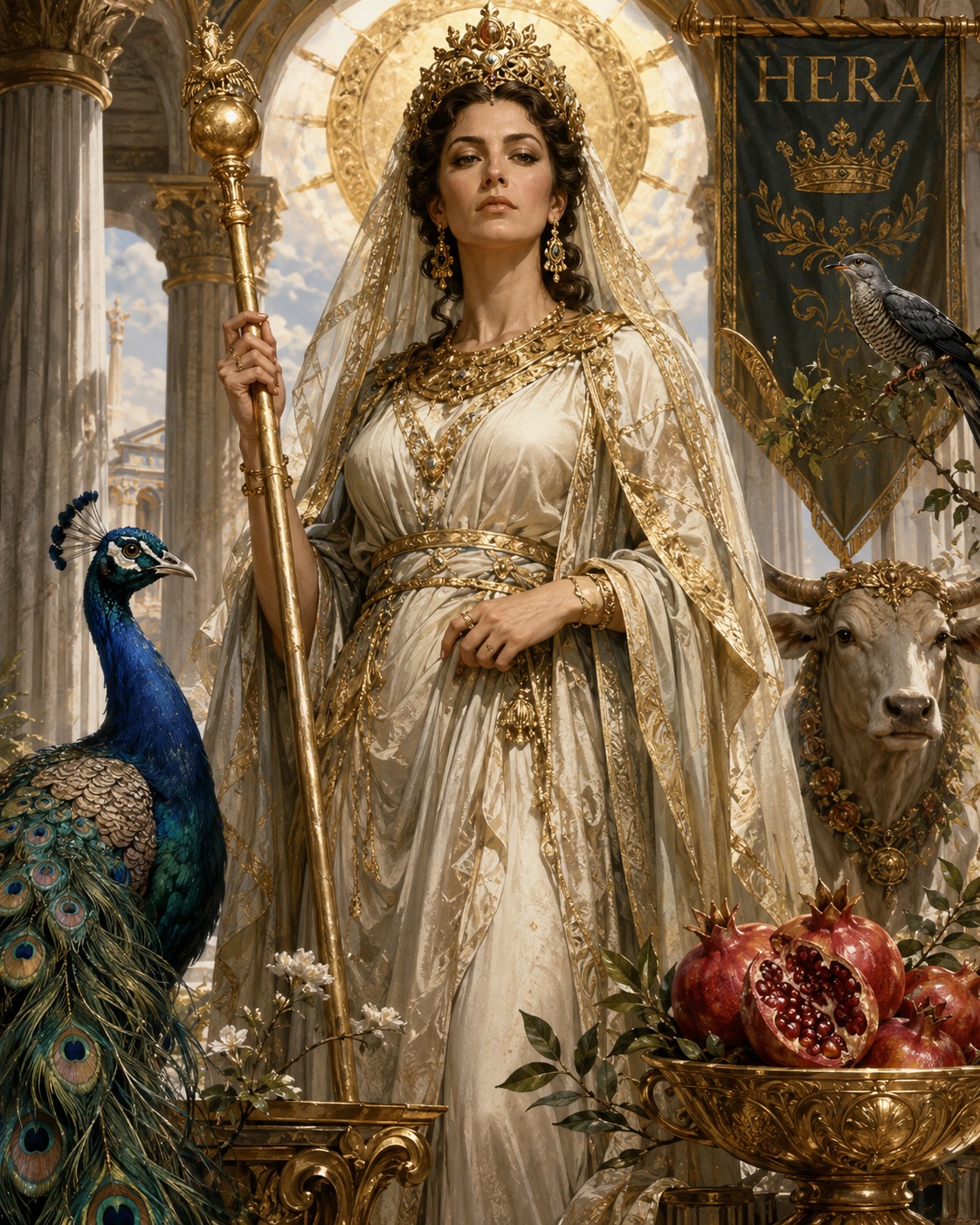
Hera
Hera · Queen of Olympus — Goddess of Marriage
Names in Other Languages
 헤라한국어
헤라한국어Hera · 결혼·여왕의 신 — 올림포스 여왕
 ヘラ日本語
ヘラ日本語Hera · オリンポスの女王 — 結婚の女神
 赫拉繁體中文
Hera · 奧林匹斯女王 — 婚姻女神
 HeraDeutsch
Hera · Königin des Olymp — Göttin der Ehe
 HéraFrançais
Héra · Reine de l'Olympe — Déesse du mariage
 HeraEspañol
Hera · Reina del Olimpo — Diosa del matrimonio
 HeraPortuguês
Hera · Rainha do Olimpo — Deusa do casamento
 HeraPolski
Hera · Królowa Olimpu — Bogini małżeństwa
 ГераРусский
Hera · Царица Олимпа — Богиня брака
Hera (Ancient Greek Hera, Latin Juno) is the decisive canonical goddess of marriage, childbirth, women, sovereignty, and the family among the 12 Olympian gods of Greek mythology, the queen of Olympus, and the decisive canonical iconographic figure as the daughter of Kronos (Kronos) and Rhea (Rhea), the elder sister and legitimate wife of Zeus (Zeus). The etymology Greek Hera is the decisive canonical vocabulary meaning 'lady' or 'season' (hora), and the aliases Teleia (Teleia, 'fulfilled' or 'of marriage'), Basileia (Basileia, 'queen'), Parthenos (Parthenos, 'virgin'), Aigiochos (Aigiochos), and Boopis (Boopis, 'ox-eyed') are the decisive canonical vocabulary. The decisive textual canon is the Theogony (Theogony) lines 453-491 of Hesiod (Hesiod) of c. 8th-7th century BCE — the decisive canon in which Kronos swallows his children — and lines 921-923 — the decisive canon of the birth of Hebe (Hebe), Ares (Ares), and Eileithyia (Eileithyia), children of Zeus and Hera — and the Iliad (Iliad) Book 14 lines 292-353 of Homer (Homer) of c. 8th century BCE — the decisive canon of Hera seducing Zeus — and Book 1 lines 518-611 — the decisive heroic-epic canon of the quarrel between Hera and Zeus.
Origin
The iconographic origin is the Bronze Age Mycenaean civilisation (c. 1600-1100 BCE) Mycenaean Linear B clay tablet inscription 'e-ra' (Hera) — the decisive origin canon, and the decisive textual canon is the Theogony (Theogony) lines 453-491 of Hesiod (Hesiod) of c. 8th-7th century BCE — the decisive canon in which Kronos (Kronos) swallows his children — and lines 921-923 — the decisive canon of the birth of Hebe (Hebe, youth), Ares (Ares, war), and Eileithyia (Eileithyia, childbirth), children of Zeus (Zeus) and Hera (Hera). The Iliad (Iliad) Book 1 lines 518-611 of Homer (Homer) of c. 8th century BCE — the decisive canon of the quarrel between Hera and Zeus — and Book 14 lines 292-353 — the decisive canon in which Hera, borrowing the kestos himas (kestos himas, girdle of love) of Aphrodite (Aphrodite), seduced Zeus on Mount Ida (Mt. Ida) and put him to sleep to help the Greeks in the Trojan War. The Bibliotheca (Bibliotheke) Book 2 chapter 5 of Pseudo-Apollodorus of c. 1st century BCE — the decisive canon of the 12 Labours of Heracles (Heracles) — is the decisive canon of Hera's persecution of her legitimate son Heracles, and the Metamorphoses (Metamorphoses) Book 1 lines 583-746 of Ovid (Publius Ovidius Naso) of c. 1st century CE — the decisive canon in which Hera transformed Io (Io) into a white cow and had the 100-eyed giant Argus (Argus) watch her.
Features
- Mature dignified goddess wearing a crown
- Peacock, cow, cuckoo, and pomegranate symbols
- Sceptre and veil
- 100-eyed giant Argus (Argus) — after his death the 100 eyes are placed on the peacock's tail
- Commands the rainbow messenger goddess Iris (Iris)
- Marriage blessed by the golden apples of the Garden of the Hesperides
Stories
The Bronze Age Mycenaean 'e-ra' (Hera) inscription is the decisive origin, and the decisive textual canon is Hesiod Theogony lines 453-491 and 921-923 of c. 8th-7th century BCE and Homer Iliad Book 1 lines 518-611 and Book 14 lines 292-353 of c. 8th century BCE — the decisive canon. The Homeric Hymns (Homeric Hymns) No. 12 Hymn to Hera of c. 7th-6th century BCE and the Bibliotheca Book 2 chapter 5 of Pseudo-Apollodorus of c. 1st century BCE — the decisive canon of the 12 Labours of Heracles — is the decisive canon. The decisive religious and art canon is the Heraion of Samos (Heraion of Samos) — the decisive religious canon of c. 8th century BCE on the island of Samos — about 53m long, the first Doric-style temple of Greece — and the Heraion of Argos (Heraion of Argos) of c. 460-450 BCE in the Peloponnese — Argos (Argos) — the chryselephantine Hera colossal statue of about 8m by Polyclitus (Polyclitus) — is the decisive art canon. The Hera Farnese (Hera Farnese), Hera Barberini, and Hera of Villa Albani — various Hera models of c. 4th century BCE Greek sculpture — are the decisive art canon, and the Metamorphoses (Metamorphoses) Book 1 lines 583-746 of Ovid (Publius Ovidius Naso) of c. 1st century CE — the Io and Argus canon — is the decisive Latin canon. The Hera (positive mother) of the Disney film Hercules (Hercules) released in the USA on 27 June 1997 and the golden armour of Hera of the Warner Bros. film Wonder Woman (Wonder Woman) released in the USA on 2 June 2017 are the 21st-century decisive film canon.
Weakness
Hera's weaknesses are: (1) jealousy at Zeus's infidelities — the decisive canonical weakness in the c. 1st-century-CE Ovid Metamorphoses Book 1 lines 583-746 — the decisive canon in which Hera transformed Zeus's mistress Io (Io) into a white cow and had the 100-eyed giant Argus (Argus) watch her — and Book 3 lines 1-137 — the decisive canon in which she killed Semele (Semele) with the truth of the oracle; (2) persecution of Heracles — the decisive canon of the 12 Labours of the c. 1st-century-BCE Pseudo-Apollodorus Bibliotheca Book 2 chapter 5 — the decisive canon of the persecution of her legitimate son Heracles; (3) expulsion of Hephaistos (Hephaistos) — Homer Iliad Book 18 — the decisive canon in which Hera threw her own son Hephaistos from Olympus for being ugly; (4) hatred of Troy — the decisive canon in the c. 7th-century-BCE Cypria (Cypria) and the Homer Iliad Book 24 Judgement of Paris (Judgement of Paris) in which Paris chose Aphrodite instead of Hera and Athena, and Hera hated Troy to the end; (5) Zeus's authority — Hera is under Zeus's authority — the decisive canon; (6) binding of marriage — the decisive canon of Hera as the goddess of marriage; (7) binding of the sacred domain — the decisive canon; (8) binding of Samos and Argos — the decisive canon. The decisive canonical finale is the decisive mythological canon of the 12 Labours of Heracles of the c. 1st-century-BCE Pseudo-Apollodorus Bibliotheca Book 2 chapter 5.
Cultural Significance
Hera is not merely a marriage-goddess icon but the canonical iconographic figure of the decisive Greek-Roman canon, traversing the Bronze Age Mycenaean 'e-ra' inscription, the c. 8th-7th-century-BCE Hesiod Theogony, the c. 8th-century-BCE Homer Iliad, the c. 7th-6th-century-BCE Homeric Hymns No. 12, the c. 8th-century-BCE Heraion of Samos, the c. 460-450 BCE Heraion of Argos, the c. 4th-century-BCE Greek sculpture Hera Farnese, the c. 1st-century-BCE Pseudo-Apollodorus Bibliotheca, the c. 1st-century-CE Ovid Metamorphoses, and the 1997 Disney Hercules. The Bronze Age Mycenaean civilisation (c. 1600-1100 BCE) Mycenaean Linear B clay tablet inscription 'e-ra' (Hera) is the decisive origin, and the decisive mythological canon is the c. 8th-7th-century-BCE Hesiod Theogony lines 453-491 — the decisive canon in which Kronos swallows his children — and lines 921-923 — the decisive canon of the birth of Hebe (youth), Ares (war), and Eileithyia (childbirth), children of Zeus and Hera. The c. 8th-century-BCE Homer Iliad Book 1 lines 518-611 — the decisive canon of the quarrel between Hera and Zeus — and Book 14 lines 292-353 — the decisive canon in which Hera, borrowing Aphrodite's kestos himas (girdle of love), seduced Zeus on Mount Ida and put him to sleep — and the c. 1st-century-BCE Pseudo-Apollodorus (Pseudo-Apollodorus) Bibliotheca Book 2 chapter 5 — the decisive canon of the 12 Labours of Heracles — is the decisive canon of Hera's persecution. The decisive religious canon is the Heraion of Samos (Heraion of Samos) — about 53m long, the first Doric-style temple of Greece — of c. 8th century BCE on the island of Samos — and the Heraion of Argos (Heraion of Argos) of c. 460-450 BCE in the Peloponnese — Argos — the chryselephantine Hera colossal statue of about 8m by Polyclitus (Polyclitus) — is the decisive art canon. The decisive 21st-century canon is the Hera (positive mother) of the Disney film Hercules (Hercules) (directed by John Musker and Ron Clements) released in the USA on 27 June 1997, and the Hera of Rick Riordan Percy Jackson & the Olympians published in the USA on 1 February 2010 is the 21st-century decisive young-adult novel and film canon.
In Popular Culture
- Mycenaean Linear B 'e-ra' (Bronze Age) — decisive origin canon
- Hesiod Theogony lines 453-491 and 921-923 (c. 8th-7th century BCE) — decisive birth canon
- Homer Iliad Books 1 and 14 (c. 8th century BCE) — decisive heroic-epic canon
- Homeric Hymns No. 12 Hymn to Hera (c. 7th-6th century BCE) — decisive religious canon
- Heraion of Samos (c. 8th century BCE) — decisive religious canon
- Heraion of Argos Polyclitus chryselephantine Hera (c. 460-450 BCE) — decisive art canon
- Greek sculpture Hera Farnese (c. 4th century BCE) — decisive art canon
- Pseudo-Apollodorus Bibliotheca Book 2 chapter 5 12 Labours of Heracles (c. 1st century BCE) — decisive persecution canon
- Ovid Metamorphoses Book 1 Io, Argus (c. 1st century CE) — decisive Latin canon
- Disney film Hercules, Hera (1997) — decisive 21st-century film canon
Trivia
The etymology Greek Hera is the decisive canonical vocabulary meaning 'lady' or 'season' (hora), and the aliases Teleia (Teleia, 'fulfilled' or 'of marriage'), Basileia (Basileia, 'queen'), Parthenos (Parthenos, 'virgin'), Aigiochos (Aigiochos), Boopis (Boopis, 'ox-eyed'), Argeia (Argeia, 'of Argos'), and Samia (Samia, 'of Samos') are the decisive canonical vocabulary. The decisive textual canon is the Theogony (Theogony) lines 453-491 of Hesiod (Hesiod) of c. 8th-7th century BCE — the decisive canon in which Kronos (Kronos), fearing the prophecy of Gaia (Gaia) and Ouranos (Ouranos), swallows his children — and lines 921-923 — the decisive canon of the birth of Hebe (Hebe, youth), Ares (Ares, war), and Eileithyia (Eileithyia, childbirth), children of Zeus (Zeus) and Hera (Hera). The c. 8th-century-BCE Homer (Homer) Iliad (Iliad) Book 14 lines 292-353 — the decisive canon in which Hera, borrowing Aphrodite's (Aphrodite) kestos himas (kestos himas, girdle of love), seduced Zeus on Mount Ida (Mt. Ida) to help the Greeks in the Trojan War and put him to sleep — and Book 1 lines 518-611 — the decisive canon in which Hera suspected Zeus's plot and Hephaistos defended his mother. The c. 1st-century-BCE Pseudo-Apollodorus (Pseudo-Apollodorus) Bibliotheca (Bibliotheke) Book 2 chapter 5 — the decisive canon of the 12 Labours of Heracles (Heracles, 'glory of Hera') as a result of Hera's persecution — and the c. 1st-century-CE Ovid Metamorphoses Book 1 lines 583-746 — the decisive canon in which Hera transformed Io (Io) into a white cow and had the 100-eyed giant Argus (Argus) watch her, but Hermes killed Argus, and after his death the 100 eyes were placed on the peacock's tail. The Hera (positive mother) of the Disney film Hercules (Hercules) released in the USA on 27 June 1997 is the 21st-century decisive global canon.