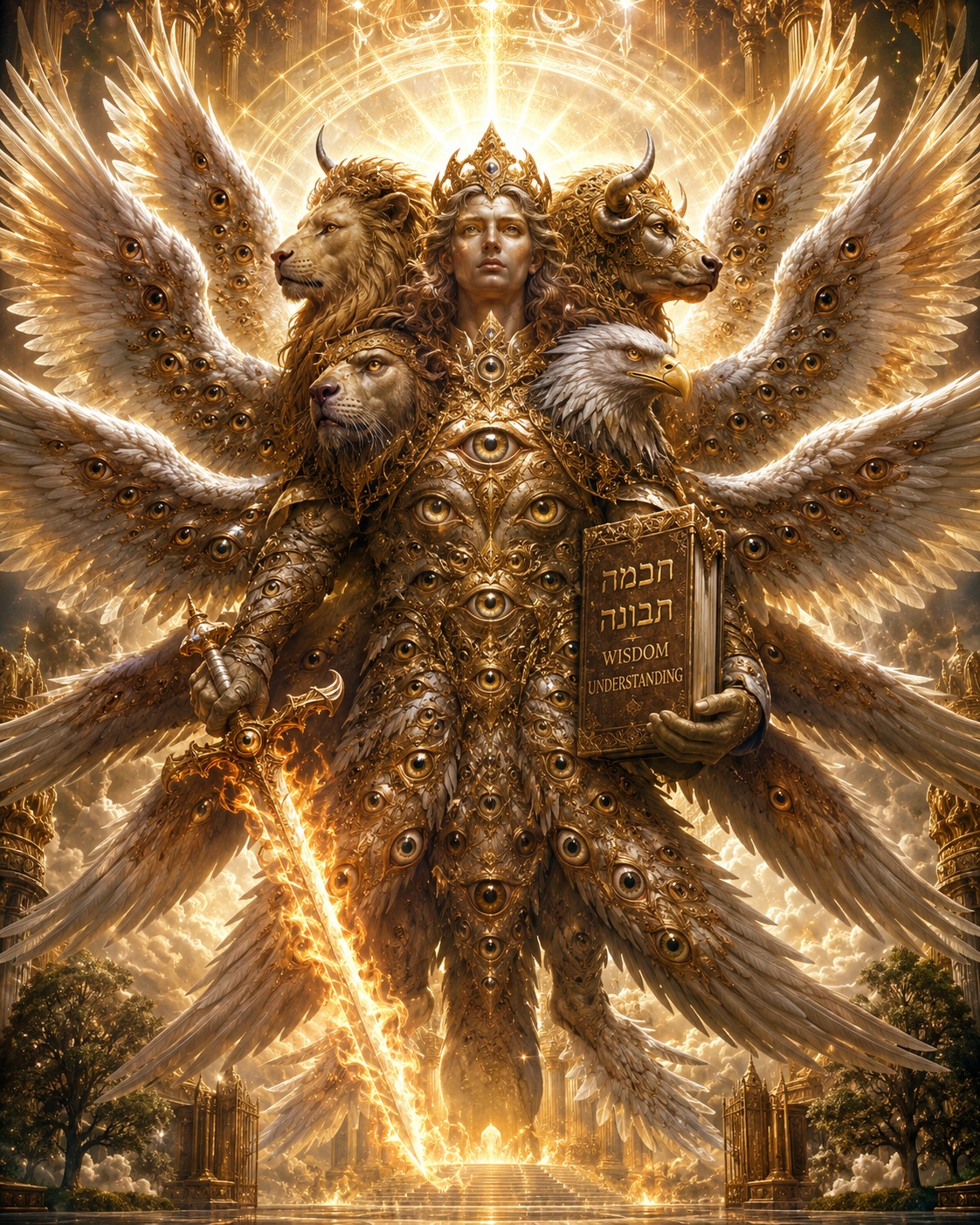
Cherubim
Cherubim · Second of the Nine Angelic Choirs — Guardians of Divine Wisdom and the Throne
Names in Other Languages
 케루빔한국어
Cherubim· 천사 9계급 제2위 신의 지혜와 보좌의 수호자
 ケルビム日本語
Cherubim· 天使九階級第二位 神の知恵と御座の守護者
 智天使繁體中文
Cherubim· 天使九階級第二位 神之智慧與寶座之守護者
 CherubimDeutsch
Cherubim · Zweiter der neun Engelchöre — Hüter göttlicher Weisheit und des Thrones
 ChérubinsFrançais
Chérubins · Deuxième des neuf chœurs angéliques — Gardiens de la sagesse divine et du trône
 QuerubinesEspañol
Querubines · Segundo de los nueve coros angélicos — Guardianes de la sabiduría divina y del trono
 QuerubinsPortuguês
Querubins · Segundo dos nove coros angélicos — Guardiões da sabedoria divina e do trono
 CherubiniPolski
Cherubini · Drugi z dziewięciu chórów anielskich — Strażnicy boskiej mądrości i tronu
 ХерувимыРусский
Cherubim · Второй из девяти ангельских чинов — Стражи Божественной мудрости и престола
Cherubim (Hebrew kerubim, singular kerub, Greek cheroubin, Latin cherubim) is the 2nd-rank angel after Seraphim (Seraphim) of the 9 ranks of Jewish-Christian angelology — the decisive canon, the decisive canonical iconographic figure who supports the throne of God and transmits divine wisdom. The etymology is the decisive canonical vocabulary derived from the Akkadian karibu (intercessor) or Aramaic kerub (close), and the influence of the composite iconography of the Assyrian lamassu (lamassu) and shedu (shedu) of bull, human, and eagle is the decisive canon. The decisive textual canon is the Genesis (Bereshit) chapter 3 verse 24 of c. 6th century BCE — the decisive canon of 'the cherubim and the flaming sword that turned every way (lahat ha-herev ha-mithapeketh)' that guarded the way to the Garden of Eden — and Exodus (Shemot) chapter 25 verses 18-22 and chapter 26 verse 31 — the decisive canon of the two gold cherubim on the mercy seat (kapporet) of the Ark of the Covenant (Ark of the Covenant) — and 1 Kings chapter 6 verses 23-28 — the decisive canon of the 10-cubit (about 4.5 m) cherubim of Solomon's temple. The Ezekiel (Yehezkel) chapter 1 verses 5-14 of 593-571 BCE — the decisive canon of the 'four living creatures (chayot, faces of human, lion, ox, and eagle, four wings)' — and chapter 10 — the decisive canon of the cherubim and wheels (ophanim) — and the Pseudo-Dionysius the Areopagite (Pseudo-Dionysius the Areopagite)'s Celestial Hierarchy (De Coelesti Hierarchia) chapter 7 of c. 5th-6th century CE — the decisive canon as the 2nd rank of the 9 ranks.
Origin
The iconographic origin is the lamassu (lamassu) and shedu (shedu) at the entrance of Assyrian palaces of c. 9th-7th century BCE — composite guardians with the body of a bull or lion, the face of a human, and the wings of an eagle — the decisive origin canon, and the decisive textual canon is the Genesis (Bereshit) chapter 3 verse 24 of c. 6th century BCE — the decisive canon of the cherubim and the flaming sword that turned every way (lahat ha-herev ha-mithapeketh) that guarded the eastern way to the Garden of Eden after the expulsion of Adam and Eve — and Exodus (Shemot) chapter 25 verses 18-22 — the decisive canon of the two gold cherubim on the mercy seat (kapporet) of the Ark of the Covenant (Ark of the Covenant). 1 Kings chapter 6 verses 23-28 — the decisive canon of the 10-cubit (about 4.5 m) olive wood cherubim of the inner sanctuary of Solomon's temple — and 2 Samuel chapter 22 verse 11 and Psalm 18 verse 10 — the decisive canon in which Yahweh 'rides upon a cherub and flies'. The decisive canon of the 'four living creatures (chayot)' vision of the prophet Ezekiel (Yehezkel) of 593-571 BCE by the river Chebar in Babylon — Ezekiel chapter 1 verses 5-14 — the appearance of a man, 4 faces (human, lion, ox, eagle), 4 wings — and chapter 10 verses 1-22 — the decisive canon of the cherubim and wheels (ophanim). Chapter 28 verses 14-16 — the decisive canon of the 'anointed cherub that covereth (anointed cherub that covereth)' of the king of Tyre (Tyre).
Features
- 4 faces human, lion, ox, and eagle (Ezekiel)
- 4 or 6 pairs of wings and body full of eyes
- The flaming sword of Eden that turns every way (lahat ha-herev ha-mithapeketh)
- A pair of gold statues on the mercy seat of the Ark of the Covenant
- Carriers of the throne of Yahweh (Merkabah)
- 2nd rank of the 9 ranks of angels (Pseudo-Dionysius)
Stories
The influence of the Assyrian lamassu (lamassu) and shedu (shedu) of c. 9th-7th century BCE is the decisive origin, and the decisive textual canon is Genesis chapter 3 verse 24 of c. 6th century BCE Garden of Eden flaming sword, Exodus chapter 25 verses 18-22 two cherubim on the Ark of the Covenant, 1 Kings chapter 6 verses 23-28 Solomon's temple, and Ezekiel chapter 1 verses 5-14, chapter 10 verses 1-22, and chapter 28 verses 14-16 of 593-571 BCE. The Pseudo-Dionysius the Areopagite Celestial Hierarchy (Celestial Hierarchy) chapter 7 of c. 5th-6th century CE — the decisive canon as the 2nd rank of the 9 ranks — and Thomas Aquinas's Summa Theologica (Summa Theologica) Part 1 Question 108 Article 5 of 1273 — the decisive scholastic theological canon. The decisive canon called upon in meditation seeking divine wisdom, and the decisive canon as a spiritual symbol guarding the entrances of sanctuaries and temples. The decisive canon transformed into the putto (putto, baby angel) iconography of the Renaissance — the two putti of Raphael (Raffaello Sanzio)'s Sistine Madonna (Sistine Madonna) of 1513-1514 is the decisive Renaissance art canon — but in orthodox theology, it is treated as the dignified throne angel — the decisive canon. The 'cherubic legions (cherubic legions)' of John Milton (John Milton)'s Paradise Lost (Paradise Lost) Book 4 line 778 of 1667 is the decisive English-literature canon, and the Cherub (Cherub) of the 1977 USA TSR D&D Monster Manual (Monster Manual) is the decisive fantasy RPG canon.
Weakness
Cherubim's weaknesses are: (1) duty of the throne — the decisive canonical weakness — the decisive canon that the duty to support the throne of God is absolute, so free will is limited; (2) degradation to putto — the decisive canonical weakness — the decisive canon that they were degraded to the putto (putto, baby angel) in Renaissance art, and the original dignity was forgotten by the public; (3) fall of the king of Tyre — the decisive canon of the 593-571 BCE Ezekiel chapter 28 verses 14-16 'anointed cherub that covereth' compared to the king of Tyre, who fell by pride and was cast out of the mountain of God — the decisive canon as the model of the later fall of Satan (Lucifer); (4) binding of the flaming sword — the decisive canon of guarding only the way of Eden; (5) binding of the hierarchy — the decisive canon of the 2nd rank of the 9 ranks of Pseudo-Dionysius; (6) binding of the vision — the decisive canon of being bound by Ezekiel's vision; (7) binding of the sacred domain — the decisive canon; (8) binding of the carrier of the throne — the decisive canon of the Merkabah (Merkabah). The decisive canonical finale is the decisive mythological canon of the 593-571 BCE Ezekiel chapter 28 verses 14-16 — the 'anointed cherub that covereth' was cast out of the mountain of God by pride.
Cultural Significance
Cherubim is not merely a baby-angel icon but the canonical iconographic figure of the decisive Judeo-Christian canon, traversing the c. 9th-7th century BCE Assyrian lamassu-shedu influence, the c. 6th century BCE Genesis chapter 3 verse 24, Exodus chapter 25 verses 18-22, 1 Kings chapter 6 verses 23-28, the 593-571 BCE Ezekiel chapter 1 verses 5-14, chapter 10 verses 1-22, chapter 28 verses 14-16, the c. 5th-6th century CE Pseudo-Dionysius Celestial Hierarchy chapter 7, the 1273 Thomas Aquinas Summa Theologica Part 1 Question 108 Article 5, the 1513-1514 Raphael Sistine Madonna, the 1667 John Milton Paradise Lost Book 4 line 778, and the 1977 TSR D&D Monster Manual. The iconographic origin is the lamassu (lamassu) and shedu (shedu) at the entrance of Assyrian palaces of c. 9th-7th century BCE — composite guardians with the body of a bull or lion, the face of a human, and the wings of an eagle — settled as the decisive canon in Genesis chapter 3 verse 24 of c. 6th century BCE — the decisive canon of the cherubim and the flaming sword that turned every way that guarded the way to the Garden of Eden. The decisive vision canon is the decisive canon of the 'four living creatures (chayot)' vision of the prophet Ezekiel (Yehezkel) of 593-571 BCE by the river Chebar in Babylon — Ezekiel chapter 1 verses 5-14 — the appearance of a man, 4 faces (human, lion, ox, eagle), 4 wings — and chapter 10 verses 1-22 — the decisive canon of the cherubim and wheels (ophanim), and the iconography of the 4 faces became the prototype of the decisive canon of the symbols of the 4 Gospels (Matthew=human, Mark=lion, Luke=ox, John=eagle). The decisive art canon is the two putti (putto) of the Sistine Madonna (Sistine Madonna) of 1513-1514 by Italian Raphael Sanzio (Raffaello Sanzio, 1483-1520) — about 265x196 cm — Dresden Gemaeldegalerie Alte Meister — the decisive Renaissance art canon, and the Cherubim of the 1977 USA TSR D&D Monster Manual is the decisive fantasy RPG canon. The decisive 21st-century canon is the Cherubim iconography of the film Noah (Noah) (directed by Darren Aronofsky, Paramount) released in the USA on 28 February 2014 — and the Cherubim of the D&D 5th Edition Monster Manual — the 21st-century decisive video canon.
In Popular Culture
- Assyrian lamassu and shedu (c. 9th-7th century BCE) — decisive origin canon
- Genesis chapter 3 verse 24 Garden of Eden flaming sword (c. 6th century BCE) — decisive origin canon
- Exodus chapter 25 verses 18-22 Ark of the Covenant two cherubim (c. 6th century BCE) — decisive religious canon
- 1 Kings chapter 6 verses 23-28 Solomon's temple 10-cubit cherubim (c. 6th century BCE) — decisive temple canon
- Ezekiel chapter 1 verses 5-14 four living creatures (chayot) (593-571 BCE) — decisive vision canon
- Ezekiel chapter 10 verses 1-22 cherubim and wheels (ophanim) (593-571 BCE) — decisive vision canon
- Ezekiel chapter 28 verses 14-16 'anointed cherub that covereth' (593-571 BCE) — decisive Tyre canon
- Pseudo-Dionysius Celestial Hierarchy chapter 7 (c. 5th-6th century CE) — decisive theological canon
- Thomas Aquinas Summa Theologica Part 1 Question 108 Article 5 (1273) — decisive scholastic theological canon
- Raphael Sistine Madonna (1513-1514) — decisive Renaissance art canon
- John Milton Paradise Lost Book 4 line 778 (1667) — decisive English-literature canon
- TSR D&D Monster Manual, Cherub (1977) — decisive fantasy RPG canon
Trivia
The etymology of Cherubim (Hebrew kerubim, singular kerub) is the decisive canonical vocabulary derived from the Akkadian karibu (karabu, 'intercessor' or 'one who blesses') or Aramaic kerub (close), and the Greek cheroubin and Latin cherubim are the decisive canonical vocabulary. The iconographic origin is the lamassu (lamassu) and shedu (shedu) at the entrance of Assyrian palaces of c. 9th-7th century BCE — composite guardians with the body of a bull or lion, the face of a human, and the wings of an eagle — the decisive origin canon. The decisive textual canon is the Genesis (Bereshit) chapter 3 verse 24 of c. 6th century BCE — the decisive canon of the cherubim and the flaming sword that turned every way (lahat ha-herev ha-mithapeketh) that guarded the eastern way to the Garden of Eden after the expulsion of Adam and Eve — and Exodus (Shemot) chapter 25 verses 18-22 — the decisive canon of the two gold cherubim on the mercy seat (kapporet) of the Ark of the Covenant (Ark of the Covenant) — and chapter 26 verse 31 — the decisive canon of the cherubim on the veil of the tabernacle — and 1 Kings chapter 6 verses 23-28 — the decisive canon of the 10-cubit (about 4.5 m) olive wood cherubim of the inner sanctuary of Solomon's temple. The decisive canon of the 'four living creatures (chayot)' vision of the prophet Ezekiel (Yehezkel) of 593-571 BCE by the river Chebar in Babylon — Ezekiel chapter 1 verses 5-14 — the appearance of a man, 4 faces (human, lion, ox, eagle), 4 wings — and chapter 10 verses 1-22 — the decisive canon of the cherubim and wheels (ophanim), and chapter 28 verses 14-16 — the decisive canon of the 'anointed cherub that covereth' of the king of Tyre (Tyre) being cast out of the mountain of God by pride — the decisive canon as the model of the later fall of Satan (Lucifer). The Pseudo-Dionysius the Areopagite (Pseudo-Dionysius the Areopagite)'s Celestial Hierarchy (De Coelesti Hierarchia) chapter 7 of c. 5th-6th century CE — the decisive canon as the 2nd rank after Seraphim of the 9 ranks — and Thomas Aquinas (Thomas Aquinas, 1225-1274)'s Summa Theologica (Summa Theologica) Part 1 Question 108 Article 5 of 1273 — the decisive scholastic theological canon. The two putti (putto) of the Sistine Madonna (Sistine Madonna) of 1513-1514 by Italian Raphael Sanzio (Raffaello Sanzio, born 6 April 1483 in Urbino, died 6 April 1520 in Rome) — about 265x196 cm — Dresden Gemaeldegalerie Alte Meister — is the decisive Renaissance art canon, and the Cherub (Cherub) of the 1977 USA TSR D&D Monster Manual (Monster Manual) is the decisive fantasy RPG canon.