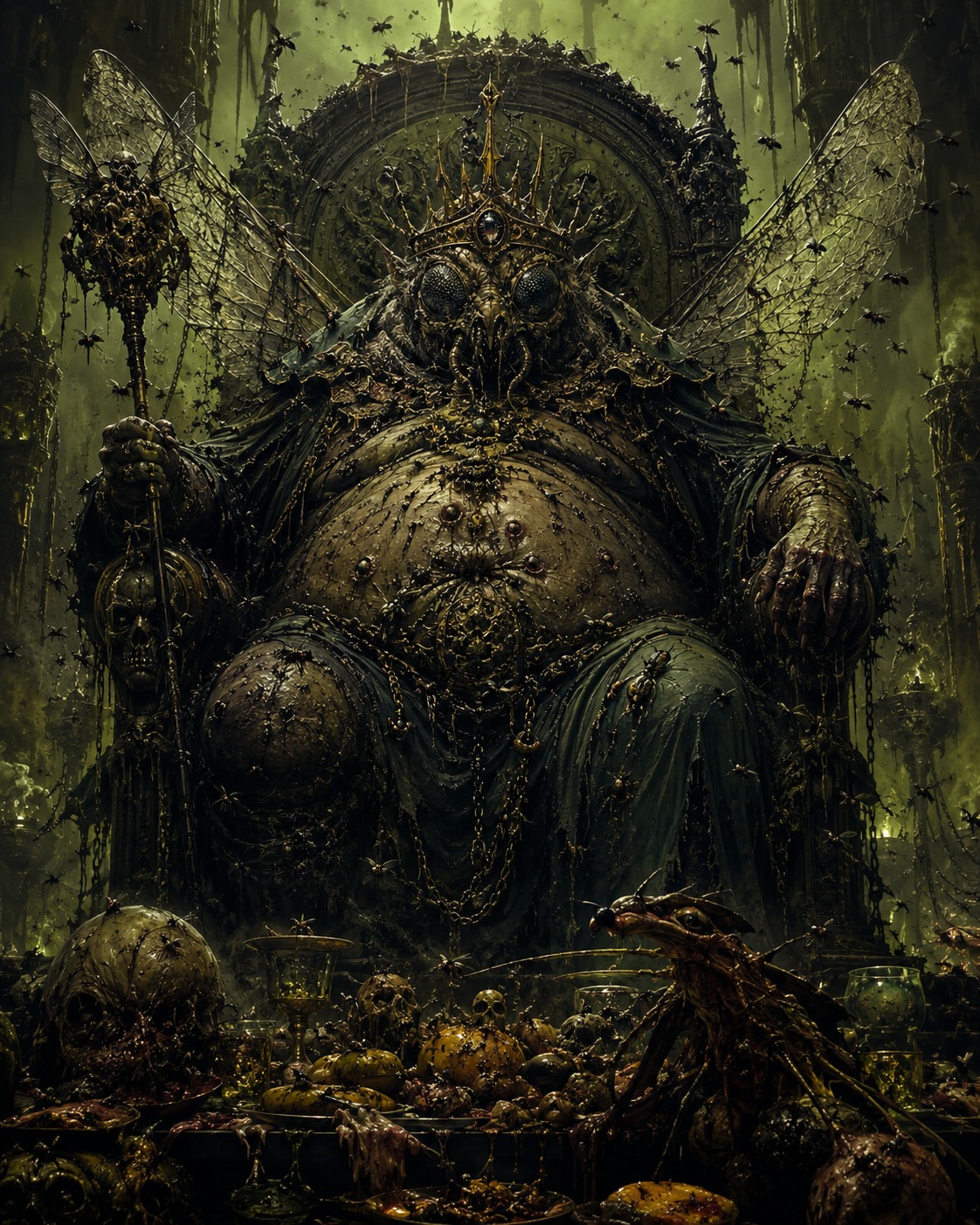
Beelzebub
Beelzebub · Lord of the Flies — Prince of Gluttony
Names in Other Languages
 베엘제붑한국어
Beelzebub · 파리들의 왕 — 폭식의 대공
 ベルゼブブ日本語
Beelzebub · 蝿の王 — 暴食の大公
 別西卜繁體中文
Beelzebub · 蒼蠅之王 — 暴食大公
 BeelzebubDeutsch
Beelzebub · Herr der Fliegen — Fürst der Völlerei
 BelzébuthFrançais
Belzébuth · Seigneur des Mouches — Prince de la gourmandise
 BelcebúEspañol
Belcebú · Señor de las Moscas — Príncipe de la gula
 BelzebuPortuguês
Belzebu · Senhor das Moscas — Príncipe da gula
 BelzebubPolski
Belzebub · Pan Much — Książę obżarstwa
 ВельзевулРусский
Beelzebub · Повелитель мух — Князь чревоугодия
Beelzebub (Hebrew Baʿal-Zəvuv, Greek Beelzeboul, Latin Beelzebub) is the great demon of the Judeo-Christian tradition — the decisive canon — derived from the Hebrew Baal-zebub meaning 'Lord of the Flies' — the decisive canonical iconographic figure originating in the city of Ekron of Philistia where the god 'Baal-Zebul (Baal-Zebul, prince Baal)' was worshipped, with Jews scornfully changing the name to 'Lord of the Flies (zebub = fly)'. Aliases — Beelzeboul, Lord of the Flies, prince of devils, and Archduke of 'Gluttony (Gula, Gluttony)' among the Seven Deadly Sins — are the decisive canonical vocabulary. The decisive textual canon is the decisive origin canon of 2 Kings 1:2-16 of c. 6th-4th century BCE in which the king of Israel Ahaziah (Ahaziah) fell ill and sent messengers to consult Beelzebub of Ekron, only to be rebuked by Elijah (Elijah), and the decisive canon of Matthew (Matthew) 12:24-27, Luke (Luke) 11:15-19, and Mark (Mark) 3:22 of the 1st century CE in which the Pharisees slandered Christ by saying 'he casts out demons by Beelzebub, the prince of demons'. The decisive 17th-century English-literary canon of John Milton's (John Milton) Paradise Lost (Paradise Lost) Book 1 lines 78-81 of 1667 — the fallen angel next to Lucifer — and the decisive 20th-century English-literary canon of William Golding's (William Golding) novel Lord of the Flies (Lord of the Flies) of 1954.
Origin
The etymological origin is the decisive origin canon of the Hebrew Baal-zebub — 'Lord of the Flies' — the decisive canon of the Canaanite god 'Baal-Zebul (Baal-Zebul, prince Baal)' originally worshipped in the city of Ekron (Ekron, present-day Tel Miqne in Israel) of Philistia. The decisive canon in which Jews scornfully changed the name of this pagan god from 'Zebul (princely)' to 'Zebub (fly)', and the decisive textual canon is the decisive origin canon of 2 Kings 1:2-16 of c. 6th-4th century BCE in which the king of Israel Ahaziah (Ahaziah) fell from the lattice of his upper chamber and became ill, sent messengers to consult Beelzebub (Baal-zebub) of Ekron about whether he would recover, was rebuked by an angel of YHWH and Elijah (Elijah), and died. The decisive New Testament canon is the decisive canon of Matthew (Matthew) 12:24-27, Luke (Luke) 11:15-19, and Mark (Mark) 3:22 of the 1st century CE in which the Pharisees slandered Christ by saying 'he casts out demons by Beelzebub, the prince of demons', and Christ refuted them saying 'If Satan cast out Satan, he is divided against himself; how shall then his kingdom stand?' — the decisive canon in which Beelzebub was established as the 'prince of demons' in the New Testament. The decisive canon of the Testament of Solomon (Testament of Solomon) of the 1st-3rd century CE in which Beelzeboul claimed to be the chief of all demons.
Features
- Giant fly form or giant surrounded by flies
- Crowned figure on a throne — 'Lord of the Flies'
- Followed by rotten food and the stench of decay
- Hand that spreads disease and plague
- Main axis — Archduke of 'Gluttony (Gluttony)' among the Seven Deadly Sins
- New Testament — 'prince of devils'
Stories
Beelzebub of Ekron in 2 Kings 1:2-16 of c. 6th-4th century BCE is the decisive origin, and the decisive textual canon is Matthew 12:24-27, Luke 11:15-19, and Mark 3:22 of the 1st century CE, the Testament of Solomon of the 1st-3rd century CE, Peter Binsfeld's 'Seven Princes of Hell' of 1589, and Milton's Paradise Lost Book 1 lines 78-81 of 1667. The decisive canon called upon as a symbol of gluttony, decay, and plague, and the decisive canon of the demon associated with food addiction and compulsive eating behavior expelled in exorcism. The decisive 20th-century English-literary canon in which the title of William Golding's (William Golding) 1954 novel Lord of the Flies (Lord of the Flies) comes from his name, symbolizing the corruption of humanity that has lost control. The decisive grimoire canon of Beelzebub in The Magus of 1801 by the English Francis Barrett (Francis Barrett), and the decisive art canon of the Beelzebub iconography as a giant fly in the Dictionnaire Infernal (Dictionnaire Infernal) of 1818 by Collin de Plancy (Collin de Plancy). The decisive 20th-century music canon of the lyric 'Beelzebub has a devil put aside for me' in 'Bohemian Rhapsody' by the English rock band Queen of 1975, and the decisive 21st-century canon is the decisive fantasy RPG canon of Beelzebub in the 1977 USA TSR Monster Manual, and the decisive global video canon of Beelzebub (depicted as Lucifer's brother) in the TV series Lucifer (Lucifer) Seasons 5-6 by USA Fox and Netflix from 2016 to 2021 — the 21st-century decisive global video canon.
Weakness
Beelzebub's weaknesses are: (1) god of filth and decay — the decisive canonical weakness — weak against rituals of purity and fasting; (2) God's name — the decisive canonical weakness — submits like all other demons before God's name and Christ's authority; (3) purified environment — the decisive canonical weakness — loses power in a purified environment; (4) rebuke by YHWH's angel and Elijah — the decisive canonical weakness — the decisive canon of 2 Kings 1 of c. 6th-4th century BCE in which Ahaziah died from the rebuke of YHWH's angel and Elijah; (5) Christ's refutation — the decisive canonical weakness — the decisive canon of Matthew 12:25-27 of the 1st century CE — 'If Satan cast out Satan, he is divided against himself' — Christ's refutation; (6) binding of the fly — the decisive canon of the giant fly form; (7) binding of the sacred domain — the decisive canon; (8) binding of the gluttony of the Seven Deadly Sins — the decisive canon. The decisive canonical finale is the decisive mythological canon of being depicted as the fallen angel next to Lucifer in Milton's Paradise Lost Book 1 lines 78-81 of 1667.
Cultural Significance
Beelzebub is not merely a gluttony-demon icon but the canonical iconographic figure of the decisive Judeo-Christian canon, traversing 2 Kings 1:2-16 of c. 6th-4th century BCE, Matthew 12:24-27, Luke 11:15-19, and Mark 3:22 of the 1st century CE, the Testament of Solomon of the 1st-3rd century CE, Peter Binsfeld's 'Seven Princes of Hell' of 1589, Milton's Paradise Lost Book 1 lines 78-81 of 1667, Collin de Plancy's Dictionnaire Infernal of 1818, William Golding's Lord of the Flies of 1954, Queen's 'Bohemian Rhapsody' of 1975, and Fox/Netflix Lucifer of 2016-2021. The etymological origin settled as the decisive origin canon in which Jews scornfully changed the name of the Canaanite god 'Baal-Zebul (princely Baal)' originally worshipped in the city of Ekron of Philistia, from 'Zebul (princely)' to 'Zebub (fly)'. The decisive mythological canon is the decisive origin canon of 2 Kings 1:2-16 of c. 6th-4th century BCE in which the king of Israel Ahaziah fell from the lattice of his upper chamber and became ill, sent messengers to consult Beelzebub of Ekron, was rebuked by an angel of YHWH and Elijah, and died, and the decisive canon of Matthew 12:24-27 of the 1st century CE in which the Pharisees slandered Christ by saying 'he casts out demons by Beelzebub, the prince of demons', and Christ refuted them saying 'If Satan cast out Satan, he is divided against himself' — the decisive canon. The decisive 17th-century English-literary canon is the decisive canon of the fallen angel next to Lucifer in Paradise Lost (Paradise Lost) Book 1 lines 78-81 of the English John Milton (John Milton, 1608-1674) of 1667 — 'one next himself in power, and next in crime, long after known in Palestine, and named Beelzebub' — depicted as Satan's lieutenant. The decisive 20th-century English-literary canon is the decisive canon in which the title of William Golding's (William Golding, 1911-1993, 1983 Nobel Prize in Literature) novel Lord of the Flies (Lord of the Flies) of 1954 comes from his name, symbolizing the corruption of humanity that has lost control. The decisive 21st-century canon is the decisive global video canon of Beelzebub (depicted as Lucifer's brother) in the TV series Lucifer (Lucifer) Seasons 5-6 (created by Tom Kapinos) by USA Fox (Fox) → Netflix from 25 January 2016 to 10 September 2021.
In Popular Culture
- 2 Kings 1:2-16 Beelzebub of Ekron (c. 6th-4th century BCE) — decisive origin canon
- Matthew 12:24-27, Luke 11:15-19, Mark 3:22 'prince of devils Beelzebub' (1st century CE) — decisive origin canon
- Testament of Solomon (1st-3rd century CE) — decisive apocryphal canon
- Peter Binsfeld 'Seven Princes of Hell' Beelzebub=Gluttony (1589) — decisive grimoire canon
- John Milton Paradise Lost Book 1 lines 78-81 (1667) — decisive 17th-century English-literary canon
- Francis Barrett The Magus (1801) — decisive grimoire canon
- Collin de Plancy Dictionnaire Infernal giant fly form (1818) — decisive art canon
- William Golding Lord of the Flies (1954) — decisive 20th-century English-literary canon
- Queen 'Bohemian Rhapsody' (1975) — decisive music canon
- TSR D&D Monster Manual (1977) — decisive fantasy RPG canon
- Fox/Netflix Lucifer Seasons 5-6 (2016-2021) — 21st-century decisive TV canon
Trivia
The etymology of Beelzebub (Hebrew Baʿal-Zəvuv) is the decisive canonical vocabulary of the Hebrew Baal-zebub — 'Lord of the Flies (Lord of the Flies)' — the decisive canonical vocabulary of the Canaanite god 'Baal-Zebul (Baal-Zebul, prince Baal)' originally worshipped in the city of Ekron (Ekron, present-day Tel Miqne in Israel) of Philistia, with Jews scornfully changing 'Zebul (princely)' to 'Zebub (fly)', and aliases Beelzeboul, Lord of the Flies (Lord of the Flies), prince of devils (prince of devils), and Archduke of 'Gluttony (Gula, Gluttony)' among the Seven Deadly Sins are the decisive canonical vocabulary. The decisive textual canon is the decisive origin canon of 2 Kings (2 Kings) 1:2-16 of c. 6th-4th century BCE in which the king of Israel Ahaziah (Ahaziah, 9th-century BCE figure) fell from the lattice of his upper chamber and became ill, sent messengers to consult Beelzebub of Ekron about whether he would recover, was rebuked by an angel of YHWH and Elijah (Elijah), and died. The decisive New Testament canon is the decisive canon of Matthew (Matthew) 12:24-27, Luke (Luke) 11:15-19, and Mark (Mark) 3:22 of the 1st century CE in which the Pharisees slandered Christ by saying 'he casts out demons by Beelzebub, the prince of demons', and Christ refuted them saying 'If Satan cast out Satan, he is divided against himself; how shall then his kingdom stand?'. The decisive canon of the Testament of Solomon (Testament of Solomon) of the 1st-3rd century CE in which Beelzeboul claimed to be the chief of all demons, and the decisive canon of the German Peter Binsfeld (Peter Binsfeld, 1545-1598)'s 'Seven Princes of Hell' of 1589 in which Beelzebub is assigned as the Archduke of 'Gluttony (Gula, Gluttony)'. The decisive 17th-century English-literary canon is the decisive canon of the fallen angel next to Lucifer in Paradise Lost (Paradise Lost) Book 1 lines 78-81 of the English John Milton (John Milton, born 9 December 1608 in London, died 8 November 1674 in London) of 1667 — 'one next himself in power, and next in crime, long after known in Palestine, and named Beelzebub' — and the decisive art canon of the Beelzebub iconography as a giant fly in the Dictionnaire Infernal (Dictionnaire Infernal) of 1818 by the French Collin de Plancy (Collin de Plancy, 1793-1881). The decisive 20th-century English-literary canon is the decisive canon in which the title of William Golding's (William Golding, born 19 September 1911 in Cornwall, England, died 19 June 1993 in Cornwall, England, 1983 Nobel Prize in Literature) novel Lord of the Flies (Lord of the Flies) of 1954 comes from his name, symbolizing the corruption of humanity that has lost control, and the decisive 20th-century music canon of the lyric 'Beelzebub has a devil put aside for me (Beelzebub has a devil put aside for me)' in 'Bohemian Rhapsody (Bohemian Rhapsody)' released on 31 October 1975 by the English rock band Queen (Queen). The decisive 21st-century canon is the Beelzebub (depicted as Lucifer's brother) in the TV series Lucifer (Lucifer) Seasons 5-6 by USA Fox and Netflix from 2016 to 2021 — the 21st-century decisive global video canon.