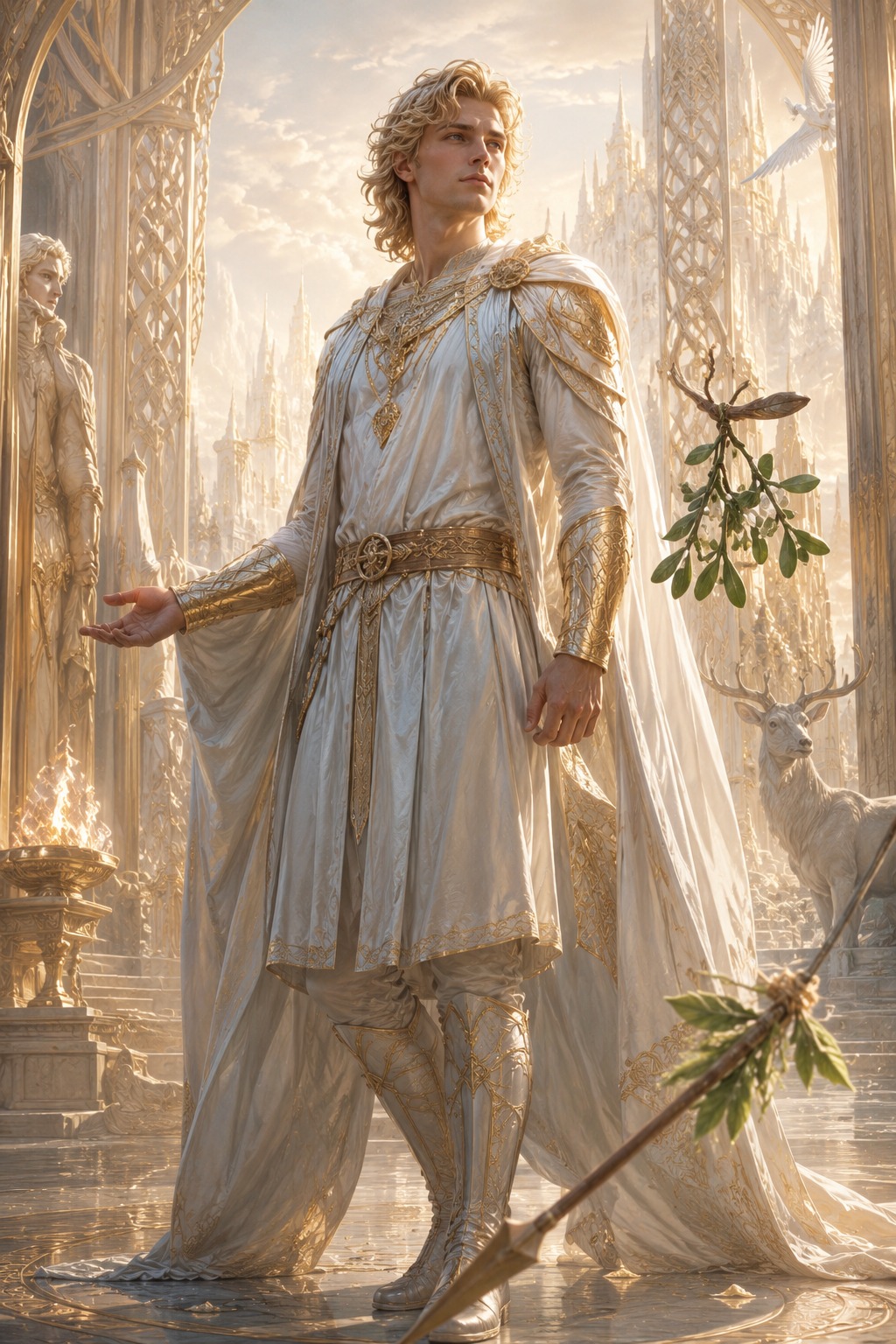
Baldr
Baldr · God of Light and Purity — Tragedy of the Beloved
Names in Other Languages
 발드르한국어
Baldr · 빛과 순결의 신 — 가장 사랑받은 자의 비극
 バルドル日本語
Baldr · 光と純潔の神 — 最愛者の悲劇
 巴德爾繁體中文
Baldr · 光與純潔之神 — 至愛者之悲劇
 BaldrDeutsch
Baldr · Gott des Lichts und der Reinheit — Tragödie des Geliebten
 BaldrFrançais
Baldr · Dieu de la lumière et de la pureté — Tragédie du bien-aimé
 BaldrEspañol
Baldr · Dios de la luz y la pureza — Tragedia del bienamado
 BaldrPortuguês
Baldr · Deus da luz e da pureza — Tragédia do amado
 BaldrPolski
Baldr · Bóg światła i czystości — Tragedia umiłowanego
 БальдрРусский
Baldr · Бог света и чистоты — Трагедия возлюбленного
Baldr (Old Norse Baldr or Baldur, Proto-Germanic Balthraz 'brave, bright') is the decisive canonical god of light, purity, joy, beauty, and dreams of the Aesir (Aesir) in Norse mythology, and the decisive canonical iconographic figure as the son of Odin (Odin) and Frigg (Frigg), the brother of Thor (Thor), and the most beloved among the gods. The etymology is the decisive canonical vocabulary derived from the Old Norse baldr or Proto-Germanic Balthraz ('brave, bold, bright'), cognate with the English bold. The decisive textual canon is the Prose Edda (Prose Edda) of c. 1220 of the early 13th-century Icelandic poet-historian Snorri Sturluson (Snorri Sturluson, 1179-1241) — chapter 49 of Gylfaginning (Gylfaginning) — the decisive canon of Baldr's death — and the Baldrs draumar (Baldrs draumar, Baldr's Dreams) and Voluspa (Voluspa) of the Poetic Edda (Poetic Edda) of the c. 1270 Codex Regius (Codex Regius) manuscript are the decisive poetic canon. When Baldr dreamed nightmares predicting his death, his mother Frigg took oaths from all things not to harm him, but the mistletoe (mistilteinn), considered too young to swear, became his weakness, and Loki (Loki) had the blind brother Hodr (Hodr) hold a mistletoe arrow and killed Baldr — the decisive canon that became the catalyst of Ragnarok (Ragnarok).
Origin
The iconographic origin is the light-god worship of the 9th-11th-century Norse Viking mythology, and the decisive textual canon is the Prose Edda (Prose Edda) of c. 1220 of the early 13th-century Icelandic — Reykholt — Snorri Sturluson (Snorri Sturluson, 1179-1241) — chapter 49 of Gylfaginning (Gylfaginning) — the decisive canon in which when Baldr dreamed nightmares predicting his death, his mother Frigg (Frigg) took oaths from all things (fire, water, stones, metals, earth, trees, diseases, beasts, birds, snakes, etc.) not to harm Baldr — and the decisive mythological canon in which the mistletoe (mistilteinn), considered too young to swear, became Baldr's weakness, and the trickster god Loki (Loki) found this out, had the blind brother Hodr (Hodr) hold a mistletoe arrow, and killed Baldr. The decisive canon in which Hermod (Hermodr) rode Odin's 8-legged horse Sleipnir (Sleipnir) for 9 days to the goddess Hel (Hel) of Hel (Hel) to plead for Baldr's return, and Hel granted the return if all things wept for Baldr, but the ogress Thokk (Thokk, Loki in disguise) refused, and Baldr remained in Hel. The Baldrs draumar (Baldrs draumar) and Voluspa (Voluspa) of the Poetic Edda of the c. 1270 Codex Regius manuscript are the decisive poetic canon, and Book 3 of the Gesta Danorum (Gesta Danorum) of the c. 1200 Danish historian Saxo Grammaticus (Saxo Grammaticus) — the decisive canon of the duel between Balderus (Balderus) and Hotherus (Hotherus) over Nanna (Nanna) — is the decisive canon.
Features
- Handsome youthful male god surrounded by radiant light
- Light golden hair and pure white robes
- Mistletoe (mistilteinn) as his only weakness
- Dwelling Breidablik (Breidablik, 'broadly shining')
- After Ragnarok resurrected as god of the new world
- Wife Nanna (Nanna) and son Forseti (Forseti, god of justice)
Stories
The light-god worship of the 9th-11th-century Norse Viking mythology is the decisive origin, and the decisive textual canon is chapter 49 of Snorri Sturluson Prose Edda Gylfaginning of c. 1220 and the Baldrs draumar and Voluspa of the Poetic Edda of the c. 1270 Codex Regius manuscript. Book 3 of the Gesta Danorum (Gesta Danorum) of the c. 1200 Danish historian Saxo Grammaticus (Saxo Grammaticus) — the decisive canon of the duel between Balderus and Hotherus — is the decisive canon, and the 19th-century Germanic-nationalism revival — the 1835 Deutsche Mythologie of Jacob Grimm and the 1856 German prose Edda translation of Karl Simrock — is the decisive 19th-century scholarly canon. The 1855 Balder Dead (Balder Dead) — long poem — of the British poet Matthew Arnold (Matthew Arnold, 1822-1888) and the 13-17 August 1876 Bayreuth Festspielhaus premiere of the opera tetralogy Der Ring des Nibelungen (Der Ring des Nibelungen) of Richard Wagner are the decisive 19th-century musical and literary canon. The Balder of the 1980 D&D Deities & Demigods (Deities & Demigods) by TSR in the USA is the decisive fantasy RPG canon, and the decisive 21st-century canon is the main antagonist Baldur (Baldur, played by Jeremy Davies (Jeremy Davies)) of God of War (God of War) (directed by Cory Barlog, Santa Monica Studio) released by Sony Interactive Entertainment in the USA on 20 April 2018 — the 21st-century decisive video-game canon.
Weakness
Baldr's weaknesses are: (1) mistletoe (mistilteinn) — the decisive canonical weakness in the c. 1220 Snorri Gylfaginning chapter 49 canon — when his mother Frigg took oaths from all things not to harm Baldr, but the mistletoe, considered too young to swear, was the decisive canonical weakness; (2) Loki's cunning — the decisive canon in the 13th-century Snorri Gylfaginning canon in which the trickster god Loki, disguised as an old woman, asked Frigg what was left out of the oaths and found out; (3) blind brother Hodr — the decisive canon in the 13th-century Snorri Gylfaginning canon in which Loki had the blind brother Hodr (Hodr) hold a mistletoe arrow and killed Baldr; (4) binding of Hel — when Hermod (Hermodr) rode Sleipnir to plead with the goddess of Hel, the decisive canon in which Baldr remained in Hel due to the refusal of Thokk (Loki in disguise); (5) catalyst of Ragnarok — the decisive canon that Baldr's death was the catalyst of Ragnarok; (6) precognition of dreams — the decisive canon in the 13th-century Gylfaginning and the 1270 Baldrs draumar canon — the nightmare of his own death; (7) binding of purity — the decisive canon; (8) binding of the sacred domain — the decisive canon. The decisive canonical finale is the decisive mythological canon of the 1270 Voluspa — Baldr is resurrected after Ragnarok with Hodr in the new world.
Cultural Significance
Baldr is not merely a light-god icon but the canonical iconographic figure of the decisive Norse canon, traversing the early 13th-century c. 1220 Snorri Sturluson Prose Edda, the c. 1270 Codex Regius manuscript Poetic Edda Baldrs draumar and Voluspa, the c. 1200 Saxo Grammaticus Gesta Danorum, the 1835 Jacob Grimm Deutsche Mythologie, the 1856 Karl Simrock German translation, the 1855 Matthew Arnold Balder Dead, the 1876 Wagner Der Ring des Nibelungen, the 1980 D&D Deities & Demigods, and the 2018 Sony God of War. The light-god worship of the 9th-11th-century Norse Viking mythology settled as the decisive canon in chapter 49 of Gylfaginning (Gylfaginning) of the Prose Edda (Prose Edda) of c. 1220 of the early 13th-century Icelandic — Reykholt — Snorri Sturluson (Snorri Sturluson, born c. 1179 in Hvammur, Iceland, assassinated 23 September 1241 at Reykholt, Iceland by order of King Haakon IV of Norway). The decisive mythological canon is the decisive mythological canon in which when Baldr dreamed nightmares of his own death, his mother Frigg (Frigg) took oaths from all things not to harm Baldr, but the mistletoe (mistilteinn), considered too young to swear, was Baldr's weakness, and the trickster god Loki (Loki), disguised as an old woman, found out from Frigg, had the blind brother Hodr (Hodr) hold a mistletoe arrow, and killed Baldr, and the decisive canon that became the catalyst of Ragnarok. The decisive 21st-century canon is the main antagonist Baldur (Baldur, played by Jeremy Davies (Jeremy Davies, b. 1969)) of God of War (God of War) (directed by Cory Barlog, Santa Monica Studio, Metacritic 94, worldwide sales about 23 million) released by Sony Interactive Entertainment in the USA on 20 April 2018 — the 21st-century decisive global video-game canon, and the decisive canon of Baldur's curse of invincibility and the grief of his mother Freya (Freya).
In Popular Culture
- Snorri Sturluson Prose Edda Gylfaginning chapter 49 (c. 1220) — decisive origin canon
- Codex Regius manuscript Poetic Edda Baldrs draumar, Voluspa (c. 1270) — decisive poetic canon
- Saxo Grammaticus Gesta Danorum Book 3 (c. 1200) — decisive Latin canon
- Jacob Grimm Deutsche Mythologie (1835) — decisive 19th-century scholarly canon
- Matthew Arnold Balder Dead (1855) — decisive 19th-century literary canon
- Richard Wagner Der Ring des Nibelungen (1876) — decisive 19th-century musical canon
- TSR D&D Deities & Demigods, Balder (1980) — decisive fantasy RPG canon
- Sony God of War, main antagonist Baldur (2018) — 21st-century decisive video-game canon
Trivia
The etymology of Baldr (Baldr) is the decisive canonical vocabulary derived from the Old Norse baldr or Proto-Germanic Balthraz ('brave, bold, bright'), cognate with the English bold. The decisive textual canon is the Prose Edda (Prose Edda) of c. 1220 of the early 13th-century Icelandic — Reykholt — Snorri Sturluson (Snorri Sturluson, born c. 1179, died 23 September 1241) — chapter 49 of Gylfaginning (Gylfaginning) — the decisive canon of Baldr's nightmare of his own death. His mother Frigg (Frigg) took oaths from all things (fire, water, stones, metals, earth, trees, diseases, beasts, birds, snakes, etc.) not to harm Baldr, but the mistletoe (mistilteinn), considered too young to swear, was Baldr's weakness, and the trickster god Loki (Loki), disguised as an old woman, asked Frigg what was left out of the oaths and found out, then at the gathering where the gods were testing Baldr's invincibility, had the blind brother Hodr (Hodr) hold a mistletoe arrow and killed Baldr — the decisive mythological canon. The decisive canon in which Hermod (Hermodr) rode Odin's 8-legged horse Sleipnir (Sleipnir) for 9 days to the goddess Hel of Hel (Hel) to plead for Baldr's return, and Hel granted the return if all things wept for Baldr, but the ogress Thokk (Thokk, 'thanks' — Loki in disguise) refused, and Baldr remained in Hel. The main antagonist Baldur (Baldur, played by Jeremy Davies (Jeremy Davies, born 8 October 1969 in Mississippi, USA)) of God of War (God of War) (directed by Cory Barlog, Santa Monica Studio, Metacritic 94, worldwide sales about 23 million) released by Sony Interactive Entertainment in the USA on 20 April 2018 is the 21st-century decisive global video-game canon, and the decisive canon in which Baldur, cursed by his mother Freya (Freya), cannot feel any pain but has also lost all senses is the 21st-century decisive canon.