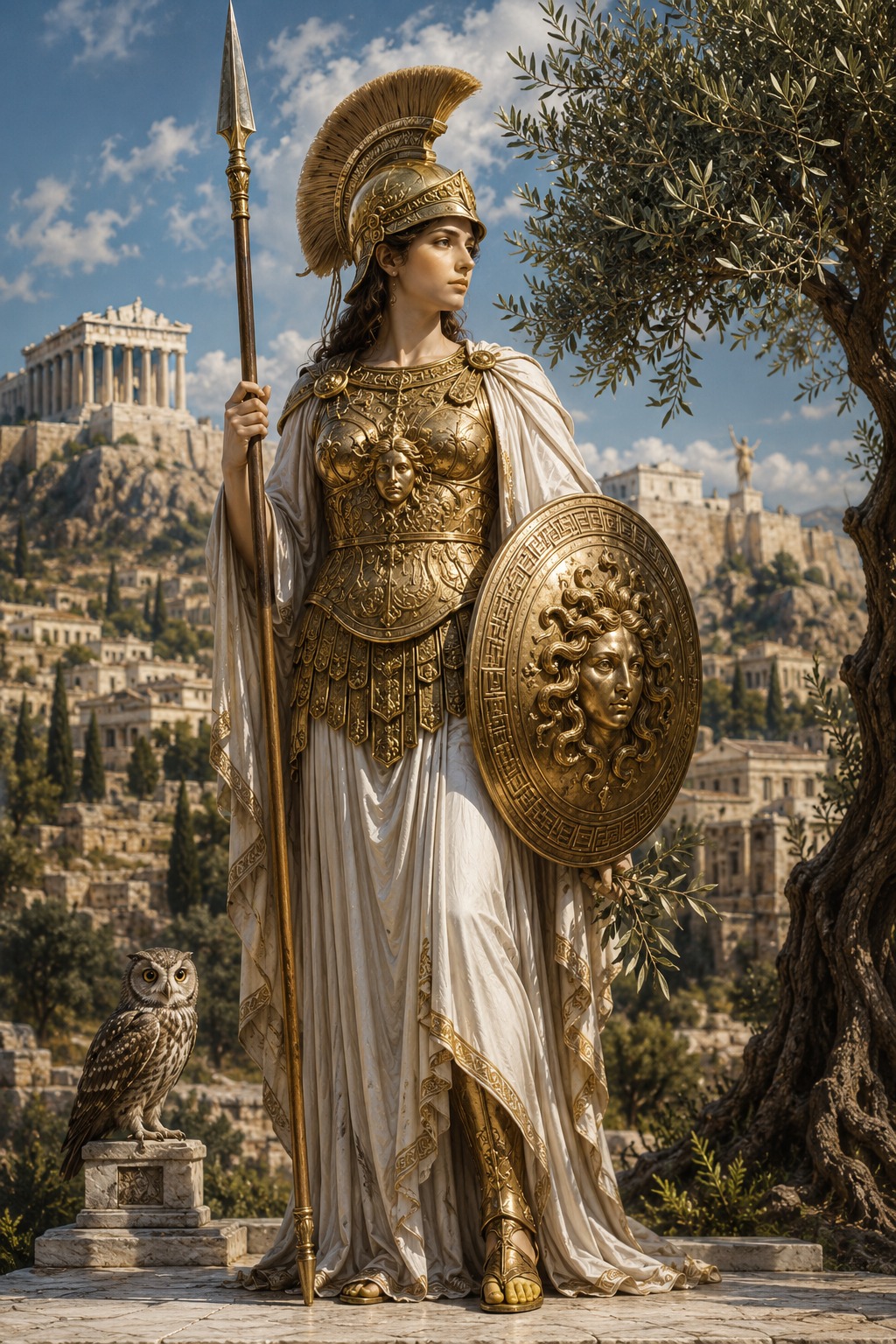
Athena
Athena · Goddess of Wisdom, Strategy, and Craft
Names in Other Languages
 아테나한국어
Athena · 지혜·전략·공예의 여신
 アテナ日本語
Athena · 知恵・戦略・工芸の女神
 雅典娜繁體中文
Athena · 智慧、戰略與工藝女神
 AtheneDeutsch
Athene · Göttin der Weisheit, Strategie und Handwerks
 AthénaFrançais
Athéna · Déesse de la sagesse, de la stratégie et des arts
 AteneaEspañol
Atenea · Diosa de la sabiduría, estrategia y artesanía
 AtenaPortuguês
Atena · Deusa da sabedoria, estratégia e artesanato
 AtenaPolski
Atena · Bogini mądrości, strategii i rzemiosła
 АфинаРусский
Athena · Богиня мудрости, стратегии и ремёсел
Athena (Ancient Greek Athene, Latin Minerva) is the decisive canonical virgin goddess (Parthenos) of wisdom, war strategy, crafts, and city protection among the 12 Olympian gods of Greek mythology, and the decisive canonical iconographic figure born fully armed from the head of Zeus (Zeus). The etymology is the decisive canonical vocabulary as the patron goddess of the city Athens (Athenai), and the aliases Pallas (Pallas, 'maiden'), Glaukopis (Glaukopis, 'grey-eyed' or 'owl-faced'), Tritogeneia (Tritogeneia), Polias (Polias, 'of the city'), and Ergane (Ergane, 'the crafter') are the decisive canonical vocabulary. The decisive textual canon is Theogony (Theogony) lines 886-900 of Hesiod (Hesiod) of c. 8th-7th century BCE — the decisive canon in which Zeus swallows the pregnant Metis (Metis) — and lines 924-926 — the decisive mythological canon in which Hephaestus (Hephaestus) splits Zeus's head with an axe and Athena is born fully armed. The Iliad (Iliad) Book 5 lines 733-747 of Homer (Homer) of c. 8th century BCE — the decisive canon of Athena's Aegis (aigis) shield — and the Bibliotheca (Bibliotheke) Book 3 chapter 14 section 1 of Pseudo-Apollodorus of c. 1st century BCE — the decisive canon of the contest with Poseidon (Poseidon) for the patronage of Athens — Athena gifting the olive tree (elaia).
Origin
The iconographic origin is the Bronze Age Mycenaean civilisation (c. 1600-1100 BCE) Mycenaean Linear B clay tablet inscription 'a-ta-na po-ti-ni-ja' (Athena goddess) — the decisive origin canon, and the decisive textual canon is Theogony (Theogony) lines 886-900 of Hesiod (Hesiod) of c. 8th-7th century BCE — the decisive canon in which Zeus, fearing the prophecy of Gaia (Gaia) and Uranus (Uranus) that Metis (Metis, wisdom) would bear a child surpassing him, swallows the pregnant Metis — and lines 924-926 — the decisive mythological canon in which Hephaestus (Hephaestus) splits Zeus's head with a bronze axe and Athena is born fully armed (helmet, spear, Aegis shield). The Iliad (Iliad) Book 5 lines 733-747 of Homer (Homer) of c. 8th century BCE — Athena's Aegis (aigis) shield — and Book 21 lines 391-414 — the decisive canon in which Athena strikes down Ares (Ares) with a stone — and the Homeric Hymns (Homeric Hymns) No. 28 Hymn to Athena of c. 7th-6th century BCE is the decisive religious canon. The Bibliotheca (Bibliotheke) Book 3 chapter 14 section 1 of Pseudo-Apollodorus of c. 1st century BCE — the decisive canon in which in the contest with Poseidon for the patronage of Athens, Poseidon offered a salt spring with his trident, and Athena gave the olive tree (elaia) and won.
Features
- Helmet, armour, spear, and Aegis shield
- Accompanied by the owl of wisdom (glaux)
- Olive tree and weaving loom symbols
- Virgin goddess (Parthenos), unmarried
- Born fully armed from Zeus's head
- Decisive patron of the Athenian polis
Stories
The Bronze Age Mycenaean 'a-ta-na po-ti-ni-ja' (Athena goddess) inscription is the decisive origin, and the decisive textual canon is Hesiod Theogony lines 886-900 and 924-926 of c. 8th-7th century BCE, Homer Iliad Books 5 and 21 and Odyssey of c. 8th century BCE, Homeric Hymns No. 28 Hymn to Athena of c. 7th-6th century BCE, and Pseudo-Apollodorus Bibliotheca Book 3 chapter 14 section 1 of c. 1st century BCE — the decisive canon. The Parthenon (Parthenon) on the Acropolis built in 447-432 BCE under Pericles (Pericles, 495-429 BCE) of the c. 5th-century-BCE Athenian polis — with architects Ictinus (Ictinus) and Callicrates (Callicrates) — and the chryselephantine Athena Parthenos (Athena Parthenos) statue of c. 11.5m by sculptor Pheidias (Pheidias) of 438 BCE is the decisive art canon, and the annual Panathenaia (Panathenaia) festival in July-August is the decisive religious canon. The Metamorphoses (Metamorphoses) Book 6 lines 1-145 of Ovid (Publius Ovidius Naso) of c. 1st century CE — the decisive canon of the weaving contest with Arachne (Arachne) — and Book 4 lines 753-803 — the decisive canon of Medusa (Medusa) — is the decisive Latin canon. The Las Hilanderas (The Spinners) of Diego Velazquez (Diego Velazquez) of 1655 — Madrid Prado Museum — is the decisive Baroque canon, and the decisive 21st-century canon is the Percy Jackson & the Olympians series of Rick Riordan started in the USA on 18 February 2010 (The Lightning Thief) and the Fate series of Japan are the 21st-century decisive global canon.
Weakness
Athena's weaknesses are: (1) attachment to the honour of the virgin goddess — the decisive canonical weakness in the c. 1st-century-CE Ovid Metamorphoses Book 6 lines 1-145 — the decisive canon of transforming Arachne (Arachne), who tried to surpass her in weaving, into a spider — and Book 4 lines 753-803 — the decisive cruel canon of making Medusa (Medusa), defiled by Poseidon in her temple, into a Gorgon (gorgo); (2) hatred of Troy — the decisive canon in the c. 7th-century-BCE Cypria (Cypria) and the Homer Iliad Book 24 — Judgement of Paris (Judgement of Paris) — in which Paris chose Aphrodite (Aphrodite) instead of Hera and Athena, and Athena hated Troy to the end; (3) pride disputes — the Arachne and Medusa canons; (4) Zeus's authority — Athena is under Zeus's authority — the decisive canon; (5) inability to marry — the decisive canonical weakness of the virgin goddess (Parthenos); (6) contest with Poseidon — the contest for the patronage of Athens — the decisive canon; (7) binding of the sacred domain — the decisive canon; (8) the decisive canon in which Athena's temple is defiled by the rape of Cassandra (Cassandra) by Ajax (Ajax) of Troy. The decisive canonical finale is the decisive mythological canon of the c. 8th-century-BCE Homer Iliad Book 21 lines 391-414 — in which Athena strikes down Ares (Ares) with a stone.
Cultural Significance
Athena is not merely a wisdom-goddess icon but the canonical iconographic figure of the decisive Greek-Roman canon, traversing the Bronze Age Mycenaean 'a-ta-na po-ti-ni-ja' inscription, the c. 8th-7th-century-BCE Hesiod Theogony, the c. 8th-century-BCE Homer Iliad and Odyssey, the c. 7th-6th-century-BCE Homeric Hymns No. 28, the c. 5th-century-BCE Acropolis Parthenon, the Pheidias Athena Parthenos, the c. 1st-century-BCE Pseudo-Apollodorus Bibliotheca, the c. 1st-century-CE Ovid Metamorphoses, and the 1655 Velazquez Las Hilanderas. The Bronze Age Mycenaean civilisation (c. 1600-1100 BCE) Mycenaean Linear B clay tablet inscription 'a-ta-na po-ti-ni-ja' (Athena goddess) is the decisive origin, and the decisive mythological canon is the c. 8th-7th-century-BCE Hesiod (Hesiod) Theogony (Theogony) lines 886-900 — the decisive canon in which Zeus swallows the pregnant Metis — and lines 924-926 — the decisive mythological canon in which Hephaestus (Hephaestus) splits Zeus's head and Athena is born fully armed. The Bibliotheca (Bibliotheke) Book 3 chapter 14 section 1 of Pseudo-Apollodorus of c. 1st century BCE — the decisive canon in which in the contest with Poseidon for the patronage of Athens, Poseidon offered a salt spring with his trident, and Athena gave the olive tree (elaia) and won — and the Parthenon (Parthenon) on the Acropolis built in 447-432 BCE under Pericles (Pericles, 495-429 BCE) of the c. 5th-century-BCE Athenian polis — with architects Ictinus (Ictinus) and Callicrates (Callicrates) — and the chryselephantine Athena Parthenos (Athena Parthenos) statue of c. 11.5m by sculptor Pheidias (Pheidias) of 438 BCE — is the decisive art canon. The decisive 21st-century canon is the Percy Jackson & the Olympians film series (The Lightning Thief) of Rick Riordan started in the USA on 18 February 2010 and the Fate series — the decisive canon.
In Popular Culture
- Mycenaean Linear B 'a-ta-na po-ti-ni-ja' (Bronze Age) — decisive origin canon
- Hesiod Theogony lines 886-900 and 924-926 (c. 8th-7th century BCE) — decisive birth canon
- Homer Iliad Books 5 and 21 (c. 8th century BCE) — decisive heroic-epic canon
- Homeric Hymns No. 28 Hymn to Athena (c. 7th-6th century BCE) — decisive religious canon
- Pseudo-Apollodorus Bibliotheca Book 3 chapter 14 section 1 (c. 1st century BCE) — decisive Athens-patron canon
- Parthenon and Pheidias Athena Parthenos (438 BCE) — decisive art canon
- Ovid Metamorphoses Book 6 Arachne, Book 4 Medusa (c. 1st century CE) — decisive Latin canon
- Velazquez Las Hilanderas (1655) — decisive Baroque canon
- Rick Riordan Percy Jackson & the Olympians (2005-2024) — 21st-century decisive young-adult novel and film canon
- TSR D&D Deities & Demigods, Athena (1980) — decisive fantasy RPG canon
Trivia
The etymology of Athena (Athene) is the decisive canonical vocabulary as the patron goddess of the city Athens (Athenai), and the aliases Pallas (Pallas, 'maiden'), Glaukopis (Glaukopis, 'grey-eyed' or 'owl-faced'), Tritogeneia (Tritogeneia, 'born of Triton'), Polias (Polias, 'of the city'), and Ergane (Ergane, 'the crafter') are the decisive canonical vocabulary. The iconographic origin is the Bronze Age Mycenaean civilisation (c. 1600-1100 BCE) Mycenaean Linear B clay tablet inscription 'a-ta-na po-ti-ni-ja' (Athena goddess) — the decisive origin, and the decisive textual canon is Theogony (Theogony) lines 886-900 of Hesiod (Hesiod) of c. 8th-7th century BCE — the decisive canon in which Zeus, fearing the prophecy of Gaia and Uranus that Metis (Metis, wisdom) would bear a child surpassing him, swallows the pregnant Metis — and lines 924-926 — the decisive mythological canon in which Hephaestus (Hephaestus) splits Zeus's head with a bronze axe and Athena is born fully armed. The Bibliotheca (Bibliotheke) Book 3 chapter 14 section 1 of Pseudo-Apollodorus of c. 1st century BCE — the decisive canon in which in the contest with Poseidon (Poseidon) for the patronage of Athens, Athena gave the olive tree (elaia, elaia) and won — and the Parthenon (Parthenon) on the Acropolis built in 447-432 BCE under Pericles (Pericles, 495-429 BCE) of the c. 5th-century-BCE — with architects Ictinus (Ictinus) and Callicrates (Callicrates) — and the chryselephantine Athena Parthenos (Athena Parthenos) statue of c. 11.5m by sculptor Pheidias (Pheidias) of 438 BCE — is the decisive art canon. The annual Panathenaia (Panathenaia) festival in July-August is the decisive religious canon of the Athenian polis.