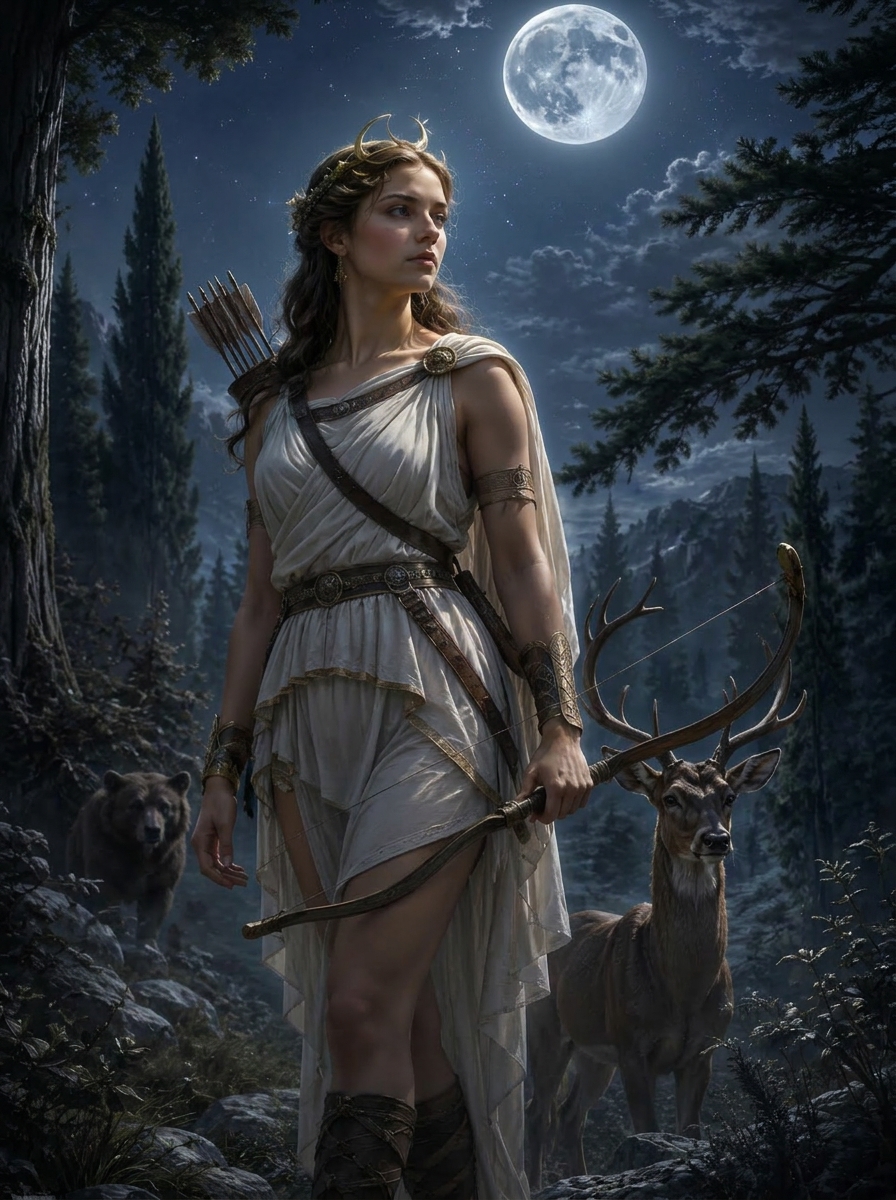
Artemis
Artemis · Goddess of the Hunt, Moon, and Maidenhood
Names in Other Languages
 아르테미스한국어
Artemis · 사냥·달·처녀성의 여신
 アルテミス日本語
Artemis · 狩猟・月・処女の女神
 阿提密斯繁體中文
Artemis · 狩獵、月與貞女女神
 ArtemisDeutsch
Artemis · Göttin der Jagd, des Mondes und der Jungfräulichkeit
 ArtémisFrançais
Artémis · Déesse de la chasse, de la lune et de la virginité
 ArtemisaEspañol
Artemisa · Diosa de la caza, la luna y la virginidad
 ÁrtemisPortuguês
Ártemis · Deusa da caça, da lua e da virgindade
 ArtemidaPolski
Artemida · Bogini łowów, księżyca i dziewictwa
 АртемидаРусский
Artemis · Богиня охоты, луны и девственности
Artemis (Ancient Greek Artemis, Latin Diana) is the decisive canonical virgin goddess (Parthenos) of the hunt, wilderness, the moon, virginity, childbirth, and girls' initiation rites among the 12 Olympian gods of Greek mythology, and the decisive canonical iconographic figure of the daughter of Zeus (Zeus) and Leto (Leto), twin sister of Apollo (Apollon). The etymology Greek Artemis is the decisive canonical vocabulary meaning 'the safe one' or 'butcher', and the aliases Phoibe (Phoibe, 'shining'), Delia (Delia, 'of Delos'), Kynthia (Kynthia, 'of Cynthus'), and Potnia Theron (Potnia Theron, 'mistress of wild beasts') are the decisive canonical vocabulary. The decisive textual canon is the Theogony (Theogony) lines 918-920 of Hesiod (Hesiod) of c. 8th-7th century BCE — the decisive canon of the birth of Apollo and Artemis as children of Zeus and Leto — and the Homeric Hymns (Homeric Hymns) No. 27 Hymn to Artemis of c. 7th-6th century BCE and the Hymn 3 to Artemis (Hymn 3 to Artemis) of Callimachus (Callimachus) of c. 3rd century BCE are the decisive canon, and the decisive canon in which the 3-year-old young Artemis, on the knee of Zeus, requested eternal virginity, bow, arrows, short tunic, 60 Oceanid (Oceanides) handmaidens, 20 Amnisides (Amnisides) nymphs, and hunting dogs given by Pan (Pan).
Origin
The iconographic origin is the Bronze Age Mycenaean civilisation (c. 1600-1100 BCE) Mycenaean Linear B clay tablet inscription 'a-te-mi-to' (Artemis) — the decisive origin canon, and the decisive textual canon is the Theogony (Theogony) lines 918-920 of Hesiod (Hesiod) of c. 8th-7th century BCE — the decisive canon of the twin birth of Apollo (Apollon) and Artemis (Artemis) as children of Zeus and Leto (Leto). The Homeric Hymns (Homeric Hymns) No. 27 — Hymn to Artemis — of c. 7th-6th century BCE and the Hymn 3 to Artemis (Hymn 3 to Artemis) of Callimachus (Kallimachos, c. 305-240 BCE) of the Mouseion of Alexandria of c. 3rd century BCE are the decisive canon, and the decisive canon in which the 3-year-old young Artemis, on the knee of Zeus, requested eternal virginity, bow, arrows, short tunic, 60 Oceanid (Oceanides) handmaidens, 20 Amnisides (Amnisides) nymphs, and 7 hunting dogs given by Pan (Pan). The decisive canon in which Leto (Leto), persecuted by Hera (Hera), gave birth to Artemis first on the island of Delos (Delos) and as soon as she was born, helped her mother give birth to Apollo, and the Iliad (Iliad) Book 21 lines 470-513 of Homer (Homer) of c. 8th century BCE — the decisive canon in which Hera strikes Artemis.
Features
- Young goddess with bow and quiver
- Short tunic (chiton) and hunting boots
- Symbols of the moon and stars
- Accompanied by deer (Ancient Greek elaphos) and bear
- Cypress, cedar, and palm as sacred trees
- Eternal virgin with 60 Oceanid handmaidens
Stories
The Bronze Age Mycenaean 'a-te-mi-to' (Artemis) inscription is the decisive origin, and the decisive textual canon is Hesiod Theogony lines 918-920 of c. 8th-7th century BCE, Homeric Hymns No. 27 Hymn to Artemis of c. 7th-6th century BCE, Callimachus Hymn 3 to Artemis of c. 3rd century BCE, and Homer Iliad Book 21 lines 470-513 of c. 8th century BCE — the decisive canon. The Temple of Artemis (Artemision) at Ephesus (Ephesus) in Asia Minor from c. 550 BCE — one of the Seven Wonders of the Greek world (c. 2nd-century-BCE Antipater of Sidon canon) — is the decisive religious and art canon, and the burning by Herostratos (Herostratos) on 21 July 356 BCE and the rebuilding are the decisive canon. The Iphigenia at Aulis (Iphigenia at Aulis) of Euripides (Euripides) of c. 5th century BCE — the decisive tragic canon of the sacrifice of Iphigenia (Iphigeneia), daughter of Agamemnon (Agamemnon) — and the Metamorphoses (Metamorphoses) Book 3 lines 138-252 of Ovid (Publius Ovidius Naso) of c. 1st century CE — the decisive canon of transforming Actaeon (Aktaion) into a stag — and Book 6 lines 146-312 — the canon of the massacre of the 14 children of Niobe (Niobe) — is the decisive Latin canon. The Artemis (Artemis) of the 1980 D&D Deities & Demigods (Deities & Demigods) by TSR in the USA and the decisive 21st-century canon — the Artemis of Percy Jackson & the Olympians: The Titan's Curse (The Titan's Curse) of Rick Riordan published in the USA on 1 May 2007 — is the 21st-century decisive young-adult novel canon.
Weakness
Artemis's weaknesses are: (1) absolute pride in virginity — the decisive canonical weakness in the c. 1st-century-CE Ovid Metamorphoses Book 3 lines 138-252 — the decisive cruel canon of transforming the hunter Actaeon (Aktaion), who accidentally saw her bath, into a stag and having him torn apart by his 50 hunting dogs; (2) cruelty of pride disputes — the c. 1st-century-CE Ovid Metamorphoses Book 6 lines 146-312 — the decisive mythological canon in which Niobe (Niobe) compared herself with Leto, and Artemis shot Niobe's 7 daughters with her bow — and the decisive canon in which Apollo shot the 7 sons; (3) Hera's violence — the c. 8th-century-BCE Homer Iliad Book 21 lines 470-513 — the decisive canon in which Hera takes Artemis's quiver and strikes Artemis; (4) inability to marry — the decisive canonical weakness of the eternal virgin (Parthenos); (5) Zeus's authority — Artemis is under Zeus's authority — the decisive canon; (6) labor of birth — mother Leto's birth — the decisive canon; (7) binding of the sacred domain — the decisive canon; (8) Callisto (Callisto) — the decisive canon in which her handmaiden, having been impregnated by Zeus, was transformed by Artemis into a bear and exiled. The decisive canonical finale is the decisive mythological canon of the c. 1st-century-CE Ovid Metamorphoses Book 3 lines 138-252 — in which Actaeon is torn apart by his own hunting dogs.
Cultural Significance
Artemis is not merely a hunting-goddess icon but the canonical iconographic figure of the decisive Greek-Roman canon, traversing the Bronze Age Mycenaean 'a-te-mi-to' inscription, the c. 8th-7th-century-BCE Hesiod Theogony, the c. 8th-century-BCE Homer Iliad, the c. 7th-6th-century-BCE Homeric Hymns No. 27, the c. 3rd-century-BCE Callimachus Hymn 3 to Artemis, the c. 550 BCE Temple of Artemis at Ephesus (one of the Seven Wonders), the c. 5th-century-BCE Euripides Iphigenia at Aulis, and the c. 1st-century-CE Ovid Metamorphoses Book 3 Actaeon and Book 6 Niobe. The Bronze Age Mycenaean civilisation (c. 1600-1100 BCE) Mycenaean Linear B clay tablet inscription 'a-te-mi-to' (Artemis) is the decisive origin, and the decisive mythological canon is the c. 8th-7th-century-BCE Hesiod Theogony lines 918-920 — children of Zeus and Leto — the decisive canon of the twin birth of Apollo and Artemis — and the c. 3rd-century-BCE Callimachus Hymn 3 to Artemis — the decisive canon in which the 3-year-old young Artemis, on the knee of Zeus, requested eternal virginity, bow, arrows, short tunic, 60 Oceanid handmaidens, 20 Amnisides nymphs, and 7 hunting dogs given by Pan. The Temple of Artemis (Artemision) at Ephesus in Asia Minor from c. 550 BCE — one of the Seven Wonders of the Greek world — is the decisive religious and art canon, and the burning by Herostratos on 21 July 356 BCE and the rebuilding are the decisive canon. The decisive 21st-century canon is the Artemis of Percy Jackson & the Olympians: The Titan's Curse (The Titan's Curse) of Rick Riordan published in the USA on 1 May 2007 — the 21st-century decisive young-adult novel canon, and the Artemis of the Nintendo DS Athena no Himitsu series released in Japan on 12 December 2008 and the US game SMITE (released in 2014) is the decisive video-game canon.
In Popular Culture
- Mycenaean Linear B 'a-te-mi-to' (Bronze Age) — decisive origin canon
- Hesiod Theogony lines 918-920 (c. 8th-7th century BCE) — decisive birth canon
- Homer Iliad Book 21 lines 470-513 (c. 8th century BCE) — decisive heroic-epic canon
- Homeric Hymns No. 27 Hymn to Artemis (c. 7th-6th century BCE) — decisive religious canon
- Callimachus Hymn 3 to Artemis (c. 3rd century BCE) — decisive Hellenistic canon
- Temple of Artemis at Ephesus (c. 550 BCE) — decisive Seven Wonders canon
- Euripides Iphigenia at Aulis (c. 5th century BCE) — decisive tragic canon
- Ovid Metamorphoses Book 3 Actaeon, Book 6 Niobe (c. 1st century CE) — decisive Latin canon
- Rick Riordan The Titan's Curse (2007) — 21st-century decisive young-adult novel canon
- TSR D&D Deities & Demigods, Artemis (1980) — decisive fantasy RPG canon
Trivia
The etymology Greek Artemis is the decisive canonical vocabulary meaning 'the safe one' or 'butcher', and the aliases Phoibe (Phoibe, 'shining'), Delia (Delia, 'of Delos'), Kynthia (Kynthia, 'of Mount Cynthus'), Potnia Theron (Potnia Theron, 'mistress of wild beasts'), Selasphoros (Selasphoros, 'light-bearer'), and Hekaerga (Hekaerga, 'far-shooter') are the decisive canonical vocabulary. The decisive textual canon is the Theogony (Theogony) lines 918-920 of Hesiod (Hesiod) of c. 8th-7th century BCE — the decisive canon of the twin birth of Apollo and Artemis as children of Zeus (Zeus) and Leto (Leto). The Hymn 3 to Artemis (Hymn 3 to Artemis) of Callimachus (Callimachus, c. 305-240 BCE) of c. 3rd century BCE — the decisive canon in which the 3-year-old young Artemis, on the knee of Zeus, requested eternal virginity, bow and arrows, short tunic (chiton), 60 Oceanid (Oceanides) handmaidens, 20 Amnisides (Amnisides) nymphs, and 7 hunting dogs given by Pan (Pan). The Temple of Artemis (Artemision) at Ephesus (Ephesus) in Asia Minor from c. 550 BCE — about 115m long and 55m wide — one of the Seven Wonders of the Greek world (c. 2nd-century-BCE Antipater of Sidon) — is the decisive religious and art canon, and the burning by Herostratos (Herostratos) on 21 July 356 BCE — the birthday of Alexander the Great — and the rebuilding are the decisive canon. The c. 1st-century-CE Ovid Metamorphoses Book 3 lines 138-252 — the decisive cruel canon of transforming the hunter Actaeon (Aktaion), who accidentally saw her bath on Mount Cithaeron (Kithairon), into a stag and having him torn apart by his 50 hunting dogs, and the Artemis of Percy Jackson & the Olympians: The Titan's Curse of Rick Riordan published in the USA on 1 May 2007 is the 21st-century decisive young-adult novel canon.