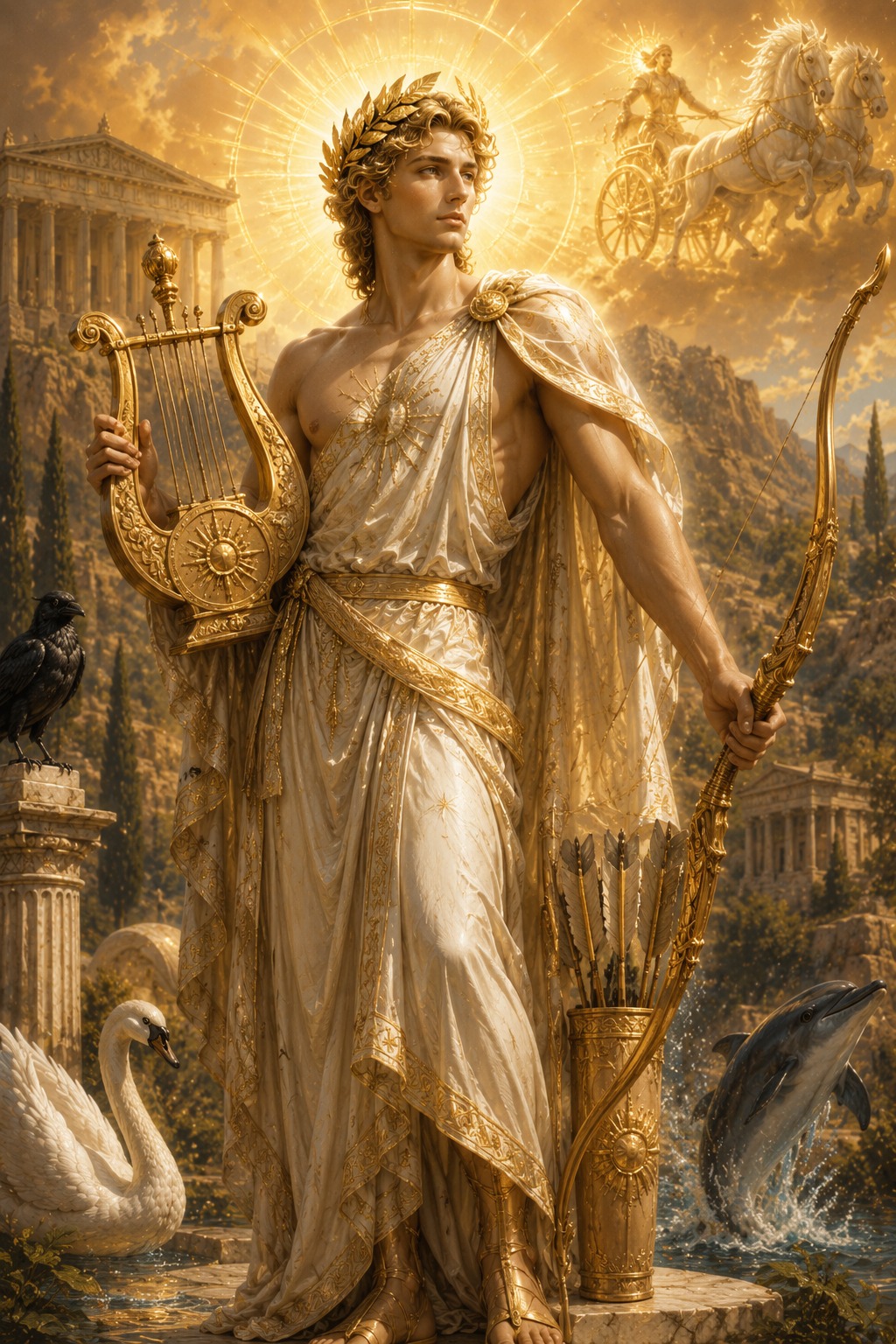
Apollo
Apollo · God of Sun, Music, Prophecy, and Healing
Names in Other Languages
 아폴론한국어
Apollo · 태양·음악·예언·의술의 신
 アポロン日本語
Apollo · 太陽・音楽・予言・医術の神
 阿波羅繁體中文
Apollo · 太陽、音樂、預言與醫術之神
 ApollonDeutsch
Apollon · Gott der Sonne, Musik, Prophezeiung und Heilung
 ApollonFrançais
Apollon · Dieu du Soleil, de la musique, de la prophétie et de la médecine
 ApoloEspañol
Apolo · Dios del Sol, la música, la profecía y la curación
 ApoloPortuguês
Apolo · Deus do Sol, da música, da profecia e da cura
 ApolloPolski
Apollo · Bóg Słońca, muzyki, proroctwa i uzdrawiania
 АполлонРусский
Apollo · Бог Солнца, музыки, пророчества и врачевания
Apollo (Ancient Greek Apollon, Latin Apollo) is the decisive canonical god of the sun, music, poetry, prophecy, healing, and archery among the 12 Olympian gods of Greek mythology, and the decisive canonical iconographic figure of the son of Zeus (Zeus) and Leto (Leto), the twin brother of Artemis (Artemis). The etymology Greek Apollon is the decisive canonical vocabulary meaning 'destroyer' or 'assembler' or 'the revered one', and the aliases Phoibos (Phoibos, 'the shining one'), Delios (Delios, 'of Delos'), Pythios (Pythios, 'of Python'), and Musagetes (Musagetes, 'leader of the Muses') are the decisive canonical vocabulary. The decisive textual canon is Homer (Homer) Iliad (Iliad) Book 1 lines 43-52 of c. 8th century BCE — the decisive canon in which Apollo, receiving the prayer of his priest Chryses (Chryses), shoots arrows of plague (loimos) into the Greek camp for 9 days with his silver bow (argurotoxos) — and Theogony (Theogony) lines 918-920 of Hesiod (Hesiod) of c. 8th-7th century BCE — the decisive canon of the birth of Apollo and Artemis as children of Zeus and Leto. The Homeric Hymns (Homeric Hymns) No. 3 — Hymn to Apollo — of c. 7th-6th century BCE is the decisive canon of the birth on Delos and the killing of Python (Python) at Delphi (Delphi), and the Pythia (Pythia) of the Delphic oracle is the decisive canon.
Origin
The iconographic origin is the Anatolian-Asia Minor sun worship before the Bronze Age Mycenaean civilisation (c. 1600-1100 BCE), and the decisive textual canon is Homer (Homer) Iliad (Iliad) Book 1 lines 43-52 of c. 8th century BCE — the decisive canon in which Apollo, receiving the prayer of his priest Chryses (Chryses), shoots arrows of plague into the Greek camp for 9 days with his silver bow (argurotoxos) — and Theogony (Theogony) lines 918-920 of Hesiod (Hesiod) of c. 8th-7th century BCE — the decisive canon of the twin birth of Apollo and Artemis (Artemis) as children of Zeus (Zeus) and Leto (Leto). The Homeric Hymns (Homeric Hymns) No. 3 — Hymn to Apollo — of c. 7th-6th century BCE is the decisive canon in which Leto, persecuted by Hera (Hera), gives birth on the island of Delos (Delos) along with Artemis, and the young Apollo kills the giant serpent Python (Python) of Delphi (Delphi) with his bow and establishes the oracle (Pythian oracle). The Pythian Odes (Pythian Odes) of Pindar (Pindar) of c. 5th century BCE, Plato (Plato) of c. 4th century BCE, and the Argonautica (Argonautika) of Apollonius Rhodius (Apollonius Rhodius) of c. 3rd-2nd century BCE are the decisive Greek canon.
Features
- Young beardless handsome youthful male god
- Lyre (string instrument) and golden bow and arrows
- Laurel wreath and solar chariot
- Symbols of the raven, dolphin, and swan
- Master of the Delphic oracle
- Bow that sends or withdraws plague
Stories
The Anatolian-Asia Minor sun worship of the Bronze Age is the decisive origin, and the decisive textual canon is Homer Iliad Book 1 lines 43-52 of c. 8th century BCE, Hesiod Theogony lines 918-920 of c. 8th-7th century BCE, and Homeric Hymns No. 3 Hymn to Apollo of c. 7th-6th century BCE — the decisive canon. The decisive canon of the Pythia (Pythia, prophetess) of Delphi (Delphi) delivering Apollo's oracles in the c. 8th-century BCE Homeric Hymns is the decisive canon of Greek religion, and the Pythian Games (Pythian Games) held at Delphi every four years from c. 6th century BCE is the decisive canon. The Aeneid (Aeneid) of Virgil (Publius Vergilius Maro, 70-19 BCE) of c. 8 BCE in Rome is the decisive Roman Apollo canon, and the Daphne (Daphne) of Metamorphoses (Metamorphoses) Book 1 lines 452-567 and the Hyacinthus (Hyacinthus) of Book 10 lines 162-219 of Ovid (Publius Ovidius Naso, 43 BCE-17 CE) of c. 1st century CE are the decisive Latin canon. The Parnassus (Parnassus) fresco of the Stanza della Segnatura in the Sistine Chapel of the Vatican by the Italian Renaissance Raphael (Raffaello Sanzio) of c. 1510 and the c. 4th-century BCE Greek sculpture Apollo Belvedere (Apollo Belvedere) are the decisive art canon. The decisive 21st-century canon is the c. 16 July 1969 NASA Apollo 11 — Neil Armstrong, Buzz Aldrin, Michael Collins — the first human moon landing on 20 July — the decisive scientific and cultural canon, and the Percy Jackson & the Olympians series of the American author Rick Riordan of 2005-2009 is the 21st-century decisive young-adult novel canon.
Weakness
Apollo's weaknesses are: (1) failure in love — the decisive canonical weakness in the c. 1st-century-CE Ovid Metamorphoses Book 1 lines 452-567 — Daphne (Daphne) transforming into a laurel tree — the decisive canon — and the canon of making Cassandra's (Cassandra) prophecies disbelieved and the canon of Coronis's (Coronis) betrayal — the decisive canon; (2) death of ambition — the c. 8th-century-BCE Homer Iliad Book 1 lines 43-52 — the plague arrow canon — the decisive canon — Apollo is feared also as the god of plague — the decisive canon; (3) cruelty of pride disputes — the c. 1st-century-BCE Pseudo-Apollodorus Bibliotheca (Bibliotheke) Book 1 chapter 4 section 2 — the decisive cruel canon of flaying Marsyas (Marsyas) in the musical contest; (4) Niobe's (Niobe) children massacre — the c. 8th-century-BCE Homer Iliad Book 24 lines 602-617 — the decisive mythological canon in which when Niobe insults Leto, Apollo and Artemis kill all 14 children of Niobe; (5) fall of Troy — the decisive canon in which in the Homer Iliad canon Apollo was on the Trojan side but Troy fell; (6) Zeus's authority — Apollo is under Zeus's authority — the decisive canon; (7) dependence on the Muses — as Musagetes (leader of the Muses), depends on the Muses — the decisive canon; (8) binding of the sacred domain — the decisive canon. The decisive canonical finale is the 9-day plague canon of Homer Iliad Book 1 lines 43-52 of c. 8th century BCE.
Cultural Significance
Apollo is not merely a sun-god icon but the canonical iconographic figure of the decisive Greek-Roman canon, traversing the c. 8th-century-BCE Homer Iliad and Odyssey, the c. 8th-7th-century-BCE Hesiod Theogony, the c. 7th-6th-century-BCE Homeric Hymns No. 3, the c. 5th-century-BCE Pindar Pythian Odes, the c. 1st-century-BCE Virgil Aeneid, the c. 1st-century-CE Ovid Metamorphoses, the c. 4th-century-BCE Greek sculpture Apollo Belvedere, the c. 1510 Raphael Parnassus, and the 1969 NASA Apollo 11. The Anatolian-Asia Minor sun worship before the Bronze Age Mycenaean civilisation (c. 1600-1100 BCE) settled as the decisive canon in the Iliad (Iliad) of Homer (Homer) of c. 8th century BCE. The decisive mythological canon is the c. 8th-7th-century-BCE Hesiod Theogony lines 918-920 — children of Zeus and Leto — the decisive canon of the twin birth of Apollo and Artemis — and the c. 7th-6th-century-BCE Homeric Hymns No. 3 Hymn to Apollo — the decisive canon in which Leto, persecuted by Hera, gives birth on the island of Delos. The decisive canon in which the young Apollo kills the giant serpent Python of Delphi with his bow and establishes the oracle — Pythian Games (Pythian Games) held at Delphi every four years — the decisive canon. The c. 16 July 1969 NASA Apollo 11 (Apollo 11) — Neil Armstrong (Neil Armstrong, 1930-2012), Buzz Aldrin (Buzz Aldrin, b. 1930), Michael Collins (Michael Collins, 1930-2021) — the first human moon landing on 20 July ('That's one small step for [a] man, one giant leap for mankind') — is the 21st-century decisive global scientific and cultural canon, and the Percy Jackson & the Olympians series of the American author Rick Riordan of 2005-2009 is the 21st-century decisive young-adult novel canon.
In Popular Culture
- Homer Iliad Book 1 lines 43-52 (c. 8th century BCE) — decisive origin canon
- Hesiod Theogony lines 918-920 (c. 8th-7th century BCE) — decisive birth canon
- Homeric Hymns No. 3 Hymn to Apollo (c. 7th-6th century BCE) — decisive religious canon
- Greek sculpture Apollo Belvedere (c. 4th century BCE) — decisive art canon
- Ovid Metamorphoses Book 1 Daphne, Book 10 Hyacinthus (c. 1st century CE) — decisive Latin canon
- Raphael Parnassus (c. 1510) — decisive Renaissance canon
- NASA Apollo 11 moon landing (1969) — decisive scientific and cultural canon
- Rick Riordan Percy Jackson & the Olympians (2005-2009) — 21st-century decisive young-adult novel canon
- TSR D&D Deities & Demigods, Apollo (1980) — decisive fantasy RPG canon
Trivia
The etymology Greek Apollon is the decisive canonical vocabulary meaning 'destroyer' or 'assembler' or 'the revered one', and the aliases Phoibos (Phoibos, 'the shining one'), Delios (Delios, 'of Delos'), Pythios (Pythios, 'of Python'), Musagetes (Musagetes, 'leader of the Muses'), and Hekatos (Hekatos, 'the far-shooter') are the decisive canonical vocabulary. The decisive textual canon is the Iliad (Iliad) of Homer (Homer) of c. 8th century BCE Book 1 lines 43-52 — the decisive canon in which Apollo, receiving the prayer of his priest Chryses (Chryses) of the Trojan War, shoots arrows of plague (loimos) into the Greek camp (Achaians) for 9 days with his silver bow (argurotoxos). The Theogony (Theogony) lines 918-920 of Hesiod (Hesiod) of c. 8th-7th century BCE — children of Zeus (Zeus) and Leto (Leto) — is the canon of the twin birth of Apollo and Artemis, and the Homeric Hymns (Homeric Hymns) No. 3 Hymn to Apollo of c. 7th-6th century BCE is the decisive canon in which Leto, persecuted by Hera (Hera), gives birth on the floating island of Delos (Delos) under a palm tree along with Artemis after 9 days of labour. The decisive canon in which the young Apollo at age 4 kills the giant serpent Python (Python) of Delphi (Delphi) with his bow and establishes the oracle (Pythian oracle), and the Pythia (Pythia, prophetess) of the Delphic oracle delivers Apollo's oracles — the decisive canon. The c. 16 July 1969 NASA Apollo 11 (Apollo 11) — Neil Armstrong (Neil Armstrong), Buzz Aldrin (Buzz Aldrin), Michael Collins (Michael Collins) — the first human moon landing on 20 July UTC is the decisive canon.