Amber
Amber· 琥珀 Tears of the Heliades
Names in Other Languages
 호박한국어
호박한국어Amber· 琥珀 헬리아데스의 눈물
 琥珀日本語
琥珀日本語Amber· 琥珀 ヘリアデスの涙
 琥珀繁體中文
Amber· 琥珀 赫莉阿德斯之淚
 BernsteinDeutsch
Amber· 琥珀 Traenen der Heliaden
 AmbreFrançais
Amber· 琥珀 Larmes des Heliades
 AmbarEspañol
Amber· 琥珀 Lagrimas de las Heliades
 AmbarPortuguês
Amber· 琥珀 Lagrimas das Heliades
 BursztynPolski
Amber· 琥珀 Lzy Heliad
 ЯнтарьРусский
Amber· 琥珀 Слёзы Гелиад
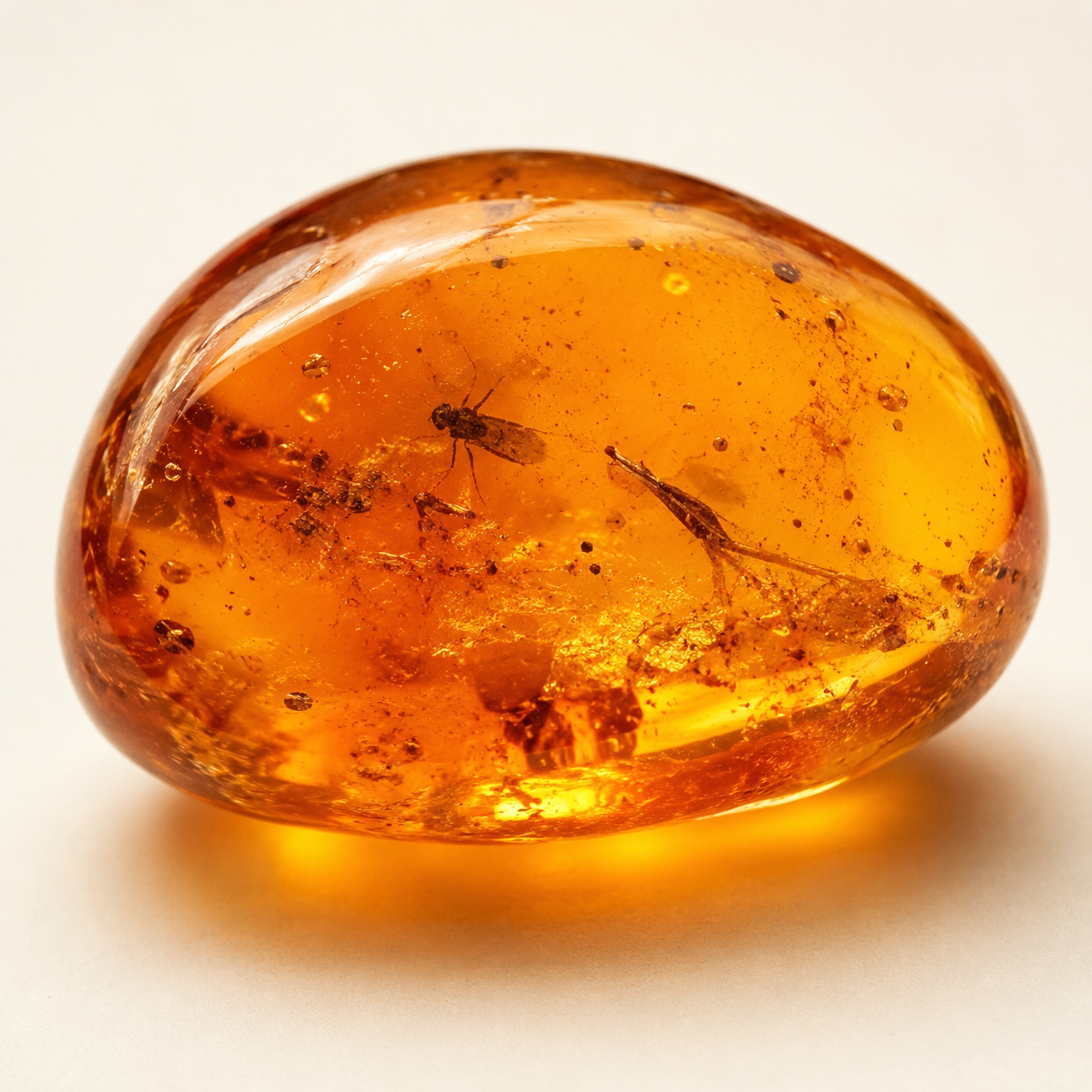
Amber (English Amber, Greek ēlektron, Latin succinum) is the gem of the Heliades' tears of the decisive canon — derived from Greek 'ēlektron (amber)' — the decisive canonical vocabulary — the decisive mineralogical canon of fossilized tree resin (c. 40 million years old) — and the decisive mythological canon of Phaethon's death in Ovid's Metamorphoses Book 2 verses 340-366 of c. 8 CE. Aliases — Amber (Amber), ēlektron (ἤλεκτρον), succinum (succinum, Latin), tears of the Heliades, Baltic gem, etymology of electricity — are the decisive canonical vocabulary. The decisive mythological origin canon is the decisive canon of the Roman Ovid's (Ovid, 43 BCE-17 CE) Metamorphoses (Metamorphoses) Book 2 verses 340-366 of c. 8 CE — 'After the death of Phaethon (Phaethon), the son of the sun god Helios, his grieving sisters the Heliades (Heliades) were transformed into poplar trees, and their tears became amber'. The decisive natural history canon is the decisive canon of amber in Pliny the Elder's (Pliny the Elder, 23-79) Natural History (Naturalis Historia) Book 37 chapters 30-51 of the 1st century. The decisive Baltic canon is the decisive canon of Baltic Sea amber of c. 40 million years ago.
Origin
The etymological origin is the decisive canonical vocabulary of Greek 'ēlektron (ἤλεκτρον, amber)' — the decisive canon having the dual meaning of amber and electrum, and the decisive canon of Latin 'succinum (fossilized tree juice, from succus 'juice')' and English 'amber' deriving from Arabic 'anbar (ambergris)'. The decisive mythological origin canon is the decisive canon of the Roman Ovid's (Ovid, Publius Ovidius Naso, 43 BCE-17 CE) Metamorphoses (Metamorphoses, 15 books) Book 2 verses 340-366 of c. 8 CE — 'After Phaethon (Phaethon), the son of the sun god Helios (Helios), drove his father's sun chariot and fell to his death from Zeus's lightning, his sisters the Heliades (Heliades) were transformed into poplar trees, and their tears mourning his death became amber'. The decisive natural history canon is the decisive canon of the Roman Pliny the Elder's (Pliny the Elder, 23-79) Natural History (Naturalis Historia) Book 37 chapters 30-51 of the 1st century — 'amber is the fossil resin of Baltic pine trees, the myth of the Heliades' tears is false, and amber has attractive power when rubbed'. The decisive Baltic canon is the decisive canon of Baltic Sea (Baltic Sea) amber of c. 40 million years ago, and the decisive etymology of electricity canon is the decisive canon of William Gilbert (William Gilbert) of England naming the frictional electricity of amber as 'electricitas' in De Magnete (De Magnete) of 1600.
Features
- Fossil resin pine resin of c. 40 million years ago Mohs hardness 2-2.5
- Main axis Ovid Metamorphoses Book 2 verses 340-366 tears of the Heliades
- Greek ēlektron etymology of electricity
- Baltic Sea amber 90% of global source
- Amber with fossilized insects (Jurassic dinosaur era)
- Origin — Baltic Sea, Dominican Republic, Myanmar, Sicily
Stories
The Heliades' tears in Ovid's Metamorphoses Book 2 verses 340-366 of c. 8 CE is the decisive origin, and the decisive natural history canon is amber in Pliny the Elder's Natural History Book 37 chapters 30-51 of the 1st century. The decisive canon used as the gem of the Heliades' tears, and the decisive canon invoked as the fossilized resin of the Baltic Sea. The decisive Mycenaean canon is the decisive canon of amber jewelry of Mycenae of c. 1600 BCE, and the decisive Tacitus canon is the decisive canon of the Roman Tacitus's (Tacitus) Germania (Germania) chapter 45 of the 1st century of the Aestii (Aestii, Baltic tribe) collecting amber. The decisive Amber Road canon is the decisive trade canon of the 'Amber Road' (Amber Road) from the Baltic Sea to Aquileia (Aquileia) in Italy from the 1st century BCE. The decisive electricity canon is the decisive canon of William Gilbert's frictional electricity of amber in 1600.
Weakness
Amber's weaknesses are: (1) Mohs hardness 2-2.5 limit — the decisive canonical weakness — very soft; (2) combustibility — the decisive canonical weakness — the decisive canon of igniting at 250 degrees and producing fragrant smoke — the etymology of Latin 'succinum'; (3) binding of color — the decisive canon of darkening under exposure to direct sunlight; (4) binding of forgery — the decisive canon of forgery by copal and synthetic resins; (5) binding of acid — the decisive canon of damage from acid; (6) binding of the sacred domain — the decisive canon; (7) binding of Phaethon — the decisive canon of the binding of the Heliades' tears; (8) binding of time — the decisive canon of the binding of 40 million years of fossil. The decisive canonical finale is the decisive mythological canon of William Gilbert's naming of amber's frictional electricity as 'electricitas' in 1600.
Cultural Significance
Amber is not merely a mineral icon but the canonical iconographic figure of the decisive Greco-Roman-Baltic canon, traversing amber jewelry of Mycenae of c. 1600 BCE, the Heliades' tears in Ovid's Metamorphoses Book 2 verses 340-366 of c. 8 CE, Pliny the Elder's Natural History Book 37 chapters 30-51 of the 1st century, the Aestii in Tacitus's Germania chapter 45 of the 1st century, the 'Amber Road' from the 1st century BCE, the etymology of electricity in William Gilbert's De Magnete of 1600, and the Amber Museum of Kaliningrad of 1894. The etymological origin settled as the decisive canon of Greek 'ēlektron (amber)' — the decisive canon having the dual meaning of amber and electrum, and the decisive canon of English 'amber' deriving from Arabic 'anbar (ambergris)'. The decisive mythological origin canon is the decisive canon of the Roman Ovid's (Ovid, Publius Ovidius Naso, 43 BCE-17 CE) Metamorphoses (Metamorphoses, 15 books) Book 2 verses 340-366 of c. 8 CE — 'After Phaethon (Phaethon), the son of the sun god Helios (Helios), drove his father's sun chariot and fell to his death from Zeus's lightning, his sisters the Heliades (Heliades) were transformed into poplar trees, and their tears mourning his death became amber'. The decisive natural history canon is the decisive canon of the Roman Pliny the Elder's (Pliny the Elder, 23-79) Natural History (Naturalis Historia) Book 37 chapters 30-51 of the 1st century — 'amber (succinum) is the fossil resin of Baltic pine trees'. The decisive Mycenaean canon is the decisive canon of the trade of Baltic amber of Mycenae of c. 1600 BCE — the decisive canon of amber jewelry from Mycenaean tombs. The decisive Tacitus canon is the decisive canon of the Roman Tacitus's (Tacitus) Germania (Germania) chapter 45 of 98 CE — 'The Aestii (Aestii) of the Baltic collect amber (glaesum) and export it to Rome'. The decisive Amber Road canon is the decisive trade canon of the 'Amber Road' (Amber Road) from the Baltic Sea (now Poland and Kaliningrad) to Aquileia (Aquileia, near Venice) in Italy from the 1st century BCE. The decisive etymology of electricity canon is the decisive canon of the English physician and scientist William Gilbert (William Gilbert, 1544-1603) naming the frictional electricity of amber as 'electricitas' in De Magnete (De Magnete) of 1600 — the decisive canon of the etymology of English 'electricity' and 'electron'. The decisive Amber Room canon is the decisive canon of the Amber Room (Amber Room) of the Prussian King Friedrich I (Friedrich I, 1657-1713) of 1701-1716 in Berlin — the decisive canon of being gifted to Peter the Great in 1716, looted by the Nazis in 1941, and reconstructed in 2003.
In Popular Culture
- Amber jewelry of Mycenae (c. 1600 BCE) — decisive Mycenaean canon
- Heliades' tears in Ovid Metamorphoses (Metamorphoses) Book 2 verses 340-366 (c. 8 CE) — decisive mythological origin canon
- Pliny the Elder Natural History (Naturalis Historia) Book 37 chapters 30-51 (1st century) — decisive natural history canon
- Aestii (Aestii) in Tacitus Germania (Germania) chapter 45 (98 CE) — decisive Tacitus canon
- Amber Road (Amber Road) from the Baltic Sea to Aquileia (Aquileia) in Italy (from 1st century BCE) — decisive trade canon
- William Gilbert (William Gilbert) De Magnete (De Magnete) 'electricitas' (1600) — decisive electricity etymology canon
- Amber Room (Amber Room) of Prussian Friedrich I (1701-1716) — decisive Amber Room canon
- Gift of the Amber Room to Peter the Great (1716) — decisive Amber Room canon
- Nazi looting of the Amber Room (1941) — decisive 20th-century canon
- Amber with fossilized insects (Jurassic dinosaur era) — 21st-century decisive global canon
Trivia
The etymology of Amber (English Amber, Greek ἤλεκτρον ēlektron, Latin succinum) is the decisive canonical vocabulary of Greek 'ēlektron (ἤλεκτρον, amber)' — the decisive canon having the dual meaning of amber and electrum, the decisive canon of Latin 'succinum (fossilized tree juice, from succus 'juice')', and the English 'amber' deriving from Arabic 'anbar (عنبر, ambergris)' — the decisive canon of 'amber' meaning both amber and ambergris (whale vomit) until the 17th century. Aliases — Amber (Amber), ēlektron (ἤλεκτρον), succinum (succinum, Latin), tears of the Heliades, Baltic gem, etymology of electricity, birthstone of November, glaesum (glaesum, Germanic for amber) — are the decisive canonical vocabulary. The decisive mythological origin canon is the decisive canon of the Roman Ovid's (Ovid, Publius Ovidius Naso, born 20 March 43 BCE, died 17 CE) Metamorphoses (Metamorphoses, 15 books, ~12,000 lines of Latin epic poetry) Book 2 verses 340-366 of c. 8 CE — 'After Phaethon (Phaethon), the son of the sun god Helios (Helios), drove his father's sun chariot and fell to his death in the Eridanus (Eridanus, modern Po river) from Zeus's lightning, his sisters the Heliades (Heliades, daughters of Helios) were transformed into poplar trees, and their amber-colored tears mourning his death fell into the river and hardened into amber'. The decisive natural history canon is the decisive canon of the Roman Pliny the Elder's (Pliny the Elder, born 23 CE, died at Pompeii 79 CE) Natural History (Naturalis Historia) Book 37 chapters 30-51 of the 1st century — 'amber (succinum) is the fossil resin of Baltic pine trees, the myth of the Heliades' tears is false, and amber has attractive power when rubbed' — the decisive canon of the first recorded observation of amber's static electricity. The decisive Mycenaean canon is the decisive canon of the trade of Baltic amber of Mycenae (Mycenae) of c. 1600 BCE — the decisive canon of the discovery of amber jewelry from Mycenaean tombs (excavated by Heinrich Schliemann in 1876). The decisive Tacitus canon is the decisive canon of the Roman historian Tacitus's (Publius Cornelius Tacitus, 56-120) Germania (Germania, De origine et situ Germanorum) chapter 45 of 98 CE — 'The Aestii (Aestii, ancestors of modern Estonians) of the Baltic collect amber (glaesum) and export it to Rome, yet they do not know its value'. The decisive Amber Road canon is the decisive trade canon of the ~400 km 'Amber Road' (Amber Road) from the Baltic Sea (now Poland and Kaliningrad) via Carnuntum (Carnuntum) to Aquileia (Aquileia, near Venice) in Italy from the 1st century BCE. The decisive etymology of electricity canon is the decisive canon of the English physician and scientist William Gilbert (William Gilbert, 1544-1603, physician of Elizabeth I) of 1600 naming the frictional electricity of amber as 'electricitas' in De Magnete (De Magnete, Magneticisque Corporibus, et de Magno Magnete Tellure) — the decisive canon of the etymology of English 'electricity', 'electron', and 'electronic'. The decisive Amber Room canon is the decisive canon of the Amber Room (Amber Room, a room decorated with amber) in Berlin of the Prussian King Friedrich I (Friedrich I, 1657-1713) of 1701-1716 — the decisive canon of being gifted to Peter the Great by Friedrich Wilhelm I in 1716, and the decisive canon of being looted by the Nazis in 1941, going missing in 1944, and being reconstructed in 2003.