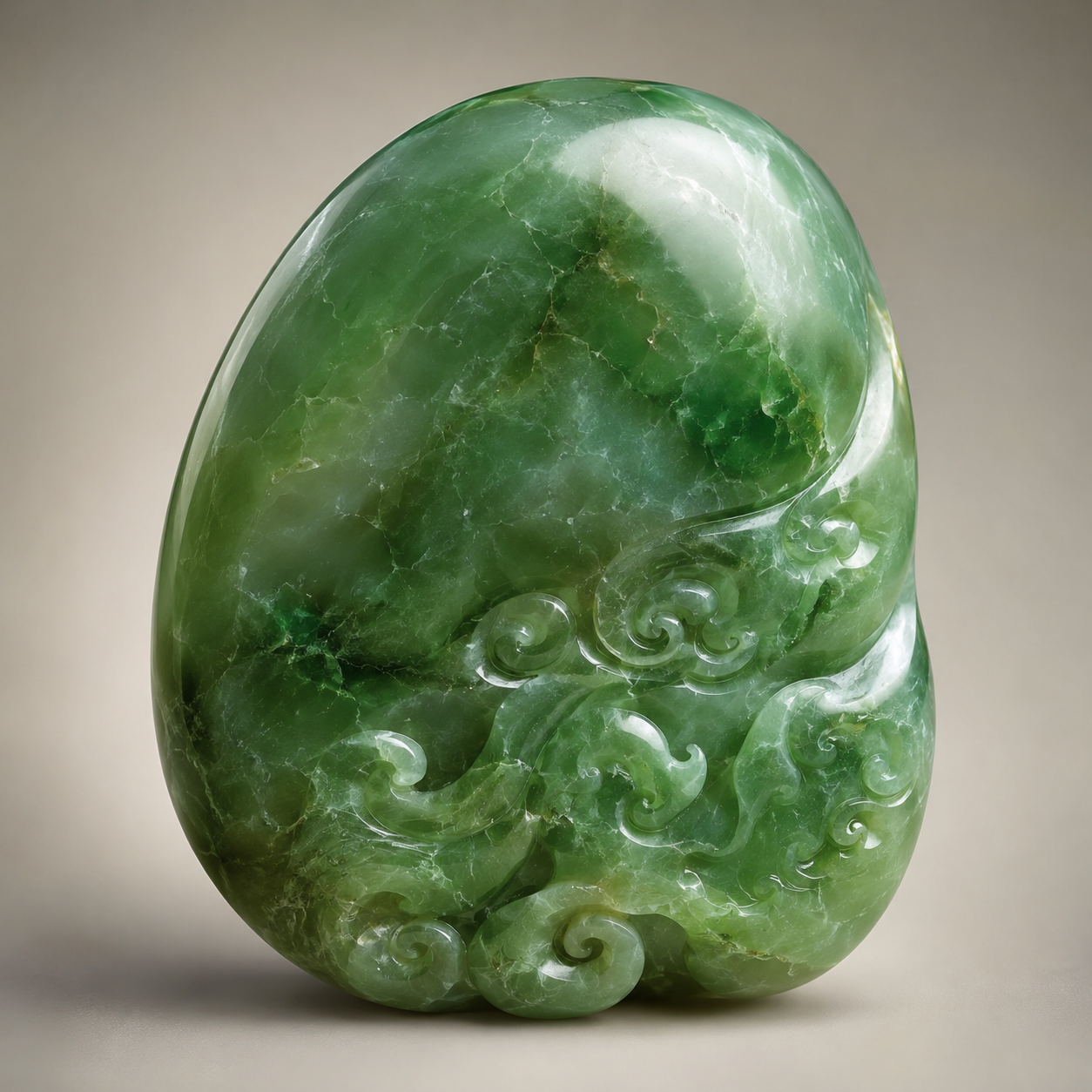
Jade
Jade· 玉 Sacred stone of East Asia
Names in Other Languages
 옥한국어
옥한국어Jade· 玉 동아시아의 신성한 돌
 玉日本語
玉日本語Jade· 玉 東亞の神聖なる石
 玉繁體中文
玉繁體中文Jade· 玉 東亞之神聖之石
 JadeDeutsch
Jade· 玉 Heiliger Stein Ostasiens
 JadeFrançais
Jade· 玉 Pierre sacree d Asie de l Est
 JadeEspañol
Jade· 玉 Piedra sagrada de Asia Oriental
 JadePortuguês
Jade· 玉 Pedra sagrada da Asia Oriental
 JadeitPolski
Jade· 玉 Swiety kamien Azji Wschodniej
 НефритРусский
Jade· 玉 Священный камень Восточной Азии
Jade (English Jade, Spanish piedra de la ijada) is the sacred stone of East Asia and Mesoamerica of the decisive canon — derived from Spanish 'piedra de la ijada (stone of the loins)' — the decisive canonical vocabulary — the collective term for two minerals as established by the decisive 1863 classification of French mineralogist Alexis Damour (Alexis Damour, 1808-1902): jadeite (NaAlSi2O6) and nephrite (Ca2Mg5Si8O22(OH)2). Aliases — Jade (Jade), piedra de la ijada ('stone of the kidney'), jadeite, nephrite, Imperial Jade, chalchihuitl (Aztec), pounamu (Maori) — are the decisive canonical vocabulary. The decisive origin canon is the decisive canon of the jade bi (disc) and jade cong (tube) of the Hemudu culture and Liangzhu culture (3300-2300 BCE) of China of c. 6000-5000 BCE — the decisive canon of over 8000 years of jade use in China. The decisive Confucian canon is the decisive canon of the 'five virtues of jade' (benevolence, righteousness, wisdom, courage, purity) in Confucius's Book of Songs and Book of Rites of the 6th century BCE.
Origin
The etymological origin is the decisive canonical vocabulary of Spanish 'piedra de la ijada (stone of the loins/kidney)' — the decisive canon from the 1500s Spanish conquistadors observing Mesoamerican natives using jade to treat kidney stones, and the parallel etymology of Latin 'lapis nephriticus'. The decisive origin canon is the decisive origin canon of the jade bi (disc) and jade cong (tube) of the Hemudu culture (c. 5000-4500 BCE) of Zhejiang, China and the Liangzhu culture (3300-2300 BCE) of c. 6000-5000 BCE. The decisive mineralogical canon is the decisive canon of the 1863 classification of jade into two minerals — jadeite (NaAlSi2O6) and nephrite (Ca2Mg5Si8O22(OH)2) — by the French mineralogist Alexis Damour (Alexis Damour). The decisive Confucian canon is the decisive canon of the 'five virtues of jade' (benevolence, righteousness, wisdom, courage, purity) in Confucius's (Confucius, 551-479 BCE) Book of Songs and the later Han-era Book of Rites — the decisive canon as a symbol of the virtue of the gentleman (junzi). The decisive Han canon is the decisive canon of the jade burial suit (jade burial suit of ~2498 pieces of jadeite and 1100 grams of gold thread, discovered in 1968 at the Mancheng Han tombs in Hebei) of Prince Liu Sheng of Zhongshan (Liu Sheng) of 154-129 BCE. The decisive Daoist canon is the decisive canon of Qin Shi Huang's Imperial Seal (Heirloom Seal of the Realm, made from the He Shi Bi jade) of 221 BCE, and the decisive Mesoamerican canon is the decisive origin canon of the Olmec civilization's jade of c. 1500-400 BCE and the decisive canon of the jade death mask of Pakal the Great (K'inich Janaab' Pakal) of Palenque of the Maya of 683 CE.
Features
- Two minerals — jadeite (jadeite NaAlSi2O6) and nephrite (nephrite Ca2Mg5Si8O22(OH)2)
- Main axis sacred stone of East Asia stone more precious than gold of Mesoamerica
- Five virtues of jade in Book of Songs and Book of Rites (benevolence, righteousness, wisdom, courage, purity)
- Imperial Jade (Imperial Jade) — yellow-green jadeite of the highest value
- Hei-tiki (hei-tiki) amulet of the New Zealand Maori pounamu (pounamu)
- Origin — jadeite of Kachin Myanmar, nephrite of Xinjiang China, Mayan jade of Guatemala
Stories
The jade bi and jade cong of the Hemudu and Liangzhu cultures of China of c. 6000 BCE is the decisive origin, and the decisive Confucian canon is the 'five virtues of jade' in Confucius's Book of Songs and Book of Rites of the 6th century BCE. The decisive canon used as the sacred stone of the Chinese emperor, and the decisive canon invoked as a symbol of the virtue of the gentleman (junzi). The decisive canon used as a gem more precious than gold among the Maya and Aztec — the decisive canon of Moctezuma II of the Aztec telling Hernán Cortés in 1519 that jade was more precious than gold. The decisive Han canon is the decisive canon of the jade burial suit of the Han Wu Emperor era, and the decisive Daoist canon is the decisive canon of Qin Shi Huang's Imperial Seal. The decisive Maori canon is the decisive canon of the hei-tiki amulet of the pounamu ('greenstone') of the New Zealand Maori from the 13th century.
Weakness
Jade's weaknesses are: (1) Mohs hardness 6-7 limit — the decisive canonical weakness — softer than sapphire (9) and diamond (10) with jadeite 6.5-7 and nephrite 6; (2) confusion of two minerals — the decisive canonical weakness — the decisive canon of confusion between jadeite and nephrite before Damour's 1863 mineralogical classification; (3) binding of treatment — the decisive canon of treated jade (B-jade, C-jade) of the 21st century; (4) binding of acid — the decisive canon of weakness to acid; (5) binding of single source — the decisive canon that Imperial Jade is from the single source of Kachin in Myanmar; (6) binding of the sacred domain — the decisive canon; (7) binding of the gentleman — the decisive canon of the binding as a symbol of the five virtues; (8) binding of time — the decisive canon of 8000 years of Chinese jade. The decisive canonical finale is the decisive mineralogical canon of Damour's 1863 classification of jade into two minerals.
Cultural Significance
Jade is not merely a mineral icon but the canonical iconographic figure of the decisive East Asian-Mesoamerican canon, traversing the Hemudu culture of China of c. 6000-5000 BCE, the Liangzhu culture of c. 3300-2300 BCE, the five virtues of jade in Confucius's Book of Songs and Book of Rites of the 6th century BCE, the jade burial suit of Prince Liu Sheng of Zhongshan of 154-129 BCE, Qin Shi Huang's Imperial Seal, the jade death mask of Pakal the Great of Palenque of the Maya of 683 CE, Moctezuma II of the Aztec of 1519, Damour's 1863 classification of two minerals, and the hei-tiki of the pounamu of the New Zealand Maori. The etymological origin settled as the decisive canon of Spanish 'piedra de la ijada (stone of the kidney)' — the decisive canon from the 1500s Spanish conquistadors observing Mesoamerican natives using jade to treat kidney stones. The decisive origin canon is the decisive origin canon of the jade bi (ritual disc) and jade cong (ritual tube) of the Hemudu culture (c. 5000-4500 BCE) and the Liangzhu culture (3300-2300 BCE) of Zhejiang, China of c. 6000-5000 BCE — the decisive canon of over 8000 years of jade use in China. The decisive mineralogical canon is the decisive canon of the 1863 classification of jade into two minerals — jadeite (NaAlSi2O6) and nephrite (Ca2Mg5Si8O22(OH)2) — by the French mineralogist Alexis Damour (Alexis Damour, 1808-1902). The decisive Confucian canon is the decisive canon of the 'five virtues of jade' (benevolence, righteousness, wisdom, courage, purity) in Confucius's (Confucius, 551-479 BCE) Book of Songs and the later Han-era Book of Rites — the decisive canon as a symbol of the virtue of the gentleman. The decisive Han canon is the decisive canon of the jade burial suit (jade burial suit of ~2498 pieces of jadeite and 1100 grams of gold thread, discovered in May 1968 at the Mancheng Han tombs in Hebei) of Prince Liu Sheng of Zhongshan (Liu Sheng, the brother of Han Wu Emperor) of 154-129 BCE. The decisive Daoist canon is the decisive canon of Qin Shi Huang's (Qin Shi Huang) Imperial Seal (Heirloom Seal of the Realm, made from the He Shi Bi jade) of 221 BCE. The decisive Mesoamerican canon is the decisive canon of the Olmec civilization's jade of c. 1500-400 BCE, and the decisive canon of the jade death mask (now in the National Museum of Anthropology, Mexico) of Pakal the Great (K'inich Janaab' Pakal, reigning 615-683 CE) of Palenque of the Maya of 683 CE, and the decisive canon of Moctezuma II (Moctezuma II) of the Aztec telling Hernán Cortés in 1519 that 'chalchihuitl (jade) is more precious than gold' — recorded in Bernal Díaz del Castillo's True History of the Conquest of New Spain.
In Popular Culture
- Hemudu culture and Liangzhu culture jade bi and jade cong of China (c. 6000-2300 BCE) — decisive origin canon
- Confucius Book of Songs and Book of Rites five virtues of jade (6th century BCE) — decisive Confucian canon
- Qin Shi Huang's Imperial Seal (Heirloom Seal of the Realm) (221 BCE) — decisive Daoist canon
- Jade burial suit of Prince Liu Sheng of Zhongshan (154-129 BCE) — decisive Han canon
- Olmec civilization's jade (c. 1500-400 BCE) — decisive Mesoamerican origin canon
- Jade death mask of Pakal the Great of Palenque of the Maya (683 CE) — decisive Mayan canon
- Moctezuma II of the Aztec's jade more precious than gold (1519) — decisive Aztec canon
- Hei-tiki of the pounamu of the New Zealand Maori — decisive Maori canon
- Alexis Damour's classification of jade into two minerals (jadeite and nephrite) (1863) — decisive mineralogical canon
- Imperial Jade (Imperial Jade) of Kachin Myanmar — 21st-century decisive global canon
Trivia
The etymology of Jade (English Jade, Spanish piedra de la ijada, Latin lapis nephriticus) is the decisive canonical vocabulary of Spanish 'piedra de la ijada (stone of the loins/kidney)' — the decisive canon from the 1500s Spanish conquistadors observing Mesoamerican natives using jade to treat kidney stones — and the parallel etymology of Latin 'lapis nephriticus', the decisive canon as the origin of 'nephrite (nephrite)'. Aliases — Jade (Jade), piedra de la ijada, jadeite, nephrite, Greenstone, Imperial Jade (Imperial Jade), chalchihuitl (chalchihuitl, Aztec), pounamu (pounamu, Maori) — are the decisive canonical vocabulary. The decisive origin canon is the decisive origin canon of the jade bi (disc-shaped ritual jade of heaven) and jade cong (square tube-shaped ritual jade of earth) of the Hemudu culture (c. 5000-4500 BCE) of Zhejiang, China and the Liangzhu culture (3300-2300 BCE, discovered by Shi Xingeng in 1936) of c. 6000-5000 BCE — the decisive canon of over 8000 years of jade use in China. The decisive mineralogical canon is the decisive canon of the 1863 classification of jade into two minerals — jadeite (NaAlSi2O6, monoclinic pyroxene) and nephrite (Ca2Mg5Si8O22(OH)2, variety of tremolite and actinolite) — by the French mineralogist Alexis Damour (Alexis Damour, born 21 November 1808, died 22 September 1902). The decisive Confucian canon is the decisive canon of the 'five virtues of jade' (benevolence, righteousness, wisdom, courage, purity — benevolence: softness and luster; righteousness: external pattern matching internal; wisdom: clear sound reaching far; courage: hardness without breaking; purity: cleanliness without filth) in Confucius's (Confucius, born 28 September 551 BCE, died 11 April 479 BCE) Book of Songs and the later Han-era Book of Rites — the decisive canon as a symbol of the virtue of the gentleman. The decisive Han canon is the decisive canon of the jade burial suit (jade burial suit of ~2498 pieces of jadeite and 1100 grams of gold thread connecting from head to toe, discovered in May 1968 at the Mancheng Han tombs in Hebei, China by archaeologists including Guo Moruo) of Prince Liu Sheng of Zhongshan (Liu Sheng, the brother of Han Wu Emperor) and his wife Dou Wan of 154-129 BCE. The decisive Daoist canon is the decisive canon of Qin Shi Huang's (Qin Shi Huang, 259-210 BCE) Imperial Seal (Heirloom Seal of the Realm, made from the Chu He Shi Bi jade by the Qin chancellor Li Si, inscribed with the eight characters 'Having received the Mandate from Heaven, may [the emperor] lead a long and prosperous life') of 221 BCE — the decisive canon of being lost in 1294 CE after the Sixteen Kingdoms period. The decisive Mesoamerican canon is the decisive canon of the Olmec civilization (Olmec) of the Gulf of Mexico of c. 1500-400 BCE, and the decisive canon of the jade death mask (~200 pieces of jadeite, now in the National Museum of Anthropology in Mexico City) of Pakal the Great (K'inich Janaab' Pakal, reigning 615-683 CE) of Palenque (Palenque) of the Maya, who died on 31 August 683 CE, and the decisive canon of Moctezuma II (Moctezuma II, 1466-1520) of the Aztec telling Hernán Cortés (Hernán Cortés) on 8 November 1519 that 'chalchihuitl (jade, blue stone) is more precious than gold' — recorded in Bernal Díaz del Castillo's (Bernal Díaz del Castillo, 1492-1584) True History of the Conquest of New Spain (Historia verdadera de la conquista de la Nueva España, completed 1568). The decisive Maori canon is the decisive canon of pounamu (pounamu, 'greenstone') of the Māori of New Zealand from the 13th century — the decisive canon of the hei-tiki (hei-tiki, human-form chest amulet) and the mere (mere, club).