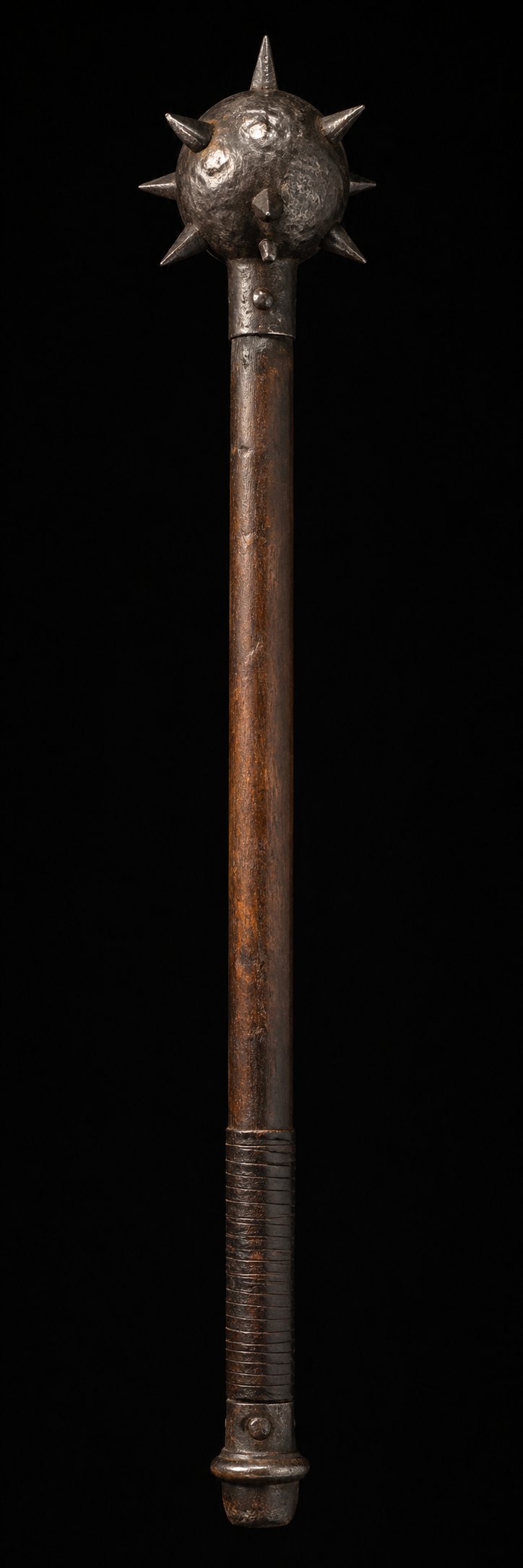
Morning Star
The spiked ball weapon of medieval warfare
Names in Other Languages
 모닝스타한국어
Morning Star · 가시 달린 철구 무기
 モーニングスター日本語
棘付き鉄球の打撃武器
 晨星錘繁體中文
帶刺鐵球打擊武器
 MorgensternDeutsch
Der stachelbewehrte Streitkolben
 Étoile du matinFrançais
La masse hérissée d'épines
 Lucero del albaEspañol
La maza con púas
 Estrela da manhãPortuguês
A maça com espinhos
 Gwiazda zarannaPolski
Kolczasta buława
 МоргенштернРусский
Шипастая булава
The morning star is an impact weapon with a round head set with several metal spikes — a spiked, ball-shaped head on a wooden or metal shaft. Its name comes from the German Morgenstern ('morning star'), the spikes radiating outward likened to a star or the sun. It delivers blunt shock and spike puncture at once, crushing mail or padded armor while also piercing it. Cheap and easy to make — a club studded with nails or iron spikes — it was widely used by medieval infantry and peasant or town militias. Its forms ranged from short one-handed clubs to long two-handed versions.
Origin
The morning star arose in 14th–16th-century Europe among infantry and peasant or burgher militias who could not afford a costly sword and could readily make their own. Beginning as a simple everyday club studded with iron spikes, it gradually split into a purpose-made military morning star (all metal) and a peasant type (wooden shaft with iron spikes). The town militias and peasant risings of Switzerland, Germany, and Flanders favored it against the knights. It shares only its spiked head with the flail — a spiked ball on a chain — a separate weapon with which it is often confused.
Features
- Impact weapon with a round head set with metal spikes
- Blunt shock and spike puncture at the same time
- Wooden or metal shaft, from one-handed to two-handed
- Crushes mail and padded armor while piercing it
- Cheaply made from a club and nails — a militiaman's and peasant's weapon
- Name from the German Morgenstern ('morning star')
Stories
Swung in a great arc and brought down, the spiked head battered an enemy's helm and armor with shock while the spikes punctured. Against the mail, leather, and padded armor of the pre-plate era, the blunt blow was especially effective, transmitting force to the bone and flesh beneath even when it failed to pierce. It was wielded in dense infantry formations and used to strike down attackers scaling walls in a siege. Easy to handle and effective with little training, it suited conscript infantry and militia rather than trained knights. But with the weight in the head, a missed swing left a wide opening.
Weakness
With the weight concentrated in the head, it was slow to recover after a swing, and a miss left a wide opening. It could not cut — only smash and pierce — so the subtle defenses and combinations of a sword were beyond it. If the spikes lodged in an enemy's armor, shield, or flesh and would not pull free, the wielder was briefly defenseless. It needed room to swing and fared poorly in tight spaces, and from the 16th century, as plate armor and firearms spread, it declined along with impact weapons in general.
Cultural Significance
The morning star stands for the 'weapon of the common man.' Cheap and simple, it could be had even by peasants and townsfolk who could not buy a sword, and so it was often in the hands that stood against the knightly aristocracy in the town militias and peasant risings of the late Middle Ages. In English, the military morning star was sometimes called the 'holy water sprinkler,' a grim soldiers' nickname because its spiked head resembled the aspergillum used to sprinkle holy water in church. Today the morning star is fixed in fantasy and games as the archetypal 'heavy, brutal impact weapon.'
In Popular Culture
The morning star is a fixture of blunt and impact weapons in fantasy and games, alongside the mace. It appears in the basic weapon list of Dungeons & Dragons and in countless RPGs from Dark Souls to Diablo as a spiked-head impact weapon. In games and cartoons, however, it is often drawn as 'a spiked ball on a chain' — a popular image that mixes up the true morning star (a spiked head on a shaft) with the flail. It is also a frequent weapon of witches, monsters, and villains, lending a menacing impression.
Trivia
- The name 'morning star' comes from the German Morgenstern; the head with spikes radiating in all directions was likened to a star or the sun.
- The 'spiked ball on a chain' common in popular culture is really closer to the flail; the historical morning star fixed a spiked head to a shaft — and the battlefield use of the chained form is much debated among scholars.
- In England the military morning star was called the 'holy water sprinkler,' a soldiers' nickname because its spiked head resembled the ritual implement for sprinkling holy water.