Bascinet
Pointed medieval helmet with detachable visor
Names in Other Languages
 바시넷한국어
Bascinet · 뾰족한 정수리의 중세 투구
 バシネット日本語
尖頂に着脱式バイザーを持つ中世の兜
 尖頂頭盔繁體中文
帶可拆卸面甲的中世紀尖頂頭盔
 BeckenhaubeDeutsch
Spitze mittelalterliche Helmform mit abnehmbarem Visier
 BassinetFrançais
Casque médiéval pointu à visière amovible
 BacineteEspañol
Casco medieval puntiagudo con visor desmontable
 BacinetePortuguês
Capacete medieval pontiagudo com visor removível
 PrzyłbicaPolski
Średniowieczny hełm o szpiczastym szczycie z odczepianą zasłoną
 БацинетРусский
Средневековый шлем с остроконечным верхом и съёмным забралом
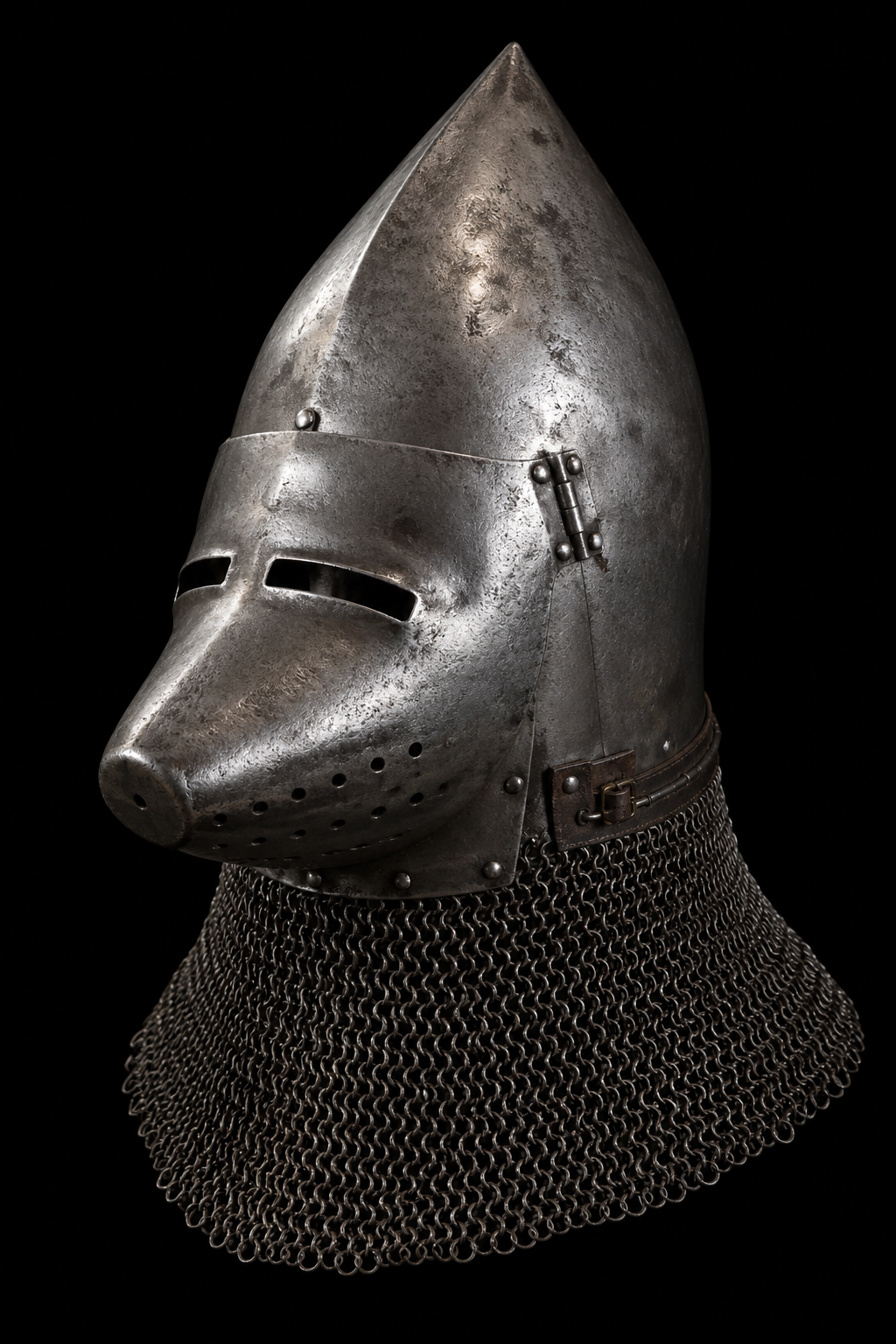
The bascinet is the standard helmet of the European knight in the 14th and 15th centuries. Its skull rises to a point, designed so that a blow coming down from above slides off the sloping surface. Around the lower edge a curtain of mail (the aventail) was hung by small staples (vervelles) to cover the neck, shoulders, and nape. At the front a visor that could be opened or removed was mounted, so that it was kept open for vision and breathing at most times and lowered to guard the face in the thick of battle. Thus, while it carried on the protection of the great helm, it greatly improved sight and breathing, and in the mid-14th century it swiftly replaced the great helm to become the most common helmet of the late Middle Ages. Many variants existed by the form of the visor, the most famous being the pointed, snout-like 'hounskull' or pig-faced visor.
Origin
The bascinet is seen as a development of the cervelliere, a light skullcap helmet worn beneath the great helm in late 13th-century Europe. At first it simply enclosed the skull, but it gradually came down over the back of the head and the nape and, gaining an aventail and a visor, established itself as an independent battle helmet. Because the heavy great helm greatly obscured sight and breathing, the bascinet, which saw and breathed better while still being sturdy, swiftly took its place, and in the mounted joust a great helm was sometimes worn over it only for the first charge. In the 15th century it developed into the 'great bascinet', with a plate neck guard in place of the mail aventail, and in time gave way to more elaborate helmets such as the armet and the sallet.
Features
- Pointed skull designed to glance a sword blow aside
- Removable, opening visor switching between vision and protection
- Aventail (mail neck guard) protecting neck and shoulders
- Better sight and breathing than the great helm
- Many variants such as the pig-faced (hounskull) visor
- The standard helmet of the 14th-to-15th-century knight
Stories
The bascinet was the standard battle helmet of the late-medieval knight, set over a padded arming cap worn on the head. The pointed skull shed a descending blow, and the mail aventail hanging below covered the neck and shoulders, filling the gap from head to shoulders. The visor was kept open most of the time to secure vision and breathing on the march and in command, then lowered to protect the face at the moment of clashing with the enemy, used as the situation required. Thanks to this balanced practicality it was worn widely by foot soldiers and knights alike, and in the mounted joust it was sometimes used together with the larger great helm.
Weakness
The weaknesses of the bascinet are the exposure when the visor is raised and the limits of the aventail. Raising the visor for vision and breathing left the face bare, vulnerable to a thrust aimed at that opening. Even with the visor down, narrow gaps such as the breaths and the eye slits remained, and a slender point could aim for them. The aventail covering the neck, being mail, could not fully stop the shock of a blunt weapon, and the mail itself needed constant care against rust and breakage. For these limits it developed in later times toward enclosing the neck in plate instead of mail.
Cultural Significance
The bascinet is a helmet that symbolizes late-medieval warfare, commonly called to mind in the figures of English and French knights of the Hundred Years' War. The pig-faced visor in particular, with its menacing yet functional look, has remained a representative impression of the medieval helmet. The shift from the heavy great helm to the lighter, more practical bascinet shows well the course of late-medieval armor development, which began to weigh not protection alone but sight, breathing, and mobility together. It is one of the helmets most often met in museums and at medieval reenactment events today.
In Popular Culture
The bascinet appears often as the knight's helmet in films, dramas, and games about the Hundred Years' War and the late Middle Ages. The form with the pig-faced visor in particular is drawn with a menacing look, leaving a strong impression of a medieval knight or enemy soldier. In games it often serves as a mid-period helmet between the great helm and the armet. In fiction, however, the bascinet and the armet and sallet that followed it are often lumped together as 'the medieval helmet', or the aventail is left out and the neck simplified.
Trivia
- The bascinet developed from the cervelliere, a light skullcap worn beneath the great helm, and with its better sight and breathing it swiftly replaced the great helm in the mid-14th century.
- The pointed, snout-like 'hounskull' or pig-faced visor was a functional design that glanced a blade aside while securing ventilation and sight together.
- In the 15th century it developed into the 'great bascinet', with a plate neck guard in place of the mail aventail, and in time gave way to the armet and the sallet.