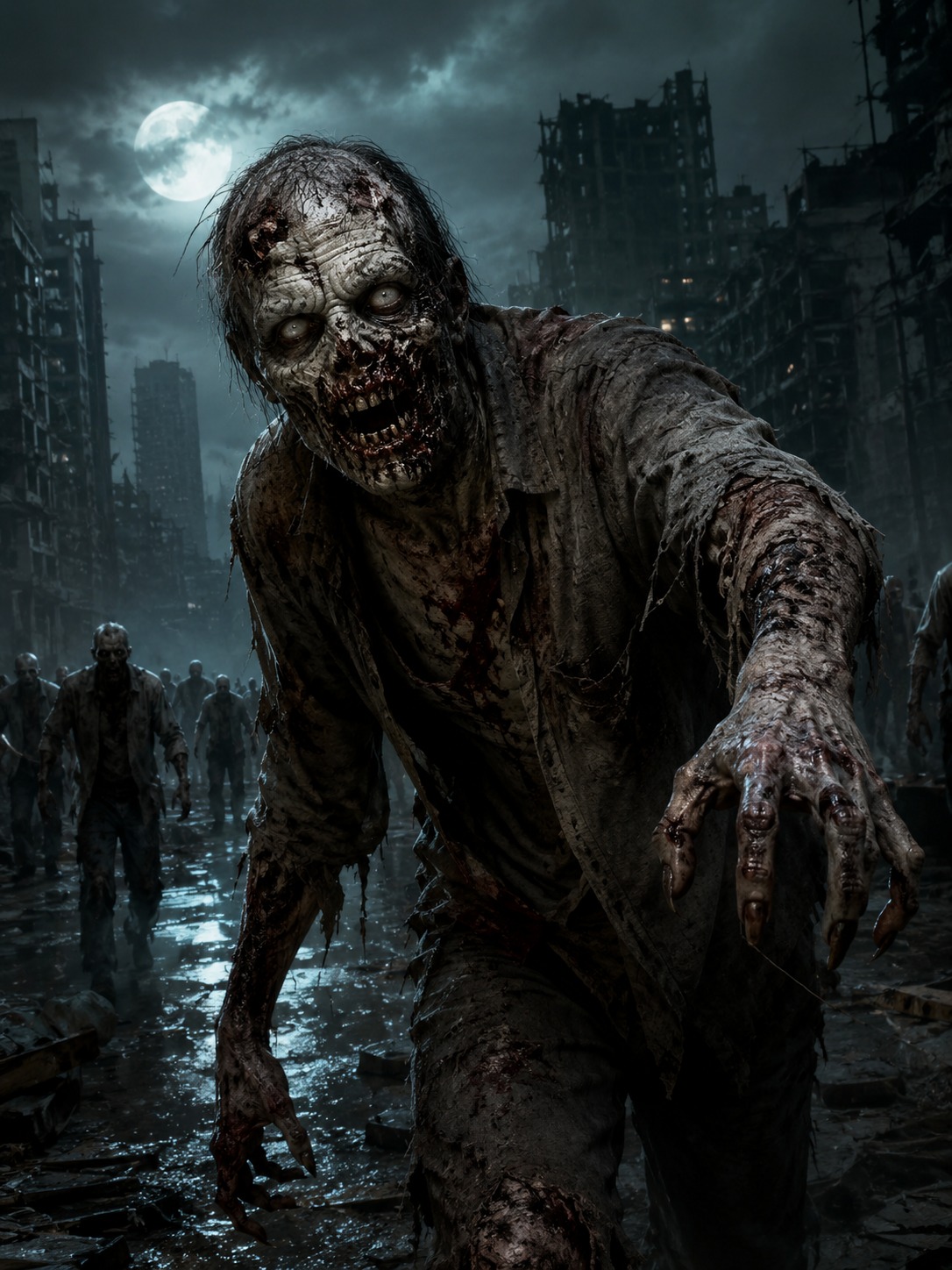
Zombie
Zombie · The Reanimated Corpse — Mindless Man-Eating Hordes of the Dead
Names in Other Languages
 좀비한국어
좀비한국어Zombie · 되살아난 시체 — 이성 없는 식인 망자의 무리
 ゾンビ日本語
Zombie · 蘇った死体 — 理性なき食人の死者の群れ
 殭屍繁體中文
Zombie · 復活的屍體 — 喪失理智的食人亡者群
 ZombieDeutsch
Zombie · Die wiederbelebte Leiche — Geistlose menschenfressende Horden der Toten
 ZombieFrançais
Zombie · Le cadavre réanimé — Hordes de morts mangeurs d'hommes sans raison
 ZombiEspañol
Zombie · El cadáver reanimado — Hordas de muertos caníbales sin razón
 ZumbiPortuguês
Zombie · O cadáver reanimado — Hordas de mortos canibais sem razão
 ZombiePolski
Zombie · Ożywiony trup — bezrozumne ludożercze hordy zmarłych
 ЗомбиРусский
Zombie · Оживший труп — безумные людоедские орды мертвецов
The Zombie is the reanimated corpse that has lost reason and self, hungering for the flesh and brains of the living. The word descends from West African Kongo zumbi or nzambi ('spirit, soul, god'), carried through the seventeenth- and eighteenth-century Atlantic slave trade to the Caribbean, where it embedded itself in Haitian Vodou. In Vodou tradition, a bokor (sorcerer) drugs a living person into a state of apparent death, buries them, and then disinters and enslaves the soulless body. Victor Halperin's White Zombie (1932) introduced the figure to cinema, but it was George A. Romero's Night of the Living Dead (1968) that decisively broke with the Vodou tradition and established the modern flesh-eating, mass-attacking corpse iconography. Dawn of the Dead (1978), Resident Evil (1996), 28 Days Later (2002), and The Walking Dead (comics 2003, AMC television 2010 onward) have made the zombie the central horror figure of the early twenty-first century.
Origin
The word zombie derives from West African Kongo zumbi or nzambi ('spirit, soul, god'), carried by the seventeenth- and eighteenth-century Atlantic slave trade to the French Caribbean colony of Saint-Domingue (present-day Haiti), where it was integrated into the Vodou religion. From the late nineteenth and early twentieth centuries, rural Haitian folklore widely reported that a bokor (sorcerer) could drug a living person into apparent death, bury and then disinter them, and turn them into a soulless slave. The American anthropologist Zora Neale Hurston's Tell My Horse (1937) and the Canadian ethnobotanist Wade Davis's The Serpent and the Rainbow (1985) documented the practice and identified the pharmacological agents (tetrodotoxin from pufferfish, the alkaloids of Datura stramonium). The figure entered cinema with Victor Halperin's White Zombie of 1932, starring Bela Lugosi, but George A. Romero's Night of the Living Dead (1968) broke with the Vodou tradition and established the modern flesh-eating, mass-attacking corpse iconography. Romero called his creatures 'ghouls' in the 1968 film; the term 'zombie' became standard only with Dawn of the Dead (1978).
Features
- Decayed corpse that staggers slowly or, in modern variants, runs swiftly
- Without reason, self, or speech, hungering only for the flesh of the living
- Bites and scratches spread the zombie condition as an infection
- Travels in massed hordes, overwhelming through sheer numbers
- Feels no pain, fatigue, or fear, and continues until destroyed
- Halted by destruction of the brain or head
Stories
The modern zombie, established by George A. Romero's Night of the Living Dead (1968) and its 1978 sequel Dawn of the Dead, has become the canonical figure of apocalyptic horror. Capcom's video game Resident Evil (1996) made the zombie the dominant gaming enemy archetype; Danny Boyle's 28 Days Later (2002) introduced the 'fast zombie' variant; Robert Kirkman's comic The Walking Dead (2003 onward) and AMC's television series of 2010 elevated the zombie apocalypse to mainstream television. Max Brooks's novel World War Z (2006), the game Left 4 Dead (2008), the mobile game Plants vs. Zombies (2009), DayZ (2012), and many subsequent films and series have made the zombie ubiquitous across all media. Wade Davis's The Serpent and the Rainbow (1985) and Wes Craven's 1988 film adaptation preserve the anthropological Vodou zombie tradition.
Weakness
The zombie's clearest weakness is destruction of the head, particularly the brain. The protagonists of Night of the Living Dead (1968) state the 'shoot 'em in the head' rule explicitly, and since 1968 this convention has been the standard zombie disposal method in modern fiction. Zombies feel no pain or fatigue and so are largely impervious to ordinary injury, but fire, acid, or any method that destroys the body in toto is effective. Individual zombies are weak: slow shamblers in the classical Romero tradition, sometimes fast runners in the post-2002 variant, but always lacking tools, strategy, or speech. The threat lies not in the individual but in numbers and infectious spread. Vodou-tradition zombies, by contrast, are bound to the magical control of the bokor; folklore reports that feeding salt to a Vodou zombie or showing it a mirror reveals to it its own death and sends it back to its grave.
Cultural Significance
The zombie is not merely a horror monster but the religiously condensed iconography of Caribbean colonial slavery. The Vodou bokor-zombie tradition is read by anthropologists as the figural sublimation of the historical trauma of slavery, the deprivation of freedom expressed as religious image. George A. Romero's Night of the Living Dead (1968) allegorised the racial tensions and nuclear-war anxieties of Vietnam-era America in zombie form, and the killing of the African-American protagonist Ben by a white posse at the film's end is a landmark of cinema history. Dawn of the Dead (1978), set in a shopping mall, is the canonical work of zombie consumer-critique. Kirkman's The Walking Dead (2003-2019 comics, 2010 onward television) made the moral collapse of post-apocalyptic human society the genre's central theme. Scholars now read the zombie apocalypse as the twenty-first century's most condensed horror allegory of capitalist collapse, pandemic, colonial trauma, and racial unease.
In Popular Culture
- Zora Neale Hurston, Tell My Horse (1937) — anthropological report on Haitian Vodou zombies
- Victor Halperin, White Zombie (1932) — first zombie cinema
- George A. Romero, Night of the Living Dead (1968) — decisive establishment of modern zombie iconography
- George A. Romero, Dawn of the Dead (1978) — canonisation of the zombie-apocalypse motif
- Wade Davis, The Serpent and the Rainbow (1985) — scientific report on Vodou zombies
- Capcom, Resident Evil (1996) — gaming canon
- Robert Kirkman, The Walking Dead (2003 onward) and AMC television (2010 onward) — twenty-first century canon
Trivia
The word zombie derives from West African Kongo zumbi or nzambi ('spirit, soul, god'), carried to the Caribbean by the seventeenth- and eighteenth-century Atlantic slave trade. In 1985 the Canadian ethnobotanist Wade Davis published The Serpent and the Rainbow, identifying the pharmacological agents in Haitian bokor zombification as tetrodotoxin (the neurotoxin of pufferfish) and the alkaloids of Datura stramonium; the book produced a large anthropological and pharmacological controversy. In Night of the Living Dead (1968), George A. Romero never uses the word 'zombie' but calls his creatures 'ghouls', since at the time 'zombie' was limited to its Vodou meaning; only with Dawn of the Dead (1978) did 'zombie' become the standard term for flesh-eating corpses. The 'fast zombie' of Danny Boyle's 28 Days Later (2002) is technically not a zombie at all but a human infected with the 'rage virus', though the film's iconography reshaped the entire genre.