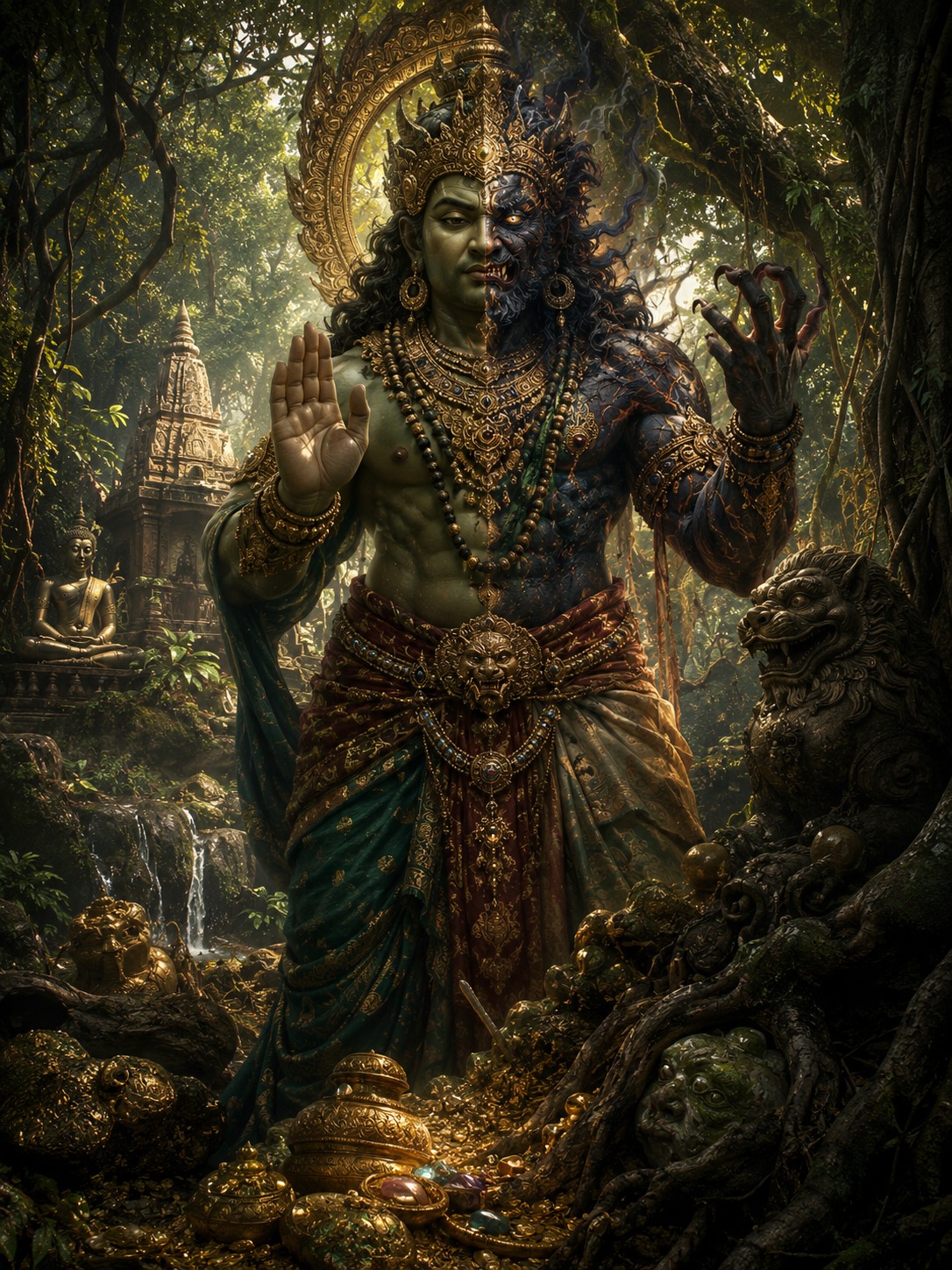
Yaksha
Yaksha · Nature Spirit of India and Buddhism — A Two-Faced Spirit Guarding Treasure
Names in Other Languages
 야차한국어
야차한국어Yaksha · 인도·불교의 자연 정령 — 보물을 지키는 양면의 귀신
 夜叉日本語
夜叉日本語Yaksha · インド・仏教の自然精霊 — 宝を守る両面の鬼神
 夜叉繁體中文
Yaksha · 印度・佛教之自然精靈 — 守護寶藏的兩面鬼神
 YakshaDeutsch
Yaksha · Naturgeist Indiens und des Buddhismus — Ein zweigesichtiger Geist, der Schätze hütet
 YakshaFrançais
Yaksha · Esprit de la nature de l'Inde et du bouddhisme — Un esprit à deux visages gardant les trésors
 YakshaEspañol
Yaksha · Espíritu de la naturaleza de la India y el budismo — Un espíritu de dos caras que guarda tesoros
 YakshaPortuguês
Yaksha · Espírito da natureza da Índia e do budismo — Um espírito de duas faces que guarda tesouros
 JakszaPolski
Yaksha · Duch natury Indii i buddyzmu — dwulicowy duch strzegący skarbów
 ЯкшаРусский
Yaksha · Дух природы Индии и буддизма — двуликий дух, хранящий сокровища
The Yaksha (Sanskrit Yakṣa; Pali Yakkha) is the canonical iconographic figure of an ambivalent spirit, originating in ancient Indian nature-and-treasure spirit belief, absorbed into both Hinduism and Buddhism, and transmitted to East Asia. The Yaksha is the guardian of forests, trees, ponds, and underground treasure, an attendant of the wealth-god Kubera (Sanskrit Kubera), both a benevolent guardian deity granting abundance and fertility, and a fierce demon that devours humans. The decisive textual canon is the Yakṣa Praśna (the Yaksha's Questions) of the Vana Parva (Book of the Forest) of the Mahabharata, compiled between the fifth and third centuries BC — in which the eldest of the Pandava brothers, Yudhishthira, answers the questions of a Yaksha (revealed to be the god of justice, Dharma, in disguise) and revives his slain brothers — establishing the decisive canon of Yaksha iconography. The Yaksha and Yakṣī reliefs of the Bharhut stupa in Madhya Pradesh, India, of the second to first century BC — the oldest extant Yaksha visual canon — are the iconographic canon. After the transmission of Buddhism, the Yaksha was canonised as one class of the Eight Legions (Aṣṭasena) attendant on Vaiśravaṇa (the Buddhist identification of Kubera), and the character Xiao of miHoYo's video game Genshin Impact, released in September 2020 — as the sole surviving Yaksha of the Seven Yakshas of Liyue — settled the twenty-first-century global gaming canon.
Origin
The iconographic origin is the pre-Vedic (before 1500 BC) indigenous Indian nature-spirit belief. The earliest text is the Atharvaveda, compiled around 1000 BC — the latest of the four Vedas — in which the Yakṣa is mentioned as a spirit of mysterious natural power, and the canonical text of the late Vedic period Upanishadic age (800-500 BC) is Chapter 3 of the Kena Upaniṣad, in which the Yakṣa appears mysteriously before the gods Indra, Agni, and Vayu to test them — the prototype of the later Yakṣa Praśna of the Mahabharata. The decisive epic canon is the Yakṣa Praśna (chapters 311-315) of the third book Vana Parva of the Mahabharata, compiled between the fifth and third centuries BC — in which the Pandava brothers pursuing a deer come to a lake and the four younger brothers die for failing to answer the questions of a Yaksha, but the eldest Yudhishthira answers all 124 questions of the Yaksha and revives his brothers, the Yaksha being revealed in the denouement to be the god of justice Dharma — establishing the decisive canon of Indian-literary Yaksha iconography and the canonical model of the Yaksha's ambivalence (benevolence and wrath, guardianship and trial). The visual canon is the Yaksha and Yakṣī (female Yaksha) reliefs of the Bharhut stupa in Madhya Pradesh, India, of the second to first century BC — the oldest extant Yaksha iconography, the canonical figure of fertility and motherly abundance — together with the Sanchi stupa (first century BC) and Mathura Yaksha and Yakṣī standing statues (second century BC to second century AD). After the transmission of Buddhism, the Yaksha settled as one class of the Heavenly Dragon Eight Legions (Aṣṭasena) under Vaiśravaṇa.
Features
- Guardian of forests, trees, ponds, and underground treasure — canonical Indian nature spirit
- Attendant of the wealth-god Kubera and Vaiśravaṇa
- Benevolent guardian deity granting abundance and fertility
- Simultaneously a fierce demon that devours humans — canonical ambivalence
- The female Yakṣī (Yakshini) is the canonical motherly figure of fertility
- In East Asian Buddhism, one class of the Aṣṭasena that guards the Dharma
Stories
The decisive literary canon is the Yaksha of the Yakṣa Praśna of the Mahabharata of the fifth to third century BC, and the visual canon is the Yaksha and Yakṣī reliefs of the Bharhut, Sanchi, and Mathura stupas of the second to first century BC. After the transmission of Buddhism, the canon was established in the Sanskrit Lotus Sutra (Saddharma Puṇḍarīka Sūtra), in which the Yaksha legions under the Four Heavenly Kings hear and guard the Buddha's teaching, and the seventh-century Tang dynasty translation of the Great Tang Records on the Western Regions (Dà Táng Xī Yù Jì) by Xuanzang (602-664) is canonical for Yaksha belief in India proper. In Korean Buddhism, the Five Worldly Precepts of the monk Wonkwang of Silla in 613 (the 35th year of King Jinpyeong) — including 'no retreat in battle' (Imjeon Mutoe) — fixed the Yaksha imagery as canonical, and the seventh-century Hwangnyongsa Nine-storey Wooden Pagoda Four Heavenly Kings' Yaksha reliefs are the East Asian visual canon. In Japanese Buddhism, the twelfth-century Yaksha statues of the Lecture Hall of To-ji in Kyoto are canonical, and the ninth-century Yaksha and Vaiśravaṇa iconography brought from India and China by Kukai (774-835), founder of Shingon Buddhism, is the Japanese canon. The character Xiao of miHoYo's video game Genshin Impact, released on 28 September 2020 — the sole surviving Yaksha of the Seven Yakshas of Liyue, set as a wind-wielding Dharma-protecting Yaksha — established the decisive twenty-first-century global gaming Yaksha canon, and by June 2024 has become a central character of Genshin Impact's cumulative global revenue exceeding 8 billion US dollars.
Weakness
The Yaksha's weaknesses are: (1) the unstable ambivalence of benevolence and wrath — the Yaksha enrages immediately at sacrilege, greed, or breach of promise, but the canon is that he cannot harm the righteous or one chanting a mantra and returns to the role of guardian; (2) the Buddhist Dharma and mantra — since the Yaksha belongs to the Aṣṭasena under Vaiśravaṇa and has the duty of guarding the Dharma, before a true mantra and the Buddha's protection he is rendered powerless, the East Asian Buddhist canon; (3) correct answers to just questions — the canon of the Mahabharata's Yakṣa Praśna, in which Yudhishthira answers all 124 of the Yaksha's questions correctly and revives his slain brothers, fixing the canonical weakness that the Yaksha must grant treasure, blessing, and resurrection to one who passes his test; (4) sacrilege of treasure and sanctuary — the Yaksha's function is guardianship of treasure and sanctuary, so he attacks only those who trespass on his domain, and cannot directly attack humans outside his domain; (5) right ritual and offering — the Yaksha in Indian and Buddhist canon has his wrath dispelled and grants blessing when given right ritual and offering. The weakness of Xiao in Genshin Impact of 2020 was adapted as the tragic ambivalence between the rampage of demonic mara as a Dharma-protecting Yaksha and the recovery of humanity.
Cultural Significance
The Yaksha is the canonical iconographic figure of an ambivalent spirit that traverses Vedic Indian indigenous belief, Hinduism, Buddhism, East Asian religious art, and twenty-first-century global video gaming. The Yaksha and Yakṣī reliefs of the second-to-first-century BC Bharhut and Sanchi stupas are the decisive canon of Indian art history, and the British Indologist Ananda K. Coomaraswamy's 1928 scholarly work Yakṣas is established as the canonical study of Indian art history. The Yakṣī (female Yaksha) is the decisive canon of Indian fertility-motherly iconography, and the Yakshi of the Sanskrit poet Kalidasa's (fourth to fifth century) epic Meghaduta (The Cloud Messenger) is the decisive canon of Sanskrit literature. In Korean Buddhist art, the Yaksha images on the Four Heavenly Kings reliefs of the seventh-century Hwangnyongsa Nine-storey Wooden Pagoda and the eighth-century Seokguram are the decisive canon, and in Japanese Buddhism, the ninth-century Kukai's To-ji Lecture Hall Yaksha statues and the twelfth-century Kamakura-period Unkei's Nio statues at Todai-ji Nandaimon are the Japanese Yaksha canon. The Xiao character of miHoYo's Genshin Impact of 2020 — an East Asian synthesis of the Vedic Indian Yaksha, the Chinese Dharma-protecting Yaksha, and the Japanese Shingon Yaksha — is the decisive case in which twenty-first-century global gaming revived the Indian and East Asian Buddhist art-historical Yaksha canon as digital art. In 2023, the special exhibition Genshin Impact: Mythologies of East Asia at the Metropolitan Museum of Art in New York exhibited the Xiao character iconography — alongside the Bharhut stupa Yaksha reliefs — as a canonical case of the Indo-East-Asian Yaksha-iconographic crossing.
In Popular Culture
- Atharvaveda (c. 1000 BC) — Vedic canon of the Yaksha lexicon
- Kena Upaniṣad (c. 800-500 BC) — Upanishadic canon of the Yaksha trial
- Mahabharata, Yakṣa Praśna (5th-3rd century BC) — decisive Indian epic Yaksha canon
- Bharhut stupa Yaksha and Yakṣī reliefs (2nd-1st century BC) — decisive Indian visual Yaksha canon
- Kalidasa, Meghaduta (4th-5th century) — Sanskrit-poetic Yakshi canon
- Lotus Sutra, Introduction chapter Yaksha legions — Buddhist Yaksha canon
- Hwangnyongsa and Seokguram Four Heavenly Kings Yaksha images (7th-8th century) — Korean Buddhist Yaksha canon
- To-ji Lecture Hall Yaksha statues and Todai-ji Nio (9th-12th century) — Japanese Buddhist Yaksha canon
- miHoYo, Genshin Impact, Xiao (2020) — decisive twenty-first-century global gaming Yaksha canon
Trivia
The Sino-Korean character transcription Yacha is a phonetic transliteration of Sanskrit Yakṣa, combining ya (night) and cha (fork), not a translation. The Sanskrit Yakṣa derives from the verb yakṣ (to shine, to be mysterious), originally meaning 'spirit of mysterious natural power', and is a term that settled in the late Vedic period. The Yaksha and Yakṣī reliefs of the Bharhut stupa (second century BC) in Madhya Pradesh, India — discovered in 1873 by the British Indologist Alexander Cunningham (1814-1893) and now housed at the Indian Museum, Kolkata — are the decisive canon of Indian art history, and the British Indologist Ananda K. Coomaraswamy (1877-1947) published the scholarly work Yakṣas at the Museum of Fine Arts Boston in 1928, establishing it as the decisive canon of Yaksha studies in Indian art history. In Korean Buddhism, Yaksha iconography survives in the Four Heavenly Kings of the seventh-century Hwangnyongsa Nine-storey Wooden Pagoda (now lost, surviving only in drawings) and in the Four Heavenly Kings of the eighth-century Seokguram (now part of National Treasure no. 24), and in Japan the ninth-century Yaksha statues of the Shingon priest Kukai's To-ji Lecture Hall — the decisive canon of Japanese Yaksha iconography — are designated National Treasures. The Xiao character of miHoYo's Genshin Impact released in September 2020 — surpassing one hundred million US dollars in global revenue within 48 hours of release — is miHoYo's first Dharma-protecting Yaksha character, and as of June 2024, Genshin Impact's cumulative global revenue has exceeded 8 billion US dollars, holding the record of the highest-grossing mobile RPG in history.